Choosing the right PoE switch can simplify professional network deployments by carrying power and data over a single Ethernet cable. The best option depends on your port count, PoE budget, management features, uplink speed, and network growth plans.
We compared ten professional-focused models ranging from compact eight-port switches to powerful 48-port platforms with advanced management, VLAN support, and high-speed uplinks.
Best 10 PoE Network Switches for Professionals Picks for 2026
High-Capacity Managed Pick
Linksys LGS352MPC 48-Port PoE+ Switch

- 48 Gigabit ports and a 740W PoE budget
- Four 10G SFP+ uplink slots
- Managed security, VLAN, QoS, and routing features
Best For: Large professional networks with demanding PoE and uplink requirements
Compact Multi-Gig Pick

- Four 2.5GbE PoE++ ports
- Two 10G SFP+ uplink ports
- Silent, fanless design with flexible mounting
Best For: Compact professional networks needing multi-gig PoE connectivity
Simple Deployment Pick
NETGEAR GS316PP 16-Port PoE+ Switch

- 16 Gigabit PoE+ ports
- 183W shared PoE budget with dynamic allocation
- Unmanaged, fanless, and wall-mountable
Best For: Small installations needing simple, quiet plug-and-play PoE
High-Port Multi-Gig Pick
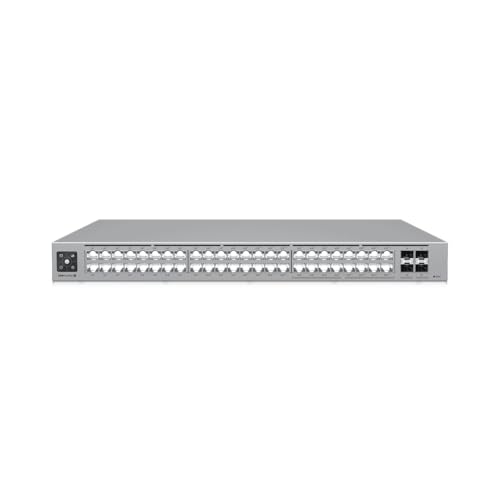
- 48 ports with 2.5GbE and Gigabit connectivity
- 720W total PoE availability
- Four 10G SFP+ ports and UniFi management
Best For: Dense UniFi deployments needing high PoE capacity and fast uplinks
High-Capacity PoE Workhorse

- 16 PoE+ ports with up to 30W each
- 250W total PoE budget
- Two combo SFP slots and rack-mountable metal chassis
Best For: Larger professional camera, phone, and access-point deployments
UniFi Network Core

- 24 ports for dense installations
- PoE+, RJ45, and SFP interfaces
- Supports cameras, phones, access points, servers, and storage
Best For: High-port-count office and UniFi-oriented network deployments
Compact Smart Choice

- Four 802.3af PoE ports
- 57W total PoE budget
- Fanless metal design with VLAN and QoS features
Best For: Small offices and branch networks with a few lower-power PoE devices
Best Value PoE Switch

- 8 PoE+ ports plus 2 Gigabit uplinks
- 820-foot Extend mode and PoE auto recovery
- 60W budget with one-button operating modes
Best For: Small surveillance, office, and access-point deployments
Best for Large Networks
Ubiquiti UniFi Pro 48-Port PoE+

- 48 Gigabit PoE+ ports for dense installations
- Four 10G SFP+ uplinks and 176Gbps switching capacity
- Layer 2/3 controls with UniFi centralized management
Best For: Business racks, campuses, and high-density PoE networks
Best Compact Managed Option

- Six PoE+ and two PoE++ Gigabit ports
- 120W total PoE availability
- Two 10G SFP+ ports in an 8-port design
Best For: Small managed networks needing higher-power PoE
High-Capacity Managed Pick – Linksys LGS352MPC 48-Port PoE+ Switch
For professionals building out surveillance, access-control, or wireless networks, the Linksys LGS352MPC is a high-capacity option among PoE network switches for professionals. It combines 48 Gigabit ports, a 740W PoE budget, and four 10G SFP+ uplinks in a metal enclosure.
Best For: Larger managed networks needing extensive PoE capacity, VLANs, QoS, security controls, and fast uplinks.
Pros:
- 48 Gigabit ports support large device deployments.
- 740W PoE budget helps power cameras, access points, and access-control systems.
- Four 10G SFP+ uplinks support high-speed connections to the core network.
- Includes QoS, VLAN, IGMP, static routing, and MAC-based port security features.
Cons:
- Managed features require more setup than a plug-and-play switch.
- Its 48-port design may be excessive for smaller installations.
- The supplied specifications list Gigabit Ethernet port speeds, while the faster connections are provided through the SFP+ uplinks.
The LGS352MPC is a strong professional choice when port count, PoE headroom, and network control matter more than a compact footprint. Its long warranty and 24/7 technical support add confidence for business deployments.
Compact Multi-Gig Pick – Ubiquiti USW-Pro-Max-16-PoE
The Ubiquiti USW-Pro-Max-16-PoE is a compact choice among PoE network switches for professionals who need multi-gig connectivity without a large chassis. It offers 16 ports, four 2.5GbE PoE++ ports, twelve Gigabit PoE+ ports, two 10G SFP+ ports, and a 180W PoE budget.
Best For: Small professional networks using multi-gig access points, cameras, or other PoE devices where quiet operation and flexible mounting are important.
Pros:
- Four 2.5GbE PoE++ ports support faster compatible devices.
- Two 10G SFP+ ports provide high-speed uplink flexibility.
- Fanless cooling enables silent operation.
- Supports desktop, wall, and rack mounting.
Cons:
- The 180W total PoE availability is more limited than larger professional switches.
- Only 16 ports are available for connected devices.
- The supplied warranty information lists six months from the manufacturer.
This Ubiquiti switch is well suited to a compact deployment that benefits from 2.5GbE access and 10G uplinks. Its fanless design and mounting flexibility make installation easier in office or equipment-room environments.
Simple Deployment Pick – NETGEAR GS316PP 16-Port PoE+ Switch
The NETGEAR GS316PP is a straightforward option among PoE network switches for professionals who want to connect powered devices without configuring a managed network. Its 16 Gigabit PoE+ ports provide up to 30W per port from a shared 183W budget, with automatic power allocation.
Best For: Small offices, camera systems, and access-point installations that prioritize plug-and-play setup over advanced management features.
Pros:
- All 16 ports support Gigabit Ethernet and PoE+.
- Up to 30W per port supports a range of powered devices.
- Unmanaged operation requires no software or configuration.
- Fanless metal design supports quiet desktop or wall-mounted installation.
Cons:
- Unmanaged operation does not provide VLAN, QoS, or advanced security controls.
- The shared 183W budget limits simultaneous power demands.
- It does not offer dedicated 10G uplink ports.
Choose the GS316PP when ease of deployment is the priority. It provides useful PoE capacity and quiet operation, but professional networks requiring traffic control or segmentation should look to a managed model instead.
High-Port Multi-Gig Pick – Ubiquiti USW-Pro-Max-48-PoE
The Ubiquiti USW-Pro-Max-48-PoE is designed for dense professional deployments that need many powered connections. It provides 48 ports, a mix of 2.5GbE and Gigabit interfaces, four 10G SFP+ ports, and 720W of total PoE availability.
Best For: Larger UniFi-managed networks connecting cameras, access points, workstations, and other PoE devices with room for future expansion.
Pros:
- 48-port layout supports dense device installations.
- 720W PoE availability provides substantial power capacity.
- Includes eight 2.5GbE PoE+ ports and eight 2.5GbE PoE++ ports.
- Four 10G SFP+ ports support fast uplinks, and DC power backup readiness adds deployment flexibility.
Cons:
- Its large 48-port chassis may be unnecessary for smaller networks.
- Management requires UniFi Network 8.0.24 or later.
- The supplied warranty information lists six months from the manufacturer.
This is a capable choice for expanding UniFi environments where high port density and PoE capacity are central requirements. Its combination of 2.5GbE access ports and 10G uplinks makes it suitable for bandwidth-conscious deployments.
High-Capacity PoE Workhorse – 16-Port Gigabit PoE+ Switch
For professionals building out surveillance, voice, or wireless networks, the TP-Link TL-SG1218MP is a practical choice among PoE network switches for professionals. It provides 16 Gigabit PoE+ ports with up to 30W per port, a 250W total PoE budget, two non-PoE Gigabit uplink ports, and two combo SFP slots.
Best For: Professional installations needing many powered devices, rack mounting, and flexible high-speed uplink options.
Pros:
- Sixteen 802.3at/af PoE+ ports support up to 30W each.
- 250W total PoE budget accommodates larger deployments.
- QoS and IGMP Snooping help prioritize voice and video traffic.
- Sturdy metal, rack-mountable design with professional heat dissipation.
Cons:
- Its 17.3-inch rack-oriented chassis is less suitable for small desktop setups.
- Plug-and-play operation does not provide the advanced management features of a fully managed switch.
The TL-SG1218MP stands out when port count and PoE capacity matter more than compact size. Its combination of Gigabit connectivity, SFP expansion, traffic-prioritization features, and durable construction makes it well suited to structured professional deployments.
UniFi Network Core – 24-Port Layer 2 PoE Switch
The Ubiquiti UniFi USW-24-POE is designed for installations that need a high port count in a metal, rack-friendly form factor. With 24 ports, PoE+, SFP, and RJ45 interfaces, it is a strong candidate for professionals comparing PoE network switches for professionals across cameras, access points, VoIP phones, servers, and storage devices.
Best For: Offices and managed network environments requiring 24 Ethernet ports and broad device compatibility.
Pros:
- Twenty-four ports provide substantial connection capacity.
- Supports PoE+, RJ45, and SFP interfaces.
- Compatible with IP cameras, VoIP phones, access points, servers, and network storage.
- Metal construction suits structured installations.
Cons:
- The supplied details do not specify the total PoE power budget or per-port wattage.
- Its 1-year manufacturer warranty is shorter than some competing options in this roundup.
The USW-24-POE is most compelling when the priority is maximizing port availability while keeping support for common professional network devices and SFP connectivity. Confirm the required PoE capacity before deployment, especially for installations with many powered endpoints.
Compact Smart Choice – 8-Port Easy Smart PoE Switch
The TP-Link TL-SG108PE V3 is a compact option for smaller professional networks. Its four 802.3af PoE ports provide up to 15.4W per port within a 57W budget, while web-based smart management adds VLAN, QoS, IGMP Snooping, rate-limiting, and traffic-monitoring capabilities expected from practical PoE network switches for professionals.
Best For: Small offices, work areas, or branch installations with a few lower-power PoE devices.
Pros:
- Four PoE ports support up to 15.4W per port.
- Compact, fanless metal design is easy to place on a desktop.
- Smart management provides VLAN, QoS, IGMP Snooping, and traffic monitoring.
- Offers plug-and-play setup alongside configurable network features.
Cons:
- Only four ports provide PoE power.
- The 57W budget and 15.4W per-port limit are intended for lower-power devices.
- It has fewer ports and less PoE capacity than the larger switches in this roundup.
The TL-SG108PE V3 is a sensible fit when space, simplicity, and basic traffic control matter more than expansion capacity. Its fanless enclosure and manageable feature set make it well suited to small deployments with a limited number of PoE endpoints.
Best Value PoE Switch – UGREEN 10-Port PoE+ Switch
For professionals seeking practical PoE network switches for professionals, the UGREEN 10-port model offers eight Gigabit PoE+ ports, two Gigabit uplinks, and a 60W total power budget. Its plug-and-play design suits small surveillance, phone, and wireless-access-point deployments.
Best For: Small offices, security-camera systems, and longer-distance PoE installations that need simple connectivity and automatic device recovery.
Pros:
- Eight 802.3af/at PoE+ ports with up to 30W per port, plus two Gigabit uplinks.
- Extend mode supports PoE runs up to 820 feet and enables automatic recovery for ports 1–6.
- Standard, port-isolation VLAN, and Extend modes are selectable with one button.
- Metal enclosure, 1000Mbps connectivity, and a 24-month UGREEN warranty.
Cons:
- The 60W total power budget may limit simultaneous high-power device use.
- Power is shed by port priority if the budget is exceeded.
- Its unmanaged design provides less administrative control than a fully managed switch.
The UGREEN is a straightforward choice when port count, PoE automation, and long cable support matter more than advanced network configuration. It is especially well matched to smaller deployments with predictable power demands.
Best for Large Networks – Ubiquiti UniFi Pro 48-Port PoE+
Among PoE network switches for professionals, the UniFi Pro USW-PRO-48-POE is built for high-density installations. It combines 48 Gigabit PoE+ ports with four 10G SFP+ uplinks, Layer 2/3 management, and centralized UniFi Network application control.
Best For: Rack-mounted business networks, campuses, and deployments with many access points, cameras, or VoIP phones.
Pros:
- Provides 48 RJ-45 Gigabit ports with IEEE 802.3af/at PoE and PoE+ support.
- Four SFP+ 10G uplinks support high-performance backbone connections.
- Offers VLANs, spanning tree, 802.1X, RADIUS, DHCP server, and port mirroring.
- Integrates with the UniFi ecosystem for centralized network management.
Cons:
- Its 48-port rack-oriented design may be excessive for small installations.
- Management features require more planning than a plug-and-play switch.
- The supplied specifications do not state a total PoE power budget.
This Ubiquiti model is the strongest fit for organizations that need substantial PoE port capacity and 10G uplinks alongside structured network administration. Its UniFi integration can simplify oversight across a broader deployment.
Best Compact Managed Option – Ubiquiti Professional 8 PoE
The Ubiquiti Professional 8 PoE is a compact option for professionals comparing PoE network switches for professionals in smaller managed environments. It offers six GbE PoE+ ports, two GbE PoE++ ports, two 10G SFP+ ports, and 120W of total PoE availability.
Best For: Small business networks and focused installations that need higher-power PoE++ connections plus 10G uplink capability.
Pros:
- Six Gigabit PoE+ ports and two Gigabit PoE++ ports support varied powered devices.
- 120W total PoE availability provides more headroom than the supplied UGREEN option.
- Two 10G SFP+ ports support fast uplink connections.
- Layer 3 switching is listed in the supplied specifications.
Cons:
- Eight total ports limit expansion compared with larger professional switches.
- The supplied notes do not detail specific Layer 3 management features.
- Its listed one-year manufacturer warranty is shorter than the UGREEN warranty.
Choose this model when a compact footprint and 120W PoE capacity are priorities. The two PoE++ ports make it particularly useful for smaller deployments with devices that need more power than standard PoE+ can provide.
How We Picked the Best PoE Network Switches for Professionals
We evaluated these switches against the requirements common in offices, security installations, hospitality environments, classrooms, and small-to-medium business networks. Our comparison considers port count, total PoE power budget, Gigabit performance, uplink options, management capabilities, installation flexibility, and scalability.
Managed models receive extra consideration for VLANs, QoS, monitoring, static routing, and centralized administration. Unmanaged switches remain useful where straightforward plug-and-play connectivity matters more than configuration control.
Quick Comparison
- Best for large deployments: Choose a 48-port managed switch with a substantial PoE budget and 10G SFP+ uplinks.
- Best for growing offices: A 16- or 24-port smart or managed model offers room for access points, cameras, phones, and other endpoints.
- Best for simple installations: An unmanaged PoE switch minimizes setup and maintenance.
- Best for compact networks: An eight-port smart switch suits small offices, workspaces, and limited camera or access-point installations.
Key Buying Factors for PoE Network Switches for Professionals
Port Count and Expansion
Count every current PoE device, then allow room for additions. Cameras, wireless access points, VoIP phones, intercoms, and access-control hardware can consume ports quickly. Also check whether the switch includes non-PoE uplink ports for connecting to a router, server, or distribution switch.
PoE Standard and Power Budget
PoE+ generally provides more power than basic 802.3af PoE and is better suited to modern access points, pan-tilt-zoom cameras, and feature-rich phones. Compare the total wattage—not just the per-port rating—with your devices’ combined requirements. Leave a safety margin for startup demand and future expansion.
Management and Security
Managed switches are preferable for professional networks that need VLAN segmentation, traffic prioritization, loop prevention, diagnostics, port controls, or centralized administration. VLANs can separate guest traffic, cameras, voice devices, and business systems. Unmanaged models are appropriate for isolated networks with minimal configuration needs.
Uplink Speed and Installation
Gigabit uplinks are sufficient for many small deployments, but 10G SFP+ uplinks can prevent bottlenecks when multiple access points, cameras, or switches share traffic. Confirm rack depth, fan noise, mounting hardware, power requirements, and the availability of compatible transceivers or cables.
Who Should Buy Which PoE Network Switches for Professionals?
Buy a compact eight-port smart switch for a small office, studio, or limited camera system. Choose a 16-port model for a growing branch office or mixed phone, access-point, and camera deployment. A 24-port managed switch is a practical middle ground when segmentation and monitoring matter.
For dense professional installations, select a 48-port managed switch with a generous PoE budget and high-speed uplinks. If you want the simplest possible setup and do not need VLANs or advanced controls, an unmanaged model can reduce configuration time and ongoing maintenance. Before buying, verify device compatibility, required PoE wattage, management ecosystem, and the switch’s long-term expansion capacity.