Cleaner indoor air starts with knowing what you cannot see. The best smart indoor air quality monitors help track key pollutants, comfort levels, and real-time changes so you can respond faster.
From compact CO2 alarms to broader multi-sensor displays, this 2026 roundup makes it easier to compare the features that matter before you buy.
Best 10 Smart Indoor Air Quality Monitors Picks for 2026
Alexa Home Monitoring
Amazon Smart Air Quality Monitor

- Measures PM2.5, VOCs, CO, humidity, and temperature
- Shows an air quality score in the Alexa app
- Can trigger Alexa routines and alerts
Best For: Alexa households that want simple monitoring and automation
Radon and Whole-Home Sensing

- Adds radon, CO2, PM2.5, VOCs, humidity, temperature, and pressure
- Battery-powered with a customizable eInk screen
- App supports live data, trends, and notifications
Best For: Homes where radon monitoring is a top priority
Quick PM Monitoring
GoveeLife Smart Air Quality Monitor

- Tracks PM2.5, temperature, and humidity
- Two-second refresh with LED air-quality levels
- Works with compatible GoveeLife automations
Best For: Govee users who want fast, basic air tracking
Advanced Multi-Sensor Monitor

- Tracks CO2, PM1/PM2.5/PM10, TVOC, formaldehyde, temp, and humidity
- Offers 90-day history and data export in the app
- Rechargeable with up to 6 hours of portable use
Best For: Users who want detailed air-quality data and longer history
Bedroom Air Monitor Pick
GoveeLife Smart CO2 Detector H5140

- SCD4x sensor with 5-second updates
- CO2, temp, humidity, and clock display
- Triple alerts plus 2 years of data
Best For: Bedrooms, nurseries, and offices
Smart Home Integration Pick
SONOFF AirGuard SAWF-08P Matter Monitor
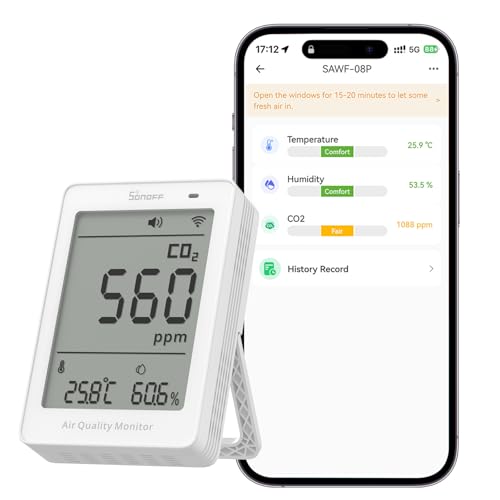
- Matter support for major smart home platforms
- NDIR sensor with 5-second updates
- Sound, LED, and app alerts
Best For: Matter-based smart home setups
Smart Matter CO2 Monitor
SONOFF AirGuard for Bedrooms & Nurseries
- Matter compatible with major smart home platforms
- NDIR sensor with 5-second CO2 updates
- Shows CO2, temperature, and humidity together
Best For: Bedrooms, nurseries, and offices with smart-home integration
7-Inch All-in-One Air Monitor

- Tracks CO2, PM, HCHO, TVOC, temp, humidity, and AQI
- 7-inch display with three brightness levels
- 7 alert buzzers plus mute button
Best For: Large rooms and buyers who want broad pollutant coverage
Matter PM Air Monitor
SONOFF SAWF-07P for Bedroom Air Tracking

- Matter compatible with major smart home platforms
- Tracks PM2.5, PM10, temperature, and humidity
- Triple alerts: sound, LED, and app notifications
Best For: Bedrooms and offices needing particle-focused monitoring
Alexa Home Monitoring – Amazon Smart Air Quality Monitor
If you want smart indoor air quality monitors that fit neatly into an Alexa home, this plug-in option keeps tabs on the basics without adding setup hassle. It measures PM2.5, VOCs, carbon monoxide, humidity, and temperature, then turns those readings into an easy-to-read score in the Alexa app.
Best For: Alexa users who want simple air tracking and automatic alerts.
Pros:
- Tracks five key factors: PM2.5, VOCs, CO, humidity, and temperature
- Color-coded LED and Alexa app score make readings easy to understand
- Real-time alerts and Echo announcements when air quality drops
- Can trigger Alexa routines for purifiers, dehumidifiers, fans, and thermostat-linked comfort control
Cons:
- Needs to stay plugged in
- Works best in an Alexa-focused smart home
This is a straightforward pick if you want monitoring plus automation in one device. It focuses on the most practical indoor air signals and makes it easy to respond when conditions change.
Radon and Whole-Home Sensing – Airthings View Plus
Among smart indoor air quality monitors, this one stands out for adding radon to a wide set of readings. The Airthings View Plus continuously measures radon, PM2.5, CO2, VOCs, humidity, temperature, and air pressure, with live data and app-based trend tracking.
Best For: Homeowners who want radon monitoring plus broad air-quality insight.
Pros:
- Measures radon, PM2.5, CO2, VOCs, humidity, temperature, and air pressure
- Battery-powered and cable-free for flexible placement
- App provides live data, notifications, trends, and pollen forecast info
- Customizable eInk display and optional five-year warranty registration
Cons:
- Requires the Airthings app and internet access to function
- Account setup is required
If radon is a priority, this monitor offers a deeper health-focused feature set than many indoor monitors. Its portable design also makes it easier to place where you need it most.
Quick PM Monitoring – GoveeLife Smart Air Quality Monitor
If you mainly want a smart indoor air quality monitor for PM2.5, temperature, and humidity, this wired GoveeLife model keeps the focus tight. It updates quickly, shows a simple LED quality indicator, and can work with compatible GoveeLife devices for automatic climate responses.
Best For: Users who want quick, simple monitoring with GoveeHome automations.
Pros:
- Measures PM2.5, temperature, and humidity
- Fast two-second data refresh and stated PM2.5 accuracy of ±15 µg/m³
- LED indicator shows four air-quality levels
- Can automate compatible GoveeLife purifiers, humidifiers, fans, and heaters
Cons:
- Must be connected to a power source
- Uses 2.4G Wi-Fi for time display
This is a practical choice if you want a clear read on particle levels without extra complexity. Its strongest advantage is the ability to tie air readings into the Govee ecosystem.
Advanced Multi-Sensor Monitor – BREATHE Airmonitor Plus Gen 2
For buyers comparing smart indoor air quality monitors with more advanced sensing, the BREATHE Airmonitor Plus Gen 2 packs a lot into one compact device. It tracks CO2, PM1, PM2.5, PM10, TVOC, formaldehyde, temperature, and humidity, then stores history in the app for longer-term review.
Best For: Users who want detailed, multi-pollutant monitoring with app history.
Pros:
- 8-in-1 monitoring covers CO2, PM sizes, TVOC, formaldehyde, temperature, and humidity
- NDIR CO2 measurement plus laser particle sensing for more detailed data
- Free app offers alerts, 90-day history, and data export
- Rechargeable design supports up to 6 hours of portable use or USB-C continuous power
Cons:
- Portable runtime is limited to up to 6 hours
- Requires 2.4 GHz Wi-Fi for app features
This model is a strong fit if you want a broader picture of indoor air than a basic PM or CO2 monitor can provide. The mix of chemical, particle, and comfort readings makes it useful for more serious home analysis.
Bedroom Air Monitor Pick – GoveeLife Smart CO2 Detector H5140
If you want a smart indoor air quality monitor that focuses on the basics most people actually watch day to day, this GoveeLife model keeps CO2, temperature, and humidity visible in one place. It is designed for continuous indoor monitoring with fast 5-second updates, app tracking, and alerting that fits bedrooms, nurseries, and offices.
Best For: Bedrooms, nurseries, and home offices where CO2 awareness and quiet overnight monitoring matter.
Pros:
- Uses an SCD4x CO2 sensor with stated ±(40ppm + 5%) accuracy and 5-second refreshes.
- Shows CO2, temperature, humidity, and a clock on the display for quick at-a-glance checks.
- Includes triple alerts: buzzer, app notifications, and email reports.
- Offers two years of data history plus CSV export for deeper review.
Cons:
- Clock functionality requires app connection.
- Needs outdoor calibration in the app if required.
- CO2 is monitored rather than reduced, so it is for awareness and alerting.
This is a solid choice if you want an always-on monitor with strong alerting and long-term data tracking. It is especially useful when you care more about dependable CO2 visibility than a broad pollution sensor suite.
Smart Home Integration Pick – SONOFF AirGuard SAWF-08P Matter Monitor
The SONOFF AirGuard SAWF-08P is a smart indoor air quality monitor built around CO2, temperature, and humidity tracking with Matter support for broader smart home compatibility. If you want a compact monitor that fits into Apple Home, Alexa, Google Home, SmartThings, or Home Assistant, this one is aimed at easy integration as much as basic air monitoring.
Best For: Smart home users who want Matter compatibility and simple CO2 monitoring in one display.
Pros:
- Matter compatible for integration with major smart home platforms.
- NDIR sensor with stated ±(50ppm + 5%) accuracy and 5-second updates.
- Shows CO2, temperature, and humidity on one screen.
- Includes sound, LED, and app notifications with customizable thresholds.
Cons:
- Tracks CO2, temperature, and humidity only, not broader pollutants.
- Uses 2.4GHz WiFi, so network compatibility matters.
- Voice checks are limited to supported assistants.
For buyers who care about ecosystem compatibility, this model stands out more than a basic standalone detector. Its value is strongest when you want CO2 monitoring that can sit comfortably inside a larger connected-home setup.
Full-Feature Sensor Pick – Portable 10-in-1 Air Quality Tester
If you want a smarter indoor air quality monitor that goes well beyond CO2, this 10-in-1 tester covers a much wider set of readings in a portable format. It measures CO2, HCHO, TVOC, AQI, PM2.5, PM1.0, PM10, temperature, and humidity, making it a practical all-around option for checking more than just ventilation.
Best For: Buyers who want a broad indoor air snapshot with particulate and chemical measurements included.
Pros:
- Measures CO2, HCHO, TVOC, AQI, PM1.0, PM2.5, PM10, temperature, and humidity.
- High-definition color screen changes with air-quality thresholds for quick visibility.
- Supports Bluetooth time calibration through the MT13S phone connection.
- Compact and portable for bedrooms, cars, offices, basements, and more.
Cons:
- Requires a phone connection for automatic time calibration.
- Operation relies on multiple button presses for settings and calibration.
- Portability is a strength, but it is not a wall-mounted smart-home hub.
This model is best if you want a broader read on indoor air conditions instead of a CO2-only view. It offers a practical mix of metrics and portability, which makes it useful in many rooms and even in vehicles.
Smart Matter CO2 Monitor – SONOFF AirGuard for Bedrooms & Nurseries
If you want a smart indoor air quality monitor that focuses on everyday comfort, the SONOFF AirGuard keeps CO2, temperature, and humidity visible in one place. It updates every 5 seconds, supports Matter-based smart home setups, and adds app alerts so you can react quickly when indoor conditions drift.
Best For: Bedrooms, nurseries, and offices where CO2 tracking and smart-home integration matter most.
Pros:
- Matter compatible with Apple Home, Amazon Alexa, Google Home, SmartThings, and Home Assistant.
- NDIR sensor with ±(50ppm + 5%) CO2 accuracy and 5-second updates.
- Displays CO2, temperature, and humidity together on one screen.
- App notifications, multi-color LED indicator, and 12 months of history with export.
Cons:
- Tracks CO2, temperature, and humidity only, not particulate or VOC readings.
- Requires continuous power supply.
- 2.4GHz WiFi only.
This is a practical pick if your main priority is understanding CO2 buildup and keeping a smart home routine around it. The data history and Matter support add value if you want more than a basic display.
7-Inch All-in-One Air Monitor – 16-in-1 Real-Time CO2 Display
This smart indoor air quality monitor is built for users who want a broad snapshot of indoor conditions on a large screen. It covers CO2, particulate matter, HCHO, TVOC, temperature, humidity, AQI, and time, with audible alerts that make it easier to notice changes without checking the display constantly.
Best For: Homeowners who want a large, easy-to-read monitor with broad pollutant coverage and alert buzzers.
Pros:
- Monitors CO2, PM2.5, PM1.0, PM10, HCHO, TVOC, temperature, humidity, AQI, and time.
- Large 7-inch LED display with three brightness settings.
- Includes 7 AQI alert buzzers plus a mute button.
- External high-precision sensors and direct air sampling design.
Cons:
- Does not list app connectivity or smart-home integration.
- Larger display footprint than simpler monitors.
- Alert-heavy design may be unnecessary if you only want basic readings.
If you want a feature-rich standalone monitor, this model stands out for its wide parameter list and oversized display. It is most useful in spaces where quick visual checks and alerts are more important than app-based control.
Matter PM Air Monitor – SONOFF SAWF-07P for Bedroom Air Tracking
If you need a smart indoor air quality monitor focused on particles and comfort data, the SONOFF SAWF-07P keeps PM2.5, PM10, temperature, and humidity on a single 3.73-inch screen. It also adds Matter support, fast refresh timing, and app-based thresholds so you can monitor conditions in real time.
Best For: Bedrooms, nurseries, and offices where PM2.5 alerts and smart notifications are the priority.
Pros:
- Matter compatible with Apple Home, Amazon Alexa, Google Home, SmartThings, and Home Assistant.
- Data updates every 2 seconds with continuous power.
- Displays PM2.5, PM10, temperature, and humidity together.
- Triple notification system: sound prompt, LED indicator, and app alerts.
Cons:
- Does not measure CO2, HCHO, or TVOC.
- 3.73-inch display is smaller than large-screen standalone monitors.
- Requires 2.4GHz WiFi and continuous power.
This is a focused option if particle monitoring matters more than having every possible sensor type. The smart notifications and Matter support make it especially convenient for connected homes.
How We Picked These Smart Indoor Air Quality Monitors
We focused on monitors that balance useful sensor coverage, clear readings, smart connectivity, and practical alerts. Priority went to models that measure the pollutants and comfort factors most homeowners actually want to track, including CO2, PM2.5, VOCs, humidity, temperature, and, where available, radon.
We also favored devices with readable displays, app support, notification options, and smart-home compatibility when it adds real value rather than complexity.
Quick Comparison: What Each Type Is Best for
Not every monitor serves the same purpose. Some are best for basic ventilation checks and CO2 awareness, while others are better for broader indoor air quality awareness with particulate, gas, and comfort monitoring. If you want one simple screen for a bedroom or office, a focused CO2 monitor may be enough. If you want a fuller picture of air quality across multiple rooms, a multi-sensor unit is usually the better fit.
Key Buying Factors for Smart Indoor Air Quality Monitors
What to Measure
Choose sensors based on your main concern. CO2 is useful for ventilation and occupancy, PM2.5 matters for smoke and fine particles, VOCs can help flag odors and off-gassing, and radon is important in basements or ground-level spaces. Temperature and humidity are also helpful because comfort and mold risk often go hand in hand with air quality.
Display, Alerts, and App Support
A good monitor should be easy to read at a glance. Look for clear displays, color indicators, sound alarms, push notifications, and app history if you want trends over time. For Smart Indoor Air Quality Monitors, alerts matter as much as raw numbers because they tell you when to act.
Connectivity and Ecosystem Fit
Wi-Fi, Bluetooth, and Matter support can make a monitor easier to integrate with your broader smart home. That said, don’t pay extra for features you will not use. A reliable local display can be the best option if you mainly want quick room-by-room checks.
Who Should Buy Which Smart Indoor Air Quality Monitors?
If you want a simple solution for a bedroom, nursery, or home office, pick a straightforward CO2-focused model with a clear display and alarms. If you are concerned about wildfire smoke, cooking particles, or general indoor pollution, choose a monitor with PM2.5 tracking. If you want the most complete overview, look for multi-gas and multi-sensor devices that combine CO2, PM, VOC, humidity, and temperature. Homeowners in older properties or basements should strongly consider a model with radon monitoring.
In short, the best choice depends on whether you want basic awareness, ventilation guidance, or a broader indoor air quality dashboard for everyday decision-making.