Commercial-grade thermal imaging cameras can turn hidden heat patterns into fast, actionable diagnostics for electrical, mechanical, and building inspections.
Below, we’ve narrowed the field to 10 practical picks for 2026, focusing on image quality, usability, and the features that matter most in professional workflows.
Best 10 Commercial-Grade Thermal Imaging Cameras Picks for 2026
Dual-Lens Precision

- Dual-lens IR + 2MP visible-light camera
- TISR boosts resolution to 512×384
- IP54-rated and drop-resistant
Best For: Technicians needing versatile fusion imaging and rugged jobsite use
Budget-Friendly Inspection Tool

- 192×192 IR sensor with 25Hz refresh
- Adjustable emissivity for varied surfaces
- 8-hour battery life with 8GB storage
Best For: Simple, durable thermal inspections with dependable core measurements
High-Detail Field Camera

- 512×384 effective resolution with X³ IR
- 40mK sensitivity and 25Hz refresh
- WiFi, USB, and voice-note workflow
Best For: Professionals needing detailed thermal imaging and flexible documentation
Cloud-Connected Inspector

- 160×120 thermal resolution with MSX
- FLIR Ignite Cloud for storage and sharing
- 10-year detector warranty coverage
Best For: Inspectors who prioritize cloud workflows and dependable FLIR support
Intelligent Scene Detection Pick
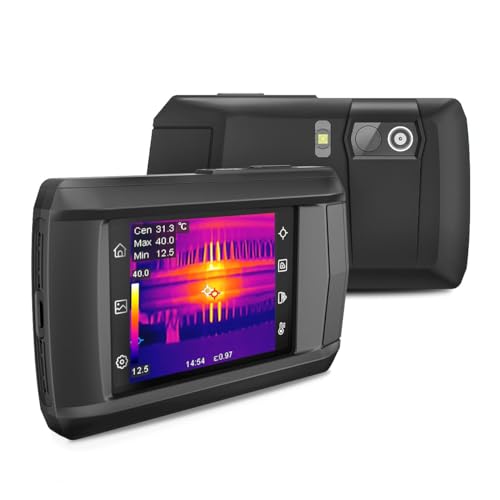
- IntellFault scene recognition for leaks and insulation gaps.
- 3.5" touchscreen with recording, playback, and simple controls.
- Live super resolution boosts 96x96 viewing to 240x240.
Best For: technicians who want fast, easy inspections with guided thermal detection
PC Analysis Value Pick

- 320x240 LCD with TISR-enhanced thermal detail.
- Windows software supports 2D/3D analysis and reports.
- IP54-rated and drop-resistant for field use.
Best For: inspectors who want a rugged handheld camera with detailed PC analysis
High-Resolution App Connect Pick

- 256x192 detector enhanced to 640x480 super resolution.
- Wi-Fi app and Windows software support analysis and reporting.
- IntellFault and Pro Scene help flag leaks and insulation voids.
Best For: users who want higher visual clarity plus app-based analysis and reporting
Pro-Grade Portable Scan

- 240 x 240 TISR detail with 25Hz imaging
- Up to 24 hours of battery life
- IP65 protection with drop resistance
Best For: Long inspection days and rugged on-site thermal checks
Compact Inspection Tool

- 240 x 240 TISR enhancement in a pocket-friendly body
- 15-hour runtime with auto shut-off options
- Auto photo capture on temperature warnings
Best For: Portable inspections where size, alerts, and simplicity matter
Dual-Lens Precision – FOXWELL RT280 PRO
If you’re comparing commercial-grade thermal imaging cameras for field diagnostics, the FOXWELL RT280 PRO stands out for its dual-lens setup and flexible image modes. It combines thermal and visible-light capture with fusion views, making it easier to match hot spots to real-world components during electrical, HVAC, plumbing, or mechanical inspections.
Best For: Technicians who want dual-lens imaging and strong troubleshooting versatility.
Pros:
- Dual-lens design with built-in IR and 2MP visible-light camera.
- 5 image modes, including Thermal, PIP, and overlay fusion.
- 512×384 effective resolution via TISR for finer thermal detail.
- IP54-rated and drop-resistant for demanding work environments.
Cons:
- 25Hz frame rate is solid, but not the fastest in this group.
- PC analysis is Windows-only, not compatible with Mac.
The RT280 PRO is a practical choice if you want clearer context around thermal findings and field-ready durability. Its blend of image fusion, measurement tools, and reporting software makes it a capable option for routine professional inspections.
Budget-Friendly Inspection Tool – MILESEEY TR10
The MILESEEY TR10 is a straightforward pick among commercial-grade thermal imaging cameras when you need dependable thermal checks without extra complexity. Its 192×192 sensor, 25Hz refresh rate, and adjustable emissivity make it suitable for identifying hot spots, anomalies, and surface temperature differences across a range of materials.
Best For: Users who want a durable, practical thermal imager with simple core functions.
Pros:
- 192×192 thermal resolution with 25Hz smooth image updates.
- High/low temperature alarms help flag anomalies quickly.
- Adjustable emissivity improves readings on different surfaces.
- 8-hour battery life and 8GB storage support longer work sessions.
Cons:
- No visible-light camera or fusion modes are listed.
- Wired connectivity is more limited than wireless options.
TR10 focuses on the fundamentals: solid thermal clarity, dependable measurement, and durable construction. If your workflow values simplicity and long runtime over advanced imaging features, it’s an easy model to keep in the toolkit.
High-Detail Field Camera – Thermal Master Thor002
If you need commercial-grade thermal imaging cameras with stronger detail and workflow flexibility, the Thermal Master Thor002 is built for professional inspections. It pairs a 512×384 upgraded IR resolution with a 3.5-inch IPS display, plus WiFi and USB image transfer for easier analysis on larger screens.
Best For: Professionals who want high thermal detail, long runtime, and wireless file handling.
Pros:
- 512×384 effective resolution with X³ IR technology.
- 40mK sensitivity supports finer temperature differentiation.
- Up to 10.5 hours of battery life with fast charging.
- WiFi, USB transfer, voice notes, and QR code file management.
Cons:
- Bulkier than compact handheld alternatives at 3.12 pounds.
- Feature set may be more than casual users need.
The Thor002 is a strong fit for on-site professionals who want more resolution, longer uptime, and smoother documentation. Its combination of zoom, alarms, and robust storage makes it especially useful for recurring inspection work.
Cloud-Connected Inspector – FLIR E5 Pro WiFi
The FLIR E5 Pro is a good option in commercial-grade thermal imaging cameras if you value easy sharing and a proven inspection workflow. With 160×120 thermal resolution, MSX detail enhancement, and FLIR Ignite Cloud support, it helps speed up image storage, editing, and sharing while keeping the camera updated over the air.
Best For: Teams and solo inspectors who want cloud-based image handling and trusted FLIR tooling.
Pros:
- MSX technology adds visual detail to thermal images.
- Ignite Cloud streamlines storage, editing, and sharing.
- Temperature range covers -4°F to 752°F.
- Includes FLIR’s 10-year detector warranty coverage.
Cons:
- 160×120 resolution is lower than some competing models.
- Fewer advanced imaging features are listed than on higher-resolution units.
The E5 Pro is best viewed as a reliable workflow tool rather than a resolution leader. For users who want straightforward thermal troubleshooting with cloud connectivity and strong brand support, it remains an appealing choice.
Intelligent Scene Detection Pick – HP96 Thermal Imaging Camera
If you want commercial-grade thermal imaging cameras that feel straightforward in the field, the HP96 is built around speed and simplicity. Its 3.5″ touchscreen UI, IntellFault scene recognition, and live anomaly tracking make it easier to spot leaks, insulation gaps, and electrical hotspots without a steep learning curve.
Best For: technicians who want fast, easy inspections with intelligent scene detection and a touch-friendly interface.
Pros:
- IntellFault scene recognition helps identify water leaks and insulation gaps automatically.
- 3.5″ touchscreen, live audio/video recording, and simple swipe controls improve day-to-day usability.
- 50° field of view with max/min/center temperature tracking supports efficient large-area scanning.
- Dual camera setup plus five imaging modes adds flexibility for different inspection scenarios.
Cons:
- No moisture readings, so leak-related findings are based on thermal analysis only.
- Native thermal resolution is 96×96 before super-resolution enhancement.
- Battery life is listed at up to 4 hours, which may require planning for longer jobs.
Overall, the HP96 is a practical choice if you value guided detection and easy operation more than deep manual analysis. It leans toward fast, reliable field work for inspections where clarity and workflow matter.
PC Analysis Value Pick – FOXWELL RT280 Thermal Camera
For buyers comparing commercial-grade thermal imaging cameras, the RT280 stands out for its mix of handheld clarity and PC-based analysis. The 320×240 LCD, TISR-enhanced effective resolution, and Windows software for 2D/3D temperature analysis make it a strong fit when you need both field capture and deeper review later.
Best For: inspectors who want a rugged handheld camera with detailed PC analysis and reporting.
Pros:
- 320×240 LCD plus TISR enhancement improves thermal detail for inspections.
- Windows software supports point, line, and area analysis with automatic report generation.
- 8GB eMMC storage can hold over 20,000 images, which is useful for documentation-heavy work.
- Rugged build includes IP54 protection and 6.6-foot drop resistance.
Cons:
- PC analysis is Windows-only and not compatible with Mac.
- Native effective thermal resolution starts lower before TISR enhancement.
- Smaller 2.8-inch display may feel cramped versus larger-screen models.
The RT280 is a solid pick when documentation, analysis, and portability all matter. It is especially appealing for users who want a field-ready camera that can turn thermal data into organized reports after the job.
High-Resolution App Connect Pick – HSFTOOLS F2W Thermal Camera
If you’re shopping commercial-grade thermal imaging cameras for clearer visuals and connected workflows, the F2W is built to cover both. Its 256×192 detector, 640×480 super resolution, Wi-Fi app support, and Pro Scene alerts make it a versatile option for faster inspections and easier sharing.
Best For: users who want higher visual clarity plus app-based analysis and reporting.
Pros:
- Live Super Resolution boosts thermal output from 256×192 to 640×480.
- Wi-Fi pairing with the HSFTOOLS app supports image sharing, analysis, and reporting.
- IntellFault and Pro Scene color alarms help detect water leaks and insulation voids.
- Fast anomaly recognition includes temperature alerts, hotspot tracking, and flashlight/audio warnings.
Cons:
- Advanced software features require the app or Windows PC software to get the most value.
- Some scene-detection functions depend on firmware updates and setup steps.
- The listed package weight of 2.05 pounds may feel less compact than simpler handheld units.
The F2W is a strong all-around choice if you want more clarity and connected tools without sacrificing inspection speed. It is best suited to users who will take advantage of both the thermal camera and the software ecosystem around it.
Pro-Grade Portable Scan – H128 Handheld Thermal Camera
If you want a commercial-grade thermal imaging camera that stays practical on long jobs, the H128 is built around clarity, battery life, and field durability. Its 240 x 240 TISR output, 25Hz refresh rate, and 40mK sensitivity help it reveal small temperature differences while keeping inspections smooth and readable.
Best For: Contractors, inspectors, and maintenance teams who need long runtime and rugged handheld thermal checks.
Pros:
- 240 x 240 TISR enhancement gives more detail than a basic 128 x 128 thermal view.
- Up to 24 hours of battery life supports extended inspection days.
- IP65 protection and 6.56-foot drop resistance add confidence in tougher environments.
- Temperature alarm and max/min/center tracking help spot anomalies quickly.
Cons:
- No advanced AI scene recognition features like some competing models.
- At 1.06 pounds, it is still a handheld tool rather than an ultra-compact pocket unit.
Overall, the H128 is a strong fit for buyers who value dependable operation, solid image enhancement, and all-day use over extra software-driven automation. It keeps the core inspection workflow straightforward while still offering practical temperature tools.
Smart Fault Finder – HF96 Thermal Camera
The HF96 is aimed at buyers who want a commercial-grade thermal imaging camera with more automation built in. Its AI scene recognition can identify water leaks and insulation gaps, while live super resolution pushes images to 240 x 240 clarity for smoother, more useful inspections.
Best For: HVAC, electrical, and building inspection users who want AI-assisted fault detection.
Pros:
- AI Scene Recognition helps detect water leaks and insulation gaps faster.
- Live super resolution enhances thermal images to 240 x 240 clarity.
- 25Hz refresh rate and 50° field of view support efficient scanning.
- Built-in laser pointer, tripod hole, and PC software improve usability.
Cons:
- AI scene features require firmware update and scene selection in settings.
- No moisture readings are provided, despite leak-focused detection.
- IP54 protection is solid, but less rugged than higher-rated industrial models.
In practice, the HF96 is best for users who want faster anomaly recognition and more guided inspections. It combines automation, software support, and a long 11-hour runtime into a versatile tool for common maintenance work.
Compact Inspection Tool – TOPDON TC004 Mini
The TOPDON TC004 Mini is a practical choice if you want a compact commercial-grade thermal imaging camera without giving up key inspection features. It starts at 128 x 128 and uses TISR to enhance images to 240 x 240, while the 40° x 30° field of view and 25Hz refresh rate keep scans steady and easy to interpret.
Best For: Portable home, electrical, and leak inspections where compact size matters.
Pros:
- 240 x 240 TISR enhancement improves detail beyond the base thermal image.
- Mini, pocket-friendly design is easy to carry and hold.
- 15-hour runtime and auto shut-off options help extend use.
- Automatic photo capture on temperature warnings streamlines documentation.
Cons:
- 512MB eMMC storage is more limited than larger-capacity models.
- No paper manual is included, so setup depends on the electronic version.
- Less rugged than some heavier-duty options, with IP54 protection.
For buyers who prioritize portability, the TC004 Mini keeps the essentials in a small package. It is a good fit for quick diagnostics and regular field use, especially when you want thermal alerts and photo capture without carrying a larger device.
How We Picked These Commercial-Grade Thermal Imaging Cameras
We focused on specs that affect real-world use: thermal resolution, frame rate, temperature range, display quality, battery life, and workflow features like Wi-Fi, cloud support, and on-device scene analysis. Preference went to models that balance portability with enough detail for inspection work, rather than consumer toys with limited measurement value.
We also considered how easy each camera should be to carry, aim, review, and document findings on the job. That means the best choice is not always the highest-resolution model; it is the one that fits your inspection environment and reporting needs.
Quick Comparison: What Matters Most
In this roundup, higher-resolution models are better for spotting smaller anomalies and viewing finer details, while lower-resolution options can still work well for basic leak detection, HVAC checks, and general troubleshooting. A higher refresh rate helps moving scans feel smoother, and a wider temperature span is useful for industrial and electrical applications.
Features such as intelligent scene detection, dual-lens systems, and cloud connectivity can save time if you inspect frequently or need to share results quickly. If you only need occasional diagnostics, simpler models may deliver better value.
Key Buying Factors for Commercial-Grade Thermal Imaging Cameras
Thermal Resolution
Resolution is one of the biggest quality drivers. More pixels usually mean clearer outlines, better edge definition, and easier interpretation at a glance. For commercial use, aim for the highest resolution your budget allows.
Refresh Rate and Responsiveness
A faster frame rate makes handheld scanning smoother and can improve usability when tracking hot spots on moving equipment or surveying larger areas.
Temperature Range and Accuracy
Make sure the camera covers the temperatures you expect to measure. Electrical, mechanical, and industrial jobs often require a wider range than home inspections.
Display, Ergonomics, and Reporting
A bright screen, intuitive controls, and simple image capture tools matter more than many buyers expect. If you create reports regularly, look for Wi-Fi transfer, app support, or cloud integration.
Battery Life and Durability
Field work can run long, so battery endurance is worth paying attention to. Rugged construction and a comfortable grip also help when you’re using the camera all day.
Who Should Buy Which Commercial-Grade Thermal Imaging Cameras?
Choose a higher-end model if you need sharper thermal detail for professional diagnostics, documentation, or frequent commercial use. Midrange cameras are a strong fit for electricians, HVAC techs, maintenance teams, and building inspectors who want reliable performance without paying for premium extras.
If your work is occasional or you mainly need quick spot checks, a simpler camera with solid resolution and easy controls may be the best value. For teams that depend on documentation and sharing, prioritize Commercial-Grade Thermal Imaging Cameras with smart connectivity and reporting-friendly software.