Professional USB testing demands more than a basic voltage readout. The right meter can reveal charging speed, power negotiation, cable behavior, battery capacity, and faults across USB-A and USB-C equipment.
We selected 10 USB power meters spanning compact field testers, high-power USB-C analyzers, protocol readers, and feature-rich diagnostic tools. Use the guide below to match specifications with your workflow.
Best 10 USB Power Meters for Professionals Picks for 2026
Advanced USB-C Analysis

- Up to 50V, 6A, and 240W PD testing
- Measures protocols, E-markers, capacity, and energy
- Rotating display with PC software support
Best For: High-power USB-C engineering and protocol analysis
Protocol Testing Specialist

- Supports a wide range of fast-charge protocols
- Graphs voltage, power, ripple, and capacity data
- Reads E-markers and tests cable resistance
Best For: Fast-charging diagnostics across USB-A and USB-C
Rugged General-Purpose Meter

- Tests USB-A and USB-C voltage and current
- Stores up to 10 readings for comparison
- 6.6-foot drop protection for jobsite use
Best For: Routine field testing and service work
240W USB-C Pass-Through Meter

- Monitors USB-C connections up to 240W
- Bidirectional design with OLED screen rotation
- Passes through USB data and Alt Mode video
Best For: High-power USB-C charging and connection checks
Versatile USB-A Monitor

- Seven display modes for voltage, current, power, and capacity
- Measures 3.2–30V and up to 5A
- Dual USB-A outputs with PD and QC 3.0 support
Best For: Everyday USB-A charger, cable, and power-bank testing
USB-C PD Specialist
StarTech 240W USB-C Power Tester

- Measures voltage, current, and wattage bidirectionally
- Supports USB PD 3.1 EPR up to 240W
- Passes USB 10Gbps data and DP Alt Mode video
Best For: Professional USB-C PD, cable, dock, and port troubleshooting
Advanced USB Diagnostics
CT-3 Programmable USB Power Meter

- Measures up to 26V and 6A with 0.1% maximum gain error
- Supports numerous PD, QC, and proprietary fast-charge protocols
- Adds PC logging, ripple viewing, and Lua programming
Best For: Advanced bench testing, charger development, and USB diagnosis
High-Current USB-C Tester

- 4–30V and 0–12A measurement range
- Supports multiple fast-charging protocols
- Color display with real-time curve monitoring
Best For: High-current USB-C charging diagnostics
Multi-Port Diagnostic Meter
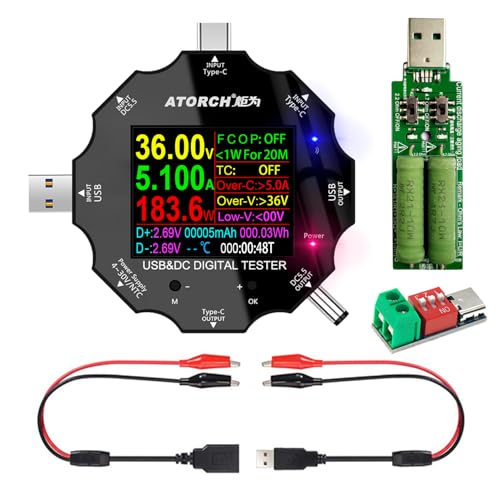
- Tests USB, USB-C, DC5.5, and micro USB
- Includes clip cable and load configuration
- Adds protection features and app-based data viewing
Best For: Mixed-port bench testing and load measurements
Portable Capacity Tester

- 3.6–32V and 0–8A measurement range
- Tracks capacity, energy, temperature, and charging time
- Supports PD, QC, and BC1.2 standards
Best For: Charger, cable, and power-bank testing
Advanced USB-C Analysis – ChargerLAB KM003C
For professionals who need USB power meters for professionals-grade USB-C testing, the ChargerLAB POWER-Z KM003C combines high power handling with protocol and performance analysis. Its 1.54-inch rotating display and broad test set make readings easier to review in the field.
Best For: USB-C engineers, repair technicians, and testers working with high-power PD devices.
Pros:
- Supports measurements up to 50V and 6A, with up to 240W in PD mode.
- Tests voltage, current, capacity, energy, E-marker data, PDOs, and charging protocols.
- Offers PC software support, a 20-bit ADC, and a high-contrast rotating display.
Cons:
- Designed for USB-C connections rather than USB-A testing.
- Advanced features may require downloading the manual and PC software.
The KM003C is the most feature-rich choice here for detailed USB-C power and protocol work, particularly when PC-based data analysis and high-wattage testing matter.
Protocol Testing Specialist – FNIRSI FNB58
The FNIRSI FNB58 is a versatile option for professionals comparing chargers, cables, and fast-charging systems. It combines USB-A, Micro-USB, and USB-C interfaces with protocol triggering, graphing, and app or PC connectivity.
Best For: Technicians who need broad fast-charge protocol detection and recorded measurement data.
Pros:
- Supports multiple PD, QC, AFC, FCP/SCP, VOOC, and related charging protocols.
- Monitors voltage, current, power, capacity, resistance, ripple, and D+/D− voltage.
- Includes real-time graphing, E-marker reading, cable resistance testing, and software support.
Cons:
- It does not include a printed manual; documentation is accessed through the package QR code.
- Incorrect port or protocol settings can leave the tester at a 5V output.
- Its upper temperature rating is 40°C.
Choose the FNB58 when protocol coverage and diagnostic functions are more important than a simple plug-in readout. Its recording and graphing tools suit comparative testing and troubleshooting.
Rugged General-Purpose Meter – Klein Tools ET920
The Klein Tools ET920 is a straightforward choice for professionals who want USB power meters for professionals-grade field checks without a complex software workflow. It measures common USB-A and USB-C power characteristics and stores readings for later comparison.
Best For: Electricians, installers, and service technicians performing routine USB power checks on jobsites.
Pros:
- Supports 3–20V testing, with current ranges up to 3A on USB-A and 5A on USB-C.
- Monitors voltage, current, capacity, energy, and calculated resistance for up to 1,000 hours.
- Stores up to 10 readings and has overload detection, a high-resolution LCD, and 6.6-foot drop protection.
Cons:
- Its voltage and current ranges are narrower than the high-power USB-C analyzers listed here.
- It focuses on measurement rather than protocol analysis or PC graphing.
The ET920 is a practical, durable meter for everyday service work. Its USB-A and USB-C support, memory, and jobsite-oriented construction make it a strong general-purpose pick.
240W USB-C Pass-Through Meter – Plugable USBC-VAMETER3
The Plugable USBC-VAMETER3 is a compact option for professionals evaluating USB-C charging connections up to 240W. Its bidirectional design, pass-through data support, and updated OLED display make it useful for checking chargers, docks, and other USB-C accessories.
Best For: USB-C users and technicians testing high-power charging setups while retaining data or video pass-through.
Pros:
- Monitors USB-C power up to 240W across a 4.5–50V and 50mA–6.5A operating range.
- Works in either orientation and includes a button for screen rotation.
- Supports USB data pass-through, USB-C Alt Mode video, and charging connections.
Cons:
- It is not compatible with Thunderbolt 3 devices.
- Its listed measurements focus on voltage and amperage rather than protocol or capacity analysis.
The Plugable meter is a strong fit when a compact USB-C power check must remain in the connection during normal data, video, or charging use. It offers high-power coverage without requiring drivers.
Versatile USB-A Monitor – 7-Mode DROK USB Tester
For professionals comparing USB power meters for professionals, the DROK USB Tester offers a straightforward way to monitor voltage, current, power, and accumulated capacity. Its color display cycles through seven viewing modes, while the USB-A format and dual outputs suit routine charger, cable, power-bank, and solar-panel checks.
Best For: Everyday USB-A troubleshooting, charging checks, and capacity monitoring.
Pros:
- Displays voltage, current, power, and capacity in seven selectable modes.
- Supports testing across 3.2–30V and up to 5A.
- Supports PD and QC 3.0 fast-charge protocols, with dual USB-A outputs.
- Includes over/under-voltage, over-current, and short-circuit alarms.
Cons:
- Designed around USB-A connections rather than USB-C.
- One output supports data transfer, while the second is charging-only.
- Operation is button-based rather than computer-connected.
This is a practical, easy-to-read option for USB-A workflows. Choose it when broad voltage coverage and simple on-device readings matter more than advanced logging or USB-C support.
USB-C PD Specialist – StarTech 240W USB-C Power Tester
Among USB power meters for professionals, the StarTech USB-C Power Tester stands out for high-power USB-C and Power Delivery work. It measures voltage, current, and wattage bidirectionally, passes USB data at up to 10Gbps, and supports USB PD 3.1 EPR applications up to 240W.
Best For: IT technicians diagnosing USB-C chargers, docks, hubs, cables, and high-power devices.
Pros:
- Supports measurements from 4.5–50V and 50mA–6.5A.
- Handles USB PD 3.1 EPR applications up to 240W.
- Bi-directional USB-C male-to-female design works in either direction.
- Retains USB 10Gbps data pass-through and DP Alt Mode video support.
Cons:
- Not compatible with Thunderbolt 3 devices.
- Focused on USB-C rather than USB-A testing.
- Provides real-time readings but does not list onboard data logging.
For USB-C service benches and field troubleshooting, this tester combines high-power measurement with signal pass-through. It is the strongest fit here for checking modern PD systems without interrupting supported USB data or video functions.
Advanced USB Diagnostics – CT-3 Programmable USB Power Meter
For demanding USB power meters for professionals applications, this CT-3-style tester adds precision measurement, fast-charge triggering, PC logging, ripple viewing, and Lua programmability. It covers up to 26V and 6A, making it suited to charger development, device diagnosis, and repeatable bench testing.
Best For: Engineers and advanced technicians who need protocol testing, logging, ripple analysis, and programmable workflows.
Pros:
- Measures 0–26V and 0–6A with four-and-a-half-digit readings and up to 0.1% maximum gain error.
- Supports PD with PPS, QC 2.0–4.0, Huawei, Samsung, VOOC, and other listed fast-charge protocols.
- PC software enables logging up to 1000 samples per second and VBUS ripple viewing at 3.2Msps.
- Integrated Lua interpreter, APIs, and 12MB memory enable custom scripts and storage.
Cons:
- Its advanced feature set may be excessive for basic charging checks.
- Maximum operating voltage is 26V, below some wider-range meters.
- More involved to configure than a simple plug-in display tester.
This is the most feature-rich choice of the three for laboratory-style USB analysis. Its combination of protocol triggers, high-speed software tools, and scripting makes it especially useful when live readings alone are not enough.
High-Current USB-C Tester – 12A PD Protocol Meter
For professionals comparing USB power meters for professionals, the KWS-2303C stands out with a 4–30V range, current measurement up to 12A, and support for a broad selection of fast-charging protocols. Its color display and curve function make it useful for evaluating chargers, cables, power banks, and other USB-C equipment.
Best For: High-current USB-C charging tests and fast-charge protocol troubleshooting.
Pros:
- Measures 4–30V and up to 12A.
- Supports PD, QC, FCP, SCP, AFC, PE, DASH, VOOC, and Super VOOC protocols.
- Records real-time voltage and current with selectable curve durations.
- Displays voltage, current, power, capacity, energy, time, and peak readings.
Cons:
- Designed for USB-C connections rather than a broad mix of connector types.
- The supplied information does not specify app connectivity or data export.
The 12A capacity and protocol coverage make this a strong choice for demanding USB-C diagnostics. It is particularly appealing when peak-current testing and live trend monitoring matter more than extra connectivity features.
Multi-Port Diagnostic Meter – 3-in-1 USB-C Load Tester
Among USB power meters for professionals, this UD18 model is notable for its 3-in-1 connectivity and included clip cable with load. It can monitor USB, USB-C, DC5.5, and micro USB sources while displaying electrical data on an IPS color screen and providing multiple protection features.
Best For: Bench testing varied USB and DC-powered equipment, including routers, notebooks, and power supplies.
Pros:
- Supports USB, USB-C, DC5.5, and micro USB testing.
- Measures voltage, current, power, resistance, capacity, and temperature.
- Offers fast-charge recognition and two-way current measurement.
- Includes over-voltage, over-current, and low-voltage protection.
Cons:
- The temperature probe is not included.
- The supplied specifications list a minimum operating voltage of 3.6V, which may limit very-low-voltage testing.
This is the most versatile option of the three for mixed connector environments. Its protection settings and load-oriented accessories add practical value for bench work, while the app and graph functionality may appeal to users who want to review measurements on a phone.
Portable Capacity Tester – YOJOCK 8A USB-C Meter
This YOJOCK meter is a practical pick for professionals comparing USB power meters for professionals who need portable charging and power-bank diagnostics. It measures 3.6–32V and up to 8A, tracks several charging metrics, and supports common PD, QC, and BC1.2 standards.
Best For: Checking charger performance, USB cables, and power-bank capacity across USB-A and USB-C setups.
Pros:
- Measures 3.6–32V and 0–8A.
- Tracks voltage, current, power, capacity, energy, temperature, resistance, and charging time.
- Supports PD2.0/3.0, QC2.0/3.0, and BC1.2.
- Includes over-voltage, over-current, under-voltage, and low-energy protection.
Cons:
- Its 8A maximum is lower than the 12A rating of the KWS-2303C.
- Accurate power-bank capacity testing requires a full charge, cleared data, and continuous discharge through a load or phone.
The broad voltage range, compact format, and capacity-testing guidance make this a well-rounded everyday diagnostic tool. Choose it for charger and power-bank checks; choose a higher-current model when testing demands exceed 8A.
How We Picked the Best USB Power Meters for Professionals
We focused on the measurements and capabilities that matter in repair benches, electronics development, IT support, field service, and charging-system validation. The selection covers USB-A and USB-C compatibility, voltage and current ranges, power calculations, capacity and energy tracking, USB Power Delivery and Quick Charge support, E-marker reading, display usability, and high-wattage operation.
We also considered practical differences between simple inline meters and more advanced diagnostic instruments. A compact tester may be ideal for troubleshooting a charger in the field, while engineers may need protocol visibility, broader measurement limits, or programmable and logging-oriented features.
Quick Comparison
| Best For | Look For | Notable Capability |
|---|---|---|
| USB-C PD testing | High wattage and protocol support | Useful for modern laptop and charger validation |
| Portable troubleshooting | Compact design and clear display | Fast voltage, current, and power checks |
| Cable diagnostics | E-marker and resistance information | Helps identify cable and wiring limitations |
| Battery and power-bank testing | Capacity and energy tracking | Shows delivered charge over time |
| Bench development | Wide ranges and detailed readings | Better flexibility for varied devices |
Key Buying Factors for USB Power Meters for Professionals
Measurement Range and Accuracy
Check the supported voltage and current range before buying. Basic meters can be sufficient for phones and accessories, but higher-current tools are better suited to power banks, hubs, laptops, and USB-C power supplies. Resolution and stated accuracy also matter when comparing small differences between chargers or cables.
USB-C PD and Protocol Coverage
USB-C equipment can negotiate multiple power profiles, so protocol support is a major differentiator. Look for compatibility with USB Power Delivery and Quick Charge when testing modern adapters. E-marker reading is especially useful for verifying whether a USB-C cable reports the expected current and capability.
Power, Capacity, and Energy Readings
Voltage and current are instantaneous measurements. Capacity and energy readings provide a longer-term view of how much charge a power bank or battery actually delivers. If you test portable power products, choose a meter that can track these values clearly and reset them reliably between tests.
Connectors, Display, and Usability
Confirm whether the meter supports USB-A, USB-C, or both, and whether it must be used with an adapter. A color display can improve readability, while a compact inline design is convenient for field work. For bench use, prioritize stable readings, accessible controls, and a layout that does not obstruct adjacent ports.
Who Should Buy Which USB Power Meters for Professionals?
Choose a compact USB-C tester if you mainly diagnose chargers, cables, phones, and laptops on location. Choose a high-power PD meter if your work involves USB-C docks, laptop chargers, or power supplies approaching 240W. Choose a protocol-capable analyzer if you need to inspect negotiation behavior or confirm charging standards. Choose a capacity-focused meter for power-bank and battery testing, where delivered energy matters more than a single live reading. For general electronics work, a model with broad voltage and current limits, multiple connector types, and clear power calculations offers the best flexibility.