Commercial-grade rackmount NAS systems give businesses a structured way to centralize files, backups, surveillance data, and application workloads in standard server racks. The right model balances drive capacity, network speed, redundancy, expandability, and management features.
This roundup compares 10 rackmount NAS options ranging from compact short-depth units to high-capacity 2U systems with enterprise-oriented processors, redundant power, and ZFS-based storage.
Best 10 Commercial-Grade Rackmount NAS Systems Picks for 2026
Flexible Expansion

- 12 drive bays with up to 32GB RAM support
- Redundant PSUs for rack deployment resilience
- Two PCIe Gen3 x4 expansion slots
Best For: Growing businesses needing scalable rack storage
ZFS-Focused Reliability
TrueNAS Mini R Rackmount Storage Server

- 32GB ECC RAM and eight-core Intel Atom CPU
- 12 hot-swap bays with dual 10GbE ports
- IPMI remote management and broad protocol support
Best For: SMB and edge deployments needing ZFS-oriented storage
High-Speed SMB Storage

- Eight SATA drive bays in a rackmount chassis
- Dual 10GbE SFP+ and dual 2.5GbE ports
- Expandable DDR4 memory up to 16GB
Best For: SMBs needing fast networking in an eight-bay NAS
Compact High Availability

- Eight-bay chassis with a short 298 mm depth
- Up to 2,315 MB/s read performance listed
- Supports Synology High Availability clustering
Best For: Space-constrained offices prioritizing uptime
Best Enterprise ZFS Powerhouse
QNAP TS-h1887XU-RP-E2336-32G-US
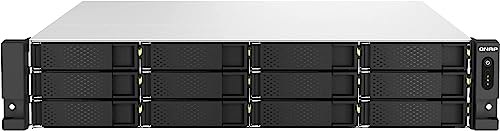
- 18-bay hybrid design with Intel Xeon and ECC memory
- Dual 10GbE plus dual 2.5GbE networking
- ZFS snapshots and enterprise backup capabilities
Best For: Virtualization and data-intensive enterprise workloads
Best Compact High-Performance Rack NAS

- Compact 1U chassis with four drive bays
- Dual 10GbE and high sequential throughput
- Hot-swappable trays and five-year warranty
Best For: Space-conscious business storage deployments
Best Short-Depth Midrange Option

- Eight bays in a short-depth 2U chassis
- Dual 2.5GbE and dual M.2 NVMe slots
- Two PCIe Gen 3 expansion slots
Best For: Growing teams and flexible business file storage
Balanced Office Performance

- Up to 2,000 MB/s sequential reads
- Expandable from four to eight bays
- PCIe upgrade slot and storage tiering
Best For: Growing offices needing expandable file sharing and backup
Short-Depth Connectivity

- Dual 2.5GbE and dual 10GbE ports
- Two M.2 NVMe slots for cache or storage
- Supports Google Workspace and Microsoft 365 backup
Best For: Teams needing compact rack storage with versatile networking
High-Speed Network Value
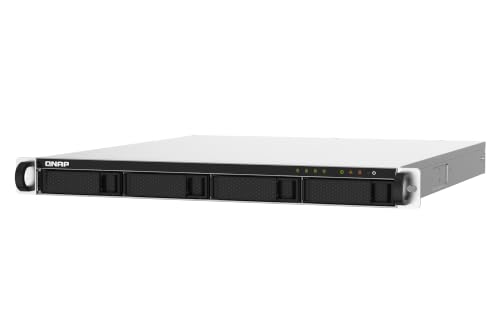
- Two 10GbE SFP+ ports
- Two 2.5GbE Ethernet ports
- Expandable memory up to 16GB
Best For: Businesses prioritizing multiple high-speed network connections
Flexible Expansion – QNAP TS-1273AU-RP-8G-US
QNAP TS-1273AU-RP-8G-US 12 Bay High-Performance Rackmount NAS with 2 x 2.5GbE Ports, Redundant PSU
Check Price On AmazonFor organizations evaluating commercial-grade rackmount NAS systems, the QNAP TS-1273AU-RP-8G-US combines 12 drive bays with a quad-core AMD processor, 2.5GbE networking, and redundant power supplies. It is a diskless platform, so storage capacity and drive selection remain up to you.
Best For: Businesses needing a scalable 12-bay rackmount NAS with redundant power and room for PCIe expansion.
Pros:
- 12 x 3.5-inch drive bays provide substantial storage expansion.
- AMD Ryzen Embedded V1500B quad-core processor supports demanding NAS workloads.
- Redundant power supplies add resilience for rack deployments.
- Two PCIe Gen3 x4 slots allow future expansion.
Cons:
- Ships diskless, so drives must be purchased separately.
- Its included networking is limited to two 2.5GbE ports.
With 8GB of DDR4 memory and support for up to 32GB, this QNAP offers a practical upgrade path. Its combination of capacity, redundant PSUs, and PCIe slots makes it a strong fit for growing business environments.
ZFS-Focused Reliability – TrueNAS Mini R Rackmount Storage Server
The TrueNAS Mini R is a commercial-grade rackmount NAS system built around ZFS storage, ECC memory, remote management, and 12 hot-swap bays. Its dual 10GbE ports and broad protocol support make it suitable for file services, backup, virtualization, and other SMB workloads.
Best For: SMBs and edge deployments prioritizing ECC memory, ZFS features, hot-swap storage, and 10GbE connectivity.
Pros:
- 32GB ECC RAM supports data-focused workloads.
- Eight-core 2.2GHz Intel Atom CPU provides a capable processing foundation.
- Twelve 3.5-inch hot-swap SATA bays simplify storage maintenance.
- Dual 10GbE ports and IPMI remote management suit business racks.
Cons:
- Ships diskless, requiring a separate drive investment.
- Hardware warranty coverage is listed as one year.
Support for SMB, NFS, iSCSI, S3, and other protocols gives the Mini R broad deployment flexibility. SSD caching, virtualization, plugins, and TrueCommand management further extend its usefulness, although the platform is best suited to buyers comfortable building out their own storage configuration.
High-Speed SMB Storage – QNAP TS-832PXU-4G
The QNAP TS-832PXU-4G is a compact commercial-grade rackmount NAS system for SMB environments that need fast network connectivity without moving to a 12-bay chassis. It offers eight SATA bays, dual 10GbE SFP+ ports, and dual 2.5GbE ports in a diskless design.
Best For: Small and medium-sized businesses needing multi-gigabit networking and eight-bay rack storage.
Pros:
- Two 10GbE SFP+ ports support high-speed network links.
- Two additional 2.5GbE ports provide flexible connectivity.
- Eight 3.5-inch SATA bays offer a balanced capacity footprint.
- Memory can be expanded from 4GB up to 16GB.
Cons:
- Ships without drives.
- The ARM-based quad-core processor is less oriented toward heavy compute than higher-end server CPUs.
This QNAP emphasizes network throughput and practical rack density. It is a sensible choice when dual 10GbE SFP+ connectivity matters more than maximum bay count or advanced processor performance.
Compact High Availability – Synology RS1221+ RackStation
The Synology RS1221+ is a short-depth, eight-bay commercial-grade rackmount NAS system designed for multi-user environments. It provides strong listed read and write performance, optional network upgrades through PCIe, and support for pairing two units in a Synology High Availability cluster.
Best For: Businesses needing a compact rack NAS with multi-user performance and an HA expansion path.
Pros:
- Listed performance reaches up to 2,315 MB/s read and 1,147 MB/s write.
- Short 298 mm depth suits space-constrained racks.
- PCIe compatibility enables a 5X network-performance improvement with supported cards.
- Two units can be configured as a Synology High Availability cluster.
Cons:
- Ships diskless, so storage drives are an additional purchase.
- Network upgrades require a separately purchased compatible PCIe card.
The RS1221+ focuses on efficient rack use and service continuity rather than maximum bay count. Its compact chassis, expansion capability, and HA support make it a strong option for offices where uptime and rack depth are key considerations.
Best Enterprise ZFS Powerhouse – QNAP TS-h1887XU-RP-E2336-32G-US
For demanding commercial-grade rackmount NAS systems deployments, the QNAP TS-h1887XU-RP-E2336-32G-US combines an Intel Xeon processor, ECC memory, ZFS storage, and substantial drive capacity. Its 18-bay hybrid design, dual 10GbE ports, and PCIe Gen 4 expansion make it well suited to virtualization, intensive file access, and large backup workloads.
Best For: Enterprise teams managing virtualization, data-intensive applications, and large-scale backup or disaster-recovery tasks.
Pros:
- 18-bay hybrid layout supports 12 front 3.5-inch SATA drives and six 2.5-inch SATA drives.
- Intel Xeon processing, DDR4 ECC RAM, and memory expansion up to 128GB support demanding workloads.
- Dual 10GbE and dual 2.5GbE connectivity provide flexible high-speed networking.
- ZFS snapshots, backup tools, and ransomware-protection features strengthen data protection.
Cons:
- Its enterprise-focused capacity and 2U rackmount design may be more than smaller teams need.
- Additional networking or Fibre Channel features require optional PCIe cards.
This QNAP is a strong choice when expansion headroom, ECC memory, high-speed networking, and ZFS-based protection matter more than a compact footprint. Its three-year warranty is useful, though buyers should plan for the equipment’s substantial 41-pound maximum weight.
Best Compact High-Performance Rack NAS – Synology RS1626xs+
The Synology RS1626xs+ is a compact option among commercial-grade rackmount NAS systems, fitting four bays into a 1U chassis while delivering built-in dual 10GbE connectivity. Its ECC memory, hot-swappable components, and Synology data-protection software make it practical for organizations that need performance and easier maintenance in limited rack space.
Best For: Small to midsize businesses needing fast shared storage, virtualization-ready performance, and a compact rack footprint.
Pros:
- 1U, four-bay design helps conserve rack space.
- Dual 10GbE RJ-45 ports support high-speed file access and transfers.
- Hot-swappable drive trays and fans enable maintenance without downtime.
- Snapshot Replication, Hyper Backup, and Active Backup Suite are included without additional licenses.
Cons:
- The standard chassis has only four drive bays.
- Expansion to 16 bays requires a separate RX1225RP expansion unit.
- Its 16GB ECC RDIMM configuration may be less expandable than larger enterprise systems.
Choose the RS1626xs+ when rack efficiency and built-in 10GbE are priorities. Its stated throughput and strong maintenance features make it attractive for intensive workloads, while the five-year limited warranty adds reassurance for business deployments.
Best Short-Depth Midrange Option – QNAP TS-855eU-8G-US
The QNAP TS-855eU-8G-US offers a balanced starting point for commercial-grade rackmount NAS systems, with eight bays in a short-depth 2U enclosure. Its eight-core Intel Atom processor, dual 2.5GbE ports, NVMe cache support, and PCIe expansion provide useful flexibility for team file sharing, backups, and storage upgrades.
Best For: Growing teams that want an accessible eight-bay rack NAS for shared files, backups, and moderate performance expansion.
Pros:
- Eight-bay, short-depth 2U design fits space-constrained rack environments.
- Dual 2.5GbE ports accelerate team file sharing and large transfers.
- Dual M.2 PCIe Gen 3 x4 slots support cache acceleration or SSD storage pools.
- Two PCIe Gen 3 x4 slots allow network, QM2, or Fibre Channel expansion.
Cons:
- It includes 8GB of RAM, with expansion up to 64GB, rather than a higher-end enterprise memory configuration.
- It lacks the dual 10GbE connectivity listed for the other QNAP and Synology systems here.
- The product is diskless, so drives must be purchased separately.
This QNAP is a practical middle ground for organizations that need more bays than a compact four-bay system but do not require Xeon-class hardware. NVMe support and two PCIe slots leave room to tailor performance as workloads grow, while Boxafe adds cloud-account backup support.
Balanced Office Performance – Synology RackStation RS826+
The Synology RackStation RS826+ is a practical option for businesses evaluating commercial-grade rackmount NAS systems for centralized file sharing, synchronization, and backup. Its 1U, four-bay design supports expansion and optional high-speed networking.
Best For: Offices that need strong throughput, storage expansion, and flexible network or SSD upgrades.
Pros:
- Up to 2,000 MB/s sequential read and 1,300 MB/s sequential write throughput.
- Can expand to eight drive bays with one RX426 expansion unit.
- Four 1GbE ports and a PCIe 3.0 slot support networking and storage upgrades.
- Includes automated storage tiering and a three-year warranty.
Cons:
- Diskless design requires separate drive purchases.
- High-speed 10GbE or 25GbE connectivity requires an optional NIC.
- Storage expansion requires a separate expansion unit.
With strong stated throughput and a clear upgrade path, the RS826+ suits growing office environments, especially when paired with compatible expansion or PCIe accessories.
Short-Depth Connectivity – QNAP TS-435XeU-4G-US
The QNAP TS-435XeU-4G-US is a compact four-bay choice among commercial-grade rackmount NAS systems. It combines a quad-core ARM processor, 4GB of RAM, dual 2.5GbE ports, dual 10GbE networking, and NVMe expansion for business file services.
Best For: Teams that want short-depth rackmount storage with faster-than-gigabit networking and SSD acceleration options.
Pros:
- Dual 2.5GbE ports support faster team file sharing and transfers.
- Dual 10GbE connectivity provides a future-ready networking option.
- Two M.2 PCIe Gen 3 x1 slots support cache or SSD storage pools.
- Boxafe supports backup of Google Workspace and Microsoft 365 accounts and files.
Cons:
- Four-bay, diskless configuration requires separate storage drives.
- Its ARM-based processor may be less suitable for workloads demanding higher-end CPU performance.
- NVMe slots use PCIe Gen 3 x1 connectivity.
The TS-435XeU-4G-US stands out for combining short-depth rack mounting with both 2.5GbE and 10GbE connectivity, making it a flexible platform for networked business storage.
High-Speed Network Value – QNAP TS-432PXU-2G
The QNAP TS-432PXU-2G delivers a straightforward four-bay platform for organizations comparing commercial-grade rackmount NAS systems. It pairs a quad-core ARM processor and 2GB of DDR4 memory with two 2.5GbE ports and two 10GbE SFP+ ports.
Best For: Businesses that prioritize multiple high-speed network interfaces in a four-bay rackmount NAS.
Pros:
- Two 10GbE SFP+ ports support high-speed network connections.
- Two 2.5GbE Ethernet ports provide flexible faster-than-gigabit connectivity.
- Four 3.5-inch SATA drive bays support a conventional rackmount storage layout.
- Memory can be expanded from 2GB up to 16GB.
Cons:
- Diskless configuration requires separate drives.
- Includes 2GB of RAM, less than some comparable configurations.
- Uses an ARM Cortex-A57 processor rather than a higher-end desktop-class CPU.
Its combination of dual 10GbE SFP+ and dual 2.5GbE ports makes the TS-432PXU-2G particularly appealing where network flexibility matters more than advanced processor performance.
How We Picked These Commercial-Grade Rackmount NAS Systems
We selected systems across several business use cases, including departmental file sharing, backup targets, virtualization, surveillance, media workflows, and larger storage deployments. We considered bay count, rack height, processor class, memory, network connectivity, storage architecture, power redundancy, and expansion potential.
The lineup includes compact 4-bay and short-depth models, flexible 8-bay systems, and higher-capacity 12- to 18-bay platforms. Diskless configurations are also included, allowing organizations to choose drives based on workload, endurance, and capacity requirements.
Quick Comparison
| Best For | What to Prioritize |
|---|---|
| Small offices and branch locations | Compact depth, low power use, easy administration |
| Growing departments | 8 bays, 10GbE or 2.5GbE, expansion support |
| High-capacity file storage | 12 or more bays, redundant power, strong RAID options |
| Virtualization and databases | Xeon-class CPU, ample RAM, fast networking, ZFS support |
| Backup and disaster recovery | Snapshots, replication, encryption, and remote-management tools |
Key Buying Factors for Commercial-Grade Rackmount NAS Systems
Capacity and Drive Layout
Count usable capacity rather than raw drive capacity. RAID, hot spares, snapshots, and filesystem overhead reduce available space. More bays also make future expansion easier without replacing every drive at once.
Networking and Workload
Gigabit Ethernet is adequate for light file sharing, but 2.5GbE and 10GbE can significantly improve large transfers, multi-user editing, backup windows, and virtualization storage. Confirm that switches, cabling, client adapters, and storage protocols support the intended speed.
Redundancy and Reliability
For production environments, look for redundant power supplies, hot-swap bays, drive health monitoring, snapshots, and dependable backup integration. RAID improves availability but is not a substitute for an independent backup.
Software and Expansion
Compare the operating system, supported filesystems, virtualization tools, containers, cloud synchronization, surveillance applications, and replication features. ZFS-based platforms can be especially attractive for data integrity and snapshot-heavy workflows, while turnkey platforms may simplify administration.
Who Should Buy Which Commercial-Grade Rackmount NAS Systems?
Choose a compact 4-bay or short-depth rackmount NAS for a small office, branch site, or shallow rack where space and power efficiency matter. An 8-bay model is a practical middle ground for growing teams that need more usable capacity and faster networking.
Choose a 12-bay system when capacity, drive flexibility, and redundant operation are more important than minimizing rack space. For virtualization, databases, large-scale consolidation, or demanding shared storage, an 18-bay 2U platform with a higher-end processor, substantial memory, fast Ethernet, and enterprise storage features is the stronger fit.
Before ordering, verify rack depth, rail compatibility, drive type support, noise tolerance, power requirements, warranty terms, and whether the unit includes drives. Finally, design a tested backup and recovery plan around the NAS rather than treating RAID alone as data protection.