The best portable USB video adapters can do far more than connect a legacy camcorder or VCR. Depending on the design, they can capture HDMI gameplay, digitize VHS and composite footage, add a monitor output, or expand a USB-C laptop while traveling.
This roundup covers ten compact options across those use cases, with attention to input and output formats, resolution, frame rate, power delivery, portability, and software compatibility. Use the buying guide below to narrow the field before choosing a model.
Best 10 Portable USB Video Adapters Picks for 2026
Best for HDMI Streaming

- 4K input with 1080p60 recording
- Plug-and-play USB 3.0 or USB-C connection
- Works with consoles, cameras, OBS, and Zoom
Best For: Gamers and streamers capturing HDMI video on computers or mobile devices
Best for Car Displays

- USB input to CVBS composite output
- Designed for compatible car radios
- Compact plug-and-play format
Best For: In-car video connections using a compatible radio and composite display
Best for Mobile Gaming
Hagibis HDMI Capture Card with 100W PD

- USB-A and USB-C host connections
- 100W PD charging while capturing
- 4K60 input with 1080p60 recording
Best For: Portable gaming and streaming setups using tablets, phones, laptops, or VR headsets
Best for VHS Digitizing
RCA to USB Video Capture Device

- Captures RCA and S-Video analog sources
- Supports up to 1080p30 MJPEG output
- Includes useful cables and converters
Best For: Converting VHS and other analog footage into digital files
Best All-in-One Hub

- 4K HDMI output at 30Hz
- 100W PD charging and USB ports
- SD/TF card readers in a 43g aluminum hub
Best For: USB-C laptop users needing display, charging, and peripheral expansion
Best for Everyday Use

- Converts RCA or S-Video to USB
- Captures video up to 720P with audio
- Supports NTSC and PAL sources
Best For: Digitizing VHS, Hi8, DV, and camcorder recordings
Best for Analog Media
Oassuose VHS to Digital Converter
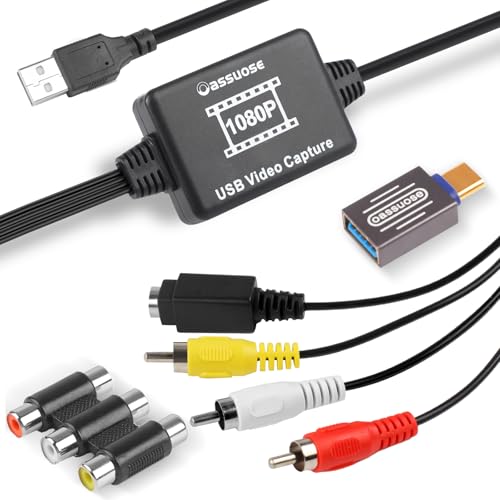
- RCA and S-Video input
- USB-A and USB-C output
- Up to 1080p/30fps capture
Best For: Digitizing VHS, DVD, and camcorder footage
Best Heavy-Duty Pick
VIXLW 4K HDMI Video Capture Card

- 4K/60Hz HDMI input
- 1080p/30Hz listed output
- Plug-and-play USB 2.0 design
Best For: HDMI streaming, gaming, and video recording
Best Budget Analog Pick
Portable USB AV/RCA Capture Card

- Composite RCA and S-Video support
- USB-powered operation
- Audio capture and image controls
Best For: Basic VCR and analog video transfers
Best for HDMI Streaming – 4K USB 3.0 HDMI Capture Card
This compact HDMI capture card is a strong option for shoppers comparing portable USB video adapters for gaming, streaming, recording, and online meetings. It accepts up to 4K@30Hz input and records up to 1080p at 60fps or 2K at 30fps through USB 3.0 or USB-C.
Best For: Gamers, streamers, and mobile recording setups using HDMI devices with Windows, macOS, Linux, or Android.
Pros:
- Supports 4K HDMI input with 1080p60 recording.
- Plug-and-play design requires no driver or external power.
- Compatible with consoles, cameras, OBS, Zoom, and other software.
- Compact aluminum-alloy body is easy to carry.
Cons:
- Recording output is limited to 2K30 or 1080p60 rather than 4K recording.
- Tablet use requires OTG support to be enabled.
With broad software and device compatibility, this is a practical portable USB video adapter for straightforward HDMI capture. Confirm your computer or tablet has the required USB connection and processing capability before buying.
Best for Car Displays – USB to CVBS Video Adapter
For shoppers seeking portable USB video adapters for an in-car setup, this adapter provides USB input and standard CVBS composite video output. It is designed to mirror video from a compatible car radio to an external monitor or screen.
Best For: Owners of compatible car radio systems, including SWTNVIN stereos, who need compact composite-video connectivity.
Pros:
- Converts USB video output to CVBS composite format.
- Simple plug-and-play connection with no external power plug.
- Small, lightweight design is convenient for storage and travel.
- Includes a stated 24-month after-sales service commitment in the product notes.
Cons:
- Compatibility is described for a wide range of car radios but specifically lists SWTNVIN stereo support.
- Outputs standard CVBS rather than a high-definition HDMI signal.
- A compatible composite video cable or display is required.
This is a specialized adapter rather than a general-purpose computer capture device. Verify that your car radio supports video output and that your display accepts CVBS before purchasing.
Best for Mobile Gaming – Hagibis HDMI Capture Card with 100W PD
This Hagibis model stands out among portable USB video adapters by combining HDMI capture with USB-A/USB-C connectivity and up to 100W PD charging. It can capture 4K@60Hz input while recording or streaming at up to 1080p60.
Best For: Mobile gaming, VR, streaming, and recording setups using laptops, tablets, phones, or devices such as Quest 3, Switch, Xbox, and PlayStation consoles.
Pros:
- Dual USB-A and USB-C interface supports varied host devices.
- Passes through up to 100W PD charging while in use.
- Supports 4K@60Hz input and 1080p@60Hz recording.
- Works without drivers or external power and supports common capture software.
Cons:
- Only HDMI input sources are supported.
- iPadOS devices need version 17 or higher.
- Some consoles require HDCP to be disabled.
The combination of charging and dual-interface connectivity makes this a flexible choice for portable gaming and streaming. Check your device’s HDMI, USB, iPadOS, and HDCP requirements for compatibility.
Best for VHS Digitizing – RCA to USB Video Capture Device
This RCA-to-USB device is one of the more specialized portable USB video adapters, converting composite RCA or S-Video signals into digital files. It is intended for previewing, recording, and archiving VHS footage on a computer.
Best For: Users digitizing VHS tapes or other analog video sources with Windows, macOS, Linux, or Android systems.
Pros:
- Accepts RCA CVBS composite and S-Video inputs.
- Supports up to 1920×1080@30Hz MJPEG capture.
- Works with OBS, PotPlayer, VLC, XSplit, and other software.
- Includes a 3.3-foot USB cable plus RCA and S-Video accessories.
Cons:
- Uses USB 2.0 rather than USB 3.0.
- Designed for analog RCA or S-Video sources, not HDMI devices.
- Recording quality depends on the original VHS or analog signal.
Its included cables and broad software support make it a practical archival tool for older media. Choose it when your source uses RCA or S-Video, and confirm that your operating system supports the intended capture software.
Best All-in-One Hub – 7-in-1 USB-C Video Adapter
If you need portable USB video adapters for a laptop workstation, this 7-in-1 USB-C hub combines 4K HDMI output with charging, USB ports, and SD/TF card access. It supports up to 4K at 30Hz, but the host USB-C port must support DisplayPort Alt Mode.
Best For: MacBook, Chromebook, and compatible USB-C laptop users who want display output plus everyday peripheral and memory-card connectivity.
Pros:
- Provides 4K HDMI mirroring or extended display output at up to 30Hz.
- Includes 100W USB-C PD charging, two USB-A ports, USB-C connectivity, and SD/TF readers.
- USB 3.0 supports transfers up to 5Gbps, with a compact 43g aluminum design.
- Plug-and-play operation supports several desktop and mobile operating systems.
Cons:
- HDMI video requires a compatible USB-C port with DP Alt Mode.
- The PD port is for charging rather than data transfer.
- Video output is limited to 4K at 30Hz.
This is a practical choice when one portable adapter needs to handle presentations, charging, USB accessories, and card-based photo or video workflows. Confirm your device’s USB-C video support before buying.
Best for Everyday Use – USB RCA Video Capture Adapter
Among portable USB video adapters, this capture device is designed for converting analog footage rather than connecting a modern monitor. It accepts RCA or S-Video sources from VHS, VCRs, camcorders, and similar equipment, then outputs USB video to a computer.
Best For: Users preserving VHS, Hi8, DV, or other analog recordings on Windows or Mac computers.
Pros:
- Converts RCA composite or S-Video sources to USB video.
- Captures video at up to 720P and records audio without requiring a separate sound card.
- Works with NTSC and PAL formats and includes controls for brightness, contrast, hue, and saturation.
- Requires no external power and is intended for plug-and-play use.
Cons:
- Requires separate acquisition software, such as OBS Studio, PotPlayer, or QuickTime Player.
- It is intended for analog capture, not HDMI monitor output or general-purpose display expansion.
- Compatibility and setup may vary between Windows and Mac systems.
This adapter makes sense for a straightforward home archiving project, especially if your source equipment still uses RCA or S-Video. Plan on installing capture software and following the included setup instructions.
Best for High-Speed USB-C Displays – 4K 60Hz USB-C Hub
This portable USB video adapter is suited to users who prioritize a sharper, smoother external display connection. The Selore hub provides one 4K at 60Hz video output alongside four 10Gbps USB-C data ports, though the host device must have a full-featured USB-C, Thunderbolt 3/4, or USB4 port.
Best For: Work, gaming, and file-heavy workflows that need 4K at 60Hz and fast USB-C data transfers from a compatible computer.
Pros:
- Supports one external display at up to 4K and 60Hz.
- Offers four USB-C data ports with transfer rates up to 10Gbps.
- 100W PD-in charging can provide up to 85W of continuous laptop power.
- Compact 50g aluminum construction is convenient for mobile setups.
Cons:
- Video requires a full-featured USB-C, Thunderbolt 3/4, or USB4 port.
- The 100W charging port requires a compatible charger, which is not included.
- Only one port supports 4K at 60Hz video output.
Choose this model when 4K smoothness and 10Gbps USB-C transfers matter more than card readers or USB-A ports. Check both the laptop’s port capabilities and monitor specifications before purchase.
Best for Analog Media – Oassuose VHS to Digital Converter
The Oassuose is a practical choice among portable USB video adapters for digitizing footage from VHS players, VCRs, DVD players, camcorders, and other RCA- or S-Video-equipped sources. It connects through USB-A or USB-C and outputs up to 1080p at 30 fps, though capture software is required.
Best For: Converting home videos and other analog recordings to computer files on Windows or Mac.
Pros:
- Supports RCA and S-Video input for a range of legacy video devices.
- Works with both USB-A and USB-C computer ports.
- Captures synchronized audio and video with support for up to 1080p/30fps output.
- Supports image controls including brightness, contrast, hue, and saturation.
Cons:
- Requires separate capture software, such as OBS Studio, PotPlayer, or QuickTime Player.
- Designed for analog inputs rather than HDMI sources.
If your priority is preserving VHS, DVD, or camcorder footage, the Oassuose offers broad source compatibility and flexible USB connectivity. Plan on installing compatible capture software before starting.
Best Heavy-Duty Pick – VIXLW 4K HDMI Video Capture Card
For HDMI-based setups, the VIXLW is one of the more versatile portable USB video adapters for streaming, recording, teaching, and video calls. It accepts 4K/60Hz HDMI input and outputs up to 1080p/30Hz over USB 2.0, with support for common capture software such as OBS.
Best For: Capturing camera or gaming HDMI video for live broadcasts, online meetings, and recording.
Pros:
- Accepts 4K/60Hz HDMI video input.
- Captures audio and video together for streaming or recording.
- Plug-and-play design requires no external power supply or complicated driver installation.
- Supports Windows, Mac OS, Linux, and Android according to the supplied specifications.
Cons:
- Maximum listed capture output is 1080p/30Hz.
- Uses USB 2.0, which may limit transfer bandwidth.
- The supplied listing identifies Windows as the platform, so compatibility should be checked for a specific setup.
The VIXLW makes sense when your source device outputs HDMI and you want a compact adapter for streaming or recording. Its 4K input support is useful, but the recorded output is listed at 1080p/30Hz.
Best Budget Analog Pick – Portable USB AV/RCA Capture Card
HDSUNWSTD Portable USB 2.0 AV/RCA Composite and S-Video Audio Video Capture Card Adapter VHS DVD
Check Price On AmazonThis compact HDSUNWSTD adapter is a straightforward option among portable USB video adapters for transferring video from a VCR or another analog source to a Mac or PC. Its USB 2.0 connection needs no separate power supply and supports composite RCA and S-Video capture.
Best For: Basic home-video capture from composite or S-Video equipment.
Pros:
- Supports composite RCA and S-Video analog connections.
- USB 2.0 interface operates without an additional power source.
- Can capture audio and transfer recordings to a computer.
- Provides brightness, contrast, hue, and saturation controls.
Cons:
- The supplied notes do not specify a maximum capture resolution.
- USB 2.0 is an older connection standard.
- Best suited to analog sources rather than HDMI equipment.
Choose this adapter if you need a simple, low-complexity way to move composite or S-Video recordings onto a computer. It covers the essential analog connections, while users seeking explicit 1080p or HDMI support should consider another model.
How We Picked These Portable USB Video Adapters
We grouped the selections by their primary function rather than treating every USB video device as interchangeable. HDMI capture cards suit cameras, consoles, and streaming setups; RCA, composite, and S-Video adapters are intended for older media; and USB-C hubs focus on display expansion and peripheral connectivity. We also considered advertised resolution, frame rate, connector type, power delivery, physical size, and whether the adapter is likely to fit a portable workflow.
Specifications can vary by host computer, source device, operating system, and capture software. A listed 4K input does not always mean 4K recording, so verify both pass-through and capture limits before buying.
Quick Comparison
| Primary use | Look for | Best connection type |
|---|---|---|
| Game or camera streaming | HDMI input, 1080p60 capture, low-latency pass-through | USB 3.0 or USB-C |
| VHS and camcorder conversion | RCA or S-Video input, stereo audio, bundled or compatible software | USB-A or USB-C |
| Adding a monitor and ports | HDMI output, USB data ports, SD readers, PD charging | USB-C |
| Car or specialty video output | Correct CVBS format and destination compatibility | USB-A or proprietary setup |
Key Buying Factors for Portable USB Video Adapters
Match the Signal Direction
Capture cards generally move video from HDMI, RCA, or S-Video into a computer. USB-C hubs usually send video from a computer to an HDMI display. They are not automatically interchangeable. Check the source, destination, and direction of the signal before ordering.
Check Resolution and Frame Rate
For smooth gameplay or camera capture, 1080p at 60 frames per second is a useful target. Some adapters accept a 4K signal but record at 1080p, while others provide 4K pass-through only. Older analog sources will not gain true HD quality through conversion.
Confirm Ports, Power, and Compatibility
USB 3.0 is preferable for higher-bandwidth capture, while USB 2.0 models can be adequate for VHS and composite footage. USB-C hubs with 100W power delivery may help keep a laptop charged, but the computer, charger, cable, and display must all support the required standards. Also confirm compatibility with Windows, macOS, ChromeOS, Linux, OBS, or the software you plan to use.
Prioritize Portability and Control
A short cable and compact enclosure are convenient for travel, but a longer attached cable may reduce strain on crowded ports. Physical audio controls, indicator lights, pass-through support, and reliable heat management can matter more than headline resolution in regular use.
Who Should Buy Which Portable USB Video Adapters?
Choose an HDMI capture card if you stream games, record a camera feed, teach from a console, or need live video in OBS or similar software. Favor USB 3.0 or USB-C and 1080p60 support for responsive footage.
Choose an RCA, composite, or S-Video converter if your priority is digitizing VHS tapes, DVDs, MiniDV footage, or older camcorder recordings. Focus on input compatibility, audio handling, and software support rather than 4K claims.
Choose a USB-C hub if you need to connect an HDMI monitor, storage, memory cards, and USB accessories through one laptop port. Verify display support and PD limits for your exact computer.
Choose a specialty adapter for car-video or other dedicated equipment only after confirming the required CVBS standard, connector layout, and output compatibility. These products are less universal than ordinary capture devices.