The right Power over Ethernet switch can simplify a small-business network by sending data and power to access points, IP cameras, VoIP phones, and other devices through one Ethernet cable.
We compared 10 practical options across port count, PoE capacity, management features, uplinks, installation flexibility, and expansion potential to help you choose a switch that fits your current network without limiting future growth.
Best 10 PoE Network Switches for Small Businesses Picks for 2026
Best Managed Capacity
TP-Link TL-SG1016PE 16-Port PoE+ Switch

- 8 PoE+ ports plus 8 non-PoE Gigabit ports
- 150W total PoE budget with auto-recovery
- VLAN, QoS, IGMP, and LAG management features
Best For: Small businesses needing flexible 16-port connectivity
Best Plug-and-Play Pick
NETGEAR GS108PP 8-Port PoE+ Switch

- Eight Gigabit PoE+ ports
- 123W total PoE power budget
- Fanless and supports desktop, wall, or rack mounting
Best For: Simple small-office installations without switch management
Best for Surveillance Flexibility
Goalake 8-Port Managed PoE Switch

- 8 PoE ports, 2 Gigabit uplinks, and 120W budget
- App/web management with VLAN and QoS
- 250m mode and fanless metal housing
Best For: Small security and access-point deployments
Best for Larger Deployments
NETGEAR GS324TP 24-Port PoE+ Switch
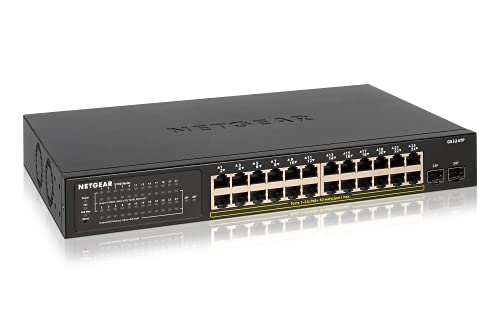
- 24 PoE+ Gigabit ports with 190W budget
- Two 1G SFP ports for uplinks
- Smart managed controls with SNMP support
Best For: Growing offices and larger PoE installations
Best for Easy Setup
TP-Link TL-SG1008P 8-Port PoE+ Switch

- Four Gigabit PoE+ ports
- 64W total PoE budget
- Fanless metal plug-and-play design
Best For: Small offices needing quiet, simple PoE connectivity
Best Managed Compact Option
EnGenius Fit EWS2910P-FIT 8-Port Switch
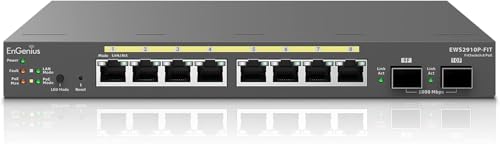
- Eight Gigabit PoE ports
- Layer 2+ management features
- Two SFP uplink ports
Best For: Growing small networks needing management and fiber options
Best High-Capacity Choice
TP-Link TL-SG1428PE 24-Port PoE+ Switch

- Twenty-four Gigabit PoE+ ports
- 250W total PoE budget
- VLANs, SFP slots, and Auto Recovery
Best For: Growing offices with many powered network devices
Flexible Office Expansion
Linksys LGS116P 16-Port PoE+ Switch

- 16 Gigabit ports with 8 PoE+ ports
- 80W dedicated PoE+ power budget
- Metal desktop or wall-mount enclosure
Best For: Small offices needing extra ports and moderate PoE+ capacity
Managed Business Backbone
NETGEAR GS728TP 28-Port PoE+ Switch

- 24 PoE+ Gigabit ports with 190W budget
- Four 1G SFP ports for uplinks
- Smart managed control and rackmount support
Best For: Growing businesses needing managed networking and higher PoE capacity
Quiet Compact Value
D-Link DGS-1008P 8-Port PoE+ Switch

- Eight Gigabit ports with 4 PoE ports
- Fanless, quiet metal desktop design
- Plug-and-play setup for simple deployments
Best For: Small offices powering a few PoE devices
Best Managed Capacity – TP-Link TL-SG1016PE 16-Port PoE+ Switch
For small businesses that need room for both powered devices and standard wired connections, the TP-Link TL-SG1016PE is a practical choice among PoE network switches for small businesses. It combines eight PoE+ Gigabit ports with eight additional Gigabit ports, plus web-based management, VLAN support, QoS, IGMP snooping, and link aggregation.
Best For: Small offices, surveillance installations, and growing networks needing 16 total ports with managed features.
Pros:
- Eight PoE+ ports provide up to 30W each within a 150W total budget.
- Eight additional non-PoE Gigabit ports expand connectivity for computers, servers, and other network devices.
- Supports VLAN, QoS, IGMP snooping, and LAG for more controlled network traffic.
- Auto-recovery can detect and reboot unresponsive PoE devices.
Cons:
- The 150W budget may require port-priority management as more devices are added.
- Its 16-port metal design is larger and heavier than compact eight-port alternatives.
The TL-SG1016PE is a strong middle-ground option when a small business needs more ports and management controls than a basic plug-and-play switch. Its power-priority behavior is worth considering if many PoE devices will run simultaneously.
Best Plug-and-Play Pick – NETGEAR GS108PP 8-Port PoE+ Switch
The NETGEAR GS108PP keeps setup simple for small offices that do not need switch configuration. With eight Gigabit PoE+ ports and a 123W power budget, it is one of the more straightforward PoE network switches for small businesses that want to connect powered devices without installing software.
Best For: Small offices, home businesses, and simple camera or access-point deployments where unmanaged operation is preferred.
Pros:
- All eight ports support Gigabit Ethernet and PoE+.
- A 123W total power budget supports power-hungry connected devices.
- Plug-and-play setup requires no software or configuration.
- Fanless, energy-efficient design supports quiet operation and desktop, wall, or rack placement.
Cons:
- Unmanaged operation does not provide VLAN, QoS, or other configuration controls.
- The eight-port layout offers less expansion room than larger switches.
Choose the GS108PP when ease of installation matters more than network customization. Its fanless metal design and flexible mounting options make it convenient for a small deployment, while the 123W budget accommodates several PoE+ devices.
Best for Surveillance Flexibility – Goalake 8-Port Managed PoE Switch
The Goalake 8-port switch targets small businesses and security installations that need more control than an unmanaged model. It provides eight Gigabit PoE ports, two dedicated Gigabit uplinks, a 120W power budget, app and web management, VLAN and QoS features, and an ultra-long-range mode for compatible extended cable runs.
Best For: Small-business surveillance systems, wireless access points, and mixed networks requiring VLANs, traffic controls, and two uplinks.
Pros:
- Eight 802.3af/at PoE ports provide up to 30W per port within a 120W total budget.
- Two dedicated Gigabit uplinks connect an NVR or router without using the PoE ports.
- VLAN, QoS, port mirroring, and storm control provide useful management options.
- Fanless metal housing and listed short-circuit, overcurrent, overvoltage, and 4KV lightning protection features suit monitoring setups.
Cons:
- The 120W power budget is lower than the TP-Link and NETGEAR larger-capacity options in this roundup.
- Advanced features may require more setup than a fully unmanaged switch.
- Ultra-long-range operation depends on the installation and connected devices.
For a small camera or access-point network, the Goalake offers a useful blend of management and installation flexibility. Its two uplinks and surveillance-oriented features are particularly valuable when an NVR or long cable runs are part of the plan.
Best for Larger Deployments – NETGEAR GS324TP 24-Port PoE+ Switch
The NETGEAR GS324TP is built for small businesses that have outgrown compact switches. It offers 24 Gigabit PoE+ ports, a 190W total power budget, two 1G SFP ports, and smart managed controls, making it a strong higher-capacity choice among PoE network switches for small businesses.
Best For: Growing offices, larger camera systems, and networks needing many PoE connections plus SFP uplink options.
Pros:
- Twenty-four PoE+ Gigabit ports provide substantial connection capacity.
- The 190W power budget supports multiple powered endpoints.
- Two 1G SFP ports add fiber-capable uplink options.
- Smart software supports managed setup, access control, and SNMP/NMS 300 management.
Cons:
- Its larger 26-port format may be excessive for very small installations.
- The 190W budget still requires attention to total device power demands.
- Managed features can involve more setup than a plug-and-play switch.
The GS324TP makes sense when port count and future expansion are priorities. Its rack-mountable design, SFP ports, and managed software give a growing small business more room to organize and control its network than an eight-port switch.
Best for Easy Setup – TP-Link TL-SG1008P 8-Port PoE+ Switch
For small businesses that need straightforward connectivity, the TP-Link TL-SG1008P is one of the more practical PoE network switches for small businesses. It provides four Gigabit PoE+ ports with a 64W total budget, plus four additional Gigabit ports, in a fanless metal enclosure.
Best For: Small offices, security cameras, access points, and VoIP devices where simple setup and quiet operation matter.
Pros:
- Four 802.3at/af PoE+ ports support up to 30W per port.
- 64W total PoE budget with eight Gigabit RJ45 ports.
- Plug-and-play setup, fanless operation, and a sturdy metal case.
- Includes QoS and IGMP Snooping for prioritizing voice, video, and multicast traffic.
Cons:
- Only four ports provide PoE power.
- Unmanaged design offers less control than a managed switch.
- Its 64W budget may be limiting for larger deployments.
The TL-SG1008P is a sensible entry-level choice when you want reliable Gigabit networking without configuration work. Choose a larger managed model if you need VLANs, extensive monitoring, or more powered devices.
Best Managed Compact Option – EnGenius Fit EWS2910P-FIT 8-Port Switch
The EnGenius Fit EWS2910P-FIT adds Layer 2+ management to a compact eight-port design, making it a capable option among PoE network switches for small businesses. Its eight Gigabit PoE ports share a 55W budget, while two SFP uplinks support fiber backbone connections.
Best For: Small businesses that need VLANs, QoS, ACLs, remote troubleshooting, and room for a fiber uplink.
Pros:
- Eight Gigabit PoE ports with intelligent 55W power allocation.
- Layer 2+ features include VLAN, QoS, ACLs, and spanning tree protocols.
- Two SFP uplinks provide fiber connectivity options.
- EnGenius Fit supports device registration and remote troubleshooting.
Cons:
- Its 55W PoE budget is lower than some larger switches.
- Management features may be more than needed for a basic plug-and-play network.
- The listed case material is plastic.
This switch is a strong middle ground for businesses that have outgrown unmanaged hardware but do not need a large port count. Its management tools and SFP uplinks make it particularly useful for a growing, segmented network.
Best High-Capacity Choice – TP-Link TL-SG1428PE 24-Port PoE+ Switch
For businesses with many powered devices, the TP-Link TL-SG1428PE offers substantial capacity in a rack-mountable format. It combines 24 Gigabit PoE+ ports, a 250W power budget, two additional Gigabit ports, and two SFP slots, making it one of the more expandable PoE network switches for small businesses.
Best For: Offices, retail locations, and surveillance deployments with numerous cameras, access points, or VoIP phones.
Pros:
- Twenty-four PoE+ ports provide up to 30W per port.
- 250W total PoE budget supports larger device deployments.
- Web-based management includes VLAN features, QoS, and network monitoring.
- Auto Recovery can detect and reboot dropped or unresponsive PoE devices.
Cons:
- Its larger rack-mountable form factor is less suitable for small desktop setups.
- Auto Recovery requires configuration.
- It may be more capacity than a very small office currently needs.
The TL-SG1428PE is the best fit when port count and PoE capacity take priority. Its management features, SFP slots, and automatic recovery also provide useful flexibility for a network expected to expand.
Flexible Office Expansion – Linksys LGS116P 16-Port PoE+ Switch
For small businesses needing extra wired capacity, the Linksys LGS116P is one of the more flexible PoE network switches for small businesses. It provides 16 Gigabit ports, including eight PoE+ ports, with a dedicated 80W power budget for compatible cameras, phones, or access points.
Best For: Small offices that need several wired connections and moderate PoE+ capacity in a desktop- or wall-mounted switch.
Pros:
- 16 Gigabit ports provide room for connected PCs and network devices.
- Eight PoE+ ports support streamlined power and data installation.
- 80W PoE+ budget and 32Gbps non-blocking bandwidth support everyday business traffic.
- Metal enclosure, desktop/wall-mount flexibility, and limited lifetime warranty add practical durability.
Cons:
- Unmanaged design does not provide advanced configuration or monitoring controls.
- Only the first eight ports provide PoE+ power.
The LGS116P is a practical middle ground for businesses that want more ports than a compact switch offers without moving to managed networking. Its 80W budget is suitable for moderate deployments, but larger PoE installations may need a higher-capacity model.
Managed Business Backbone – NETGEAR GS728TP 28-Port PoE+ Switch
The NETGEAR GS728TP is a strong option among PoE network switches for small businesses that need more capacity and management control. It combines 24 Gigabit PoE+ ports, a 190W power budget, four 1G SFP ports, and smart managed features for more structured network administration.
Best For: Growing offices, surveillance deployments, and businesses that need managed access, monitoring, and substantial PoE+ capacity.
Pros:
- 24 PoE+ Gigabit ports provide broad support for powered devices.
- 190W total PoE budget accommodates larger device deployments than basic switches.
- Four 1G SFP ports support compatible fiber or uplink connections.
- Desktop or rackmount installation, energy-efficient operation, and limited lifetime protection improve deployment flexibility.
Cons:
- Managed features may be more involved than a small office needs.
- Its 8.3-pound, 28-port design requires more space than compact desktop switches.
Choose the GS728TP when network control and PoE scale matter more than minimal setup. Its managed interface and SFP connectivity make it better suited to a growing infrastructure, while the 190W budget provides useful headroom for multiple powered endpoints.
Quiet Compact Value – D-Link DGS-1008P 8-Port PoE+ Switch
The D-Link DGS-1008P is a compact, quiet choice for small businesses seeking straightforward PoE network switches for small businesses. Its eight Gigabit ports include four PoE-capable ports, while the fanless metal design keeps installation simple and unobtrusive.
Best For: Small offices, reception areas, and compact installations powering a few IP cameras, phones, or wireless access points.
Pros:
- Plug-and-play unmanaged setup requires no complex configuration.
- Four PoE ports support up to 30W per port for compatible devices.
- Compact fanless design delivers quiet operation in office environments.
- Metal housing and shielded ports support a sturdy desktop installation.
Cons:
- Only eight total ports are available, limiting expansion.
- Unmanaged operation lacks advanced network controls.
- Four ports provide PoE, so additional connected devices need separate power.
The DGS-1008P fits smaller deployments where low noise and easy installation are priorities. It offers Gigabit connectivity and useful PoE support without the size or configuration demands of a managed switch, though its port count is best suited to modest networks.
How We Picked the Best PoE Network Switches for Small Businesses
We focused on switches that suit offices, retail locations, small warehouses, security installations, and home-based businesses. The comparison considers total PoE power budget, number of powered ports, Gigabit performance, management options, uplink flexibility, physical design, and setup requirements. Models range from unmanaged plug-and-play switches for straightforward deployments to smart and managed options with VLANs, monitoring, traffic controls, and remote administration.
Power capacity matters as much as port count. A switch with eight PoE ports may not be able to run eight high-draw cameras or wireless access points at full load, so the listed budget should be compared with the expected wattage of every connected device.
Quick Comparison
- Best for simple expansion: Unmanaged 8- or 16-port switches are easy to install and require little configuration.
- Best for growing offices: Smart-managed models add VLANs, traffic controls, diagnostics, and better visibility.
- Best for larger deployments: 24-port managed switches provide more device capacity and are generally better suited to racks and structured cabling.
- Best for surveillance: Prioritize sufficient PoE wattage, reliable Gigabit switching, and easy access to ports and status indicators.
Key Buying Factors for PoE Network Switches for Small Businesses
Port Count and Expansion
Count current wired devices, then leave room for additions. Eight ports can work for a small camera or phone installation, while 16- and 24-port models are safer choices for offices with multiple access points, printers, cameras, and workstations.
PoE Standard and Power Budget
PoE+ supports more demanding devices than basic PoE, but the total budget still limits simultaneous output. Check each camera, access point, phone, or intercom’s required wattage and add a reasonable growth margin.
Management and Network Controls
Unmanaged switches are appropriate when devices simply need connectivity. Choose smart or managed hardware if you need VLAN separation, guest Wi-Fi isolation, QoS for voice traffic, monitoring, link aggregation, or centralized administration.
Uplinks, Installation, and Noise
Gigabit uplinks prevent the switch from becoming a bottleneck. SFP ports can support fiber connections between network areas. For desks or quiet offices, a fanless compact design may be preferable; rackmount compatibility is more useful in wiring closets.
Who Should Buy Which PoE Network Switches for Small Businesses?
Choose an unmanaged 8-port model for a small office, home business, or basic camera installation where simplicity is the priority. Choose a 16-port option when you need more connections but do not require advanced network administration. Choose an easy-smart switch for a growing business that wants VLANs and basic oversight without the complexity of enterprise configuration. Choose a managed 24- or 26-port switch for offices, retail sites, and surveillance systems with many powered devices, multiple network segments, or plans for future expansion.
Before buying, verify the switch’s PoE budget, port layout, uplink type, mounting needs, and management features against your equipment. That checklist will usually matter more than choosing the highest advertised port count.