Commercial-grade PoE network switches simplify business installations by carrying both network data and electrical power over Ethernet. The right model can reduce cabling, support demanding devices, and provide the management features needed for reliable growth.
This roundup compares 10 options ranging from compact managed switches to rack-mountable models with high port counts, PoE budgets, and fast uplinks. Use the guide below to narrow your choice by deployment size, monitoring needs, and network infrastructure.
Best 10 Commercial-Grade PoE Network Switches Picks for 2026
Best for UniFi-Centric Deployments

- 48 Gigabit PoE+ ports
- Four 10G SFP+ uplinks
- Managed Layer 2/3 features
Best For: UniFi-based offices and larger PoE deployments
Best for Fortinet Security Fabric

- 24 PoE ports and four SFP+ ports
- FortiLink and FortiGate management
- Rack-mountable L2+ design
Best For: Fortinet-managed offices and SD-Branch networks
Best for High-Power UniFi Access
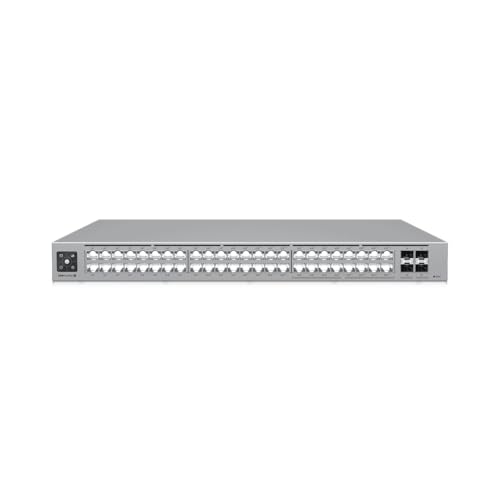
- 16 2.5 GbE ports
- PoE++ and 720W availability
- Four 10G SFP+ ports
Best For: UniFi networks with multi-gigabit and PoE++ devices
Best for Established Cisco Networks

- 24 manageable Gigabit PoE ports
- Four expansion slots
- Rack-mountable or desktop design
Best For: Cisco-based offices needing 24-port PoE connectivity
Premium 2.5G PoE Flexibility

- Four 2.5 GbE PoE++ ports
- Two 10G SFP+ uplink ports
- Fanless, flexible mounting design
Best For: Mixed-speed small business networks and access points
High-Capacity Smart PoE Value
TP-Link TL-SG1428PE 24-Port PoE+ Switch

- Twenty-four Gigabit PoE+ ports
- 250W total PoE budget
- VLAN and PoE recovery features
Best For: Multi-device office and surveillance deployments
Layer 3 UniFi Network Expansion

- Twenty-four-port Layer 3 switch
- PoE connectivity for compatible devices
- Rack-friendly 1U-height design
Best For: UniFi-oriented offices needing 24-port capacity
Reliable Plug-and-Play Pick

- 24 Gigabit ports with 16 PoE+ ports
- 190W PoE budget with dynamic allocation
- Fanless desktop or rack-mount design
Best For: Small offices and installations needing simple, high-port-count PoE
Compact Managed Powerhouse

- Managed Layer 3 switching
- Six PoE+ and two PoE++ ports
- Two 10G SFP+ ports and 120W PoE
Best For: Compact networks needing managed features and fast uplinks
Streamlined Managed Choice

- 16-port managed Ethernet switch
- Rack-oriented 1.7-inch height
- 6.17-pound installation profile
Best For: Structured installations needing a 16-port managed switch
Best for UniFi-Centric Deployments – UniFi Pro 48-Port PoE+ Switch
For organizations building around UniFi, this commercial-grade PoE network switch combines 48 Gigabit PoE+ ports with four 10G SFP+ uplinks. Its managed Layer 2/3 feature set and centralized UniFi Network management make it well suited to larger deployments of access points, cameras, and VoIP phones.
Best For: UniFi-based offices, surveillance systems, and network backbones needing many PoE ports and fast uplinks.
Pros:
- 48 Gigabit RJ-45 ports support IEEE 802.3af/at PoE and PoE+ devices.
- Four SFP+ 10G uplinks, 176 Gbps switching capacity, and 88 Mpps throughput support high-performance connectivity.
- Managed Layer 2/3 features include VLANs, spanning tree, 802.1x, RADIUS, DHCP, and port mirroring.
- 1U rack-mountable design integrates with the UniFi Network application.
Cons:
- Its strongest management experience depends on the UniFi ecosystem.
- The 48-port configuration may be more than smaller installations require.
- Operating temperature is listed as -5 to 40°C.
This is a strong choice when port density, 10G uplinks, and UniFi integration matter more than keeping the installation compact or ecosystem-neutral.
Best for Fortinet Security Fabric – FortiSwitch 124F-FPOE
The FortiSwitch 124F-FPOE is a commercial-grade PoE network switch designed for businesses that want network access tightly connected to Fortinet security management. It provides 24 PoE ports and four SFP+ interfaces in a rack-mountable L2+ platform.
Best For: Fortinet environments, SD-Branch deployments, and businesses managing access through FortiGate.
Pros:
- Provides 24 PoE ports plus four SFP+ interfaces.
- Integrates with the Fortinet Security Fabric through FortiLink.
- Can be managed from the FortiGate interface for centralized visibility and control.
- Rack-mountable design suits business network installations.
Cons:
- Its key management advantages are tied to the Fortinet ecosystem.
- It has fewer PoE ports than 48-port alternatives.
- The supplied listing states that no warranty is included.
Choose this model when FortiGate integration and centralized security-aware management are priorities. It is especially compelling for organizations already using Fortinet equipment.
Best for High-Power UniFi Access – USW-Pro-Max-48-PoE
For modern UniFi installations with demanding endpoints, the USW-Pro-Max-48-PoE stands out among commercial-grade PoE network switches with 2.5 GbE connectivity, PoE++ output, and 720W of total PoE availability. Its Etherlighting ports also provide visual indicators for port location, link speed, and native VLAN or network.
Best For: UniFi networks using higher-speed endpoints, PoE++ devices, and a large number of connected clients.
Pros:
- 48-port Layer 3 switch with 16 2.5 GbE ports.
- Supports both PoE+ and PoE++ across the port layout.
- Offers 720W total PoE availability and DC power backup readiness.
- Four 10G SFP+ ports and UniFi Network management support expansion and centralized control.
Cons:
- Management requires UniFi Network 8.0.24 or later.
- The feature set may exceed the needs of basic Gigabit-only deployments.
- The supplied listing specifies a six-month manufacturer warranty.
This is the better UniFi option when newer multi-gigabit devices and PoE++ power demands justify the upgrade. It also adds useful at-a-glance port lighting for busy installations.
Best for Established Cisco Networks – Catalyst 2960X-24PS-L
Cisco Catalyst WS-C2960X-24PS-L 24 Port Ethernet Switch with 370 Watt PoE, black (677W967)
Check Price On AmazonThe Cisco Catalyst WS-C2960X-24PS-L is a commercial-grade PoE network switch for organizations that prefer a familiar, rack-mountable Cisco platform. It provides 24 manageable Gigabit Ethernet ports with PoE and four expansion slots for established office or infrastructure deployments.
Best For: Cisco-based businesses needing a dependable 24-port PoE switch for desktop and network equipment.
Pros:
- 24 manageable 10/100/1000 Ethernet ports support PoE devices.
- Includes four expansion slots with PoE and SFP interfaces listed.
- Rack-mountable or desktop form factor supports flexible installation.
- Metal case and Enhanced Limited Lifetime Warranty are listed.
Cons:
- It offers fewer ports than the 48-port models in this roundup.
- The supplied specifications list Gigabit data transfer rather than multi-gigabit access.
- As an established Catalyst model, it may be less suitable for deployments seeking newer 2.5 GbE features.
This Catalyst is a practical fit for Cisco-oriented environments that need straightforward 24-port PoE connectivity. Consider it when compatibility with an existing Cisco installation is more important than newer multi-gigabit features.
Premium 2.5G PoE Flexibility – Ubiquiti USW-Pro-Max-16-PoE
For buyers seeking commercial-grade PoE network switches in a compact format, the Ubiquiti USW-Pro-Max-16-PoE combines 2.5 GbE connectivity, PoE++ support, Layer 3 functionality, and silent fanless cooling. Its four 2.5 GbE PoE++ ports, twelve Gigabit PoE+ ports, and two 10G SFP+ ports suit mixed-speed networks.
Best For: Small business networks, wireless access points, security cameras, and installations needing flexible desktop, wall, or rack mounting.
Pros:
- Four 2.5 GbE PoE++ ports support newer high-performance devices.
- Twelve additional Gigabit PoE+ ports provide broad device compatibility.
- Two 10G SFP+ ports support high-speed uplinks.
- Fanless cooling and versatile mounting simplify quieter installations.
Cons:
- The 16-port layout offers less device capacity than 24-port alternatives.
- Its 180W PoE availability may require careful power planning for many connected devices.
This is a strong choice when faster edge connections and flexible installation matter more than maximum port count. Etherlighting indicators add practical visual feedback for port location, link speed, and native VLAN or network information.
High-Capacity Smart PoE Value – TP-Link TL-SG1428PE 24-Port PoE+ Switch
The TP-Link TL-SG1428PE is a practical commercial-grade PoE network switch for deployments that need many Gigabit-powered endpoints. It provides 24 PoE+ ports with up to 30W per port, a 250W total PoE budget, two non-PoE Gigabit ports, and two SFP slots.
Best For: Offices, surveillance systems, and networks with numerous PoE cameras, access points, or other 802.3af/at devices.
Pros:
- Twenty-four PoE+ ports offer substantial endpoint capacity.
- Up to 30W per port and a 250W total budget support a broad range of devices.
- Web-based management includes VLAN features for traffic segmentation.
- PoE Auto Recovery can detect and reboot dropped or unresponsive powered devices when configured.
Cons:
- All copper ports are limited to Gigabit speeds.
- PoE Auto Recovery requires configuration rather than operating as an entirely hands-off feature.
Choose this model when port density and straightforward management are priorities. Its easy setup, SFP expansion slots, VLAN tools, and three-year warranty make it a practical fit for growing wired and PoE installations.
Layer 3 UniFi Network Expansion – Ubiquiti USW-Pro-24-POE
The Ubiquiti USW-Pro-24-POE is a 24-port Layer 3 switch aimed at structured UniFi installations and other commercial-grade PoE network switches setups. Its supplied specifications identify PoE connectivity, a 12 Gbps data transfer rate, a 1U-height form factor, and a white chassis suited to rack-based network equipment.
Best For: UniFi-oriented offices and structured networks that need a 24-port Layer 3 PoE switch.
Pros:
- Twenty-four-port design provides useful capacity for expanding networks.
- Layer 3 switching supports more advanced network architecture.
- Rack-friendly dimensions fit a standard 1U installation profile.
- PoE connectivity can simplify powering compatible network devices.
Cons:
- The supplied notes do not specify the PoE budget or per-port power limit.
- The listed specifications provide limited detail about uplink interfaces and management features.
This model makes the most sense for buyers already building around Ubiquiti equipment and who value 24-port capacity with Layer 3 capability. Confirm power-budget and uplink requirements before purchase because those details are not provided in the supplied specifications.
Reliable Plug-and-Play Pick – NETGEAR GS324P
The NETGEAR GS324P is a practical choice among commercial-grade PoE network switches when you need plenty of Gigabit ports without a complex setup. It provides 24 total ports, including 16 PoE+ ports and a 190W power budget, in a metal enclosure that can sit on a desk or mount in a rack.
Best For: Small businesses, offices, surveillance installations, and other networks needing multiple PoE devices with simple unmanaged operation.
Pros:
- 24 Gigabit Ethernet ports, including 16 PoE+ ports.
- 190W total PoE budget with dynamic power allocation.
- Fanless, energy-efficient design with desktop or rack-mount flexibility.
- Plug-and-play installation requires no software or configuration.
Cons:
- Unmanaged design does not provide advanced network controls.
- Only 16 of the 24 ports provide PoE+ power.
Choose the GS324P if dependable capacity and easy deployment matter more than VLANs or other managed features. Its 190W budget is useful for powering several compatible devices, while the silent fanless design suits office environments.
Compact Managed Powerhouse – Ubiquiti USW-Pro-8-PoE
The Ubiquiti USW-Pro-8-PoE is a compact option for buyers comparing commercial-grade PoE network switches with managed Layer 3 functionality. It combines six GbE PoE+ ports, two GbE PoE++ ports, two 10G SFP+ ports, and a 120W total PoE availability.
Best For: Compact networks that need managed Layer 3 switching, faster uplink options, and a mix of PoE+ and PoE++ connections.
Pros:
- Managed Layer 3 switch for more advanced network control.
- Six GbE PoE+ ports and two GbE PoE++ ports.
- Two 10G SFP+ ports support high-speed connectivity.
- 120W total PoE availability in an eight-port format.
Cons:
- Eight Ethernet ports provide less endpoint capacity than larger switches.
- Its 120W PoE availability is lower than the NETGEAR model listed here.
- The supplied specifications do not detail included management software or mounting accessories.
This Ubiquiti model is best when advanced switching capability and high-speed SFP+ connectivity are more important than a large number of copper ports. Its PoE++ ports also add flexibility for compatible higher-power devices.
Streamlined Managed Choice – Ubiquiti USW-16-POE
The Ubiquiti USW-16-POE is a straightforward managed option for networks that need more endpoint capacity than a compact eight-port switch. With 16 ports and a rack-friendly 1.7-inch height, it fits naturally into installations where organized equipment placement is a priority.
Best For: Small business networks and structured installations seeking a 16-port managed Ethernet switch in a rack-oriented form factor.
Pros:
- Provides 16 Ethernet ports for connected devices.
- Managed switching supports more control than an unmanaged model.
- 1.7-inch height suits rack-based installations.
- Listed dimensions and 6.17-pound weight help with equipment planning.
Cons:
- The supplied notes do not specify the PoE power budget or port-level PoE details.
- The supplied information does not list data-transfer speed or uplink specifications.
The USW-16-POE is worth considering when a 16-port managed Ubiquiti switch fits your installation plan. Because the supplied specifications omit important PoE and uplink details, verify those requirements before purchasing for a power-intensive deployment.
How We Picked the Best Commercial-Grade PoE Network Switches
We selected these switches based on the capabilities that matter most in business and professional installations: port count, PoE and PoE+ support, total power budget, management features, uplink capacity, rack-mounting options, and suitability for cameras, wireless access points, VoIP phones, and other powered devices. The list includes managed, smart-managed, and unmanaged designs so buyers can match the switch to their network expertise and operational requirements.
Before buying, verify the exact hardware revision, included mounting accessories, warranty terms, and compatibility with your existing controller or network-management platform.
Quick Comparison
| Best For | Recommended Type | What to Prioritize |
|---|---|---|
| Large offices and surveillance systems | 24- or 48-port managed PoE+ | High power budget, VLANs, and 10Gb uplinks |
| Growing small businesses | Smart-managed PoE switch | Simple configuration, QoS, and port monitoring |
| Small deployments | 8- or 16-port managed PoE switch | Compact design, silent operation, and adequate PoE capacity |
| Basic plug-and-play installations | Unmanaged PoE switch | Port count, power budget, and installation flexibility |
Key Buying Factors for Commercial-Grade PoE Network Switches
PoE Standard and Power Budget
PoE+ support is important for many modern access points, pan-tilt-zoom cameras, and higher-power devices. Add the wattage requirements of every planned device and leave reserve capacity for startup loads and future expansion. A switch with many PoE ports may still be unsuitable if its total power budget is too low.
Management and Network Control
Managed switches provide VLANs, traffic prioritization, port statistics, link controls, and troubleshooting tools. These features are valuable for separating guest, office, voice, and surveillance traffic. Smart-managed models offer a practical middle ground, while unmanaged switches are best when no configuration or monitoring is required.
Uplinks, Capacity, and Installation
Gigabit access ports are suitable for most endpoints, but SFP or SFP+ uplinks can prevent bottlenecks between switches, servers, and storage. Check rack depth, mounting hardware, cooling, noise, and power requirements before installing a unit in a cabinet or equipment closet.
Who Should Buy Which Commercial-Grade PoE Network Switches?
Choose a 24- or 48-port managed model for larger offices, multi-camera systems, or networks expected to expand. Choose a compact 8- or 16-port managed switch for a branch office, small studio, retail location, or dedicated access-point installation. Smart-managed TP-Link-style designs suit buyers who want basic VLAN and traffic controls without complex administration. An unmanaged NETGEAR-style switch is appropriate for straightforward installations where devices simply need dependable connectivity and PoE. Buyers already invested in UniFi or Fortinet ecosystems should favor compatible switches to centralize monitoring and configuration.