The best compact PoE network switches simplify installations by sending network data and electrical power through one Ethernet cable. That makes them useful for security cameras, wireless access points, VoIP phones, and other devices installed away from a wall outlet.
We selected 10 options spanning five- to 10-port designs, unmanaged and easy-smart models, Gigabit and 2.5Gbps connectivity, and specialized industrial hardware. Use the guide below to match port count, PoE capacity, uplink speed, and management features to your network.
Best 10 Compact PoE Network Switches Picks for 2026
Quiet Desktop Pick
D-Link 8-Port Gigabit PoE+ Switch

- Four PoE+ ports with a 68W total budget
- Eight Gigabit ports for fast wired connections
- Fanless metal design with plug-and-play setup
Best For: Quiet home-office and small-device PoE networks
Small Office Value
TRENDnet 5-Port Gigabit PoE+ Switch

- Four PoE+ ports plus one Gigabit port
- 32W PoE budget and 10Gbps switching capacity
- Fanless metal housing supports quiet installations
Best For: Compact edge networks with up to four PoE devices
Industrial High-Power Pick
8-Port 802.3at PoE+ Industrial Switch

- Eight PoE+ ports with up to 240W output capability
- Two additional Gigabit uplink interfaces
- Compact fanless metal housing with redundant DC input
Best For: Industrial DIN-rail and narrow-space PoE deployments
Managed Network Pick
TP-Link TL-SG108PE Smart PoE Switch

- Four 802.3af PoE ports with a 57W budget
- Eight Gigabit ports in a compact metal chassis
- VLAN, QoS, IGMP snooping, and monitoring features
Best For: Small managed networks needing PoE and traffic controls
Compact PoE Essential

- 5 Gigabit ports, including 4 PoE+ ports
- 63W total PoE budget
- Fanless plug-and-play metal design
Best For: Small PoE setups needing simple, quiet Gigabit networking
Multi-Gig PoE Powerhouse

- Five 2.5Gbps ports with 25Gbps switching capacity
- Four PoE++ ports and 123W total budget
- PoE auto recovery with fanless metal housing
Best For: Demanding compact installations needing multi-gigabit links and stronger PoE
Eight-Port PoE Expansion
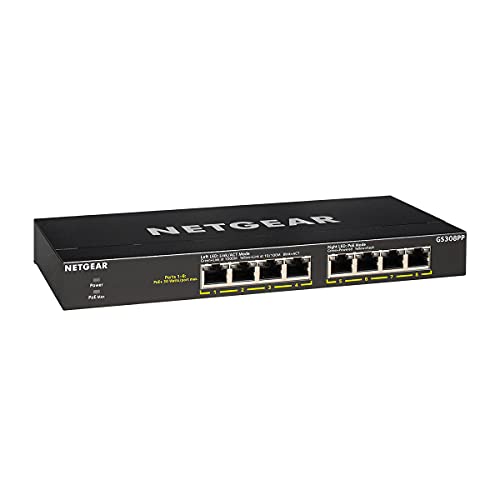
- Eight Gigabit Ethernet ports with PoE+
- 83W total PoE budget with dynamic allocation
- Fanless metal design with desktop or wall mounting
Best For: Small networks needing more PoE ports at standard Gigabit speeds
Best Budget Fast Ethernet PoE Switch

- Four PoE+ ports with a 67W total budget
- Fanless metal housing with desktop or wall mounting
- Extend Mode reaches up to 250m at reduced speed
Best For: Small, quiet surveillance and office installations
Best Flexible 10-Port PoE Switch

- Eight Gigabit PoE+ ports plus two Gigabit uplinks
- Port Isolation, Standard, and Extend modes
- Up to 820-foot PoE range in Extend Mode
Best For: Larger camera and access-point networks
Best 8-Port Gigabit PoE Switch

- Eight Gigabit PoE+ ports with a 65W budget
- Extend Mode supports up to 820 feet
- Fanless, plug-and-play metal design
Best For: Quiet surveillance and small-business networks
Quiet Desktop Pick – D-Link 8-Port Gigabit PoE+ Switch
For buyers comparing compact PoE network switches for a home office, small workspace, or basic camera setup, the D-Link DGS-1008P offers eight Gigabit ports in a fanless metal desktop design. Four ports provide PoE+ power, while plug-and-play operation keeps installation straightforward.
Best For: Quiet desktop networks needing Gigabit connectivity and power for up to four PoE devices.
Pros:
- Four PoE+ ports support up to 30W per port.
- 68W total PoE budget supports cameras, phones, and access points.
- Fanless, compact metal housing operates quietly.
- Eight Gigabit ports help reduce network bottlenecks.
Cons:
- Only four of the eight ports provide PoE power.
- Unmanaged design does not provide web-based configuration.
The DGS-1008P is a practical choice when silent operation, sturdy construction, and simple deployment matter more than advanced network controls.
Small Office Value – TRENDnet 5-Port Gigabit PoE+ Switch
The TRENDnet TPE-TG52 is one of the more compact PoE network switches for edge installations where five ports are enough. Its four Gigabit PoE+ ports, fanless metal enclosure, and wall-mountable design suit quiet desktop or small office deployments.
Best For: Small edge networks powering up to four PoE devices without adding fan noise.
Pros:
- Four Gigabit PoE+ ports and one additional Gigabit port.
- 32W PoE budget supports up to four powered devices.
- Compact, lightweight, fanless metal housing.
- Includes IEEE 802.1p QoS and DSCP pass-through support.
Cons:
- Its 32W PoE budget is lower than several larger switches.
- Only five total network ports are available.
- Manufacturer lifetime protection is specified for the U.S. and Canada.
Choose the TPE-TG52 when a small footprint and quiet operation are priorities, particularly for a few access points, cameras, or phones at the network edge.
Industrial High-Power Pick – 8-Port 802.3at PoE+ Industrial Switch
For industrial deployments that need compact PoE network switches with substantial power capacity, this unmanaged Throncom switch combines eight Gigabit PoE+ ports with two additional Gigabit uplink interfaces. Its mini DIN-rail-ready form factor and rugged metal case are designed for narrow, demanding environments.
Best For: Industrial installations requiring high PoE capacity, DIN-rail mounting, and redundant 48–57V DC input.
Pros:
- Eight 802.3at PoE+ ports provide up to a 240W output capability.
- Two extra Gigabit RJ45 interfaces provide uplink connections.
- Fanless IP40 metal design operates without cooling-fan noise.
- Supports redundant 48–57V DC power input and reverse-polarity protection.
Cons:
- Unmanaged operation lacks web-based network controls.
- Requires a 48–57V DC power source rather than a typical desktop adapter.
- Its industrial feature set may be unnecessary for ordinary home networks.
This switch stands out for high-power industrial PoE expansion in tight spaces, especially where DIN-rail installation, surge resistance, and power redundancy are important.
Managed Network Pick – TP-Link TL-SG108PE Smart PoE Switch
The TP-Link TL-SG108PE is a strong option among compact PoE network switches when basic management features are worth the added flexibility. It provides eight Gigabit ports, four 802.3af PoE ports, and web-based controls for VLANs, QoS, IGMP snooping, rate limiting, and monitoring.
Best For: Small networks that need PoE power plus traffic segmentation and prioritization controls.
Pros:
- Four PoE ports provide up to 15.4W per port.
- 57W total PoE budget supports multiple powered devices.
- Easy Smart management enables VLAN and traffic-monitoring features.
- QoS and IGMP snooping help support video and voice traffic.
Cons:
- PoE ports use 802.3af rather than the higher-power 802.3at standard.
- Only four of the eight ports supply PoE power.
- Management features require more setup than a fully unmanaged switch.
The TL-SG108PE is the better fit when a compact switch must do more than simply connect and power devices, offering practical controls for a growing small network.
Compact PoE Essential – NETGEAR GS305P
The NETGEAR GS305P is a straightforward choice for compact PoE network switches when you need to connect a small group of devices. It provides five Gigabit Ethernet ports, including four PoE+ ports, with plug-and-play setup and a fanless metal design for quiet desktop or wall-mounted installation.
Best For: Small offices, home networks, cameras, access points, and other installations needing up to four PoE-powered devices.
Pros:
- Four PoE+ ports share a 63W total power budget.
- Gigabit connectivity with auto-negotiation for Cat5e or Cat6 cables.
- Fanless, energy-efficient design with desktop or wall-mount flexibility.
- Unmanaged plug-and-play operation requires no software or configuration.
Cons:
- Only five total ports are available.
- All network ports are limited to 1Gbps.
- The 63W budget may not suit larger PoE deployments.
Choose the GS305P when simplicity, quiet operation, and a small footprint matter more than multi-gigabit speeds or advanced management features. Its four PoE+ ports make it practical for a modest device setup.
Multi-Gig PoE Powerhouse – TP-Link TL-SG105PP-M2
The TP-Link TL-SG105PP-M2 stands out among compact PoE network switches for its five 2.5-Gigabit ports and higher PoE capacity. Its four PoE++ ports support up to 60W per port, while plug-and-play operation, fanless cooling, and PoE auto recovery keep installation and everyday use simple.
Best For: Multi-gigabit networks powering demanding access points, cameras, or other compatible PoE devices.
Pros:
- Five 2.5Gbps ports provide up to 25Gbps of switching capacity.
- Four PoE++ ports support up to 60W per port and a 123W total budget.
- PoE auto recovery can detect and reboot unresponsive powered devices.
- Fanless metal housing offers quiet operation without software setup.
Cons:
- It has only five total ports for connected devices.
- Higher-capacity PoE features may be unnecessary for basic Gigabit installations.
- As an unmanaged switch, it does not provide configurable network management.
This is the stronger fit for buyers who want compact dimensions without giving up multi-gigabit performance or substantial PoE headroom. The auto-recovery feature is especially useful when connected devices need unattended operation.
Eight-Port PoE Expansion – NETGEAR GS308PP
The NETGEAR GS308PP is a practical option among compact PoE network switches when five ports are not enough. All eight Gigabit Ethernet ports support PoE+, with an 83W total budget and dynamic allocation that helps distribute available power across connected devices.
Best For: Small business, home, or security-network installations connecting several PoE devices at Gigabit speeds.
Pros:
- All eight ports provide Gigabit Ethernet and PoE+ support.
- An 83W budget supports more connected PoE devices than smaller five-port models.
- Dynamic PoE allocation redistributes unused power as needed.
- Fanless metal construction supports quiet desktop or wall-mounted placement.
Cons:
- Network speeds are limited to 1Gbps.
- The 83W budget may be insufficient for a larger collection of high-power devices.
- Unmanaged operation offers no advanced configuration controls.
The GS308PP is the sensible choice when port count is the priority. It keeps setup uncomplicated while offering PoE+ on every port, making it well suited to expanding a small camera, access-point, or office-device network.
Best Budget Fast Ethernet PoE Switch – TP-Link TL-SF1005P
The TP-Link TL-SF1005P is a compact PoE network switch for small installations that do not require Gigabit speeds. It provides four PoE+ ports for compatible cameras, access points, or phones, plus one non-PoE port for an additional wired connection.
Best For: Small surveillance or home-office setups needing affordable PoE power, simple plug-and-play installation, and quiet operation.
Pros:
- Four 802.3at/af PoE+ ports provide up to 30W per port, with a 67W total PoE budget.
- PoE Auto Recovery can detect and reboot dropped or unresponsive powered devices.
- Fanless metal design supports quiet desktop or wall-mounted installation.
- Extend Mode supports up to 250m of PoE transmission for compatible long-distance deployments.
Cons:
- All ports operate at Fast Ethernet 10/100 Mbps rather than Gigabit speeds.
- Extend Mode reduces speed to 10 Mbps.
Choose this model when low cost, straightforward setup, and dependable PoE delivery matter more than high network throughput. Its 67W budget and recovery features make it a practical fit for a few powered devices.
Best Flexible 10-Port PoE Switch – UGREEN 10-Port PoE Switch
The UGREEN 10-Port PoE Switch is a compact PoE network switch for installations that need more connections and Gigabit performance. It combines eight PoE+ ports with two Gigabit uplinks, while one-button modes add flexibility for standard, isolated, or extended deployments.
Best For: Security-camera, access-point, and IP-phone networks needing eight powered ports, Gigabit connectivity, and selectable isolation or long-distance modes.
Pros:
- Eight Gigabit PoE+ ports support up to 30W each within a 60W total power budget.
- Two additional Gigabit uplink ports provide faster network connections.
- Port Isolation and Extend modes can help separate traffic or support PoE distances up to 820 feet.
- PoE Auto Recovery restarts certain offline or frozen powered devices automatically.
Cons:
- The 60W total budget may limit simultaneous full-power use across all eight PoE ports.
- Power management cuts ports in priority order if consumption exceeds the budget.
- The supplied warranty is 24 months, shorter than the three-year coverage listed for the TP-Link models here.
This is the most flexible choice of the three for larger powered-device groups. Its Gigabit ports and one-touch modes add capability, though careful power budgeting is important when many devices are connected.
Best 8-Port Gigabit PoE Switch – TP-Link LS108GP
The TP-Link LS108GP is a compact PoE network switch designed for eight powered Gigabit connections. With plug-and-play operation, a 65W PoE budget, Extend Mode, and a fanless metal enclosure, it suits surveillance and small-business networks that need more speed than Fast Ethernet.
Best For: Users who need eight Gigabit PoE+ ports, quiet operation, and long-distance camera connectivity without manual configuration.
Pros:
- Eight 802.3at/af PoE+ ports deliver up to 30W per port with a 65W total budget.
- Gigabit connectivity provides up to 16 Gbps of switching capacity.
- Extend Mode supports PoE transmission distances up to 820 feet.
- PoE Auto Recovery can automatically restart dropped or unresponsive powered devices.
Cons:
- The 65W total budget is shared across all eight PoE ports.
- It is an unmanaged switch, so advanced configuration options are limited.
- The supplied dimensions indicate a larger footprint than the five-port TP-Link model.
The LS108GP is a strong middle ground for buyers who want eight PoE+ ports and Gigabit speed without complicated setup. Its silent operation and long-range mode are particularly useful for camera installations in noise-sensitive or spread-out spaces.
How We Picked the Best Compact PoE Network Switches
We evaluated these Compact PoE Network Switches based on the features that matter most in small installations: available PoE budget, number and speed of ports, network capacity, management options, physical design, and installation flexibility. The lineup includes straightforward plug-and-play switches for homes and small offices, as well as managed, multigigabit, and industrial options for more demanding environments.
We also considered whether a switch is suitable for cameras, access points, phones, or mixed devices. A high port count is not automatically better if the enclosure is oversized or the total PoE budget cannot support the connected equipment.
Quick Comparison
| Best For | Recommended Type | What to Prioritize |
|---|---|---|
| Small camera or phone setup | 5-port PoE+ switch | PoE budget and Gigabit uplink |
| Several powered devices | 8-port PoE+ switch | Total wattage and port count |
| Faster local networks | 2.5Gbps PoE switch | Multigigabit compatibility |
| VLANs and traffic controls | Easy-smart managed switch | Configuration features |
| Factories or control cabinets | Industrial DIN-rail switch | Power input and operating durability |
Key Buying Factors for Compact PoE Network Switches
PoE Standard and Power Budget
PoE+ generally provides more power than basic 802.3af PoE and is the safer choice for many modern cameras, access points, and phones. Check both the standard supported by your devices and the switch’s total PoE budget. A switch may have enough ports but still lack sufficient wattage to run every device simultaneously.
Port Count and Uplinks
Count the powered devices you plan to connect, then leave at least one spare port for expansion. Also check whether the switch has dedicated uplinks or uses all ports for a mixture of power and data. Gigabit ports are preferable for most current networks, while Fast Ethernet is best reserved for lower-bandwidth, cost-sensitive deployments.
Managed or Unmanaged Operation
Unmanaged models require almost no setup and suit simple networks. Easy-smart switches add useful controls such as VLAN support, traffic monitoring, and prioritization without the complexity of enterprise hardware. Choose managed features when you need segmentation, troubleshooting, or more control over traffic.
Size, Cooling, and Installation
Fanless metal enclosures are attractive for desks, media cabinets, and quiet offices. For industrial installations, verify DIN-rail compatibility, DC voltage requirements, temperature ratings, and mounting space before ordering.
Who Should Buy Which Compact PoE Network Switches?
Choose a five-port model for a few cameras, a single access point, or a small VoIP deployment. An eight-port switch is a better fit when you expect to add devices or want several spare connections. Select a 2.5Gbps model if your NAS, workstation, or uplink already supports multigigabit speeds; otherwise, Gigabit is usually sufficient. Buyers who need VLANs or traffic prioritization should choose an easy-smart model, while industrial users should prioritize rugged mounting and compatible power input over consumer features.