Finding a hidden leak, dropped fastener, or damaged component often requires seeing beyond the opening. The best budget automotive inspection cameras make those checks faster without the cost of professional workshop equipment.
These 10 options range from compact USB scopes to models with built-in screens, dual lenses, long semi-rigid cables, and articulation for more controlled inspections.
Best 10 Budget Automotive Inspection Cameras Picks for 2026
Best Plug-and-Play Pick
1920P Endoscope with 16.4-Foot Cable

- Built-in 4.3-inch screen needs no phone or app
- Long semi-rigid cable reaches deep inspection areas
- IP67 probe and adjustable LEDs support wet, dark spaces
Best For: DIY users who need simple live viewing
Best for Tight, Complex Areas
Teslong Articulating Borescope

- Two-way 210-degree articulation improves maneuverability
- 4.5-inch IPS display works without an app
- Includes 32GB card, LEDs, and carrying case
Best For: Inspections requiring precise probe positioning
Best Budget Long-Reach Option

- 16.5-foot semi-rigid cable offers extensive reach
- Dedicated 4.3-inch screen requires no phone or Wi-Fi
- IP67 probe and eight adjustable LEDs suit wet, dark areas
Best For: Long-reach automotive and DIY inspections
Best for Recording with a Phone

- Records photos and video through a compatible device
- 5.5mm IP67 probe reaches narrow automotive spaces
- Includes multiple connectors and inspection attachments
Best For: Technicians who need saved inspection documentation
Best Budget Pick
Dual-Lens 1080P Inspection Camera

- Dual-lens viewing
- 4.3-inch 1080P display
- Battery included
Best For: DIY automotive inspections with an integrated screen
Best for Autel Users
Autel MV108S 1920P Inspection Camera

- 1920P video and 2MP camera
- 39.5-inch semi-rigid cable
- Works with listed Autel scanners and PCs
Best For: Autel owners inspecting engines and confined spaces
Best Dual-Lens Value
DEPSTECH DS300 Dual-Lens Endoscope
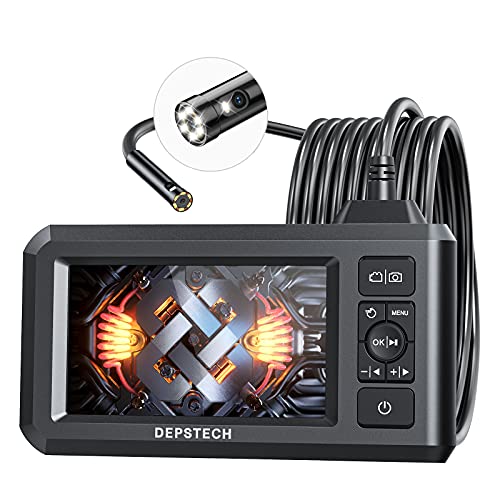
- Front and side cameras
- 16.5-foot semi-rigid cable
- About four hours of battery operation
Best For: Automotive inspections needing flexible dual-angle viewing
Best Value Screened Pick
Dual-Lens 4.3-Inch Automotive Borescope

- Built-in 4.3-inch HD display
- Dual lenses with adjustable LEDs
- 16.4-foot IP67 semi-rigid probe
Best For: DIY mechanics needing live, phone-free inspections
Best Phone-Compatible Pick
Dual-Lens 1920P Inspection Camera

- Captures photos and videos
- Includes iOS and Android connectors
- 16.5-foot IP67 semi-rigid cable
Best For: Phone users documenting engine and pipe inspections
Best Large-Screen Pick
5-Inch Dual-Lens Inspection Borescope

- Large 5-inch HD display
- 170-degree wide-angle view
- 16.4-foot waterproof probe with LEDs
Best For: Users wanting simple, live inspections on a larger screen
Best Plug-and-Play Pick – 1920P Endoscope with 16.4-Foot Cable
For budget automotive inspection cameras, this COOVIE endoscope stands out for its built-in 4.3-inch screen and long semi-rigid cable. It provides live viewing without requiring a phone, Wi-Fi connection, or app, while its adjustable LEDs and IP67-rated probe suit dark or wet inspection areas.
Best For: DIY automotive work, pipe inspection, and users who want a straightforward camera with a dedicated display.
Pros:
- 4.3-inch color screen provides real-time viewing without a smartphone.
- 16.4-foot semi-rigid cable reaches deep or difficult areas and retains its shape.
- Eight adjustable LEDs, IP67 waterproofing, and included hook, magnet, and side mirror improve versatility.
Cons:
- Cannot take pictures or record videos.
- Charging plug is not included.
This is a practical choice when live inspection matters more than documentation. Its long cable and built-in screen make it especially convenient for automotive maintenance and household repairs.
Best for Tight, Complex Areas – Teslong Articulating Borescope
Among budget automotive inspection cameras, the Teslong articulating borescope offers extra control for navigating difficult spaces. Its two-way articulating probe, 4.5-inch IPS display, and semi-rigid gooseneck help users steer the view while inspecting vehicles, HVAC systems, walls, and other confined areas.
Best For: Mechanics and DIY inspectors who need to direct the camera around bends and capture inspection images or video.
Pros:
- Two-way 210-degree articulation helps maneuver through complex spaces.
- 4.5-inch IPS screen provides sharp viewing without an app.
- Includes eight LED lights, a 32GB MicroSD card, IP67 waterproofing, and a carrying case.
Cons:
- The probe is 5 feet long, shorter than some fixed-probe alternatives.
- Articulating controls may be more involved than a basic straight camera.
The articulating design is the main advantage here. If positioning the camera precisely is more important than maximum cable length, this Teslong model offers useful control and convenient recording features.
Best Budget Long-Reach Option – Daxiongmao 1080P Borescope
This Daxiongmao model is a strong value among budget automotive inspection cameras for users who want long reach and simple operation. Its 4.3-inch display works independently of a smartphone, while the 16.5-foot semi-rigid cable and 8mm probe can help inspect engine areas, walls, vents, and pipes.
Best For: Home mechanics and DIY users who need a long cable for automotive, plumbing, HVAC, or wall inspections.
Pros:
- 16.5-foot semi-rigid cable provides substantial reach.
- Built-in 4.3-inch screen avoids Wi-Fi, app, and phone setup.
- Eight adjustable LEDs, IP67 waterproofing, and included inspection attachments support varied jobs.
Cons:
- Cannot take pictures or record videos.
- Fast charging is not supported; the manufacturer specifies a 5V/1A charger.
- Warranty coverage is 180 days.
This is a sensible low-cost choice for live inspections where reach is a priority. It trades image documentation for a long cable, dedicated display, and broad general-purpose utility.
Best for Recording with a Phone – LAUNCH VSP-600 Videoscope
The LAUNCH VSP-600 takes a different approach to budget automotive inspection cameras by connecting to compatible Android devices, Windows PCs, and select X431 scanners. Its 720p camera, 800mm semi-rigid probe, adjustable LEDs, and snapshot button support viewing, photographing, and recording in narrow or wet areas.
Best For: Automotive technicians who want to save inspection photos or videos and already use a compatible phone, tablet, PC, or X431 scanner.
Pros:
- Supports photos and videos with a snapshot button and 30fps recording.
- 5.5mm IP67 waterproof camera can reach narrow spaces through an 800mm probe.
- Includes Android, Micro USB, and USB Type-C connectors plus hook, magnet, and mirror attachments.
Cons:
- Requires the LAUNCH Videoscope app before first use.
- Requires a compatible external device rather than providing its own display.
- 720p resolution is lower than the 1080p models in this roundup.
Choose this videoscope if documentation and device compatibility matter more than a built-in monitor or extra-long cable. Its narrow probe and recording support make it particularly useful for diagnostic workflows.
Best Budget Pick – Dual-Lens 1080P Inspection Camera
For shoppers comparing budget automotive inspection cameras, this dual-lens endoscope offers a straightforward inspection setup with a 4.3-inch 1080P display. Its included lithium-polymer battery and compact package make it a practical option for checking hard-to-see areas without adding a separate monitor.
Best For: DIY automotive inspections where an integrated screen and dual-lens viewing are useful.
Pros:
- Dual-lens design for flexible viewing.
- 4.3-inch 1080P display for on-device inspection.
- Includes the required lithium-polymer battery.
Cons:
- The supplied notes do not specify cable length, waterproof rating, or recording features.
- Battery runtime is not provided.
This is a sensible entry-level choice when you want a dedicated screen and dual-lens functionality, but buyers needing detailed probe specifications should verify those features before purchase.
Best for Autel Users – Autel MV108S 1920P Inspection Camera
Among budget automotive inspection cameras, the Autel MaxiVideo MV108S stands out for Autel scanner compatibility, a 2MP camera, and 1920×1080 video. Its 8.5mm probe, 39.5-inch semi-rigid cable, bright LEDs, and IP67 design suit inspections around engines and other confined areas.
Best For: Autel scanner owners and PC users inspecting engine cylinders, pipes, machinery, or other narrow spaces.
Pros:
- 1920P HD video with a 2MP camera and eight bright LEDs.
- 39.5-inch semi-rigid cable holds its shape for guided access.
- IP67 waterproof design and compatibility with many Autel scanners and PCs.
- Plug-and-play operation with no Wi-Fi or Bluetooth required.
Cons:
- Its strongest compatibility advantage is specific to listed Autel scanners and USB-equipped PCs.
- The 8.5mm probe may not fit the narrowest inspection openings.
The MV108S is a focused value pick for users already in the Autel ecosystem. Its long, shape-holding cable and waterproof probe add versatility, while the compatibility list should be checked before ordering.
Best Dual-Lens Value – DEPSTECH DS300 Dual-Lens Endoscope
The DEPSTECH DS300 is a versatile option among budget automotive inspection cameras, combining front and side cameras with a 4.3-inch IPS screen. Its 16.5-foot semi-rigid cable, adjustable LEDs, and 180-degree camera orientation help with inspections where reaching and viewing angle are challenging.
Best For: Automotive repair and DIY inspections that benefit from dual views, a long cable, and an integrated display.
Pros:
- Dual-lens system with front, side, and wider 70-degree viewing modes.
- 1080P video, 2MP images, and a 4.3-inch IPS screen.
- 16.5-foot semi-rigid cable with 180-degree camera orientation.
- IP67 waterproof design, adjustable lighting, and approximately four-hour battery operation.
Cons:
- Micro SD/TF card is not included.
- Its stated focal ranges are relatively close, so it is designed for nearby inspection rather than distant viewing.
With dual cameras, a long flexible cable, and a built-in screen, the DS300 offers a strong feature mix for automotive and general maintenance work. Remember to supply a compatible memory card if you want to save recordings or images.
Best Value Screened Pick – Dual-Lens 4.3-Inch Automotive Borescope
For shoppers comparing budget automotive inspection cameras, this model offers a useful combination of a built-in screen, dual viewing angles, and a long semi-rigid probe. It is designed for close-up checks around engines, pipes, vents, and other hard-to-reach areas without needing a phone or Wi-Fi connection.
Best For: DIY mechanics who want a self-contained inspection camera for short engine, pipe, and duct inspections.
Pros:
- 4.3-inch HD IPS display provides real-time viewing without a separate device.
- Front and side cameras can be switched as needed.
- 16.4-foot semi-rigid cable, IP67 water resistance, and adjustable LED lighting support varied inspection conditions.
- Includes magnet, hook, and mirror attachments.
Cons:
- It cannot take pictures or record videos.
- The 8mm probe may not fit through especially narrow openings.
- Charging takes about three hours.
This is a practical budget choice when live viewing matters more than documentation. Its integrated display and included accessories make it convenient for routine automotive troubleshooting and general home inspections.
Best Phone-Compatible Pick – Dual-Lens 1920P Inspection Camera
Among budget automotive inspection cameras, this phone-connected model stands out for shoppers who want to capture photos and videos during an inspection. Its dual-lens design, 16.5-foot semi-rigid cable, and included smartphone connectors make it suitable for investigating engine spaces, pipe clogs, and other confined areas.
Best For: Phone users who want to record inspection findings for troubleshooting, sharing, or later review.
Pros:
- 1920×1440 image resolution supports detailed close-up viewing, photos, and videos.
- Works with iOS and Android devices through included Lightning, USB-C, and Android connectors.
- Dual lenses switch between front and side views.
- IP67 waterproofing and a 16.5-foot semi-rigid cable suit damp and hard-to-reach areas.
Cons:
- Requires a compatible smartphone rather than including a dedicated display.
- Phone connection and app compatibility may add setup considerations.
- Its 8mm camera diameter may limit access to very small openings.
This is the better fit for buyers who value photo and video documentation. It trades the simplicity of a standalone screen for smartphone connectivity and a more useful record of automotive inspection results.
Best Large-Screen Pick – 5-Inch Dual-Lens Inspection Borescope
This model is one of the more straightforward budget automotive inspection cameras for buyers who prefer a dedicated handheld display. Its 5-inch screen, 170-degree viewing angle, dual lenses, and semi-rigid waterproof probe are suited to automotive, plumbing, HVAC, and drain inspections.
Best For: Mechanics and DIYers who prioritize a larger built-in screen and simple plug-and-play operation.
Pros:
- 5-inch HD screen with a 170-degree wide-angle view makes live inspection easier to follow.
- Front and side cameras provide flexible viewing around obstructions.
- 16.4-foot semi-rigid cable, IP67 waterproofing, and eight adjustable LEDs support wet or dark areas.
- No app or Wi-Fi is required, and the 2000mAh battery provides about three to four hours of runtime.
Cons:
- It cannot take pictures or record videos.
- Fixed focus limits adjustment compared with autofocus designs.
- The listed runtime is shorter than the other standalone-screen model’s stated standby time.
Choose this borescope if comfortable live viewing is your priority. The larger screen and wide-angle view are useful for routine engine and pipe checks, while the lack of image capture makes it less suitable for creating inspection records.
How We Picked the Best Budget Automotive Inspection Cameras
We focused on practical features that matter during vehicle inspections: image resolution, camera diameter, cable length, lighting, waterproof protection, screen or phone compatibility, and ease of positioning. We also considered whether a camera suits common automotive jobs such as inspecting spark-plug holes, cylinders, hoses, engine bays, underbody spaces, and narrow HVAC passages.
Resolution claims are useful, but they do not guarantee a better inspection by themselves. Lens quality, LED control, focus distance, cable stiffness, and the camera’s ability to stay aimed at the target can matter just as much.
Quick Comparison
| Feature | Why It Matters |
|---|---|
| Built-in display | Allows immediate use without pairing a phone or installing an app. |
| USB connection | Useful when you want to record inspections on a compatible phone, tablet, or computer. |
| Dual lenses | Provides forward and side-facing views for broader coverage in tight spaces. |
| Articulation | Helps steer the lens around bends and aim at specific components. |
| Long cable | Improves access to deep engine, wall, drain, and underbody areas. |
Key Buying Factors for Budget Automotive Inspection Cameras
Camera Diameter and Cable Reach
Check the camera head diameter before buying. A slimmer probe is better for spark-plug openings and narrow passages, while a longer cable is helpful for pipes, cavities, and areas behind dashboards. Semi-rigid cables are generally easier to position than soft cables.
Lighting and Image Quality
Adjustable LEDs help compensate for dark engine bays and enclosed spaces. A 1080p camera can provide a useful view for many repairs, while higher advertised resolutions may offer more detail when the screen and lens support it. Look for brightness control to reduce glare on metal surfaces.
Waterproofing and Durability
IP67-rated camera heads are better suited to damp areas, fluid checks, and dirty automotive work, but waterproofing usually applies to the probe rather than the entire display or phone connection. Keep the electronics away from coolant, oil, and standing water unless the manufacturer specifically permits it.
Controls, Recording, and Compatibility
A built-in screen is convenient for quick diagnosis. USB models can be more flexible, but verify operating-system compatibility before purchase. If you need evidence for maintenance records, prioritize simple photo and video capture controls.
Who Should Buy Which Budget Automotive Inspection Cameras?
Choose a basic single-lens screen-equipped model for occasional DIY troubleshooting and general engine-bay checks. A dual-lens camera is a stronger all-purpose choice when you need to inspect both the target ahead and the surrounding walls of a cavity. Select an articulating borescope when precise steering around bends matters more than the lowest price.
For deeper inspections, prioritize a long semi-rigid cable and dependable lighting. For frequent professional use, a durable camera with a replaceable or compatible probe, stable controls, and reliable recording may justify spending more than the cheapest option. Before ordering, confirm connector type, display size, probe diameter, cable length, and the manufacturer’s waterproofing limits.