Finding faults inside engines, HVAC systems, cylinders, and tight mechanical spaces is easier with the right inspection camera. The best models combine sharp imaging, useful articulation, strong lighting, and a probe size suited to the job.
This roundup compares 10 high-performance automotive inspection cameras to help mechanics, technicians, and serious DIYers choose the right balance of reach, visibility, control, and value.
Best 10 High-Performance Automotive Inspection Cameras Picks for 2026
Best Articulating Pick
Teslong 2-Way Articulating Borescope

- 210° two-way articulation
- 4.5-inch IPS display with 1080p video
- IP67 probe with 32GB microSD card
Best For: Mechanics and DIY users inspecting tight automotive and HVAC spaces
Best Long-Reach Pick
DEPSTECH DS620 Triple-Lens Endoscope

- Three lenses for multi-angle inspection
- 16.5-foot semi-rigid cable
- 5-inch IPS display and IP67 probe
Best For: Extended automotive, HVAC, plumbing, and machinery inspections
Best 360-Degree Pick

- Full 360° articulation with joystick control
- 6.5mm dual-lens probe
- 4x zoom and included 32GB card
Best For: Confined automotive inspections requiring flexible steering and side views
Best Audio-Recording Pick
DEPSTECH DS630SL Articulating Borescope
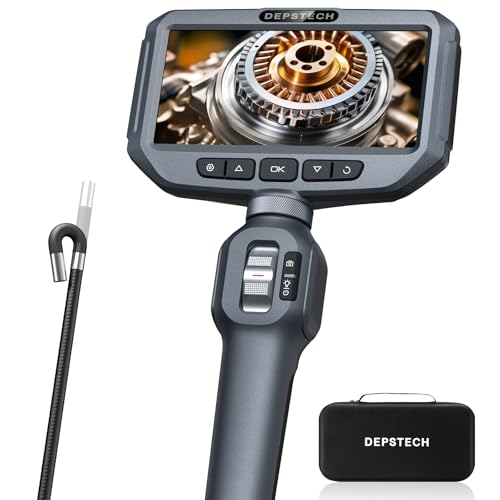
- 210° articulating 0.24-inch probe
- 1080p video with microphone and speakers
- 3350mAh battery and included 32GB card
Best For: Automotive inspections requiring video and audio documentation
Flexible Dual-View Pick
Teslong Articulating Dual-Lens Borescope

- Front- and side-view cameras
- 5-foot semi-rigid articulating probe
- 4.5-inch IPS screen with adjustable LEDs
Best For: Automotive and HVAC inspections in tight spaces
High-Resolution Steering Pick
4-Way 360° Articulating Borescope

- 360-degree four-way probe steering
- 5-inch IPS display with 1080p footage
- IP67 probe and up to four hours of runtime
Best For: Engine and industrial inspections requiring precise steering
Deep-Reach Mechanic Pick

- Slim 3.9 mm articulating probe
- 6-inch 720p IPS monitor
- 6,000mAh battery and 32GB card included
Best For: Engine inspections requiring narrow access and recorded evidence
Precision Reach
FOXWELL 2-Way Articulating Borescope
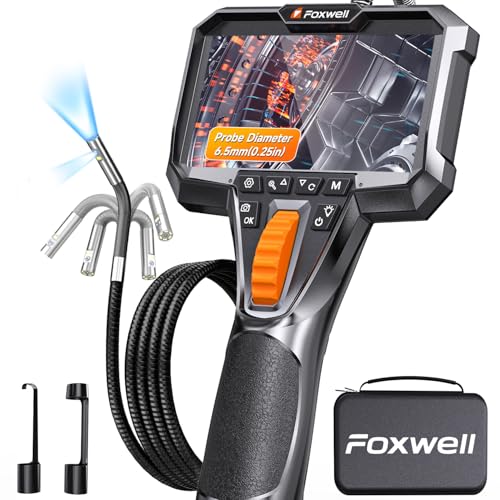
- 6.5mm dual-lens probe with 220° articulation
- HD IPS display and adjustable LED lighting
- IP67 probe and 32GB onboard storage
Best For: Detailed automotive inspections in tight, complex spaces
Compact Shop Value
DXZtoz 220° Articulating Borescope

- 220° two-way steering for obstacle navigation
- 1080p IPS monitor with 8× digital zoom
- 3000mAh battery and useful accessory kit
Best For: Portable engine and equipment inspections
Maximum Maneuverability

- 360° rotation and 210° flexion via joystick
- 6-inch 1080p screen with dual-lens cameras
- 6000mAh battery and voice-note recording
Best For: Detailed multi-angle automotive and industrial inspections
Best Articulating Pick – Teslong 2-Way Articulating Borescope
For high-performance automotive inspection cameras that balance maneuverability with straightforward operation, the Teslong articulating borescope is a practical choice. Its 210-degree two-way articulation, 5-foot semi-rigid cable, 4.5-inch IPS screen, and built-in lighting help inspect confined automotive and HVAC spaces without relying on a phone app.
Best For: Mechanics and DIY users inspecting tight engine bays, HVAC areas, walls, and other hard-to-reach spaces.
Pros:
- Two-way articulation and a semi-rigid gooseneck provide controlled positioning.
- 4.5-inch IPS display shows 1080p video without requiring an app.
- Eight adjustable LED lights, IP67 waterproofing, and a 32GB microSD card support varied inspection conditions.
- One-handed joystick controls and a compact design help reduce fatigue.
Cons:
- The 5-foot cable is shorter than some extended-reach inspection cameras.
- Still images are listed at 2MP, so this is primarily a real-time inspection tool.
The Teslong stands out when precise probe control and an independent display matter more than maximum cable length. It is a well-rounded option for routine automotive troubleshooting and general inspection work.
Best Long-Reach Pick – DEPSTECH DS620 Triple-Lens Endoscope
The DEPSTECH DS620 is one of the more versatile high-performance automotive inspection cameras for jobs that require reach and multiple viewing angles. Its triple-lens setup, 16.5-foot semi-rigid cable, 5-inch IPS display, and IP67 probe make it useful for examining extended or difficult routes.
Best For: Automotive, plumbing, HVAC, and machinery inspections where long cable reach and quick angle changes are priorities.
Pros:
- Triple-lens design lets you switch among views without repeatedly repositioning the cable.
- 16.5-foot semi-rigid cable reaches deep or distant inspection areas.
- Five-inch IPS screen provides real-time viewing, while 10 LEDs illuminate dark spaces.
- Includes a magnet and hook for retrieving small objects.
Cons:
- The microSD card needed for saving photos and videos is not included.
- Listed battery life is approximately two to three hours, depending on use.
Choose the DS620 when inspection distance and multi-angle coverage are more important than a highly articulated probe. Its long cable and triple-camera arrangement can reduce repositioning during larger jobs.
Best 360-Degree Pick – Ralcam F6 Dual-Lens Borescope
For high-performance automotive inspection cameras designed to navigate around obstructions, the Ralcam F6 offers four-way articulation with full 360-degree rotation. Its slim 6.5mm dual-lens probe, 5-inch IPS screen, 4x digital zoom, and split-screen capability support detailed engine, HVAC, and pipe inspections.
Best For: Mechanics and technicians who need flexible probe steering and front-and-side views in confined spaces.
Pros:
- Four-way articulation enables 360-degree viewing without moving the probe.
- Dual front and side lenses help reduce blind spots.
- Ultra-slim 6.5mm probe reaches narrow openings, including cylinders and ducts.
- Records 1080p video and photos to the included 32GB card, with 4x digital zoom.
Cons:
- The listed still-image resolution is 1MP, lower than some competing models.
- Its 5-foot cable may not suit especially deep inspection routes.
- The product carries a listed one-year warranty.
The Ralcam F6 is a strong fit when probe positioning and side visibility are central to the job. The replaceable battery is also useful for users who want the option of swapping in a spare during extended work.
Best Audio-Recording Pick – DEPSTECH DS630SL Articulating Borescope
The DEPSTECH DS630SL adds audio recording to the core features expected from high-performance automotive inspection cameras. Its 210-degree articulating 0.24-inch probe, 5-inch IPS screen, adjustable LEDs, and built-in microphone and speakers make it useful for documenting findings in tight spaces.
Best For: Automotive and maintenance users who want to capture inspection video with accompanying sound.
Pros:
- Two-way articulated probe can be positioned and locked for detailed viewing.
- Slim 0.24-inch probe and shape-holding metal gooseneck reach narrow gaps.
- 2MP imaging with Bluart 3.0 technology supports 1080p video recording.
- Built-in microphone, speakers, 3350mAh battery, 32GB card, and carrying case are included.
Cons:
- Articulation is two-way rather than full 360-degree steering.
- Listed battery life is approximately 3.5 hours.
- The unit is listed at 1.33 kg, which may feel substantial during long handheld inspections.
The DS630SL is particularly compelling when inspection documentation needs both visuals and sound. Its combination of probe control, lighting, and recording hardware makes it suited to repeatable automotive troubleshooting workflows.
Flexible Dual-View Pick – Teslong Articulating Dual-Lens Borescope
For high-performance automotive inspection cameras that simplify work in cramped areas, this Teslong borescope combines front- and side-view lenses with two-way articulation. Its 4.5-inch IPS display, 5-foot semi-rigid probe, and adjustable LEDs provide practical visibility without requiring a phone app.
Best For: Automotive maintenance, HVAC work, and inspections where switching between front and side views can reduce repositioning.
Pros:
- Dual cameras provide front and side views for broader inspection coverage.
- Two-way articulation and a semi-rigid 5-foot gooseneck help navigate tight spaces.
- 4.5-inch IPS screen and adjustable built-in LED lighting support viewing in varied conditions.
- Includes photo and video capture, USB-C connectivity, and a microSD recording format.
Cons:
- Video capture is limited to 720p.
- Two-way articulation may offer less directional control than four-way designs.
- The listed weight is 1.44 kg, which may feel substantial during extended handheld use.
This is a versatile choice when lens switching and a self-contained screen matter more than maximum probe articulation or higher video resolution.
High-Resolution Steering Pick – 4-Way 360° Articulating Borescope
This 4-way articulating borescope is designed for high-performance automotive inspection cameras users who need precise access and sharper live footage. Its slim 6.25 mm probe rotates through 360 degrees, while the 5-inch IPS display delivers 1080p viewing for engine, pipeline, and mechanical inspections.
Best For: Mechanics inspecting engine cylinders, valve seats, carbon deposits, and other narrow or difficult-to-reach components.
Pros:
- Four-way articulation provides 360-degree steering for reduced blind angles.
- 1080p footage appears on a 5-inch IPS built-in display.
- IP67 probe protection suits damp and oily workshop environments.
- Up to four hours of runtime, Type-C charging, and photo/video recording support field use.
Cons:
- Recording capacity is limited to a 32GB TF card.
- The 1MP still-image resolution is modest compared with the live 1080p display resolution.
- Phone dual-display functionality depends on compatibility with the user’s smartphone.
Choose this model when directional control and 1080p live viewing are priorities, especially for inspections requiring access around corners without extensive disassembly.
Deep-Reach Mechanic Pick – Teslong TF600 4-Way Borescope
For high-performance automotive inspection cameras with a particularly slim probe, the Teslong TF600 uses a 3.9 mm tip and four-way joystick control to inspect engine parts without disassembly. A large 6-inch IPS monitor, 6,000mAh battery, and included 32GB card make it suited to longer, documented inspections.
Best For: Automotive mechanics who need a narrow probe, flexible viewing angles, and onboard audio/video recording for later review.
Pros:
- 3.9 mm probe reaches narrow engine areas.
- Joystick-controlled four-way articulation turns 360 degrees and bends back 210 degrees.
- 6-inch 720p IPS screen provides a large viewing area.
- IP67 protection, a 6,000mAh battery, and included hard case support field work.
Cons:
- Video resolution is 720p rather than 1080p.
- Four-way control requires manual joystick operation.
- Its listed recording formats are JPG and AVI, which may be less convenient than MP4 for some workflows.
The TF600 stands out for narrow-access automotive work and extended use, making it a practical option when probe diameter, battery capacity, and recording accessories matter most.
Precision Reach – FOXWELL 2-Way Articulating Borescope
For high-performance automotive inspection cameras that can reach confined engine spaces, the FOXWELL Y406D-Elite combines a slim 6.5mm probe with dual-lens viewing and 220° articulation. Its HD IPS display, adjustable lighting, and onboard storage make it a practical choice for detailed inspections without extensive disassembly.
Best For: Mechanics and technicians inspecting spark plug holes, cylinders, valves, wiring, HVAC systems, and other narrow spaces.
Pros:
- Ultra-slim 0.25-inch probe reaches tight areas and supports optional hook or magnetic tips.
- Dual front and side cameras with 220° articulation provide broader visibility in complex spaces.
- HD IPS screen, adjustable LEDs, IP67 probe protection, and 32GB built-in storage support demanding inspections.
Cons:
- The probe is rated for temperatures below 70°C because of its automatic heat-protection shutdown.
- At 2.44 pounds, it may be less convenient for users seeking an especially lightweight inspection camera.
The FOXWELL stands out when probe size, image clarity, and dual-angle viewing matter most. It is a strong fit for automotive diagnostics where reaching and documenting hard-to-see areas can reduce teardown time.
Compact Shop Value – DXZtoz 220° Articulating Borescope
Among high-performance automotive inspection cameras, the DXZtoz AGC430N offers useful articulation and practical accessories for engine and equipment work. Its 220° steering lens, 1080p display, adjustable LEDs, and rechargeable battery provide a capable setup for short-insertion inspections.
Best For: Automotive mechanics and repair technicians who need maneuverability, close-up viewing, and a portable accessory-equipped kit.
Pros:
- Two-way 220° articulation helps the probe turn around obstacles and view difficult positions.
- 8.5mm camera, 2MP imaging, 8× digital zoom, and eight adjustable LED lights support close inspections.
- IP67 waterproof and oil-resistant probe, 3000mAh battery, 32GB memory card, and protective case are included.
Cons:
- The 8.5mm probe is thicker than the 6.5mm probes in the other listed options.
- Its display is 4.3 inches, providing less viewing area than the 6-inch Teslong screen.
- The supplied specifications describe 1080p video and 2MP still resolution rather than higher-resolution imaging.
The DXZtoz is a sensible choice when articulation and included accessories are more important than maximum screen size or the slimmest probe. Its straightforward, no-app operation also suits technicians who want a ready-to-use inspection kit.
Maximum Maneuverability – Teslong TF600 4-Way Borescope
For technicians seeking high-performance automotive inspection cameras with broad probe control, the Teslong TF600 uses four-way articulation with 360° rotation and 210° flexion. Its dual-lens cameras, 6-inch 1080p IPS screen, and long-lasting battery are designed for detailed inspections from multiple angles.
Best For: Professional automotive and industrial users who need extensive probe maneuverability, a large display, and inspection documentation.
Pros:
- Joystick-controlled 4-way articulation supports 360° rotation and 210° flexion without extensive disassembly.
- Dual 1MP cameras and 6+1 adjustable LEDs help illuminate and inspect obscured components.
- 6-inch 1080p IPS screen, 6000mAh battery, 32GB microSD card, and voice-note recording support longer inspections.
Cons:
- The 1MP effective still resolution is lower than the FOXWELL and DXZtoz listed specifications.
- Its 1.25kg weight may be less comfortable for extended handheld use than lighter systems.
- The advanced 4-way design may be more capability than needed for simple, straight-line inspections.
The TF600 is the strongest match for users who prioritize control and viewing flexibility over compactness. Its large screen, dual-lens setup, and voice-note capability make it well suited to thorough inspections and service documentation.
How We Picked the Best High-Performance Automotive Inspection Cameras
We focused on features that matter during real automotive inspections rather than headline specifications alone. The selected cameras offer combinations of articulating probes, dual or triple lenses, integrated lighting, built-in displays, and high-resolution imaging. We also considered probe diameter, maneuverability, screen usability, and suitability for engine bays, HVAC ducts, pipes, and other confined areas.
Because inspection work varies widely, no single design is ideal for every buyer. A slim probe may reach areas that a larger dual-lens model cannot, while a bigger screen or wider viewing system can make diagnosis faster and more comfortable.
Quick Comparison
- Best for versatile automotive work: Choose a four-way articulating model with a built-in screen and adjustable lighting.
- Best for viewing multiple angles: Dual- or triple-lens cameras reduce the need to reposition the probe.
- Best for tight access: Look for a slim probe, especially around 3.9mm to 5mm.
- Best for comfortable diagnosis: A 5-inch IPS display provides a practical balance of size and portability.
- Best for detailed inspection: Prioritize 1080p-class imaging, strong illumination, and a stable articulated tip.
Key Buying Factors for High-Performance Automotive Inspection Cameras
Probe Diameter and Reach
Probe size determines where the camera can go. Slim probes are useful for spark-plug openings, narrow passages, and compact mechanical assemblies. Larger probes may provide greater durability or additional optics, but they need more clearance. Check both the diameter and cable length before buying.
Articulation and Control
Two-way articulation can be sufficient for straightforward inspections, while four-way or 360-degree control makes it easier to steer around bends and examine a wider area without repeatedly withdrawing the probe. Smooth controls are especially valuable in engine compartments and HVAC channels.
Camera and Lighting
Resolution affects how clearly you can identify deposits, cracks, leaks, corrosion, and damaged components. Adjustable LEDs are equally important because reflective metal surfaces and dark cavities require different brightness levels. Dual- and triple-lens designs can improve situational awareness by adding forward or side-facing views.
Display, Recording, and Durability
A built-in IPS screen keeps the system usable without a phone connection and is convenient in workshops or vehicles. Confirm whether the camera supports photo and video recording, image review, and storage expansion if documentation matters. Water-resistant probes and a sturdy cable are valuable when working around oil, coolant, dirt, and moisture.
Who Should Buy Which High-Performance Automotive Inspection Cameras?
Professional mechanics should favor durable four-way articulation, clear imaging, a responsive display, and dual-lens coverage for frequent diagnostics. HVAC and maintenance technicians may benefit most from slim probes and side-view capability for ducts and enclosed equipment. DIY vehicle owners can usually choose a simpler two-way or dual-lens model if occasional checks are the main use. Inspection-heavy users should prioritize recording features, comfortable controls, replaceable accessories, and a probe length that matches their typical workspace.