Finding problems beneath a vehicle often means working around tight clearances, poor lighting, and awkward angles. The best budget underbody inspection cameras make those checks easier by combining a flexible probe, built-in illumination, and a screen or phone connection.
Our selection includes dual-lens, articulating, waterproof, and long-reach models suited to automotive maintenance and general inspection work. Compare probe design, image quality, control options, and durability to choose the right camera for your garage or workshop.
Best 10 Budget Underbody Inspection Cameras Picks for 2026
Best Dual-Lens Value
4.3-Inch Dual-Lens Inspection Camera

- Switchable front and side cameras
- 16.4-foot IP67 waterproof cable
- Live 1080P viewing with built-in screen
Best For: DIY automotive, plumbing, and confined-space inspections
Best for Maneuverability
Teslong Articulating Borescope

- Two-way 210-degree probe articulation
- 4.5-inch IPS screen and 1080P image
- Includes 32GB microSD card for recording
Best For: Angled automotive, HVAC, and wall inspections
Best Long-Reach Simplicity

- 16.6-foot semi-rigid inspection cable
- 7.9mm probe for confined spaces
- No-app operation with IP67 protection
Best For: Long-reach automotive, pipe, sewer, and wall inspections
Best Large-Screen Dual View

- 5-inch screen with 170-degree view
- Switchable front and side cameras
- 16.4-foot IP67 semi-rigid probe
Best For: Underbody, engine, plumbing, and sewer inspections
Best Phone-Compatible Pick
Ditomil 1920P Long-Reach Endoscope

- 1920P video with an ultra-thin 7.9mm probe
- 16.4-foot semi-rigid, IP67 waterproof cable
- Works with iOS and Android phones via adapters
Best For: Phone-based inspections of engines, drains, HVAC ducts, and wall cavities
Best Standalone Option
Daxiongmao 1080P LCD Borescope

- 4.3-inch built-in LCD requires no phone or app
- 16.5-foot semi-rigid cable for extended reach
- IP67 waterproof probe with eight adjustable LEDs
Best For: Simple vehicle, plumbing, HVAC, and home inspections without phone connectivity
Best Detail and Coverage
DEPSTECH NTC55 2K Dual-Lens Camera

- 2K resolution with 3.69-megapixel image detail
- Front and side lenses provide 360-degree viewing
- Phone app supports photos, video, zoom, and rotation
Best For: Detailed automotive, plumbing, HVAC, and mechanical inspections
Best No-App Pick
1080P Endoscope with 4.3-inch Screen
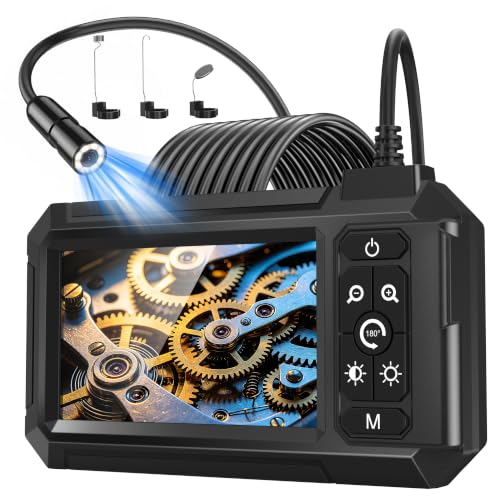
- Built-in 4.3-inch IPS display
- 16.5-foot semi-rigid cable
- IP67 probe with eight adjustable LEDs
Best For: Phone-free automotive, plumbing, and home inspections
Best High-Resolution Phone Scope

- 1920P video capture resolution
- 16.4-foot semi-rigid cable
- Type-C, Micro USB, and Lightning connectors
Best For: Mechanics and plumbers who want phone-based recording
Best for Hard Angles
Articulating Dual-Lens Borescope

- 210-degree two-way articulation
- Front and side cameras
- Built-in 32GB card and 4.3-inch screen
Best For: Complex automotive and mechanical inspections around bends
Best Dual-Lens Value – 4.3-Inch Dual-Lens Inspection Camera
For budget underbody inspection cameras, this model offers useful versatility without requiring a phone or app. Its front and side cameras, 16.4-foot semi-rigid cable, adjustable LEDs, and IP67 waterproofing make it practical for checking automotive components, pipes, vents, and other confined spaces. Note that it is designed for live viewing rather than capturing photos or videos.
Best For: DIY automotive checks, plumbing, HVAC, and wall or vent inspections where dual-angle viewing is helpful.
Pros:
- Switchable front and side cameras support different inspection angles.
- 4.3-inch HD IPS screen displays 1080P images without a smartphone.
- Long 16.4-foot semi-rigid cable, IP67 waterproofing, and adjustable LED lighting.
- Includes a hook, magnet, and mirror attachments.
Cons:
- Cannot take or store photos and videos.
- Its 8mm probe may not fit the narrowest openings.
This is a strong budget-oriented option when live inspection and reach matter more than recording. The dual-lens design adds flexibility for underbody and engine work, while the built-in display keeps operation simple.
Best for Maneuverability – Teslong Articulating Borescope
Among budget underbody inspection cameras, the Teslong stands out for its two-way articulating probe. The 210-degree articulation, semi-rigid 5-foot gooseneck, 4.5-inch IPS display, and built-in LEDs help users guide the camera through tight automotive, HVAC, and wall-access areas. It also supports capturing images and video to the included 32GB microSD card.
Best For: Mechanics and DIY users who need controlled probe movement around difficult angles.
Pros:
- Two-way 210-degree articulation improves navigation in complex spaces.
- 4.5-inch IPS screen provides clear 1080P viewing without an app.
- Includes 8 LED lights, IP67 waterproofing, and a 32GB microSD card.
- Photo and video controls are positioned for one-handed operation.
Cons:
- The 5-foot probe is considerably shorter than the long-cable alternatives.
- Articulating controls may be unnecessary for simple, straight inspections.
This is the most maneuverable choice in the group, especially when an inspection requires steering around corners rather than simply pushing a long cable forward. Its recording capability also makes it useful for documenting findings.
Best Long-Reach Simplicity – 16.5-Foot HD Borescope Camera
This MugEasy model is a straightforward pick for budget underbody inspection cameras when extended reach and simple operation are priorities. Its 16.6-foot semi-rigid cable, 7.9mm probe, 4.3-inch IPS display, adjustable eight-LED lighting, and IP67 waterproof rating suit automotive, pipe, sewer, and wall checks. It works without Wi-Fi, an app, or driver software.
Best For: Long-reach inspections in pipes, under vehicles, walls, and other wet or confined areas.
Pros:
- Long 16.6-foot semi-rigid cable reaches distant inspection points.
- Compact 7.9mm probe helps with narrower spaces.
- 4.3-inch IPS screen shows 1920×1080 live images with adjustable brightness.
- IP67 waterproofing and eight adjustable LEDs support wet, dark environments.
Cons:
- Cannot take or store photos.
- The long cable can be less convenient in very tight work areas.
Choose this model when you want a plug-and-play inspection tool with substantial cable length. It is particularly practical for live checks where recording is not needed and reaching the target is the main challenge.
Best Large-Screen Dual View – 5-Inch Dual-Lens Borescope
For shoppers comparing budget underbody inspection cameras, this dual-lens model combines a larger 5-inch display with a long 16.4-foot probe. Its front and side cameras can be switched instantly, while eight adjustable LEDs, IP67 waterproofing, and a 170-degree viewing angle support automotive, plumbing, HVAC, and sewer inspections. It is a live-view tool and does not capture photos or videos.
Best For: Users who prefer a larger screen and dual-angle viewing for underbody, pipe, and engine inspections.
Pros:
- 5-inch HD screen provides a broad 170-degree viewing angle.
- Dual-lens design switches between front and side views.
- 16.4-foot semi-rigid cable reaches pipes, ducts, and underbody areas.
- IP67 waterproofing and eight adjustable LEDs suit dark, wet environments.
Cons:
- Cannot take or record photos and videos.
- Its fixed-focus design may be less adaptable than an articulating camera.
- Specified battery runtime is approximately 3–4 hours.
This option makes sense when screen size and viewing flexibility are more important than documentation. The long waterproof probe and dual-camera arrangement give it broad practical coverage for vehicle and plumbing work.
Best Phone-Compatible Pick – Ditomil 1920P Long-Reach Endoscope
For budget underbody inspection cameras, this Ditomil model offers a practical combination of clear 1920P video, a long semi-rigid cable, and phone compatibility. Its slim, waterproof probe can help inspect hard-to-reach areas without taking apart larger sections.
Best For: Homeowners, mechanics, and plumbers who want a phone-connected camera for drains, HVAC ducts, engines, and wall cavities.
Pros:
- 1920P resolution helps reveal cracks, leaks, rust, and other damage.
- 16.4-foot semi-rigid cable provides useful reach and directional control.
- IP67 probe, adjustable LEDs, and included hook, magnet, and mirror improve versatility.
Cons:
- Requires a compatible phone and app for viewing.
- Fixed-focus 7.9mm probe may not suit every inspection distance.
This is a strong budget choice when you already use a compatible iOS or Android phone and want a long cable for automotive, plumbing, or household checks. The accessory kit adds value for retrieving small objects and viewing from different angles.
Best Standalone Option – Daxiongmao 1080P LCD Borescope
Among budget underbody inspection cameras, the Daxiongmao stands out because it has a built-in 4.3-inch LCD screen. You can begin inspecting immediately without pairing a phone or installing an app, which is useful when working around dirt, water, or grease.
Best For: DIY users and mechanics who prefer a self-contained inspection camera for vehicles, pipes, walls, vents, and HVAC work.
Pros:
- Built-in 4.3-inch color LCD provides real-time viewing without a smartphone.
- 16.5-foot semi-rigid cable offers substantial reach and control.
- IP67 waterproof probe and eight adjustable LEDs support damp, dark inspections.
Cons:
- It cannot take pictures or record videos.
- 1080P resolution is lower than the other cameras in this roundup.
- Charging requires a suitable 5V/1A household charger; fast charging is not supported.
This model is a sensible pick if simple operation matters more than saving inspection footage. Its standalone screen and 3.5-hour stated battery life make it convenient for quick field checks, while the lack of photo and video capture limits documentation.
Best Detail and Coverage – DEPSTECH NTC55 2K Dual-Lens Camera
For shoppers comparing budget underbody inspection cameras, the DEPSTECH NTC55 adds higher 2K resolution and dual-lens viewing. Its front and side cameras can reduce blind spots, while the phone app supports recording, image capture, rotation, and zoom.
Best For: Automotive, HVAC, plumbing, and mechanical inspections where detailed images and alternate viewing angles are useful.
Pros:
- 2K 2560×1440 resolution provides more detail than standard 1080P video.
- Front and side 7.9mm lenses offer 360-degree inspection coverage.
- 16.5-foot IP67 semi-rigid cable, adjustable LEDs, and retrieval accessories add versatility.
Cons:
- Requires the DEPSTECHCAM app and a compatible phone with OTG support.
- Phone and Android compatibility requirements may add setup considerations.
This is the most feature-rich option of the three for documenting and examining difficult spaces. Choose it when dual-camera coverage and sharper phone-based images justify a little more setup than a standalone LCD borescope.
Best No-App Pick – 1080P Endoscope with 4.3-inch Screen
For shoppers comparing budget underbody inspection cameras, this model is a straightforward choice when you want a built-in display instead of a phone connection. Its 1080P camera, 16.5-foot semi-rigid cable, and IP67 waterproof probe suit automotive, plumbing, drain, vent, and general home inspections.
Best For: Homeowners, DIY users, and mechanics who want a ready-to-use inspection camera with a dedicated screen.
Pros:
- 4.3-inch IPS screen shows the live inspection view without a phone or app.
- 16.5-foot semi-rigid cable provides useful reach and positioning control.
- Eight adjustable LEDs, plus hook, magnet, and mirror accessories, support dark-space inspections.
Cons:
- Cannot take photos or videos.
- Its fixed-focus design may offer less flexibility than an autofocus model.
This is a practical, uncomplicated scope for viewing problems rather than documenting them. The long cable is useful for reaching under vehicles or into pipes, while the included retrieval accessories add versatility.
Best High-Resolution Phone Scope – 1920P Smartphone Endoscope
This smartphone-connected option stands out among budget underbody inspection cameras for its 1920P capture resolution and broad device compatibility. The semi-rigid 16.4-foot cable, adjustable LEDs, and IP67 waterproof construction make it useful for checking vehicle areas, pipes, HVAC spaces, and wall wiring.
Best For: Mechanics and plumbers who prefer viewing, capturing, and sharing inspection footage on a compatible smartphone.
Pros:
- 1920P video resolution is specified for sharper inspection images than standard 1080P.
- Includes Type-C, Micro USB, and Lightning connectors for multiple smartphones.
- 16.4-foot semi-rigid cable and adjustable LEDs help with curved, dark, or damp spaces.
Cons:
- Requires a phone, QR-code app download, and compatible connector to operate.
- Phone-based use may be less convenient during dirty or wet work.
Choose this model if recording and smartphone viewing matter more than having a standalone screen. Its long reach and multi-connector setup make it flexible, although the phone requirement adds a step compared with dedicated-screen scopes.
Best for Hard Angles – Articulating Dual-Lens Borescope
For difficult underbody angles, this articulating model offers more control than a basic straight probe. Its dual lenses, 210-degree articulation, 5-foot semi-rigid cable, built-in 32GB card, and 4.3-inch IPS screen make it suited to automotive, HVAC, wall, pipe, and mechanical inspections.
Best For: Users who need to inspect around bends and record photos or videos without relying on a phone.
Pros:
- Two-way 210-degree articulation provides a 420-degree range of motion for challenging angles.
- Front and side cameras switch at the press of a button.
- Includes a 32GB Micro SD card, protective case, and eight-level LED lighting system.
Cons:
- The 5-foot cable offers less reach than the longer 16.4- and 16.5-foot alternatives.
- At 570 grams, it is heavier than the listed phone-connected model.
This is the most specialized choice of the three for navigating around obstructions. The shorter probe cable is a tradeoff, but articulation and dual-lens viewing can make complex inspections substantially easier.
How We Picked These Budget Underbody Inspection Cameras
We focused on features that matter during real inspections rather than headline resolution alone. Each selected camera offers a flexible probe, integrated lighting, and a practical way to view the feed. We also considered probe length, waterproofing, screen quality, lens configuration, articulation, recording support, and overall versatility for automotive and household tasks.
Because “HD” and “1920P” labels are not always directly comparable between manufacturers, treat stated resolution as a guide—not a guarantee of image quality. Lighting, focus, lens placement, and screen performance can make just as much difference under a vehicle.
Quick Comparison
| Feature | What to look for | Why it matters |
|---|---|---|
| Display | Built-in 4.3- or 5-inch screen, or phone compatibility | Dedicated screens are convenient; phone models can be lighter and easier to store. |
| Probe length | Approximately 16 feet for extended reach | Useful for reaching behind panels, through ducts, and along larger vehicles. |
| Camera design | Single lens, dual lens, or articulating tip | Dual lenses improve viewing angles, while articulation offers more directional control. |
| Protection | IP67-rated probe where possible | Helps protect against dust and temporary water exposure during suitable inspections. |
Key Buying Factors for Budget Underbody Inspection Cameras
Choose the Right Viewing System
A built-in IPS display is usually the simplest option for roadside or garage work because it does not depend on an app, wireless connection, or compatible phone. Phone-connected models may be more compact and convenient if you want to save images directly to your device. Dual-lens cameras can switch between a forward-facing view and a side-facing view, which is helpful around brackets, hoses, and frame rails.
Check Reach, Flexibility, and Control
A semi-rigid cable holds its shape as you guide it beneath a vehicle, but an excessively stiff probe can be difficult to maneuver. Articulating models provide better control around corners, though their mechanisms may add cost and complexity. Choose a probe length that reaches the areas you inspect most often without leaving excessive cable to manage.
Prioritize Usable Lighting and Protection
Adjustable LEDs are valuable in shadowed areas, but brighter is not always better if glare washes out oily or reflective surfaces. Waterproofing is useful for damp components and drains, but follow the manufacturer’s limits and protect the handle, display, and connectors unless they are also rated for exposure.
Who Should Buy Which Budget Underbody Inspection Cameras?
- For general DIY vehicle checks: Choose a built-in-screen model with a semi-rigid probe, adjustable LEDs, and at least basic water resistance.
- For cramped or obstructed areas: A dual-lens or articulating borescope can reduce the need to reposition the camera repeatedly.
- For long-reach inspections: Look for a roughly 16-foot probe when checking ducts, walls, drains, or extended vehicle cavities.
- For occasional household use: A phone-compatible camera may offer good portability if your device supports the required app and connector.
- For frequent workshop use: Favor a durable cable, clear physical controls, replaceable accessories, reliable image storage, and a comfortable handheld display.
Before buying, confirm the probe diameter, minimum bend radius, charging or connector type, included memory card, and warranty. These details often determine whether a low-cost inspection camera feels genuinely useful in daily work.