Inspecting a vehicle’s underside, engine bay, HVAC system, or enclosed machinery is easier when you can see around corners without dismantling components. The best inspection cameras combine useful resolution with flexible articulation, dependable lighting, and enough cable length for real-world access.
This roundup compares 10 high-performance underbody inspection cameras, including dual-lens, articulating, waterproof, and screen-equipped models. Use the guide below to match features such as probe control, display type, durability, and recording options to your inspection needs.
Best 10 High-Performance Underbody Inspection Cameras Picks for 2026
Best for Maximum Control
VEVOR 4-Way Articulating 1080P Borescope
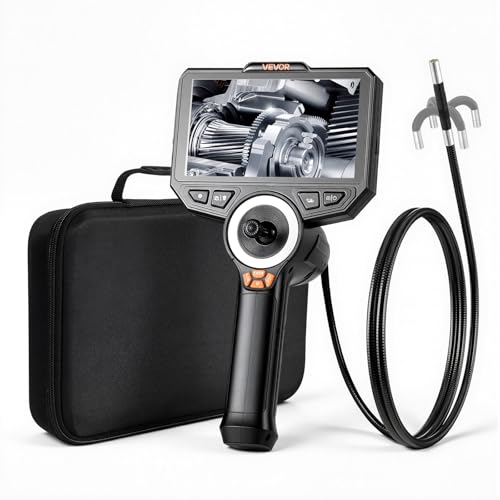
- True 1080P view with a 6-inch IPS display
- Four-way articulation and slim 0.24-inch camera head
- IP67 camera with 5–6-hour battery life
Best For: Automotive and mechanical inspections requiring precise probe steering
Best for Phone-Based Detail
DEPSTECH 2K Dual-Lens Endoscope

- 2K resolution for detailed phone or tablet viewing
- Front and side lenses reduce blind spots
- 16.5-foot semi-rigid cable with IP67 protection
Best For: Mobile inspections requiring long reach and multiple viewing angles
Best for One-Handed Inspections
Teslong Articulating Borescope

- Two-way 210° articulation with joystick control
- 4.5-inch IPS screen works without an app
- IP67 probe, adjustable LEDs, and 32GB storage
Best For: Mechanics wanting a self-contained, easy-to-operate inspection scope
Best for Simple Long-Reach Checks

- 16.6-foot semi-rigid cable for deep access
- 1920×1080P live video on a 4.3-inch IPS screen
- No app or Wi-Fi required; includes retrieval accessories
Best For: Straightforward vehicle, pipe, wall, and sewer inspections
Versatile Dual-Lens Pick
Teslong 5" Dual Lens Borescope

- Forward and side cameras
- 16.5-foot semi-rigid cable
- 5-inch screen with adjustable LEDs
Best For: Mechanics, HVAC work, plumbing, and wall-cavity inspection
Articulating Access Pick
Daxiongmao 1080P Articulating Borescope

- 210-degree two-way articulation
- 1080p camera with IPS display
- IP67 probe and six LEDs
Best For: Engine gaps, chassis work, curved pipes, and tight corners
Long-Reach Smartphone Pick
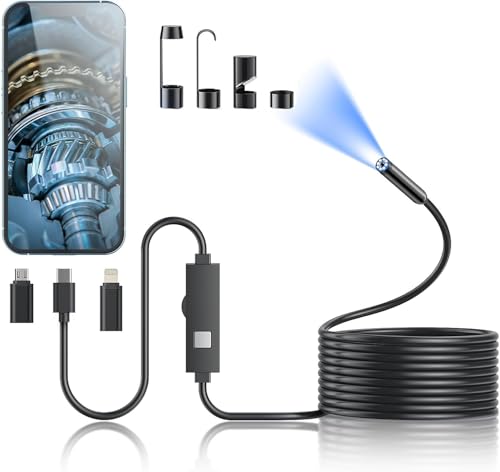
- 1920P imaging with 2.0MP resolution
- 16.4-foot semi-rigid cable
- iOS, Android, and Type-C connectors
Best For: Phone-based vehicle, pipe, wiring, and home inspections
Best Precision Pick
5-Foot Articulating Dual-Lens Borescope

- 210° two-way articulation for precise positioning
- Dual front and side cameras with one-button switching
- 4.3-inch screen, 32GB card, and IP67 waterproofing
Best For: Tight automotive, HVAC, and mechanical inspection tasks
Best Long-Reach Option
16.4-Foot Smartphone Borescope

- 16.4-foot semi-rigid cable for extended reach
- 1920P dual-lens imaging with adjustable LEDs
- Works with iOS and Android devices
Best For: Long pipe, sewer, automotive, and building inspections
Best Standalone Screen
16.4-Foot Dual-Lens Inspection Camera

- 5-inch 1080P screen for app-free live viewing
- 16.4-foot waterproof semi-rigid probe
- Eight LEDs and 3–4-hour battery runtime
Best For: Live automotive, plumbing, drain, and HVAC troubleshooting
Best for Maximum Control – VEVOR 4-Way Articulating 1080P Borescope
For demanding automotive, mechanical, HVAC, and pipeline work, the VEVOR is one of the more capable high-performance underbody inspection cameras. Its true 1080P image, 6-inch IPS display, four-way articulation, and slim 0.24-inch camera head are designed to provide detailed views in cramped spaces.
Best For: Technicians who need precise probe steering and a built-in display for extended inspections.
Pros:
- True 1080P imaging on a large 6-inch IPS screen
- Four-way articulation helps provide coverage from multiple angles
- IP67 waterproof camera and 4.9-foot flexible cable
- 7000mAh battery supports approximately 5–6 hours of operation
Cons:
- At 2.5 pounds, it is less lightweight than phone-connected scopes
- The included probe is 4.9 feet long, which may be limiting for very deep runs
The VEVOR stands out when maneuverability and viewing control matter more than minimal size. Its larger screen and articulated probe make it a strong choice for detailed inspections, while the waterproof construction and long battery help support demanding work sessions.
Best for Phone-Based Detail – DEPSTECH 2K Dual-Lens Endoscope
The DEPSTECH NTC55 is a flexible option among high-performance underbody inspection cameras for users who prefer a phone or tablet display. Its 2K resolution, front-and-side lenses, and 16.5-foot semi-rigid cable help reveal details and perspectives that a single-view camera may miss.
Best For: Mobile users who want high-resolution inspection footage and dual-angle viewing through an app.
Pros:
- 2K 2560×1440P resolution with 3.69 million pixels
- Front and side 0.31-inch lenses support 360° viewing
- 16.5-foot semi-rigid cable reaches deep or curved passages
- IP67 waterproof design with eight-plus-one adjustable LEDs
Cons:
- Requires the DEPSTECHCAM app and a compatible phone or tablet
- Android devices need OTG support, with OTG enabled
This model is particularly appealing when cable length and viewing flexibility are priorities. The phone-based setup keeps the camera portable, but buyers should confirm device compatibility and be comfortable using an app for operation.
Best for One-Handed Inspections – Teslong Articulating Borescope
The Teslong articulating borescope is a practical choice for high-performance underbody inspection cameras when easy handling and immediate operation are important. Its two-way, 210° articulation, 4.5-inch IPS screen, and semi-rigid 5-foot gooseneck provide control without requiring a phone or app.
Best For: Mechanics and inspectors who want a self-contained scope with one-handed probe control.
Pros:
- Two-way 210° articulation navigates tight areas
- Built-in 4.5-inch IPS screen requires no app
- Semi-rigid 5-foot cable holds its shape for directional control
- Adjustable LED lighting and IP67 waterproof construction
Cons:
- Its 1080P resolution is lower than the DEPSTECH’s listed 2K output
- Two-way articulation offers less directional control than a four-way design
The Teslong balances capability and convenience well. A centrally placed joystick, rear photo button, built-in screen, and included 32GB storage make it suited to technicians who want to start inspecting quickly without pairing another device.
Best for Simple Long-Reach Checks – MugEasy 1920P HD Endoscope
The MugEasy endoscope keeps operation straightforward for high-performance underbody inspection cameras used around vehicles, walls, pipes, and sewers. It combines a 4.3-inch IPS screen, 1920×1080P video, adjustable LED lighting, and a 16.6-foot semi-rigid cable without requiring Wi-Fi, an app, or a phone.
Best For: DIY users and technicians who need a long cable and simple plug-and-use operation.
Pros:
- 16.6-foot semi-rigid cable reaches deep inspection areas
- 1920×1080P live view on a 4.3-inch IPS screen
- Eight adjustable LEDs and IP67 waterproof camera
- Includes hook, magnet, and side mirror accessories
Cons:
- Cannot take or store photos
- The 7.9mm probe is larger than the VEVOR’s listed 0.24-inch camera head
- It is intended for video viewing rather than recorded inspection documentation
The MugEasy is a sensible pick when reach and ease of use matter more than image capture. Its long cable and built-in display are useful for pipes and confined spaces, but the lack of photo storage makes it less suitable for inspections requiring a saved record.
Versatile Dual-Lens Pick – Teslong 5" Dual Lens Borescope
For high-performance underbody inspection cameras, the Teslong NTS300 stands out with switchable forward and side views. Its long semi-rigid cable, built-in display, adjustable LEDs, and waterproof probe make it practical for checking engine compartments, pipes, HVAC ducts, and other hard-to-reach areas.
Best For: Mechanics, HVAC technicians, homeowners, and anyone who needs both forward and side visibility without relying on a phone or app.
Pros:
- Dual lenses provide forward and side inspection views, each with independent LEDs.
- 16.5-foot semi-rigid cable reaches deep into ducts, drains, wall cavities, and engine bays.
- 5-inch IPS screen and seven adjustable LED lights support comfortable viewing in dark spaces.
- 5000mAh rechargeable battery provides approximately 4.5 hours of continuous use.
Cons:
- At approximately 2 kg, it is heavier than more compact inspection-camera options.
- Video capture is listed at 720p, below the resolution of some newer models.
- The fixed-focus probe may be less versatile for subjects outside its stated focus range.
The Teslong is a strong choice when inspection angles matter more than maximum image resolution. Its self-contained screen and included hook, magnet, mirror, and hard case make it a convenient field-ready kit.
Articulating Access Pick – Daxiongmao 1080P Articulating Borescope
The Daxiongmao Z91-5FT is designed for high-performance underbody inspection cameras users who need to steer around obstructions. Its 210-degree two-way articulating head can help reach curved pipes, narrow engine gaps, and hidden corners while the 1080p camera and 4.5-inch IPS display show inspection details clearly.
Best For: Automotive maintenance, chassis and engine checks, pipe work, HVAC inspection, and other jobs where probe positioning is the main challenge.
Pros:
- 210-degree bidirectional articulation helps access curved and obstructed inspection areas.
- 1080p video and a 4.5-inch IPS screen provide a clear real-time view.
- IP67 protection and six adjustable LEDs suit damp, dusty, greasy, and dark work areas.
- Includes a 32GB card, charging cable, carrying bag, and an ergonomic handheld design.
Cons:
- The 5-foot cable is considerably shorter than the long-reach options in this roundup.
- Charging requires a household 5V/1A charger; fast charging is not supported.
- The supplied notes do not specify a battery runtime.
Choose this model when directional control is more valuable than maximum reach. The articulating head can reduce repositioning during difficult inspections, while the integrated screen avoids app setup in the field.
Long-Reach Smartphone Pick – Kinpthy 1920P HD Borescope
The Kinpthy W400-B is a practical option among high-performance underbody inspection cameras for users who prefer viewing through a smartphone or tablet. Its 16.4-foot semi-rigid cable, 7.9mm probe, adjustable lighting, and 1920P image support make it useful for vehicle, pipe, wiring, and home inspections.
Best For: DIY users and technicians who already have a compatible iOS or Android device and want long reach with high-resolution close-range images.
Pros:
- 1920P video and 2.0MP imaging provide detailed close-range inspection footage.
- 16.4-foot semi-rigid cable offers substantial reach while remaining easy to position and store.
- IP67 probe can operate underwater up to 3.28 feet for up to one hour.
- Includes Android, Lightning, and Type-C connectors plus hook, magnet, mirror, and protective cap.
Cons:
- Requires a compatible smartphone or tablet and the SUP-ANESOK app for viewing.
- The single fixed lens does not provide the alternate viewing angle offered by dual-lens models.
- It has no optical zoom, according to the supplied specifications.
This Kinpthy model is a good fit when long reach and high-resolution capture take priority. Its broad connector package improves device compatibility, but buyers should be comfortable using a phone or tablet rather than a dedicated display.
Best Precision Pick – 5-Foot Articulating Dual-Lens Borescope
For high-performance underbody inspection cameras, this compact borescope stands out when precise positioning matters. Its two-way 210° articulation, dual-lens design, built-in screen, and waterproof probe make it practical for automotive, HVAC, plumbing, and mechanical inspections.
Best For: Mechanics and DIY users who need controlled viewing in tight spaces without relying on a smartphone.
Pros:
- Two-way 210° articulation provides a 420° range of motion for difficult angles.
- Front and side cameras switch with one button, while eight adjustable LEDs improve visibility.
- Includes a 4.3-inch IPS screen, 32GB card, carrying case, and useful retrieval accessories.
- IP67 waterproofing and a slim 0.33-inch probe support inspections in wet, confined areas.
Cons:
- The cable is only 5 feet long, which may limit reach on larger vehicles or structures.
- Its built-in screen means inspections are not designed around smartphone connectivity.
This is a strong choice when maneuverability and self-contained operation are more important than maximum cable length. The articulating probe and side-view camera offer useful advantages for underbody and mechanical inspection work.
Best Long-Reach Option – 16.4-Foot Smartphone Borescope
This high-performance underbody inspection camera is built for situations where reach is the priority. The 16.4-foot semi-rigid cable, dual-lens probe, 1920P imaging, and smartphone compatibility make it useful for examining long pipe runs, vehicle components, walls, ducts, and other hard-to-access areas.
Best For: Users who want a long inspection cable and prefer viewing results on an iOS or Android phone or tablet.
Pros:
- The 16.4-foot semi-rigid cable reaches substantially farther than compact handheld scopes.
- Dual lenses and 1920P image capture help show front and side perspectives in confined spaces.
- Eight adjustable LEDs and IP67 waterproofing support dark or damp inspection areas.
- Includes Lightning, USB, and USB-C connectors plus magnet, hook, mirror, and protective cap accessories.
Cons:
- Requires the SUP-ANESOK app and a compatible iOS or Android device.
- The probe is not heat-resistant, so vehicle engines must cool before inspection.
- A long cable can be less convenient to manage in very tight work areas.
Choose this model when access distance matters most and carrying a phone or tablet is acceptable. Its cable length and multi-connector setup make it particularly versatile for plumbing, automotive, sewer, and building inspections.
Best Standalone Screen – 16.4-Foot Dual-Lens Inspection Camera
For high-performance underbody inspection cameras with straightforward operation, this model combines a 5-inch display with a long, waterproof probe. Its dual-lens view, 1080P clarity, adjustable lighting, and 3–4-hour battery runtime suit automotive, plumbing, HVAC, and drain inspections.
Best For: Mechanics and plumbers who want a long-reach inspection tool that works without an app or Wi-Fi.
Pros:
- Large 5-inch HD screen provides a clear real-time view during inspections.
- 16.4-foot semi-rigid probe, dual lenses, and 170° viewing angle help cover difficult areas.
- Eight adjustable LEDs and IP67 waterproofing support dark, wet, and submerged environments.
- Plug-and-play design, one-handed handling, and a 2000mAh battery provide practical field convenience.
Cons:
- It cannot take pictures or record video.
- The fixed-focus range is limited to approximately 1.2–4 inches.
- Its red housing may be less discreet for some professional work settings.
This is a sensible pick for live troubleshooting rather than documentation. Its large built-in screen and long waterproof probe make it convenient for underbody, drain, duct, and pipe inspections when image or video storage is not required.
How We Picked the Best High-Performance Underbody Inspection Cameras
We focused on the features that matter during automotive and industrial inspections: image quality, probe reach, articulation, lighting, lens coverage, water resistance, controls, and viewing convenience. The selection includes phone-connected cameras, dedicated-screen borescopes, single- and dual-lens designs, and models with articulating tips.
Rather than treating the highest resolution as the only deciding factor, we considered how effectively each camera helps users locate leaks, corrosion, blockages, damaged wiring, and hard-to-reach mechanical components. Cable length and probe flexibility are especially important when inspecting underbody cavities or routing a camera through an engine compartment.
Quick Comparison
- Best for broad visibility: Dual-lens cameras can show forward and side-facing views without repeatedly repositioning the probe.
- Best for precise routing: Articulating borescopes provide more control around bends, brackets, and enclosed spaces.
- Best for portability: Phone-connected models are compact and convenient for occasional inspections.
- Best for job-site use: Dedicated-screen units reduce dependence on a phone and often include built-in recording controls.
- Best for wet or dirty areas: IP67-rated probes offer useful protection, but the camera should still be cleaned and dried after use.
Key Buying Factors for High-Performance Underbody Inspection Cameras
Resolution and Image Coverage
1080p and 1920p-class cameras can provide a clear view of fasteners, hoses, labels, and surface damage. Dual-lens designs add side visibility, while adjustable LEDs help balance dark cavities and reflective metal surfaces.
Articulation and Probe Length
A steerable tip is valuable when the inspection path includes tight bends. Compare the articulation range, control layout, and stiffness of the probe. For vehicles and larger equipment, a cable around 16 feet can reach farther than compact probes, but it may be harder to manage.
Display and Connectivity
Dedicated screens are ready to use and remain practical in dirty shop environments. Phone-based cameras can be easier to store and share, but compatibility, wireless stability, and phone battery life deserve attention.
Durability and Recording
Look for an IP-rated probe, reinforced cable construction, and a grip that remains comfortable during extended inspections. Photo and video capture are useful for documenting findings, comparing repairs, or sharing evidence with a technician.
Who Should Buy Which High-Performance Underbody Inspection Cameras?
DIY vehicle owners should prioritize simple controls, strong lighting, and a clear screen or dependable phone connection. Professional mechanics will benefit from articulation, dual-lens coverage, long probes, and durable construction. HVAC, plumbing, and maintenance technicians should favor reach, waterproofing, and a dedicated display if the camera will be used frequently across different job sites. For occasional checks in tight spaces, a compact phone-connected model may provide the best value.