Finding problems inside engines, HVAC systems, cylinders, and other tight spaces is easier with the right inspection camera. The best models combine useful articulation, clear imaging, practical lighting, and a probe size suited to the job.
We compare 10 premium automotive inspection cameras to help mechanics, technicians, and serious DIY users choose a reliable tool for faster, less invasive inspections.
Best 10 Premium Automotive Inspection Cameras Picks for 2026
Best Articulating Control

- Two-way articulating probe
- 5-inch IPS display with no app required
- 32GB card and wireless image sharing
Best For: Mechanics needing guided engine inspections and easy recording
Best Four-Way Coverage

- Four-way 360° articulation
- Slim 6.2mm probe with 1080P video
- Replaceable 5000mAh battery
Best For: Technicians needing precise access and extended inspection sessions
Best Long-Reach Dual Lens

- Forward and side cameras
- 16.5-foot semi-rigid cable
- 5-inch display with seven LEDs
Best For: Inspectors needing long reach and alternate viewing angles
Best Slim-Probe Value

- Four-way 180° articulation
- Slim 6.2mm probe with 4X zoom
- 32GB card and heat protection
Best For: Users needing maneuverability in tight inspection spaces
Editor's Choice
FOXWELL Dual-Lens Articulating Borescope
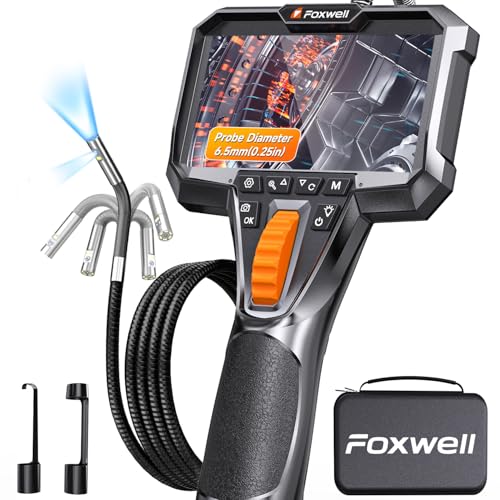
- Dual front-and-side cameras with 220° articulation
- Slim 6.5mm IP67 probe for tight spaces
- HD IPS display with 32GB built-in storage
Best For: Mechanics needing flexible, detailed views in confined areas
Comfort Pick
Teslong Articulating Automotive Borescope

- 5-foot semi-rigid gooseneck for controlled reach
- 4.5-inch IPS screen with app-free operation
- Two-way articulation and one-handed joystick control
Best For: Users handling long, awkward inspection routes
Best Value Features
ROVE RS2 Articulating Borescope

- Slim 6.2mm probe with 210° articulation
- 1080p capture with 2x/4x zoom and audio
- 4.3-inch IPS display, dual lighting, and 32GB card
Best For: Mechanics and DIYers wanting a ready-to-use inspection kit
Best Overall
DXZtoz Dual-Lens Articulating Borescope

- Dual-lens viewing for difficult angles
- Large 5-inch 1080p IPS display
- IP67 probe with 4–5-hour battery
Best For: Automotive technicians and serious DIY inspections
Best for Flexible Reach
DXZtoz 220° Articulating Endoscope

- 220° two-way steering lens
- Shape-holding IP67 gooseneck probe
- No app required and includes accessories
Best For: Routine automotive and maintenance inspections
Best Slim Dual-Lens Design
FOXWELL Y406D Articulating Borescope

- Ultra-slim 6.5mm probe
- 220° articulation with front and side cameras
- IP67 protection and 2x/4x zoom
Best For: Restricted-access automotive and HVAC inspections
Best Articulating Control – Teslong TD500
For mechanics comparing premium automotive inspection cameras, the Teslong TD500 stands out for its two-way articulating probe and self-contained 5-inch display. Its 5-foot semi-rigid cable helps position the camera around engine components without requiring a phone or external software.
Best For: Mechanics who want guided access around engine parts, onboard recording, and wireless image sharing.
Pros:
- Two-way articulation helps reach different viewing angles.
- 5-inch IPS screen operates without an app or external hardware.
- Includes a 32GB microSD card for JPG photos and AVI video.
- Built-in wireless adapter supports sharing inspection images with a tablet.
Cons:
- The 5-foot cable is shorter than some inspection-camera alternatives.
- Two-way articulation provides less directional control than four-way designs.
- The unit weighs about 1.48 kg.
The TD500 is a practical choice when straightforward operation and useful documentation matter more than maximum articulation. Its integrated screen, microphone, memory card, and wireless sharing make it well suited to routine automotive diagnostics.
Best Four-Way Coverage – ROVE RS4
The ROVE RS4 is a strong premium automotive inspection camera option for reaching difficult angles. Its four-way 360° articulation, slim 6.2mm probe, and 1080P display are designed for detailed inspections around engine cylinders, bends, and confined spaces.
Best For: Professional mechanics and technicians who need broad directional control, long runtime, and high-definition recording.
Pros:
- Four-way articulation provides 360° envelope coverage.
- 6.2mm probe fits spark plug holes and other narrow openings.
- 1080P video displays on a bright 4.3-inch IPS screen without an app.
- 5000mAh replaceable battery provides up to six hours of continuous use.
Cons:
- The screen is smaller than the 5-inch display on some alternatives.
- High-temperature protection shuts the camera down above 176°F.
- Its feature set may be more than casual DIY users need.
With four-way steering, dual lighting, IP67 protection, and a replaceable battery, the RS4 is built for demanding inspection sessions. It is especially appealing when access, runtime, and recorded 1080P footage are priorities.
Best Long-Reach Dual Lens – Teslong NTS300
For buyers seeking premium automotive inspection cameras with extra reach, the Teslong NTS300 combines a 16.5-foot semi-rigid cable with forward and side-facing lenses. The dual-camera setup helps inspect engine cylinders, compartments, walls, ducts, and pipes without repeatedly repositioning the probe.
Best For: Mechanics and HVAC technicians who need long reach and the ability to switch between forward and side views.
Pros:
- Dual lenses provide forward and side inspection views.
- 16.5-foot semi-rigid cable reaches deep areas.
- Independent lens lighting and seven adjustable LEDs help illuminate dark spaces.
- 5-inch IPS display works without a phone, Wi-Fi, or app.
Cons:
- The listed video resolution is 720P rather than 1080P.
- The 8mm probe is thicker than the 6.2mm probes in some competing models.
- Approximately 4.5 hours of battery life may require recharging during extended work.
The NTS300 favors coverage and viewing flexibility over a slimmer probe or higher video resolution. Its long cable and dual-lens design make it useful for broad-area diagnostics where reaching the inspection point is the main challenge.
Best Slim-Probe Value – Ralcam F6
The Ralcam F6 offers several features expected from premium automotive inspection cameras in a compact inspection system. Its 6.2mm probe, four-way 180° articulation, 4.3-inch IPS display, and image rotation help users work around tight engine spaces and other awkward viewing positions.
Best For: DIY users and technicians who need a slim, maneuverable probe with onboard viewing and recording.
Pros:
- Four-way articulation bends 180° in each direction.
- 6.2mm probe fits spark plug holes and fuel injector ports.
- 4X digital zoom and 180° image rotation help inspect difficult views.
- Includes a 32GB memory card and automatic high-temperature shutdown.
Cons:
- The 4.3-inch screen is smaller than the 5-inch displays on some alternatives.
- Battery runtime is described only as lasting for hours, without a specified duration.
- The supplied details do not state a video resolution.
The F6 is a versatile option for tight-access inspections where probe diameter and maneuverability matter. Its zoom, image rotation, memory card, and heat protection add useful convenience for engine, plumbing, and HVAC work.
Editor's Choice – FOXWELL Dual-Lens Articulating Borescope
For premium automotive inspection cameras, the FOXWELL stands out with a slim 6.5mm probe, dual front-and-side cameras, and 220° articulation. Its dedicated IPS display, built-in storage, and no-app operation make it a practical choice for inspecting engine components and other confined areas.
Best For: Mechanics and technicians who need broad visibility in tight automotive spaces, including spark plug holes, cylinders, valves, and narrow passages.
Pros:
- Dual-lens design lets you switch between front and side views.
- 220° articulation and a 0.25-inch probe help reach confined areas.
- HD IPS display, adjustable lighting, and enhanced imaging support detailed inspections.
- IP67 probe, 32GB storage, and USB-C file transfer add job-site convenience.
Cons:
- The product weighs 2.44 pounds, which may be less convenient for extended handheld use.
- Its heat-protection system shuts the device down above 70°C, so hot-engine inspections require care.
The FOXWELL is the most feature-rich option here for users who value viewing flexibility and detailed image capture. Its dual cameras and slim probe can reduce disassembly, while the rugged probe and built-in storage suit repeated professional inspections.
Comfort Pick – Teslong Articulating Automotive Borescope
Among premium automotive inspection cameras, the Teslong combines a 5-foot semi-rigid gooseneck with two-way articulation and a 4.5-inch IPS screen. It is designed for controlled navigation through complex spaces while keeping the live view and controls accessible without an app.
Best For: Automotive, HVAC, and household inspection work where a shape-holding probe and one-handed control are especially useful.
Pros:
- 5-foot semi-rigid gooseneck balances flexibility with positioning stability.
- Two-way articulation and a centrally placed joystick support one-handed operation.
- 4.5-inch IPS display provides a clear live view without requiring an app.
- 1080p video, adjustable probe lighting, IP67 water resistance, and included 32GB media support practical documentation.
Cons:
- Its 2MP still-image resolution is more limited than higher-resolution imaging systems.
- The listed battery life is approximately five hours, so longer jobs may require recharging.
- The probe articulates two ways rather than offering the FOXWELL’s dual-camera coverage.
The Teslong emphasizes handling comfort and reach. Its long, semi-rigid cable is helpful when the inspection point is deep or awkwardly positioned, while the large IPS screen and rear photo button make routine documentation straightforward.
Best Value Features – ROVE RS2 Articulating Borescope
The ROVE RS2 is a capable option in the premium automotive inspection cameras category, pairing a slim 6.2mm probe with 210° articulation, 1080p recording, and a built-in IPS display. Its dual-light system and included 32GB microSD card make it ready for engine, pipe, and HVAC inspections out of the box.
Best For: Mechanics and DIY users who want a compact, self-contained inspection camera with photo, video, audio, and onboard lighting.
Pros:
- 6.2mm IP67 probe fits spark plug holes, narrow pipes, and wall cavities.
- 210° articulation, a 1.6m semi-rigid gooseneck, and hand rotation help inspect around corners.
- 1080p photo and video capture includes a 90° wide-angle lens, focus range, and 2x/4x zoom.
- 4.3-inch IPS display, dual lighting, four brightness levels, and included 32GB card support field use.
Cons:
- Battery life is listed at up to four hours, which may be limiting for extended inspections.
- Unlike the FOXWELL, it uses a single camera rather than a dual-lens viewing system.
- The screen is smaller than the Teslong’s 4.5-inch display.
The RS2 offers a strong balance of reach, recording capability, lighting, and durability. It is particularly appealing when you want a grab-and-go unit that works without a phone, Wi-Fi connection, or separate storage purchase.
Best Overall – DXZtoz Dual-Lens Articulating Borescope
For shoppers seeking premium automotive inspection cameras, the DXZtoz AGC500L stands out for combining two-way articulation with front and side viewing. Its 5-inch 1080p IPS display, IP67 probe, and included retrieval tools make it a practical choice for detailed inspections without immediate disassembly.
Best For: Automotive technicians and serious DIY users inspecting engines, turbochargers, gearboxes, HVAC systems, and other confined areas.
Pros:
- Dual-lens design adds a 90-degree side camera for difficult angles and fewer blind spots.
- Rotatable probe tip and front-exit cable improve control in tight spaces.
- Large 5-inch 1080p IPS screen with 10x zoom helps reveal small details.
- IP67 waterproof and oil-resistant probe, 4–5-hour battery, and hook and magnet accessories.
Cons:
- The larger display and included case may be less convenient for users wanting a compact scope.
- Manual focus may require more adjustment than an autofocus system.
The AGC500L is a strong all-around pick when viewing flexibility and screen size matter most. Its dual-lens setup is particularly useful where a conventional forward-facing camera cannot easily be positioned.
Best for Flexible Reach – DXZtoz 220° Articulating Endoscope
The DXZtoz AGC430N is one of the more accessible premium automotive inspection cameras for users who want steering control without an app. Its 220-degree articulating lens, slim 8.5mm probe, and rigid gooseneck are suited to short, close-up inspections around engines, HVAC components, and machinery.
Best For: Mechanics and maintenance users who need a steerable probe for compact spaces and routine close-up diagnostics.
Pros:
- 220-degree two-way articulation helps the camera pass obstacles and look back inside assemblies.
- 8.5mm probe, 1080p imaging, 8x digital zoom, and adjustable LED lighting support close inspection.
- IP67 waterproof and oil-resistant probe with a shape-holding metal gooseneck.
- Includes hook, magnet, side mirror, case, 32GB card, and a rechargeable battery rated for about four hours.
Cons:
- The 4.3-inch display is smaller than the 5-inch screen on some competing models.
- Its 8.5mm probe may not fit openings designed for ultra-slim inspection cameras.
Choose the AGC430N when controllable positioning and a self-contained workflow are higher priorities than maximum display size or the thinnest possible probe.
Best Slim Dual-Lens Design – FOXWELL Y406D Articulating Borescope
The FOXWELL Y406D is a compelling option among premium automotive inspection cameras when access is the main challenge. Its 6.5mm, 0.25-inch probe combines 220-degree articulation with front and side cameras, while the IPS display, adjustable lighting, and zoom tools support clearer checks in narrow or complex spaces.
Best For: Professionals inspecting spark-plug openings, cylinders, HVAC vents, narrow pipes, and other restricted access points.
Pros:
- Ultra-slim 6.5mm probe can reach spaces larger scopes may not fit.
- Dual-lens 220-degree articulation provides front and side perspectives without repositioning the entire tool.
- HD IPS display, CMOS imaging system, adjustable LEDs, and 2x/4x zoom support detailed viewing.
- IP67 protection, heat-protection shutdown above 70°C, USB-C transfer, and built-in 32GB storage.
Cons:
- The product notes do not specify the display size or battery runtime.
- Its slim probe and feature-rich design may be more than needed for basic visual checks.
The Y406D is the most access-focused choice in this group. Its slim probe and dual-lens articulation make it especially well suited to inspections where fitting through a small opening is more important than having a larger probe or display.
How We Picked These Premium Automotive Inspection Cameras
We focused on features that have the greatest effect on real-world inspections: probe diameter, articulation range, camera configuration, image resolution, built-in lighting, display quality, recording options, and overall ease of use. Dual-lens models can provide both forward and side views, while articulating probes make it easier to steer around bends and inspect hidden components.
We also considered practical details such as included memory cards, rechargeable operation, cable flexibility, screen size, and suitability for automotive, HVAC, wall, and general equipment inspections. Because specifications and package contents can vary by listing, verify the current details before purchasing.
Quick Comparison
| Feature | Why It Matters |
|---|---|
| Probe diameter | Thinner probes reach smaller openings and tighter passages. |
| Articulation | More directional control helps navigate bends and target specific parts. |
| Dual cameras | Forward and side-facing views improve coverage without repositioning as often. |
| Lighting | Adjustable LEDs help reveal details in dark engine bays and cavities. |
| Recording | Photo and video capture supports documentation, diagnosis, and comparison. |
Key Buying Factors
Probe Size and Reach
Measure the access point before choosing a camera. A slim probe is valuable for spark-plug openings, narrow passages, and compact mechanical assemblies, while a slightly larger probe may offer a more robust cable or additional camera hardware. Pay attention to probe length as well as diameter.
Articulation and Control
Two-way articulation can be sufficient for straightforward inspections. Four-way or 360-degree articulation offers more control when the camera must turn around obstructions or inspect multiple surfaces. Smooth, precise controls are generally more useful than a high maximum angle alone.
Image Quality and Camera Views
Resolution affects how easily you can distinguish cracks, deposits, corrosion, leaks, and worn surfaces. Dual-lens systems are especially practical when the target is difficult to align with a forward-facing camera. A bright, adjustable light is essential because many inspection areas have little or no ambient illumination.
Screen, Storage, and Battery
A built-in monitor allows immediate viewing without relying on a phone connection. Check screen size, control layout, battery runtime, charging method, and whether photos or videos can be saved to removable storage. For professional work, confirm that the camera can document findings in a format that is easy to share.
Who Should Buy Which Premium Automotive Inspection Cameras?
Choose a slim, two-way model for tight automotive access points and routine maintenance checks. Select a four-way or 360-degree articulating camera when you regularly work around bends, inside complex assemblies, or across several viewing angles. A dual-lens model is a strong all-purpose choice for mechanics who inspect engines, HVAC systems, walls, and machinery.
For occasional DIY diagnosis, prioritize simple controls, a clear display, useful lighting, and dependable battery life over advanced specifications. Professional technicians should look more closely at articulation precision, probe durability, recording capabilities, and the ability to repeat inspections consistently. Whichever model you choose, match the probe diameter and articulation system to the spaces you inspect most often.