Choosing among the best 3d printers for beginners means focusing on ease of use first, not just speed or features. A good starter machine should reduce setup frustration and help you get clean prints quickly.
Below, we’ve prioritized beginner-friendly models with sensible automation, practical build sizes, and strong value for new users, kids, and hobbyists who want a smooth first experience.
Best 10 3d Printers for Beginners Picks for 2026
Fast Auto-Leveling Starter

- One-click automatic bed leveling
- Up to 600mm/s travel speed
- Quick nozzle changes and fast warm-up
Best For: New users who want speed, automation, and simple day-to-day operation
Quiet Beginner Ecosystem

- Full-auto calibration for easy setup
- MakerWorld and Bambu Handy support
- Quiet operation under 48 dB
Best For: First-time users who want a compact, quiet printer with helpful app and model support
Fast Reliable Entry Upgrade

- CR Touch auto leveling and strain sensor
- Three-step assembly in about 20 minutes
- Sprite direct extruder for multiple filaments
Best For: Beginners who want an upgraded, easy-to-assemble printer with strong everyday reliability
Mini Cloud Learning Printer

- Fully assembled with no calibration needed
- WiFi cloud printing and 1,500+ models
- Auto leveling with a flexible build plate
Best For: Kids, classrooms, and beginners who want a compact printer with the simplest possible start
Fast, Large-Format Starter Pick

- 600mm/s printing with fast heating and high acceleration
- Auto leveling and pressure compensation simplify setup
- PEI plate, quick-change nozzle, and app monitoring
Best For: Beginners who want speed and easy setup for home, school, or maker use
All-in-One Easy Starter
Fully Assembled Mini 3D Printer

- Fully assembled with auto leveling and one-touch filament loading
- Includes PLA filament, microSD card, and starter software
- Compact footprint suited to homes, dorms, and classrooms
Best For: Beginners and kids who want a complete, ready-to-use starter kit
Kid-Friendly Starter
M1 Mini 3D Printer for Kids & Beginners
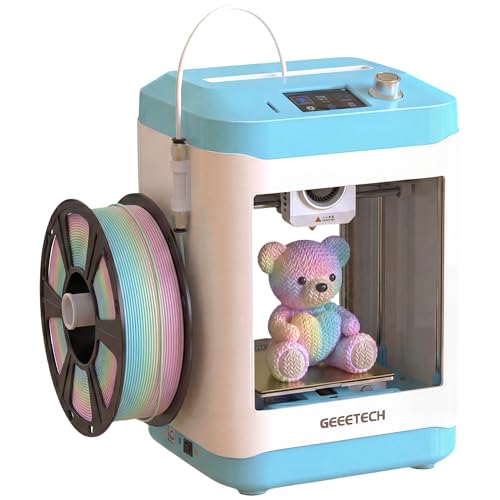
- Unboxing to first print in about 15 minutes
- 16-point auto leveling and auto nozzle cleaning
- Direct drive supports PLA and TPU
Best For: Families and first-time users who want a compact, low-fuss starter printer
Wireless Value Pick

- Fully assembled and ready to print quickly
- WiFi cloud app with 3,000+ online models
- Open-source support for popular slicers
Best For: Students and beginners who want app-based printing and a compact footprint
Fast Auto-Leveling Starter – FLASHFORGE Adventurer 5M
If you want one of the more capable 3d printers for beginners, the FLASHFORGE Adventurer 5M is built to reduce setup friction without giving up speed. Its one-click automatic leveling, quick warm-up, and detachable nozzle system make it a practical choice for newcomers who want cleaner first layers and less tinkering.
Best For: Beginners who want a fast, auto-leveling printer that stays simple to use.
Pros:
- Automatic bed leveling helps improve first-layer consistency without manual adjustment.
- CoreXY design with up to 600mm/s travel speed and high acceleration supports rapid printing.
- 3-second nozzle changes and a 35-second warm-up to 200°C make everyday use more convenient.
- Dual-sided PEI platform and app-based monitoring add practical beginner-friendly features.
Cons:
- High-speed performance is a strong feature, but beginners may still need time to learn the best print settings.
- The notes emphasize maintenance and troubleshooting, so routine upkeep still matters.
The Adventurer 5M stands out for beginners who want a faster, more automated start without a complicated build process. It is especially appealing if you value convenience and speed in equal measure.
Quiet Beginner Ecosystem – Bambu Lab A1 mini
Among 3d printers for beginners, the Bambu Lab A1 mini is aimed squarely at easy setup and low-stress printing. It adds full-auto calibration, active flow rate compensation, and access to MakerWorld so you can spend less time dialing in settings and more time printing ready-to-use models.
Best For: Beginners who want a compact, quiet printer with a friendly software and model ecosystem.
Pros:
- Designed for beginners with automatic calibration and simple setup.
- MakerWorld model library and Bambu Handy app make it easier to find and manage prints.
- Quiet operation at less than 48 dB suits home, studio, or workspace use.
- Included LED Lamp Kit adds a creative project option right away.
Cons:
- The print volume is compact, so it is better suited to smaller projects.
- The included lamp kit is useful, but it is most valuable if you want decorative light projects.
The A1 mini is a strong pick if you want a beginner printer that feels polished from the start. Its ecosystem, automation, and quiet footprint make it especially easy to live with.
Fast Reliable Entry Upgrade – Creality Ender 3 V3 SE
The Creality Ender 3 V3 SE is a practical option for shoppers comparing 3d printers for beginners and wanting a familiar format with fewer setup hassles. It adds CR Touch auto leveling, a Sprite direct extruder, and quick three-step assembly, which makes it easier to get printing without a long learning curve.
Best For: Beginners who want a budget-friendly style printer with upgraded automation and solid speed.
Pros:
- CR Touch auto leveling and strain sensor reduce the need for manual bed adjustments.
- Quick 20-minute assembly and preassembled design help shorten the path to the first print.
- Sprite full-metal direct extruder is built for smooth feeding and supports PLA, TPU, and PETG.
- 250mm/s maximum speed and dual Z-axis support add stability and efficiency.
Cons:
- The build volume is smaller than some larger desktop printers.
- It is still an FDM machine, so beginners will need to learn filament-specific basics over time.
The Ender 3 V3 SE is a sensible step-up choice for beginners who want dependable hardware with helpful automation. It balances speed, ease of assembly, and familiar Creality support in a compact package.
Mini Cloud Learning Printer – Entina TINA2S
The Entina TINA2S is built around simplicity, which makes it a good fit for buyers looking at 3d printers for beginners, kids, and home use. It arrives fully assembled, includes auto leveling, and supports WiFi cloud printing with a large model library, so you can start quickly without much setup.
Best For: Beginners, kids, and classrooms that need a compact printer with easy start-up and cloud access.
Pros:
- Fully assembled design means there is no setup or calibration required before printing.
- Auto leveling and a flexible spring steel build plate help simplify first prints and removal.
- Poloprint Cloud app provides access to 1,500+ ready-to-print models.
- Quiet operation and compact size make it suitable for bedrooms, schools, and offices.
Cons:
- The print volume is small, so it is best for mini projects rather than larger builds.
- Its feature set is focused on ease of use, not high-end performance or advanced customization.
If you want a small, approachable printer that minimizes setup stress, the TINA2S delivers exactly that. It is especially attractive for learning environments and simple creative projects.
Fast, Large-Format Starter Pick – Flashforge Adventurer 5M
If you want one of the more capable 3d printers for beginners without giving up speed, the Flashforge Adventurer 5M is a strong fit. It pairs auto bed leveling with a CoreXY frame, fast heating, and app-based monitoring, so new users can spend less time troubleshooting and more time printing useful parts.
Best For: Beginners who want a fast, low-fuss printer for home, school, or maker projects.
Pros:
- Up to 600mm/s printing with high acceleration for quick turnaround.
- Auto bed leveling with pressure-sensor compensation for easier first layers.
- Direct drive, 280°C hotend, and multiple nozzle sizes for different print types.
- MagSwitch PEI plate and quick-change nozzle system help simplify workflow.
Cons:
- Its speed-focused design may be more printer than a total first-timer needs.
- Optional enclosure setup is a separate upgrade path, not included as standard.
Overall, this is a practical choice if you want beginner-friendly features but also expect to grow into faster, more consistent printing. It stands out for users who value speed, convenience, and a more advanced platform right away.
All-in-One Easy Starter – Fully Assembled Mini 3D Printer
This fully assembled mini option is one of the simplest 3d printers for beginners if you want an out-of-the-box start. It includes filament, a microSD card, auto leveling, and one-touch filament loading, which makes it especially approachable for kids, classrooms, and first-time users.
Best For: First-time users who want a complete starter kit with minimal setup.
Pros:
- Fully assembled design removes the hassle of complex setup.
- Includes 10M PLA filament and a microSD card with designs and software.
- Auto leveling, one-touch filament loading, and active pause/resume add convenience.
- Compact size works well for homes, dorms, and classrooms.
Cons:
- Build volume is small, so it is better for compact prints than larger projects.
- Primarily designed around PLA, PLA Pro, and TPU compatibility.
For beginners who want the least intimidating entry into 3D printing, this model keeps the process simple and compact. Its starter-kit approach is the main appeal, especially if you value convenience over size or advanced features.
Compact Open-Source Learner – Geeetech M1 Mini
If you are comparing 3d printers for beginners and want a compact machine with more hands-on flexibility, the Geeetech M1 Mini is worth a look. It comes fully assembled with auto leveling, direct drive extrusion, and open-source support, giving new users a straightforward path into printing while leaving room to experiment.
Best For: Beginners who want a small, fully assembled printer with open-source flexibility.
Pros:
- Fully assembled with plug-and-play TF card printing for easy start-up.
- 16-point auto leveling helps improve print consistency.
- Direct drive extruder offers better extrusion force and TPU compatibility.
- Open-source support and included beginner-friendly controls simplify use.
Cons:
- Small print area limits larger projects.
- TF card workflow is practical, but less flexible than more advanced connected setups.
This model makes sense if you want a beginner printer that is easy to run but still leaves room for tinkering. Its compact size and open-source nature make it especially appealing for home learning, school use, and small craft projects.
Kid-Friendly Starter – M1 Mini 3D Printer for Kids & Beginners
If you’re comparing 3d printers for beginners, the TEQStone M1 is built to keep the setup simple and the first print fast. It arrives ready for quick unboxing-to-print use, includes pre-sliced models on the SD card, and adds automatic leveling plus auto nozzle cleaning to cut down on common first-timer mistakes.
Best For: Families, kids, and first-time users who want a compact printer with minimal setup and straightforward learning.
Pros:
- Gets from unboxing to first print in about 15 minutes
- 16-point automatic leveling helps improve first-layer success
- Direct drive extruder supports PLA and flexible TPU
- Compact, quiet design with filament break detection
Cons:
- Mini size may be limiting for larger projects
- Speed-focused output is better suited to small models
The M1 stands out if you want a beginner printer that reduces setup friction and keeps printing fun for younger users. Its mix of automatic calibration, included starter models, and flexible-material support makes it a practical entry point for home use.
Wireless Value Pick – TINA2 Plus Mini 3D Printer
For shoppers looking at 3d printers for beginners, the TINA2 Plus focuses on fast start-up and simple wireless printing. It comes fully assembled, includes one-tap access to a large model library through its Poloprint Cloud app, and supports phone or tablet slicing and WiFi upload for a streamlined beginner workflow.
Best For: Beginners, students, and casual makers who want a compact printer with app-based convenience and minimal setup.
Pros:
- Fully assembled and ready to print in minutes
- WiFi cloud printing with a large built-in model library
- Up to 250mm/s max speed, with 150mm/s recommended
- Open-source compatibility with Cura, PrusaSlicer, and more
Cons:
- Recommended speed is lower than the maximum rating
- Mini footprint may not suit bigger prints
This model is a strong fit if you value convenience over tinkering. The included filament, compact size, and simple app-based workflow make it easier for new users to start printing without dealing with a complicated build process.
Complete Starter Kit – Fully Assembled Mini 3D Printer
This option for 3d printers for beginners is designed to feel complete right away. It ships fully assembled with a roll of filament, an SD card, and accessories, while one-button auto-leveling, auto nozzle cleaning, and one-touch filament loading reduce the usual setup steps that can slow down new users.
Best For: New users who want a complete out-of-box starter kit with built-in convenience features and support.
Pros:
- Fully assembled starter kit with filament, SD card, and accessories
- Auto-leveling, auto nozzle cleaning, and one-touch filament loading
- Up to 250mm/s speed with claimed 0.01mm precision
- Includes 30-day returns, 12-month repair service, and lifetime support
Cons:
- Mini format is better for smaller models
- 1kg filament use requires a printed compatible holder
If you want the easiest possible entry into printing, this starter kit removes several common obstacles at once. The included materials and convenience features make it especially appealing for first-time users who want to begin printing with minimal extra shopping or setup.
How We Picked These 3d Printers for Beginners
We focused on features that matter most for first-time owners: simple assembly, auto leveling, stable extrusion, easy maintenance, and a track record of approachable software or app support. We also looked at whether each printer can produce reliable results without a long calibration process.
For 3d Printers for Beginners, convenience and consistency usually matter more than raw speed. Fast print ratings are helpful, but only if the printer is still easy to learn and dependable out of the box.
Quick Comparison: What Matters Most
When comparing beginner printers, think in terms of setup time, automation, and intended user. Core features like auto leveling and direct drive extrusion are especially useful because they reduce common first-print mistakes. Smaller mini printers can be easier to manage for kids or tight spaces, while larger machines suit users who want more project flexibility.
Key Buying Factors for 3d Printers for Beginners
Setup and Assembly
Fully assembled or nearly assembled machines are ideal if you want to start printing quickly. Kits can still be a good choice, but they usually require more patience and troubleshooting.
Auto Leveling and Bed Surface
Auto leveling is one of the most valuable beginner features. It helps compensate for minor setup errors and makes first layers much easier to dial in. A quality build surface, such as PEI, can also improve print adhesion and part removal.
Extruder Type and Temperature Range
Direct drive extruders are often better for beginners because they handle flexible and standard filament more consistently. A higher nozzle temperature range can also expand material options later, even if you start with PLA.
Print Speed Vs. Reliability
High speed sounds appealing, but reliability should come first. A printer that is slightly slower but stable and repeatable is often the better choice for beginners learning slicer settings and workflow basics.
Who Should Buy Which 3d Printers for Beginners?
If you want the easiest path to success, choose a printer with strong automation and a beginner-friendly ecosystem. If you value compact size or are buying for a child or classroom, a mini model is often the smartest fit. If you plan to grow into more advanced projects, look for a machine with better build volume, open-source flexibility, or broader filament support.
In short, the best 3d Printers for Beginners are the ones that lower the learning curve while still leaving room to grow. Match the machine to your space, experience level, and how quickly you want to go from unboxing to a successful first print.