If you want a 3D printer that works smoothly from your PC, the right choice can save time, reduce failed prints, and make setup far less frustrating. Today’s best models balance speed, auto-leveling, and software compatibility for a better desktop workflow.
This roundup focuses on 10 standout options for different needs, from beginner-friendly printers to faster multi-color systems and higher-temp machines for more demanding projects.
Best 10 3d Printers for PC Users Picks for 2026
Fastest Pick
FLASHFORGE Adventurer 5M: ultra-fast auto-leveling printer

- 600mm/s CoreXY speed for rapid printing
- Fully automatic bed leveling simplifies setup
- Remote monitoring via Flash Maker app
Best For: PC users who want a fast, mostly hands-off printer for quick prototyping
Beginner-Friendly Choice
Bambu Lab A1 Mini Combo with AMS lite

- Auto calibration and pre-assembled setup
- AMS lite enables multi-color printing
- Quiet operation at ≤48 dB
Best For: Beginners and PC users who want a compact, quiet, multi-color-ready printer
Budget Upgrade
Creality Ender 3 V3 SE with auto leveling

- 250mm/s speed with auto leveling
- Sprite direct extruder handles common filaments
- Quick 3-step assembly for fast setup
Best For: Budget-conscious PC users who want a fast, easier-to-use entry-level printer
Quiet Enclosed Pick
FLASHFORGE Adventurer 5M Pro with filtration

- 600mm/s CoreXY printing in an enclosed design
- Dual HEPA13 and carbon filtration
- Built-in camera and 50dB low-noise operation
Best For: PC users who need a quiet enclosed printer for study rooms, classrooms, or shared spaces
Speed-Focused CoreXY Pick
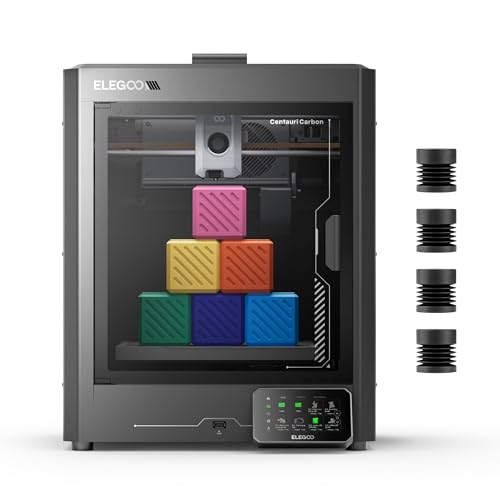
- Up to 500 mm/s CoreXY printing
- Fully assembled with auto leveling
- 320°C nozzle for advanced filaments
Best For: PC users wanting a fast, ready-to-run printer for strong functional parts
Multi-Color Performance Choice

- Prints in up to 4 colors
- CoreXY speed up to 600 mm/s
- 1-click auto leveling and remote control
Best For: PC users who want colorful, fast, and easy-to-manage prints
Budget-Friendly Starter Option

- About 20-minute, 3-step assembly
- CR Touch auto leveling and auto Z offset
- Supports PLA, PETG, and TPU
Best For: PC users who want an easy starter printer for everyday filament projects
Speed-Focused Choice

- 600mm/s max travel speed
- One-click automatic leveling
- 220 x 220 x 220 mm build volume
Best For: PC users who want fast, straightforward desktop printing
Multicolor Pick

- Up to 16-color printing with CFS units
- 95% pre-assembled for easy setup
- Quiet mode with AI camera monitoring
Best For: PC users who want multicolor printing and a plug-and-play setup
Quiet All-Rounder

- Quiet high-speed desktop printing
- 260 x 260 x 255 mm build volume
- 5-second quick-swap hotend
Best For: PC users who want a quiet, easy-to-manage printer for bigger projects
Fastest Pick – FLASHFORGE Adventurer 5M: ultra-fast auto-leveling printer
If you want one of the more speed-focused 3d printers for pc users, the FLASHFORGE Adventurer 5M is built for quick turnaround without much setup friction. Its fully automatic bed leveling, CoreXY frame, and 600mm/s travel speed make it a practical option for rapid prototyping and everyday desktop printing.
Best For: PC users who want a fast, mostly hands-off printer for quick prototyping and routine prints.
Pros:
- Full-auto bed leveling helps deliver a reliable first layer.
- CoreXY design with up to 600mm/s speed and 20,000mm/s² acceleration for fast jobs.
- Quick 3-second nozzle changes and a 35-second warm-up to 200°C.
- Remote monitoring through the Flash Maker mobile app adds convenience.
Cons:
- Build volume is limited to 220 x 220 x 220mm.
- Best results still depend on regular nozzle and platform maintenance.
Overall, the Adventurer 5M is a strong pick if speed and simplicity matter more than a large build area. It is aimed at users who want efficient printing with fewer manual adjustments.
Beginner-Friendly Choice – Bambu Lab A1 Mini Combo with AMS lite
For 3d printers for pc users who want an easy start, the Bambu Lab A1 Mini Combo focuses on guided setup, automatic calibration, and quiet operation. The included AMS lite expands it into multi-color printing, while the pre-assembled design and MakerWorld ecosystem help reduce the learning curve.
Best For: Beginners and PC users who want a compact, quiet, multi-color-ready printer.
Pros:
- Full-auto calibration handles Z-offset, bed leveling, and more.
- AMS lite support enables reliable multi-color printing.
- Fast setup takes about 20 minutes thanks to the pre-assembled design.
- Quiet operation is rated at ≤48 dB with motor noise cancellation.
Cons:
- AMS lite is required for multi-color printing.
- Small footprint means a more compact print area than larger machines.
The A1 Mini Combo is a smart buy if you value convenience, low noise, and color capability over a bigger build volume. It is especially appealing for users who want a printer that feels ready to use right away.
Budget Upgrade – Creality Ender 3 V3 SE with auto leveling
The Creality Ender 3 V3 SE is a value-minded option among 3d printers for pc users who want upgraded basics without a complex setup. It combines 250mm/s printing, CR Touch auto leveling, and a Sprite direct extruder in a compact, easy-to-assemble package.
Best For: Budget-conscious PC users who want a fast, easier-to-use entry-level printer.
Pros:
- 250mm/s max print speed helps cut print time.
- CR Touch auto leveling and strain sensor reduce manual calibration work.
- Sprite full-metal direct extruder supports PLA, TPU, and PETG.
- Quick 3-step assembly gets you printing in about 20 minutes.
Cons:
- Build volume is smaller than some larger desktop printers.
- Not as feature-rich as more premium enclosed systems.
For users who want a practical upgrade from older Ender machines, this model keeps the workflow straightforward while adding useful automation. It is a solid starter choice if you want speed and simplicity at a lower cost.
Quiet Enclosed Pick – FLASHFORGE Adventurer 5M Pro with filtration
If you are comparing 3d printers for pc users in a shared room or office, the FLASHFORGE Adventurer 5M Pro is the most environment-friendly option here. It adds an enclosed design, dual filtration, remote camera monitoring, and the same 600mm/s high-speed CoreXY platform for fast printing with less noise.
Best For: PC users who need a quiet enclosed printer for study rooms, classrooms, or shared spaces.
Pros:
- Full-auto one-click leveling supports a strong first layer.
- Up to 600mm/s speed with 20,000mm/s² acceleration for rapid output.
- Dual HEPA13 and activated carbon filtration helps block particles and VOCs.
- Built-in chamber camera and 50dB low-noise printing improve usability in shared spaces.
Cons:
- Build volume is limited to 220 x 220 x 220mm.
- Heavier and larger than compact open-frame options.
The Adventurer 5M Pro stands out when you want speed but also care about noise control and air filtration. It is a thoughtful choice for PC users who need a more contained printing setup.
Speed-Focused CoreXY Pick – ELEGOO Centauri Carbon
If you want one of the more capable 3d printers for pc users who care about speed and advanced materials, the ELEGOO Centauri Carbon stands out with its fully assembled setup, CoreXY motion system, and 500 mm/s print capability. It is designed to get you printing quickly while still offering the stability and automation needed for consistent results.
Best For: PC users who want a ready-to-print, high-speed machine for stronger functional parts and advanced filaments.
Pros:
- Arrives fully assembled and pre-calibrated for quick setup
- CoreXY design reaches up to 500 mm/s with 20,000 mm/s² acceleration
- 320°C nozzle and enclosed chamber support carbon-fiber reinforced filament and other advanced materials
- Built-in camera, dual LED lighting, and auto bed leveling add convenient monitoring and automation
Cons:
- Build volume is mid-sized at 256 x 256 x 256 mm
- At 38.5 pounds, it is a heavier desktop printer
- Best advanced-material use is highlighted more than ultra-large-format printing
Overall, this is a strong choice if you want a fast, stable printer that reduces setup friction and can handle tougher filament types. It fits users who value performance and convenience over maximum build size.
Multi-Color Performance Choice – FLASHFORGE AD5X
For 3d printers for pc users who want speed plus creative flexibility, the FLASHFORGE AD5X brings multi-color printing, a CoreXY frame, and a 600 mm/s top speed. Its automation and remote features make it a practical pick for users who want efficient printing without giving up visual impact.
Best For: PC users who want multi-color prints, fast prototyping, and user-friendly automation.
Pros:
- Supports up to 4 colors simultaneously for vivid multi-color printing
- CoreXY design reaches up to 600 mm/s with 20,000 mm/s² acceleration
- 1-click auto leveling simplifies setup and first-layer preparation
- 300°C direct-drive extruder, vibration compensation, and dual-channel cooling support quality prints
Cons:
- Build volume is smaller than some alternatives at 220 x 220 x 220 mm
- Multi-color capability may be more than some users need for basic parts
- Designed around efficiency, so it is less focused on large-format printing
This model makes sense if you want a fast machine that can also produce colorful output with less manual tuning. It is especially appealing for users who value convenience, speed, and creative flexibility in one desktop printer.
Budget-Friendly Starter Option – Creality Ender 3 V3 SE
If you’re looking for practical 3d printers for pc users on a simpler budget, the Creality Ender 3 V3 SE focuses on fast setup, automatic leveling, and dependable core features. It is a straightforward desktop printer that aims to reduce the learning curve while still delivering useful speed and stability.
Best For: PC users who want an easy-to-assemble, beginner-friendly printer for everyday PLA, PETG, and TPU work.
Pros:
- Assembles in about 20 minutes with just 3 steps
- CR Touch auto leveling and auto Z offset help create a better first layer
- Sprite direct extruder supports PLA, PETG, and TPU
- Dual Z-axis, silent 32-bit mainboard, and flexible spring steel plate improve usability
Cons:
- Build volume is smaller than the other printers in this roundup
- Top speed of 250 mm/s is lower than the CoreXY models here
- More focused on simplicity than advanced-material or multi-color features
This is a smart pick if you want a dependable entry point without a lot of setup hassle. It suits users who value easy operation, quieter printing, and versatile everyday filament support.
Speed-Focused Choice – Flashforge Adventurer 5M
If you want one of the faster 3d printers for pc users, the Flashforge Adventurer 5M is built around speed, quick setup, and practical everyday printing. Its CoreXY frame, automatic bed leveling, and high-flow nozzle make it a strong pick for users who want efficient desktop prints without a lot of manual tuning.
Best For: PC users who want a fast, easy-to-run printer for home projects, general prototyping, and high-speed prints.
Pros:
- Max 600mm/s travel speed and 20000mm/s² acceleration for very fast printing.
- One-click automatic leveling helps deliver reliable first layers.
- Rapid heating to 200°C in 35 seconds supports quicker starts.
- Dual-channel cooling and vibration compensation help improve surface quality.
Cons:
- Build volume is limited to 220 x 220 x 220 mm.
- Remote app monitoring requires the optional camera kit for full support.
Overall, the Adventurer 5M is a practical speed-first choice if you value efficient prints and straightforward operation over maximum build size. It fits well for PC users who want a responsive machine for frequent desktop jobs.
Multicolor Pick – Creality K2 Combo
The Creality K2 Combo stands out among 3d printers for pc users who want multicolor output and a more advanced, ready-to-run setup. With CFS support for up to 16 colors, a pre-assembled design, and smart leveling plus AI camera monitoring, it is geared toward users who want convenience and more creative flexibility.
Best For: PC users who want multicolor printing, quieter operation, and a plug-and-play experience.
Pros:
- Supports up to 16 colors when paired with four CFS units.
- 95% pre-assembled for easier out-of-box setup.
- Silent mode and balanced fans help keep noise low.
- Smart auto leveling and AI camera monitoring improve control and oversight.
Cons:
- The Combo includes only one CFS unit, so full 16-color use needs more hardware.
- At 65.9 pounds, it is a heavy printer to move around.
For PC users looking beyond basic single-color printing, the K2 Combo offers a polished feature set with strong automation and multicolor potential. It is a good fit if you want a capable machine that reduces setup hassle while expanding creative options.
Quiet All-Rounder – Creality SPARKX i7
The Creality SPARKX i7 is a balanced option for 3d printers for pc users who want quiet operation, large-format printing, and simple day-to-day use. Its auto leveling, WiFi connectivity, smart camera monitoring, and quick-swap hotend make it a practical desktop printer for steady creative work.
Best For: PC users who want a quiet, easy-to-manage printer for bigger models and everyday projects.
Pros:
- Automatic bed leveling and quick setup reduce manual calibration.
- Built-in smart camera monitoring supports remote viewing and print status checks.
- 260 x 260 x 255 mm build volume is suitable for larger parts and batch jobs.
- 5-second quick-swap hotend simplifies maintenance.
Cons:
- Multi-color printing requires the optional CFS Lite system sold separately.
- It emphasizes ease of use and reliability more than extreme speed claims.
For PC users who prioritize a quieter workflow and flexible monitoring, the SPARKX i7 covers the essentials well. Its larger build area and simplified maintenance make it a solid everyday printer for practical projects.
How We Picked These 3d Printers for PC Users
We prioritized models that are easy to control from a computer, quick to set up, and dependable enough for repeated use. For 3d Printers for PC Users, that means looking closely at slicing software support, USB or network workflow, calibration features, print speed, and how well the printer handles common materials.
We also favored printers with practical quality-of-life features such as auto leveling, direct-drive extruders, enclosed or camera-assisted monitoring where relevant, and ecosystems that reduce the learning curve.
Quick Comparison
If you want the simplest path from download to first print, beginner-focused machines with guided setup and strong app/software ecosystems are the easiest starting point. If speed matters most, CoreXY and high-speed bedslinger alternatives can cut wait times significantly. For color work or more advanced projects, multicolor systems and higher-temperature hotends offer more flexibility, but they usually cost more and can require a bit more tuning.
Key Buying Factors for 3d Printers for PC Users
Software and Driver Compatibility
Make sure the printer works cleanly with your preferred slicer and operating system. PC users should check whether the manufacturer offers reliable software, firmware updates, and straightforward connection options.
Setup and Calibration
Auto leveling, input shaping, and one-click calibration reduce the amount of manual tinkering needed. If you are new to the hobby or want a low-maintenance machine, these features matter a lot.
Speed Vs. Print Quality
Fast printers are appealing, but consistent acceleration, cooling, and motion control matter more than the headline speed number. For functional parts, look for models that can print quickly without sacrificing dimensional accuracy.
Material Support
Consider the materials you plan to use most often. Standard PLA is easy for most machines, but ABS, PETG, and specialty filaments may require higher nozzle temperatures, better extrusion stability, or better thermal control.
Build Volume and Workflow
Choose a build size that fits your projects without taking over your desk. Also think about whether you want a compact printer for small parts or a larger platform for prototypes and utility prints.
Who Should Buy Which 3d Printers for PC Users?
Beginners should look for the most automated, plug-and-play options. Makers who value productivity should lean toward high-speed models with strong PC software support. If you want colorful models or more advanced creative work, multi-color systems are worth the premium. For users focused on durability, tuning flexibility, and repeated desktop use, choose a printer with proven calibration tools and dependable extrusion hardware.
In short, the best choice depends on whether you care most about ease, speed, color, or material flexibility. The right printer should fit your PC workflow as naturally as any other creative tool.