Choosing the right 3D printer for engineering prototypes comes down to speed, accuracy, materials, and repeatability. The best options make it easier to move from concept to test-fit parts without constant tuning.
Below, we focus on printers and resins that suit prototype work, including models for dimensional accuracy, functional testing, and faster iteration cycles.
Best 10 3d Printers for Engineering Prototypes Picks for 2026
High-Speed Prototype Pick

- 600mm/s travel speed for rapid iteration
- Auto bed leveling reduces setup hassle
- Quick-swap nozzle supports fast maintenance
Best For: Fast prototype cycles and users who want automatic calibration
Durable Detail Resin
ELEGOO 8K Water Washable ABS-Like Resin

- ABS-like resin for functional prototypes and tooling
- 8K clarity with detail down to 35 microns
- Water-washable cleanup for easier post-processing
Best For: Detailed resin prototypes that still need useful strength
Automation-Friendly CoreXY Pick

- One-click leveling simplifies first-layer setup
- 600mm/s max speed suits fast prototyping
- App and slicer support remote monitoring
Best For: Engineers who want easy calibration and quick turnaround
Strong Utility Resin

- Tough formula resists bending and breakage
- Suitable for jigs, fixtures, and housings
- Low odor helps create a more comfortable workspace
Best For: Functional resin prototypes and stress-prone parts
Maker-Friendly Multicolor Pick
Bambu Lab A1 Combo + LED Lamp Kit

- High-speed printing with 10,000 mm/s² acceleration
- Full-auto calibration and active flow compensation
- AMS lite adds accessible multi-color output
Best For: Teams wanting a fast, quiet printer for prototype visuals and light projects
Detail-Focused Resin Choice
ELEGOO Mars 5 Resin 3D Printer
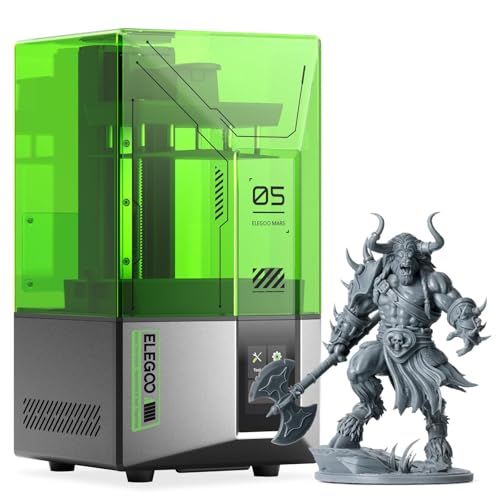
- 4K mono LCD with COB light source for fine detail
- One-click automatic leveling and self-check
- Residue detection and alarm features help prevent failures
Best For: Users who need compact, high-detail resin prototypes with simpler setup
High-Speed Engineering Upgrade
Flashforge AD5X Multicolor 3D Printer

- 600 mm/s CoreXY motion for fast iteration
- 300°C all-metal hotend supports advanced materials
- 4-color direct printing for prototypes and model sets
Best For: Teams needing a fast printer with stronger material support for functional prototyping
Ultra-Fine Resin Precision
GK3T 16K Easy-Use Resin Printer

- 16K LCD with 14×19μm pixel size
- Smart heating for stable cold-weather printing
- App control, auto-feed, and pre-leveling
Best For: Detailed engineering prototypes and small functional resin parts
Engineering-Grade Toughness
Blu Lava Black Functional Resin

- PC-like durability and rigidity
- Tappable for threaded inserts and load-bearing parts
- High-resolution output for detailed prototypes
Best For: Functional engineering resin parts that need strength and detail
High-Speed Multi-Material FDM

- Up to 600mm/s print speed
- 260×260×260mm build volume
- Supports PLA, PETG, TPU, PVA, and ASA
Best For: Fast FDM prototype iteration and larger concept parts
High-Speed Prototype Pick – FLASHFORGE Adventurer 5M
If you want one of the more capable 3d printers for engineering prototypes, the FLASHFORGE Adventurer 5M is built around speed and repeatability. Its CoreXY structure, 600mm/s travel speed, and fully automatic bed leveling make it a strong fit for rapid iteration when you need parts quickly and consistent first layers.
Best For: Fast-turn prototype work, concept parts, and users who want automatic setup with high-speed printing.
Pros:
- Fully automatic bed leveling helps produce reliable first layers without manual tuning.
- CoreXY motion system supports up to 600mm/s travel speed and 20000mm/s² acceleration for rapid prototyping.
- Quick 3-second nozzle changes and a 35-second warm-up to 200°C help reduce downtime.
- Dual-fan nozzle, vibration compensation, and multiple nozzle sizes support more controlled print quality.
Cons:
- Build volume is limited to 220 x 220 x 220 mm, so larger prototype parts will not fit.
- Best suited to users who value speed and convenience over a larger build area.
Overall, the Adventurer 5M is a practical choice when prototype speed and ease of use matter more than sheer size. It offers a solid mix of automation, high-speed motion, and maintenance-friendly design for engineering workflows.
Durable Detail Resin – ELEGOO 8K Water Washable ABS-Like Resin
For resin-based 3d printers for engineering prototypes, this ELEGOO 8K water washable ABS-like resin focuses on durability as much as detail. It combines high tensile strength and impact resistance with 8K-level micro-detail, making it a strong option when a prototype needs to look refined and still handle real-world testing.
Best For: Functional resin prototypes, small mechanical parts, and detailed models that need better toughness than standard resin.
Pros:
- ABS-like formula is designed for functional prototypes, tooling, and mechanical parts.
- High toughness and 32.61 kJ/m² impact resistance improve durability versus standard resins.
- 8K detail captures textures as fine as 35 microns for precise models.
- Water-washable cleanup simplifies post-processing and reduces alcohol use.
Cons:
- Best suited to MSLA, DLP, and LCD resin printers, not FDM machines.
- Resin printing still requires careful handling and post-processing steps.
This resin stands out when you need a mix of engineering usefulness and sharp surface detail. It is especially appealing for prototypes that must look clean while also surviving moderate stress.
Automation-Friendly CoreXY Pick – FLASHFORGE AD5M
The FLASHFORGE AD5M is a compelling choice among 3d printers for engineering prototypes when you want fast setup and dependable motion control. Its fully automatic leveling, CoreXY all-metal structure, and 600mm/s max speed are aimed at users who need to move from design to printed part with less friction.
Best For: Engineers and makers who want quick calibration, remote monitoring, and fast prototype printing.
Pros:
- One-click automatic leveling helps deliver accurate first layers with minimal effort.
- CoreXY all-metal motion structure is designed for stable, smooth, high-speed printing.
- Quick-release nozzles swap in about 3 seconds, which helps keep maintenance simple.
- Orca-flashforge slicer and Flash Maker app add batch sending and remote monitoring.
Cons:
- Build volume is 220 x 220 x 220 mm, which may be limiting for larger prototype parts.
- High-speed convenience may matter more here than maximum build size.
In practice, the AD5M is well aligned with iterative prototype work where uptime matters. Its automation and remote tools make it easier to keep prints moving through a busy development cycle.
Strong Utility Resin – ELEGOO Tough 3D Printer Resin
If your workflow centers on functional parts, this ELEGOO Tough resin is aimed squarely at practical 3d printers for engineering prototypes. Its high toughness, strong impact resistance, and low shrinkage make it suitable for structural parts, tools, jigs, fixtures, and other models that need to hold up under stress.
Best For: Structural resin prototypes, tool components, and parts that need resilience and drillability.
Pros:
- High toughness and resilience help parts bend without breaking easily.
- Strong impact resistance supports structural parts, tools, and other high-performance models.
- Low odor formula makes the printing environment more comfortable.
- Can be used for end-use products, jigs, fixtures, housings, and movable parts.
Cons:
- As a resin, it is limited to MSLA, LCD, and DLP printers.
- Best use cases are functional parts rather than large-format builds.
This is a good pick when prototype durability matters more than decorative finish alone. It has the material properties to support engineering use cases that call for toughness and some flexibility.
Maker-Friendly Multicolor Pick – Bambu Lab A1 Combo + LED Lamp Kit
If you want one of the more approachable 3d printers for engineering prototypes with a strong focus on speed and repeatability, the Bambu Lab A1 Combo + LED Lamp Kit is a practical choice. Its high acceleration, automatic calibration, and active flow compensation are aimed at getting clean results with less setup work, while the AMS lite adds accessible multi-color capability for presentation models and design iterations.
Best For: Teams and makers who want a fast, quiet, beginner-friendly printer for prototype visuals, multi-color concept parts, and functional light projects.
Pros:
- 10,000 mm/s² acceleration supports fast printing without sacrificing detail.
- Full-auto calibration reduces manual setup across bed leveling and Z-offset.
- AMS lite enables reliable multi-color printing for more polished prototypes.
- Quiet operation and simple touchscreen make it easier to use in a work area.
Cons:
- AMS lite is required for multi-color printing and is not included by default.
- The included LED Lamp Kit is useful for light projects, but it is not a prototyping essential.
- Best suited to users who value ease of use over advanced industrial enclosure features.
This model stands out when you need rapid iteration and clean presentation parts in a low-friction package. For engineering prototype workflows that also benefit from multi-color output, it offers a strong balance of speed, automation, and convenience.
Detail-Focused Resin Choice – ELEGOO Mars 5 Resin 3D Printer
For engineering prototypes that need fine surface detail, the ELEGOO Mars 5 is a focused resin option among 3d printers for engineering prototypes. Its 4K mono LCD and COB light source are built to reproduce intricate textures and small features, while automatic leveling and self-check functions help reduce setup friction before each print.
Best For: Users who need compact resin prototypes with crisp detail, automated setup, and safety-focused monitoring.
Pros:
- 4K mono LCD and COB light source support detailed, accurate resin prints.
- One-click automatic leveling simplifies setup for faster start times.
- Self-check, residue detection, and resin shortage alarms help prevent failed prints.
- Overheat protection and cooling add a useful safety layer for longer jobs.
Cons:
- Build volume is relatively small for larger prototype parts.
- Resin printing is better for detail than for large functional parts that need bigger dimensions.
- Requires resin workflow management, which may be less convenient than filament printing.
This printer makes sense when the prototype brief is all about fidelity, texture, and compact part size. If your workflow benefits from highly detailed resin output and simple startup, it is a strong candidate.
High-Speed Engineering Upgrade – Flashforge AD5X Multicolor 3D Printer
The Flashforge AD5X is a compelling option if you want 3d printers for engineering prototypes that can move quickly and handle more demanding materials. Its 600 mm/s CoreXY motion system, 300°C all-metal hotend, and auto leveling are geared toward fast iteration, while 4-color direct printing adds flexibility for visual mockups and coded part sets.
Best For: Makers and prototype teams who want a fast, multi-material-capable printer with engineering-oriented temperature support.
Pros:
- 600 mm/s CoreXY platform is designed for rapid prototype turnaround.
- 300°C all-metal hotend supports ABS, Nylon, and Carbon Fiber use cases with enclosure kit.
- 4-color direct printing can simplify part differentiation and presentation models.
- Auto leveling, PEI spring steel plate, and runout detection improve print reliability.
Cons:
- Carbon fiber and some advanced materials require an enclosed chamber kit.
- The 220 × 220 × 220 mm build volume may be limiting for larger prototypes.
- Advanced material support is useful, but it still depends on the right accessory setup.
Overall, the AD5X is the most engineering-oriented option in this group when speed and material flexibility matter. It is a strong fit for rapid functional testing, part labeling, and prototype work that may outgrow basic hobby printers.
Ultra-Fine Resin Precision – GK3T 16K Easy-Use Resin Printer
If you need 3D printers for engineering prototypes with very fine surface detail, the UniFormation GK3T is built around resolution and workflow stability. Its 16K LCD, 14×19μm pixel size, and smart heating make it a strong fit for detailed resin parts, while the auto-feed and remote monitoring features help keep the process manageable for everyday use.
Best For: Makers and prototype users who want high-detail resin output with beginner-friendly automation.
Pros:
- 16K resolution and 14×19μm pixel size for sharp detail on intricate prototypes.
- Smart resin heating helps maintain stable printing even in cold conditions as low as 0°C/32°F.
- Factory pre-leveling, smart resin feeding, and an anti-drip build platform simplify setup and cleanup.
- App control, real-time monitoring, and timelapse support improve print visibility and remote management.
Cons:
- Resin workflow still requires post-processing and compatibility with wash/cure equipment.
- The large 52.8-pound machine is less portable than compact desktop printers.
Overall, the GK3T stands out when your priority is fine-detail prototype work rather than high-throughput production. It combines precision-focused hardware with useful automation, which is a practical mix for users who want clean results without a steep learning curve.
Engineering-Grade Toughness – Blu Lava Black Functional Resin
For 3D printers for engineering prototypes, the resin matters just as much as the printer, and Siraya Tech Blu Lava Black is aimed at functional parts rather than display models. Its PC-like durability, high-resolution capability, and resistance to cracking on tapped features make it a practical pick when your prototype needs to survive handling, assembly, or fit checks.
Best For: Functional resin prototypes, brackets, housings, and load-bearing test parts.
Pros:
- PC-like toughness and rigidity suit demanding engineering applications.
- High-resolution printing supports detailed prototypes and professional models.
- Tappable without cracking, which is useful for threaded inserts and assembly tests.
- Suitable for brackets, housings, industrial parts, and architectural models.
Cons:
- Only useful for resin printers that support LCD/DLP workflows.
- Primarily optimized for strength and function, not color variety or artistic effects.
If you need a resin that behaves more like a functional engineering material than a hobby formula, Blu Lava Black fits the brief. It is especially compelling for prototype parts that must be both accurate and durable enough for real-world testing.
High-Speed Multi-Material FDM – Kobra X Color 3D Printer
If your version of 3D printers for engineering prototypes needs fast turnaround and a larger build area, the Anycubic Kobra X brings speed-focused FDM printing to the table. It reaches up to 600mm/s, includes full-auto leveling, and supports a range of materials, which makes it useful for quickly iterating concept parts, fit checks, and larger prototype assemblies.
Best For: Fast concept prototyping, large mockups, and multi-material FDM projects.
Pros:
- Up to 600mm/s printing speed helps shorten prototype turnaround times.
- 49-point auto leveling and vibration compensation support consistent first layers.
- 260×260×260mm build volume is suitable for larger prototype pieces.
- Supports PLA, PETG, TPU, PVA, and ASA with a hardened steel nozzle up to 300°C.
Cons:
- Built more for fast FDM prototyping than ultra-fine micro-detail work.
- Advanced multi-color capability depends on additional accessories beyond the base machine.
The Kobra X makes sense when speed, volume, and material flexibility matter more than the highest possible surface resolution. For engineering teams and makers who want to iterate quickly, it offers a practical balance of automation and throughput.
How We Picked These 3d Printers for Engineering Prototypes
We prioritized machines and materials that support real prototype work: stable motion systems, reliable first layers, useful build volumes, strong material compatibility, and print quality that holds up for fit checks and functional evaluation. For resin options, we looked at toughness, low shrinkage, and detail retention. For FDM systems, we favored speed, auto-calibration, and hardware that can handle engineering-grade filaments.
Quick Comparison
In general, high-speed FDM printers are the better choice for larger enclosures, brackets, jigs, and iterative test parts. Resin printers are stronger candidates for fine features, surface detail, and small precision components. Tough and PC-like resins sit in the middle when you need detail plus better mechanical behavior.
Key Buying Factors for 3d Printers for Engineering Prototypes
Dimensional Accuracy
Prototype parts need to fit together consistently. Look for solid auto-leveling, rigid frames, and settings that support repeatable extrusion or curing. If tolerances matter, prioritize printers known for stable motion and predictable calibration.
Material and Part Performance
Choose a machine or resin based on the prototype’s job. PLA may work for early fit checks, but ABS-like, tough, or PC-like materials are better for snap fits, housings, and stress testing. If heat resistance matters, verify the material’s real-world limits before buying.
Build Size and Throughput
Large parts may need a bigger build volume, while rapid iteration benefits from higher print speeds and quick setup. For teams printing multiple revisions, speed and low maintenance can matter as much as raw detail.
Surface Finish and Post-Processing
Resin typically delivers finer detail and smoother surfaces, which helps for presentation models and small precision parts. FDM is usually faster and easier for larger functional prototypes. Consider how much sanding, washing, or support removal your workflow can handle.
Who Should Buy Which 3d Printers for Engineering Prototypes?
If you need large, functional prototypes fast, a high-speed FDM printer is usually the best starting point. If your work involves small parts, tight features, or visual detail, a resin printer is often the better fit. Product designers and engineering teams often benefit from having both: FDM for fast iteration and resin for critical-fit validation.
For mixed-use labs, prioritize ecosystem reliability, readily available consumables, and easy setup over flashy specs alone. The best 3d Printers for Engineering Prototypes are the ones that reduce downtime and produce dependable parts on a repeatable schedule.