Cleaner indoor air starts with knowing what is actually in it. The best budget air quality monitoring systems make it easier to track CO2, particulate matter, VOCs, humidity, and temperature without the cost of professional equipment.
We selected 10 practical monitors with different sensor combinations, display styles, alert features, and connectivity options so you can find the right fit for a bedroom, office, nursery, grow tent, or whole-home setup.
Best 10 Budget Air Quality Monitoring Systems Picks for 2026
Most Comprehensive Coverage
10-in-1 Color Air Quality Monitor

- Measures particles, gases, AQI, temperature, and humidity
- Color display and audible alerts simplify monitoring
- Up to 96 hours of battery-powered use
Best For: Offline, multi-room air-quality monitoring
Most User-Friendly Portable Pick

- Color screen and voice alerts flag abnormal readings
- Automatic calibration supports consistent monitoring
- Lightweight design suits homes, cars, and offices
Best For: Portable monitoring with simple voice guidance
Best Connected Option

- Tracks CO, PM2.5, temperature, and humidity
- Provides prompts for ventilation and purifier use
- Connects through Amazon Sidewalk without a base station
Best For: Sidewalk-connected indoor air awareness
Best CO2-Focused Value
INKBIRDPLUS NDIR Air Quality Monitor

- Monitors CO2, PM2.5, PM10, AQI, temperature, and humidity
- NDIR sensing focuses on carbon dioxide readings
- Desktop or wall placement with AQI sound alerts
Best For: CO2-focused monitoring in homes and grow tents
Most User-Friendly
Fil-Fresh 16-in-1 Air Quality Monitor

- Tracks CO2, particles, HCHO, TVOC, temperature, and humidity
- Large 7.2-inch display with adjustable brightness
- App-free operation and up to 8 hours of battery use
Best For: Simple, portable monitoring without Wi-Fi or an app
Best for Everyday Use
Virtue Sensor 13-in-1 Wi-Fi Monitor

- Tracks key pollutants plus temperature and humidity
- Tuya app stores up to two years of historical data
- Color alerts, buzzer, and roughly two-second refresh rate
Best For: Users who want smartphone access and trend history
Best for Detailed Alerts
bonoch 16-in-1 Air Quality Monitor
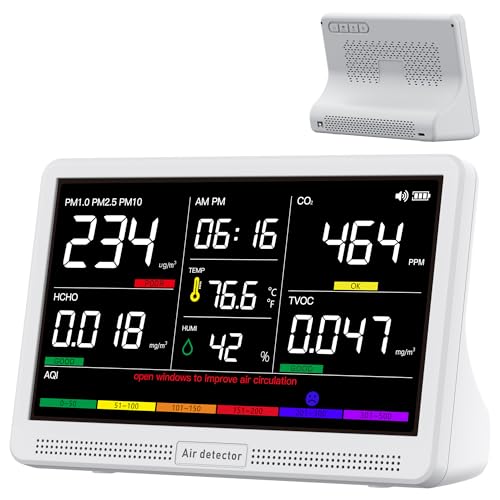
- Measures nine air-quality and comfort parameters
- Seven pollutant and AQI warning modes with mute control
- Seven-inch HD display and up to 8 hours of runtime
Best For: Detailed on-device readings and customizable alerts
Smart Connected Pick
Sacnahe Multi-Function Air Quality Monitor

- Monitors AQI, CO2, particulate matter, HCHO, TVOC, temperature, and humidity.
- Connects to Smart Life and Tuya Smart over 2.4GHz Wi-Fi.
- Includes a color display, wall-mounting support, and 3000mAh battery.
Best For: App-connected home and office monitoring
Large-Screen Choice
YNAK 16-in-1 Air Quality Monitor

- Shows key readings on a bright 7-inch LED display.
- Monitors CO2, PM levels, HCHO, TVOC, temperature, humidity, and AQI.
- Offers adjustable brightness, AQI buzzers, mute control, and USB-C charging.
Best For: Easy-to-read indoor monitoring
Portable Alert Pick
PinoTec Indoor Air Quality Monitor

- Tracks PM1.0, PM2.5, PM10, CO2, HCHO, humidity, temperature, and AQI.
- Updates readings every 1.5 seconds using laser-scattering sampling.
- Includes visual and audible AQI alerts with a rechargeable 2000mAh battery.
Best For: Portable room-to-room air checks
Most Comprehensive Coverage – 10-in-1 Color Air Quality Monitor
For shoppers comparing budget air quality monitoring systems, this tabletop model offers unusually broad coverage without requiring Wi-Fi, Bluetooth, or an app. It measures particles, gases, temperature, and humidity, then presents the results on a color display with audible alerts.
Best For: Households wanting a portable, offline monitor for rooms, vehicles, offices, or areas affected by cooking and smoke.
Pros:
- Tracks PM0.3, PM2.5, PM10, CO2, CO, HCHO, TVOC, AQI, temperature, and humidity.
- Color-coded screen makes changing air-quality levels easier to interpret.
- Samples readings every 1.2 seconds and includes an audible alert.
- Rechargeable 2000mAh battery provides up to 96 hours of monitoring.
Cons:
- Tabletop design may be less convenient for permanent wall installation.
- The supplied notes do not mention app connectivity or remote monitoring.
This is a strong value choice when measurement breadth and long battery life matter more than smart-home integration.
Most User-Friendly Portable Pick – 10-in-1 Air Quality Monitor
This compact option is a practical entry in budget air quality monitoring systems, pairing a visual color screen with voice alerts and one-button controls. It is designed for quick checks in homes, cars, offices, and other small spaces.
Best For: Users who want a lightweight monitor with automatic calibration, voice reminders, and straightforward controls.
Pros:
- Tracks CO2, HCHO, TVOC, benzene, AQI, PM1.0, PM2.5, PM10, temperature, and humidity.
- Color changes and voice broadcasts highlight readings that cross thresholds.
- Supports one-click automatic calibration for longer-term consistency.
- Compact 7.04-ounce design includes a rechargeable 2000mAh battery.
Cons:
- Battery life is listed at up to 20 hours per charge.
- Several functions depend on tap sequences that may take time to learn.
Its small size and audible guidance make it particularly convenient for moving between rooms or checking air quality while traveling.
Best Connected Option – Ring Air Quality Monitor
The Ring Air Quality Monitor takes a narrower approach than many budget air quality monitoring systems, focusing on temperature, humidity, carbon monoxide, and PM2.5. It connects through Amazon Sidewalk and can provide suggestions such as opening a window or running a purifier.
Best For: Ring or Amazon Sidewalk users who want connected indoor alerts and practical prompts rather than broad multi-gas testing.
Pros:
- Monitors temperature, humidity, CO, and PM2.5.
- Offers actionable suggestions for ventilation, purification, or appliance service.
- Uses Amazon Sidewalk without requiring a separate base station.
Cons:
- Amazon Sidewalk is required, and coverage may vary.
- It does not measure CO2 or radon.
- It is not a certified carbon monoxide alarm or detector and has no speaker or microphone for audible alarms.
This model is best viewed as a connected awareness tool, not a replacement for a certified CO alarm or a comprehensive gas monitor.
Best CO2-Focused Value – INKBIRDPLUS NDIR Air Quality Monitor
For shoppers seeking budget air quality monitoring systems with a stronger focus on carbon dioxide, the INKBIRDPLUS uses an NDIR monitor and also tracks PM2.5, PM10, AQI, temperature, and humidity. Its color screen and desktop-or-wall placement make readings easy to check.
Best For: Bedrooms, grow tents, offices, and other spaces where CO2 trends and basic particle monitoring are the main priorities.
Pros:
- Six-in-one monitoring covers CO2, PM2.5, PM10, AQI, temperature, and humidity.
- NDIR CO2 sensor design is highlighted for carbon dioxide measurement.
- Three AQI modes include normal, warning, and hazard ranges with a sound alert above 100.
- Can sit on a desk or hang on a wall.
Cons:
- It monitors fewer parameters than the supplied 10-in-1 alternatives.
- Manual CO2 calibration requires a ventilated area and a simultaneous three-button press.
This is a sensible pick when CO2 visibility, simple AQI status levels, and flexible placement matter more than formaldehyde or VOC readings.
Most User-Friendly – Fil-Fresh 16-in-1 Air Quality Monitor
For shoppers comparing budget air quality monitoring systems, the Fil-Fresh stands out for its large display, broad sensor coverage, and simple, app-free operation. It tracks CO2, particulate matter, formaldehyde, TVOC, temperature, and humidity, with readings updating every 1–2 seconds.
Best For: Households that want portable, easy-to-read monitoring without Wi-Fi, apps, or account setup.
Pros:
- Measures nine key air-quality and comfort parameters, with seven alert types.
- Large 7.2-inch display offers high-contrast text and three brightness settings.
- Built-in 2500mAh battery provides up to eight hours of wireless use and charges via USB-C.
- Simple controls include one-touch recalibration and no required app or Wi-Fi.
Cons:
- Portable operation is limited to about eight hours per charge.
- Does not offer app connectivity or historical data tracking.
The Fil-Fresh is a practical choice when immediate, readable data matters more than smart-home features. Its combination of broad measurements, visual alerts, and straightforward controls makes it especially convenient for moving between rooms.
Best for Everyday Use – Virtue Sensor 13-in-1 Wi-Fi Monitor
This Virtue Sensor model is a strong candidate among budget air quality monitoring systems for buyers who want remote access. Along with monitoring CO2, particles, HCHO, TVOC, temperature, and humidity, it connects to 2.4GHz Wi-Fi through the Tuya app for long-term data review.
Best For: Home and office users who want historical air-quality charts and smartphone access.
Pros:
- Monitors eight environmental readings and includes time, date, timer, stopwatch, and alarm functions.
- Tuya connectivity provides historical curves by day, month, or year, with up to two years of storage.
- Four-color visual alerts and a switchable buzzer make changing conditions easy to recognize.
- Refreshes readings approximately every two seconds and supports USB charging.
Cons:
- Wi-Fi support is limited to 2.4GHz networks.
- Battery life is approximately six to seven hours when used independently.
- App features require a compatible Android or iOS device and Tuya setup.
Choose this monitor if data history and remote viewing are priorities. It offers more connected functionality than a basic standalone meter, while still providing a local display and portable battery operation.
Best for Detailed Alerts – bonoch 16-in-1 Air Quality Monitor
The bonoch AirSentry is worth considering when shopping for budget air quality monitoring systems with a large screen and extensive alert controls. It measures nine core readings, including CO2, PM1.0, PM2.5, PM10, HCHO, TVOC, temperature, humidity, and AQI, while its external sensors are designed to sample air directly.
Best For: Users who want a large, detailed display and separate warning alerts for common indoor pollutants.
Pros:
- Provides 16-in-1 functionality with seven customizable AQI and pollutant alerts.
- Seven-inch HD LED display has three brightness settings for different lighting conditions.
- External high-precision sensors and enhanced airflow design are intended to detect subtle changes.
- Runs for up to eight hours and supports USB-C charging with an included AC adapter.
Cons:
- It is relatively substantial at 1.46 pounds.
- Sensor performance can be affected by touching the sensors or exposure to perfumes and strong odors.
- Unlike the connected alternative, the supplied notes do not mention Wi-Fi or app features.
The bonoch balances detailed readings with accessible controls, including a mute button and quick temperature-unit switching. Its large screen and multiple warning modes make it a good fit for users who prefer on-device information rather than a phone-based dashboard.
Smart Connected Pick – Sacnahe Multi-Function Air Quality Monitor
For shoppers comparing budget air quality monitoring systems, the Sacnahe stands out for combining broad pollutant tracking with app connectivity. It monitors AQI, CO2, PM1.0, PM2.5, PM10, TVOC, HCHO, temperature, and humidity, while Wi-Fi support enables remote checks and historical data through Smart Life or Tuya Smart.
Best For: Homes and offices where remote monitoring, app-based history, and a wide range of readings matter.
Pros:
- Tracks nine air-quality and comfort metrics, including particulate matter, CO2, HCHO, and TVOC.
- Supports 2.4GHz Wi-Fi, Smart Life, and Tuya Smart app data tracking.
- Has a color-coded HD display, auto-brightness, wall-mounting support, and a 3000mAh battery.
Cons:
- Wi-Fi setup may require compatibility mode on Wi-Fi 6 or newer routers.
- Battery runtime is approximately 7–15 hours, depending on usage.
- The product recommends keeping it plugged in for long-term data recording.
This is a flexible choice if you want both on-device readings and connected monitoring. Its broad sensor list and app features add value, though buyers should be comfortable with a wireless setup and occasional recalibration guidance.
Large-Screen Choice – YNAK 16-in-1 Air Quality Monitor
The YNAK is a practical option among budget air quality monitoring systems for readers who prefer a large, easy-to-read display. Its 7-inch screen shows CO2, PM1.0, PM2.5, PM10, HCHO, TVOC, temperature, humidity, AQI, and time, with audible alerts for changing air-quality conditions.
Best For: Bedrooms, living spaces, offices, or other areas where readings need to be visible from a distance.
Pros:
- Provides a 7-inch LED display with three brightness settings.
- Uses external sensors and provides readings every 1.5 seconds, according to the supplied specifications.
- Includes seven AQI alert buzzer functions, a mute button, USB-C charging, and an AC adapter.
Cons:
- The advertised “16-in-1” count combines nine detectable parameters with seven alert types.
- Battery runtime is listed at up to 8 hours.
- Sensor accuracy can be affected by touching the sensors or exposing them to strong odors.
The YNAK’s main advantage is usability: the oversized screen and alerts make status checks quick without navigating menus. It is a strong fit for stationary indoor monitoring, while the limited battery runtime may make continuous portable use less convenient.
Portable Alert Pick – PinoTec Indoor Air Quality Monitor
For budget air quality monitoring systems with a portable design, the PinoTec offers a focused set of indoor readings and fast updates. It tracks PM1.0, PM2.5, PM10, CO2, HCHO, humidity, temperature, and AQI, using visual and audible warnings when air quality falls below acceptable levels.
Best For: Users who want a rechargeable monitor they can move between rooms, offices, vehicles, or travel settings.
Pros:
- Measures particulate matter, CO2, formaldehyde, humidity, temperature, and AQI.
- Uses laser-scattering air sampling and updates readings every 1.5 seconds.
- Offers red LCD warnings and audible alerts, plus a rechargeable 2000mAh battery.
Cons:
- The supplied notes do not specify a companion app or wireless data history.
- Temperature and humidity accuracy are listed as ±2°F and ±4%, respectively.
- Audible “BIBI” alerts may need to be managed depending on the environment.
The PinoTec is best suited to straightforward, mobile monitoring rather than app-based analysis. Its rechargeable battery, frequent updates, and dual alert system make it useful for checking multiple spaces, provided the stated measurement tolerances fit your needs.
How We Picked the Best Budget Air Quality Monitoring Systems
We focused on monitors that provide useful indoor readings at an accessible price. Our comparison considers the number and type of sensors, measurement visibility, alert options, display quality, connectivity, portability, and ease of use. Models that track CO2, PM2.5, PM10, HCHO, TVOC, temperature, or humidity can help identify different indoor-air concerns, but a higher sensor count does not automatically mean greater accuracy.
Because product specifications and performance can vary, treat these devices as awareness and trend-monitoring tools rather than substitutes for certified safety equipment. A monitor is most useful when placed correctly and used consistently.
Quick Comparison
Use the product sections above to compare each model’s monitored pollutants, screen size, alert system, smart-home compatibility, and intended environment. Basic units are usually best for checking CO2 and general comfort, while broader multi-sensor models can provide more context around particles, formaldehyde, VOCs, humidity, and temperature.
- Best for simple monitoring: Choose a clear display with core readings such as CO2, PM2.5, temperature, and humidity.
- Best for detailed readings: Look for models listing individual particle and gas measurements instead of only a combined AQI score.
- Best for remote checks: Select Wi-Fi or compatible smart-home connectivity if you need alerts while away.
- Best for flexible placement: Prioritize a rechargeable or compact monitor for moving between rooms, offices, and travel locations.
Key Buying Factors for Budget Air Quality Monitoring Systems
Sensor Coverage
CO2 is useful for judging ventilation, while PM2.5 and PM10 help identify fine and coarse particles from cooking, smoke, dust, and outdoor pollution. TVOC and HCHO readings may provide additional warnings about chemical emissions, but sensor technology and calibration methods differ widely.
Accuracy and Calibration
Look for clear specifications, NDIR CO2 sensing, calibration instructions, and a stated measurement range. Readings should be compared over time rather than treated as perfectly precise laboratory results. Avoid placing the monitor directly beside an air purifier, window, vent, stove, or humidifier.
Alerts and Usability
Audible alarms, visual indicators, AQI categories, and adjustable thresholds make a monitor more actionable. A readable screen matters in a dark bedroom or across a large room, while app notifications are valuable when checking a vacant property or nursery remotely.
Power and Placement
Consider whether the unit uses USB power, batteries, or a rechargeable cell. For reliable readings, place it at breathing height with unobstructed airflow and away from localized sources of heat, moisture, or pollutants.
Who Should Buy Which Budget Air Quality Monitoring Systems?
Choose a straightforward CO2-focused monitor if your main goal is improving ventilation in a bedroom, classroom, or home office. Select a multi-parameter unit if you cook frequently, live near traffic or wildfire smoke, use cleaning products, or want broader trend information. A large-screen model suits shared spaces and users who want readings visible at a glance, while Wi-Fi-connected models are better for remote alerts and smart-home routines.
If you need legally dependable measurements, medical-grade monitoring, or immediate protection from a known hazard, invest in certified professional equipment instead of relying solely on a consumer air quality monitor.