Professional air quality monitoring systems make it easier to identify ventilation problems, rising pollutant levels, and changing indoor conditions before they affect comfort or health.
This roundup compares ten monitors with different sensor combinations, connectivity options, alert features, and portability levels so you can choose the right fit for a home, office, classroom, or specialized workspace.
Best 10 Professional Air Quality Monitoring Systems Picks for 2026
Best Connected Radon Monitor

- Tracks radon, PM2.5, CO2, VOCs, and comfort metrics
- Battery-powered with customizable eInk display
- App offers alerts and long-term trend analysis
Best For: Homeowners prioritizing radon and connected indoor monitoring
Best Indoor-Outdoor Bundle

- Monitors indoor and outdoor air conditions
- Outdoor unit measures PM1, PM2.5, and PM10
- Wi-Fi platform supports remote data viewing
Best For: Users tracking household air alongside neighborhood pollution
Best for Workshops

- Measures CO2, particles, formaldehyde, and TVOC
- 7-inch color display with audible alarms
- Up to six hours of rechargeable cordless use
Best For: Woodworking shops, garages, and finishing areas
Best Laser Particle Counter

- Measures particles above 0.5 and 2.5 microns
- Runs six hours on battery or continuously on AC
- Stores seven days of data for PC review
Best For: Testing particulate levels and filtration performance
Best Open-Source System
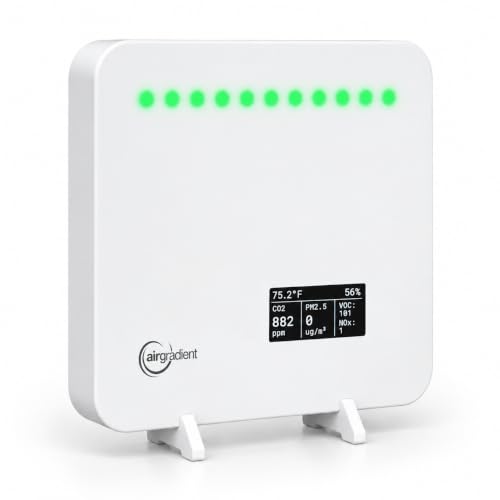
- Measures PM2.5, CO2, TVOC, NOx, temperature, and humidity
- Subscription-free dashboard with API and Home Assistant support
- Calibrated PM2.5 monitoring with included digital test report
Best For: Home Assistant users and detailed indoor-air tracking
Best Connected Simplicity

- Tracks CO, PM2.5, temperature, and humidity
- Offers actionable prompts for ventilation and purification
- Connects through Amazon Sidewalk without a base station
Best For: Households wanting simple connected air monitoring
Best for Data History

- Monitors eight metrics, including CO2, particles, TVOC, and formaldehyde
- Stores 90 days of app history with CSV export
- Provides alerts and up to six hours of rechargeable portable use
Best For: Trend analysis and portable multi-pollutant monitoring
Best All-Around Coverage
16-in-1 Portable Air Quality Monitor

- Tracks particulates, gases, temperature, and humidity
- Refreshes readings every 1.5 seconds
- Portable design with simple controls and color display
Best For: Everyday monitoring across rooms, vehicles, and offices
Best for Long Runtime
16-in-1 CO2 Air Quality Monitor
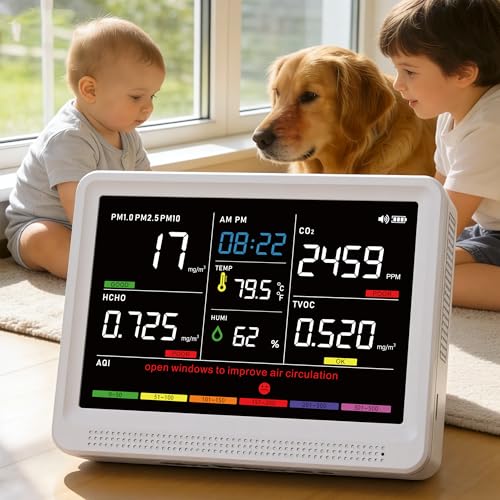
- Runs for up to 10 hours on a full charge
- Uses a large 5.5-inch HD display
- Includes seven AQI alert functions and mute control
Best For: Longer cordless monitoring with prominent alerts
Best Textured Finish
16-in-1 Black Air Quality Monitor

- Broad monitoring of particles, gases, and climate readings
- Color-coded HD screen with 1.5-second updates
- Portable textured-black design for multiple indoor settings
Best For: Portable monitoring with a subdued black finish
Best Connected Radon Monitor – Airthings View Plus
For shoppers comparing professional air quality monitoring systems for the home, the Airthings View Plus combines radon detection with continuous tracking of PM2.5, CO2, VOCs, humidity, temperature, and air pressure. Its battery-powered design and eInk display make it practical for flexible indoor placement, while the app adds alerts and trend analysis.
Best For: Homeowners who want broad indoor monitoring with dedicated radon measurements and remote app access.
Pros:
- Measures radon, PM2.5, CO2, VOCs, humidity, temperature, and pressure.
- Battery-powered for cable-free placement, with an advertised battery life of up to two years.
- App provides live readings, notifications, historical trends, and pollen information.
- Optional registration extends the warranty to five years.
Cons:
- The Airthings app, an account, and internet access are required for full operation and cloud tracking.
- Designed for indoor use within a 4–40°C operating range.
The View Plus is a strong choice when radon is a priority alongside everyday air-quality metrics. Its connected features are useful for ongoing tracking, but buyers wanting a standalone monitor without app or internet requirements may prefer a simpler instrument.
Best Indoor-Outdoor Bundle – IQAir AirVisual Bundle
The IQAir AirVisual bundle is aimed at buyers seeking professional air quality monitoring systems that connect indoor conditions with outdoor pollution and weather data. It pairs an indoor monitor with a weatherproof outdoor unit, supporting particulate measurements, optional CO2 monitoring, and wireless access through the AirVisual platform.
Best For: Households and property owners who want a broader view of indoor air quality and pollution around their building.
Pros:
- Bundle covers indoor air plus outdoor PM1, PM2.5, PM10, temperature, humidity, and pressure.
- Outdoor monitor uses two professional-grade laser sensors for added measurement reliability.
- Wi-Fi access supports smartphone, tablet, and desktop viewing.
- Outdoor unit can be mounted on a wall, roof, or pole and includes a 35-foot cable.
Cons:
- CO2 measurement on the outdoor monitor requires an optional sensor module.
- The outdoor unit uses a power adapter rather than a rechargeable battery.
- The two-unit setup requires more installation space and planning than an indoor-only monitor.
This bundle stands out for monitoring pollution sources both inside and outside the home, including traffic, smoke, cooking, and cleaning. It is more involved than a basic room monitor, but that wider coverage is valuable when outdoor conditions influence indoor air.
Best for Workshops – POWERTEC AD1001
For workshops, garages, and other spaces where dust and finishing fumes are concerns, the POWERTEC AD1001 offers a practical professional air quality monitoring system with a large 7-inch color display. It continuously measures CO2, PM1.0, PM2.5, PM10, formaldehyde, TVOC, temperature, and humidity, with visual and audible warnings.
Best For: Woodworkers, garage users, and operators who need visible, immediate alerts during cutting, sanding, painting, or finishing.
Pros:
- Combines NDIR CO2, formaldehyde, TVOC, and laser particle sensors.
- Large color LCD shows readings clearly with green, yellow, and red air-quality indicators.
- Audible alarms flag elevated CO2, VOCs, particles, and formaldehyde.
- Rechargeable battery provides up to six hours of cordless use and supports operation while charging.
Cons:
- Battery operation lasts up to six hours, so frequent recharging may be needed for extended use.
- Continuous plugged-in operation can slightly affect temperature readings because of added heat.
- Requires a two-minute warm-up when first powered on.
The AD1001 is particularly well suited to active work areas where a glanceable screen and alarms matter more than cloud connectivity. Its broad sensor set is useful for identifying several common workshop pollutants, though it is a relatively large, display-focused unit.
Best Laser Particle Counter – DC1700 Air Quality Monitor
The DC1700 is a focused option for buyers evaluating professional air quality monitoring systems around particulate measurement. Its true laser particle counter measures two particle-size ranges, and its rechargeable battery, AC operation, and PC interface support both spot checks and ongoing evaluation of indoor air or filtration equipment.
Best For: Users testing air purifiers, HEPA filters, and household or office filtration performance.
Pros:
- Uses a true laser particle counter for particles larger than 0.5 and 2.5 microns.
- Helps compare measured conditions with AQI or PM2.5 information.
- Can run for six hours on its rechargeable battery or continuously on AC power.
- Stores seven days of data and includes a PC interface plus international wall adapters.
Cons:
- Its supplied measurements focus on particulate ranges rather than gases such as CO2 or VOCs.
- It lacks the broader multi-sensor environmental coverage found on some newer monitors.
- The product uses a listed nonstandard battery.
The DC1700 makes the most sense when particle concentration and filtration testing are the main goals. Buyers wanting radon, gas, humidity, or temperature readings should consider a more comprehensive multi-sensor system instead.
Best Open-Source System – AirGradient ONE
For buyers seeking professional air quality monitoring systems with broad pollutant coverage and integration flexibility, the AirGradient ONE combines PM2.5, CO2, TVOC, NOx, temperature, and humidity readings in one subscription-free monitor. Its calibrated sensor modules, dashboard, API access, and open-source design make it suitable for ongoing indoor-air tracking.
Best For: Home Assistant users, offices, classrooms, and technically minded buyers who want detailed readings and local-control options.
Pros:
- Measures six key indoor-air factors, including PM2.5, CO2, TVOC, and NOx.
- Uses recognized sensor modules and includes an individual digital test report.
- Offers a subscription-free dashboard, free API access, Home Assistant compatibility, and open-source hardware and firmware.
- Supports tabletop or wall installation and provides an OLED display with an LED color bar.
Cons:
- Its extensive integration and self-hosting options may be more than casual users need.
- The included power adapter is specified for the US.
The AirGradient ONE is a strong choice when measurement breadth, calibration documentation, and smart-home flexibility matter more than a simple plug-and-read experience.
Best Connected Simplicity – Ring Air Quality Monitor
The Ring Air Quality Monitor is a straightforward option among professional air quality monitoring systems for households that want connected indoor readings and practical prompts. It tracks temperature, carbon monoxide, humidity, and PM2.5, then provides suggestions such as opening a window or running an air purifier.
Best For: Ring and Amazon Sidewalk users who want simple home monitoring without installing a base station.
Pros:
- Monitors temperature, CO, humidity, and PM2.5.
- Provides actionable suggestions related to ventilation, purification, and appliance servicing.
- Uses Amazon Sidewalk connectivity and requires no base station.
Cons:
- Amazon Sidewalk is required, and coverage may vary.
- It does not measure CO2 or radon.
- It is not a certified carbon monoxide alarm or detector and has no microphone or speaker for audible alarms.
This model prioritizes convenient connected monitoring over comprehensive pollutant coverage, so it is best viewed as an awareness tool rather than a replacement for certified safety alarms.
Best for Data History – BREATHE Airmonitor Plus Gen 2
The BREATHE Airmonitor Plus Gen 2 stands out among professional air quality monitoring systems for its broad eight-in-one measurement set and data-review features. It combines NDIR CO2 sensing with PM1, PM2.5, PM10, TVOC, formaldehyde, temperature, and humidity monitoring, plus app alerts, 90-day history, and CSV export.
Best For: Users who want portable monitoring, historical trend analysis, and visibility into particles and chemical pollutants.
Pros:
- Tracks eight indoor-air metrics, including three particle sizes, TVOC, and formaldehyde.
- Offers 90-day app history, configurable CO2 and PM2.5 alerts, and data export.
- Includes a rechargeable battery with up to six hours of portable use.
- Provides a color display and can operate continuously while connected to USB-C power.
Cons:
- App connectivity uses 2.4 GHz Wi-Fi.
- Portable operation is limited to up to six hours per charge.
- Its many readings and analysis features may be unnecessary for buyers seeking only basic monitoring.
Choose the BREATHE model when reviewing changes over time is as important as seeing current readings, particularly for investigating cooking, cleaning, occupancy, or ventilation patterns.
Best All-Around Coverage – 16-in-1 Portable Air Quality Monitor
For shoppers comparing professional air quality monitoring systems for everyday indoor use, this compact tester provides broad coverage in a simple, portable format. It tracks particulate matter, CO2, TVOC, HCHO, temperature, and humidity, with readings refreshed every 1.5 seconds on a color display.
Best For: Homeowners, office users, and families who want one portable monitor for several indoor spaces.
Pros:
- Measures PM1.0, PM2.5, PM10, CO2, TVOC, HCHO, temperature, and humidity.
- Updates air data automatically every 1.5 seconds.
- Simple controls, adjustable audio prompts, and a readable HD color screen.
- Includes USB-C charging, an AC adapter, and 12-month quality support.
Cons:
- Battery runtime is limited to approximately 4–5 hours.
- The supplied description does not mention app connectivity or data logging.
This is a practical choice when broad pollutant coverage and easy portability matter more than extended battery life or connected features. Its straightforward operation also makes it suitable for bedrooms, vehicles, offices, and other everyday settings.
Best for Long Runtime – 16-in-1 CO2 Air Quality Monitor
Among professional air quality monitoring systems, this model stands out for its large display, extended battery claim, and configurable air-quality alerts. It monitors nine listed parameters, including CO2, particulate matter, HCHO, TVOC, temperature, humidity, AQI, and time, while providing seven AQI alert functions.
Best For: Users who want an easy-to-read screen, audible air-quality alerts, and longer cordless monitoring sessions.
Pros:
- Offers real-time monitoring of nine listed environmental parameters.
- Large 5.5-inch HD display with three brightness levels.
- Provides seven AQI alert functions and a mute option.
- Offers up to 10 hours of runtime with USB-C charging.
Cons:
- The “16-in-1” count combines nine detected parameters with seven alert types.
- Sensors should be kept away from perfumes and strong odors, and should not be touched.
- The supplied details do not identify an app or remote-monitoring function.
The extended runtime and larger screen make this the stronger option for users who plan to leave a monitor running or want readings visible from farther away. Its alert system adds convenience, though the product’s terminology should be understood before purchase.
Best Textured Finish – 16-in-1 Black Air Quality Monitor
This textured-black version is a sensible pick for buyers seeking professional air quality monitoring systems in a compact, understated housing. It provides the same broad indoor measurements as the related model, including particulate matter, CO2, TVOC, HCHO, temperature, and humidity, with color-coded readings refreshed every 1.5 seconds.
Best For: Users who want comprehensive readings in a portable monitor with a textured black finish.
Pros:
- Measures PM1.0, PM2.5, PM10, CO2, TVOC, HCHO, temperature, and humidity.
- Processes and refreshes readings every 1.5 seconds.
- Offers one-button operation, adjustable audio prompts, and an HD color screen.
- Works in homes, offices, cars, bedrooms, and campsites.
Cons:
- Continuous runtime is approximately 4–5 hours per charge.
- The supplied information does not list wireless connectivity or stored measurement history.
Choose this version when appearance and portability are part of the decision, while retaining the broad measurement set of the standard model. It is well suited to spot checks and routine monitoring across multiple indoor locations.
How We Picked These Professional Air Quality Monitoring Systems
We focused on the measurements that matter most for practical indoor-air decisions: carbon dioxide (CO2), particulate matter such as PM2.5 and PM10, volatile organic compounds (VOCs), temperature, and humidity. We also considered whether each monitor offers radon, formaldehyde, nitrogen oxides, carbon monoxide, or outdoor data.
Beyond sensor coverage, we evaluated portability, battery operation, screen readability, alarm functions, app or smart-home support, data access, and the clarity of the product’s intended use. A large sensor count is not automatically better; useful readings, understandable alerts, and consistent placement often matter more.
Quick Comparison
- Best for broad home coverage: Choose a model measuring CO2, PM2.5, VOCs, temperature, and humidity.
- Best for radon awareness: Look for a dedicated radon sensor rather than assuming every air-quality monitor detects it.
- Best for connected monitoring: App-enabled systems can provide remote trends, alerts, and multi-room visibility.
- Best for portable checks: Battery-powered monitors with built-in screens are useful for comparing rooms or checking travel locations.
- Best for smart-home users: Verify compatibility with your preferred platform, such as Home Assistant, before buying.
Key Buying Factors for Professional Air Quality Monitoring Systems
Sensor Coverage and Accuracy
Start with the pollutants relevant to your environment. CO2 is a useful ventilation indicator, while PM2.5 can reveal smoke, cooking particles, and outdoor pollution entering a building. VOC and formaldehyde readings may help identify emissions from cleaning products, furnishings, or finishes. Treat consumer readings as guidance, and use certified professional testing when regulations, legal disputes, or serious health concerns are involved.
Data, Alerts, and Connectivity
Real-time screens are convenient for spot checks, but apps and historical graphs are more useful for diagnosing recurring patterns. Look for adjustable thresholds, audible or visual alarms, exportable data, and reliable wireless connectivity. If privacy or internet outages are concerns, prioritize a monitor that remains useful without cloud access.
Placement, Power, and Maintenance
Place the unit at breathing height and away from windows, vents, kitchens, direct sunlight, and obstructed corners. Battery models are easier to move, while continuously powered systems are better for long-term trend tracking. Check calibration requirements, sensor replacement costs, operating temperature limits, and whether filters or other consumables are needed.
Who Should Buy Which Professional Air Quality Monitoring Systems?
Homeowners and families should prioritize CO2, PM2.5, VOCs, humidity, and clear alerts. People concerned about radon need a model specifically equipped for radon monitoring. Offices, schools, and property managers will benefit from dashboards, historical data, and multi-room or indoor-outdoor comparisons. Smart-home enthusiasts should choose an open or explicitly compatible system. HVAC technicians and facility teams may prefer portable, multi-sensor instruments for troubleshooting, while recognizing that field verification may require calibrated professional equipment.
Before purchasing, define the problem you want to solve, decide whether you need continuous logging or occasional checks, and confirm that the monitor measures the pollutants most relevant to your space. The best system is the one that produces understandable data you will actually use to improve ventilation, filtration, humidity control, or source management.