High-performance air quality monitoring systems make it easier to identify ventilation problems, particulate pollution, excess humidity, and other indoor air concerns before they affect comfort or health.
We compared 10 capable monitors ranging from connected professional platforms to portable multi-sensor displays, focusing on sensor coverage, usability, alerts, history, and data access.
Best 10 High-Performance Air Quality Monitoring Systems Picks for 2026
Best Data-Export Monitor

- Measures CO2, PM2.5, PM10, temperature, and humidity
- Exports readings as CSV through USB
- Portable design with display, alarm, and rechargeable battery
Best For: Schools, homes, and small businesses needing portable monitoring with exportable records
Best Indoor/Outdoor Bundle
IQAir AirVisual Monitor Bundle

- Pairs indoor and weatherproof outdoor monitoring
- Tracks several particulate, climate, and AQI parameters
- Offers Wi-Fi app access and flexible outdoor mounting
Best For: Users comparing indoor air conditions with surrounding outdoor pollution
Best Radon Monitor

- Monitors radon plus PM2.5, CO2, VOCs, and climate data
- Battery-powered for cable-free placement
- App supports alerts, cloud history, and trend analysis
Best For: Homes prioritizing continuous radon and indoor air monitoring
Best Open-Source Pick
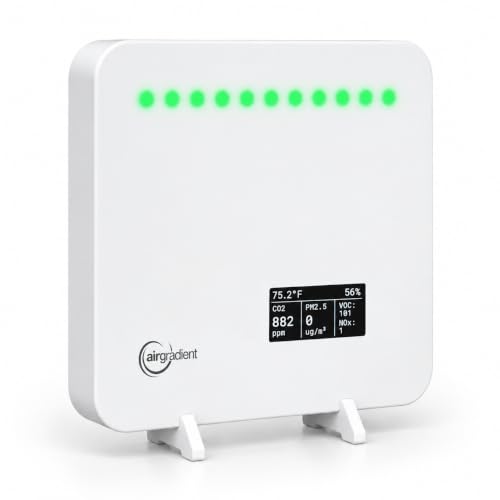
- Tracks PM2.5, CO2, TVOC, NOx, temperature, and humidity
- Open-source with Home Assistant and free API support
- Individually calibrated with a digital test report
Best For: Home Assistant users and subscription-free whole-room monitoring
Best for Trend Tracking

- Records 24-hour and 15-day air quality history
- Large 7-inch TFT display with visual and audible alerts
- True NDIR CO2 sensor with broad pollutant coverage
Best For: Households and classrooms that need clear trends and alarms
Best Portable Value

- Measures particles, CO2, TVOC, HCHO, temperature, and humidity
- Updates readings every 1.5 seconds on a color screen
- Compact design with Type-C charging and 4–5-hour runtime
Best For: Handheld air checks in homes, cars, offices, and bedrooms
Best Value Display
YNAK 16-in-1 Real-Time Air Quality Monitor

- Measures pollutants, temperature, humidity, and AQI
- 7-inch screen with three brightness settings
- Includes adapter, USB-C cable, and 12-month warranty
Best For: Everyday monitoring in homes, offices, vehicles, and campsites
Best Portable Design
AQItech Professional Indoor Air Quality Monitor

- Monitors particulate matter, gases, comfort readings, and AQI
- Analyzes air data every three seconds
- Portable design with simple one-button controls
Best For: Room-to-room, car, campsite, and nursery monitoring
Best Data-Export Monitor – Temtop M2000C 2ND
The Temtop M2000C 2ND is a practical choice for high-performance air quality monitoring systems when you need portable measurements and downloadable records. It tracks CO2, PM2.5, PM10, temperature, and humidity, while its color display and audio alarm make changing conditions easy to notice.
Best For: Schools, homes, and small businesses that need direct readings plus USB-exportable data for longer-term analysis.
Pros:
- Measures CO2, PM2.5, PM10, temperature, and humidity.
- Exports readings in CSV format through USB.
- Includes an audio alarm, colorful TFT display, and rechargeable battery.
- Backed by a 12-month warranty and round-the-clock customer support.
Cons:
- Does not provide the broader outdoor-sensor coverage of a paired indoor/outdoor system.
- Its feature set may be more than needed for users seeking only basic spot checks.
Choose this Temtop when offline usability and data review matter as much as live readings. It is especially well suited to educational or workplace environments where documenting air-quality trends is useful.
Best Indoor/Outdoor Bundle – IQAir AirVisual Monitor Bundle
The IQAir AirVisual bundle is designed for high-performance air quality monitoring systems that need both indoor context and outdoor exposure data. Its indoor monitor supports customizable alerts, while the weatherproof outdoor unit measures multiple pollution and weather parameters and connects to the IQAir platform.
Best For: Households and facilities that want to compare indoor conditions with nearby outdoor pollution from traffic, smoke, industry, or other sources.
Pros:
- Combines indoor monitoring with a weatherproof outdoor sensor.
- Outdoor monitor can measure PM1, PM2.5, PM10, AQI, temperature, humidity, and pressure.
- Wi-Fi connectivity enables app access and wireless data viewing.
- Outdoor unit supports wall, roof, or pole mounting with a 35-foot cable.
Cons:
- CO2 measurement outdoors requires an optional sensor module.
- The outdoor monitor requires a power adapter rather than battery operation.
- The bundle is likely excessive for users who need only a single-room monitor.
This is the strongest fit when air quality decisions depend on both sides of the building envelope. The combination of professional-grade pollutant sensors, app access, and outdoor mounting flexibility supports broader environmental awareness than a standalone indoor device.
Best Radon Monitor – Airthings View Plus
The Airthings View Plus adds radon detection to a broad set of sensors, making it a compelling option among high-performance air quality monitoring systems for continuous indoor use. It monitors radon, PM2.5, CO2, VOCs, humidity, temperature, and pressure, with app-based trends and notifications.
Best For: Homes that want continuous, cable-free monitoring with a particular focus on radon alongside everyday indoor air pollutants.
Pros:
- Measures radon, PM2.5, CO2, VOCs, humidity, temperature, and pressure.
- Battery-powered design supports flexible placement without a power cable.
- App provides live data, trend analysis, notifications, and cloud storage.
- Optional registration extends the warranty to five years.
Cons:
- The monitor and app require internet access to function.
- An Airthings account is required.
- Battery operation may require periodic battery replacement despite the stated long battery life.
View Plus stands out for buyers who consider radon an essential part of indoor air management. Its discreet eInk display and wireless placement are convenient, but users who prefer a fully offline monitor should look elsewhere.
Best Historical-Graph Monitor – CF-60PP SMART
The CF-60PP SMART suits high-performance air quality monitoring systems for homes, classrooms, and offices that need both immediate readings and historical context. Its on-screen graphs show pollution changes over up to 12 hours, while optional Wi-Fi adds remote alerts, cloud trends, and data export.
Best For: Businesses, facility managers, schools, and families tracking ventilation, pollutant spikes, VOCs, and pollen-related conditions.
Pros:
- Displays PM1.0, PM2.5, PM10, CO2, TVOC, HCHO, AQI, temperature, and humidity.
- Shows 4-minute, 6-minute, 2-hour, and 12-hour on-screen historical curves.
- Supports local alarms, app push notifications, and custom thresholds.
- Stores up to one year of history and supports USB data export.
Cons:
- Remote monitoring and cloud trends require Wi-Fi and the Smart App.
- Uses a required 9V battery, which may be less convenient than rechargeable operation.
- The extensive feature set may be unnecessary for simple single-reading checks.
This model is a strong documentation tool for identifying recurring indoor-air problems rather than reacting to isolated readings. Its local display remains useful without a phone, while connectivity is available when remote oversight is important.
Best Open-Source Pick – AirGradient ONE I-9PSL-DE
For buyers seeking high-performance air quality monitoring systems with broad pollutant coverage and flexible integrations, the AirGradient ONE is a strong choice. It tracks PM2.5, CO2, TVOC, NOx, temperature, and humidity, while its open-source design supports local control and Home Assistant.
Best For: Home Assistant users, offices, classrooms, and buyers who want subscription-free monitoring with detailed indoor air data.
Pros:
- Measures six key indoor air quality parameters, including PM2.5, CO2, TVOC, and NOx.
- Uses recognized sensor modules and includes individual PM2.5 calibration with a digital test report.
- Offers a subscription-free dashboard, free API access, open-source firmware, and Home Assistant support.
- Supports tabletop or wall installation and provides readings on an OLED display with an LED color bar.
Cons:
- Its compact 1.3-inch display provides less at-a-glance information than larger touchscreen monitors.
- It requires USB power rather than offering battery-powered portability.
The AirGradient ONE stands out when sensor breadth, documented calibration, and integration flexibility matter more than portability or a large built-in screen.
Best for Trend Tracking – 18-in-1 Air Quality Monitor
This 18-in-1 monitor is a practical option among high-performance air quality monitoring systems for users who want extensive readings and historical context in one freestanding unit. Its large display shows multiple measurements, while 24-hour and 15-day histories help reveal recurring air quality patterns.
Best For: Homes, nurseries, basements, offices, and classrooms where large-screen readings, alarms, and trend history are priorities.
Pros:
- Tracks PM1.0, PM2.5, PM10, CO2, HCHO, TVOC, temperature, humidity, AQI, and time.
- Provides both 24-hour and 15-day historical trends for comparing changes over time.
- Uses a true NDIR CO2 sensor and external temperature and humidity sensors.
- Includes a 7-inch TFT display, visual alerts, audible alarms, and a battery rated for up to 8 hours.
Cons:
- Its portable battery operation lasts up to 8 hours, so it may need regular recharging away from power.
- The freestanding design does not list wall-mounting support.
Choose this model if visual readability and built-in history are more important than smart-home integration or a compact footprint.
Best Portable Value – 16-in-1 Air Quality Tester
For straightforward, mobile testing, this compact model delivers the core capabilities expected from high-performance air quality monitoring systems without requiring separate meters. It measures particulate matter, CO2, TVOC, HCHO, temperature, and humidity, and updates readings every 1.5 seconds.
Best For: Users who want a simple monitor for bedrooms, offices, cars, and other indoor spaces, especially those who value handheld portability.
Pros:
- Monitors PM1.0, PM2.5, PM10, CO2, TVOC, HCHO, temperature, and humidity.
- Provides continuous updates every 1.5 seconds on a high-definition color screen.
- Offers one-button operation, adjustable audio prompts, and a quiet sampling mode.
- Uses universal Type-C charging and supports approximately 4–5 hours of continuous sampling.
Cons:
- Battery runtime is shorter than the 18-in-1 monitor’s stated up-to-8-hour runtime.
- The supplied notes do not mention historical data tracking, app connectivity, or smart-home integration.
This is a sensible pick for quick checks across multiple locations, but buyers seeking long-term trend analysis or connected monitoring may prefer a more feature-rich system.
Best All-Around Coverage – Sainlogic 16-in-1 Indoor Air Quality Monitor
For shoppers comparing high-performance air quality monitoring systems, the Sainlogic stands out for broad indoor coverage, fast refreshes, and a large display. It tracks CO2, particulate matter, HCHO, TVOC, temperature, humidity, and AQI without requiring Wi-Fi or an app.
Best For: Families, nurseries, allergy-sensitive households, and users who want portable monitoring with customizable alerts.
Pros:
- Monitors nine key environmental readings with seven configurable alert thresholds.
- Refreshes readings every 1–2 seconds and uses a 0.001-level detection sensitivity.
- Large 7.2-inch display, adjustable brightness, visual alerts, and ventilation prompts.
- Rechargeable 2500mAh battery provides up to eight hours of wireless use.
Cons:
- Wireless runtime is limited to up to eight hours per charge.
- It does not offer app or Wi-Fi connectivity for remote monitoring.
The Sainlogic is a strong fit when you want detailed, immediately visible readings and flexible placement. Its broad sensor coverage and quick updates make it especially practical for room-to-room household checks.
Best Value Display – YNAK 16-in-1 Real-Time Air Quality Monitor
The YNAK AK22A offers a straightforward way to compare readings in high-performance air quality monitoring systems. Its external sensor array monitors key pollutants and comfort conditions on a bright 7-inch screen, with audible alerts and USB-C charging.
Best For: Bedrooms, offices, vehicles, campsites, and shoppers seeking a simple monitor with included charging accessories and warranty support.
Pros:
- Detects CO2, PM1.0, PM2.5, PM10, HCHO, TVOC, temperature, humidity, and AQI.
- External high-precision sensors are designed for rapid response to environmental changes.
- Three display brightness settings and a mute function support comfortable daily use.
- Includes an AC adapter, USB-C cable, manual, and 12-month warranty.
Cons:
- Battery life is rated for up to eight hours of continuous use.
- Sensors should be kept away from perfumes and strong odors, and should not be touched.
Choose the YNAK if clear at-a-glance readings and a complete starter package matter most. It balances broad detection, portable operation, and uncomplicated controls for everyday indoor use.
Best Portable Design – AQItech Professional Indoor Air Quality Monitor
For buyers prioritizing portability among high-performance air quality monitoring systems, the AQItech monitor combines a compact design with real-time detection and simple one-button controls. It covers particulate matter, gases, temperature, humidity, and AQI alerts for use across multiple settings.
Best For: Users moving between rooms, cars, campsites, nurseries, and other spaces who want a portable monitor with quick-access controls.
Pros:
- Tracks PM1.0, PM2.5, PM10, CO2, TVOC, HCHO, temperature, humidity, and AQI alerts.
- Collects and analyzes air data every three seconds.
- One-button operation supports power, Celsius/Fahrenheit changes, and alarm silencing.
- Includes a lithium battery, Type-C cable, adapter, and 12-month warranty.
Cons:
- Wireless runtime is approximately four to five hours per charge.
- Its alert system is primarily designed around audible beeps and visual alarm information rather than connected notifications.
The AQItech is a practical choice for mobile checks where quick controls and a modern, portable form matter more than extended battery life. Its three-second sampling and broad parameter coverage support routine monitoring at home or on the go.
How We Picked the Best High-Performance Air Quality Monitoring Systems
We evaluated these monitors by looking at the measurements they can track, how clearly they present readings, and how useful their alerts and historical data are. We also considered connectivity, export options, battery or mains operation, display quality, installation flexibility, and whether each model is better suited to a home, office, classroom, or professional environment.
Sensor count alone does not determine performance. A monitor with fewer, well-chosen sensors and reliable data access may be more useful than a device that lists many measurements without explaining accuracy, calibration, or limitations.
Quick Comparison
| Best For | Look For |
|---|---|
| Whole-home awareness | CO2, PM2.5, VOC, humidity, temperature, app access, and trend history |
| Radon monitoring | A dedicated radon sensor, continuous readings, and clear long-term trends |
| Professional spaces | Real-time dashboards, alarms, data export, and multiple measurement points |
| Portable checks | Battery operation, a readable screen, fast startup, and compact construction |
| Smart-home automation | Local integrations such as Home Assistant, network access, or an open data platform |
Key Buying Factors for High-Performance Air Quality Monitoring Systems
Measurement Coverage
CO2 is a useful indicator of ventilation, while PM2.5 and PM10 help reveal smoke, dust, and other particles. VOC and formaldehyde readings can provide additional context, but these sensors may be affected by household chemicals and should be treated as directional indicators. If radon is a concern, choose a model with a dedicated radon sensor rather than assuming a general air-quality score covers it.
Accuracy, Calibration, and Trends
Look for transparent specifications, calibration guidance, and trend views rather than relying only on a color-coded AQI. Long-term history is especially valuable for comparing rooms, checking ventilation changes, or spotting recurring spikes.
Alerts and Data Access
Audible alarms are useful when you need an immediate warning, while app notifications and exported data are better for remote monitoring or documentation. Smart-home compatibility can also let a monitor trigger ventilation equipment, but confirm whether the integration is local, cloud-based, or limited to specific platforms.
Placement and Maintenance
Place the monitor away from windows, vents, kitchens, direct sunlight, and drafts unless you are deliberately testing those conditions. Check replacement filters, sensor life, charging requirements, and the manufacturer’s calibration recommendations before buying.
Who Should Buy Which High-Performance Air Quality Monitoring Systems?
Choose a connected system with indoor and outdoor context if you want whole-home tracking or neighborhood comparisons. A radon-capable monitor is the better choice for basements, lower levels, or regions where radon exposure is a known concern. Offices, schools, and commercial spaces should prioritize professional alerts, data export, and multi-room deployment. For occasional spot checks, a portable 16-in-1 or 18-in-1 display can offer broad coverage at a lower commitment. Smart-home users should favor an openly documented integration, while buyers who prefer simplicity may be better served by a monitor with a large screen, clear alarms, and minimal setup.