Choosing among commercial-grade air quality monitoring systems means looking beyond a simple air-quality score. The right setup should measure the pollutants that matter in your facility, present data clearly, and support timely corrective action.
This roundup compares professional monitors, particle counters, and connected indoor-air platforms across sensor coverage, portability, display options, data logging, and specialized features such as radon or cleanroom particle measurement.
Best 10 Commercial-Grade Air Quality Monitoring Systems Picks for 2026
Best Connected Coverage
IQAir AirVisual Air Quality Monitor Bundle

- Pairs indoor and outdoor air-quality sensors
- Supports app viewing, alerts, and historical platform data
- Outdoor unit measures multiple particulate and environmental parameters
Best For: Indoor/outdoor pollution tracking with connected access
Best for On-Site Inspection

- Measures six particle-size ranges simultaneously
- Adds PM, HCHO, TVOC, and CO2 monitoring functions
- Stores 5,000 records and supports USB export
Best For: Portable cleanroom and facility inspections
Best Simple Pro Monitor
DC1100 Pro Air Quality Monitor

- Compact fixed-monitor design
- Built for 120V power
- Lightweight at about 15.8 ounces
Best For: Basic stationary monitoring in 120V settings
Best for Particle Testing
6-Channel Dust Particle Counter
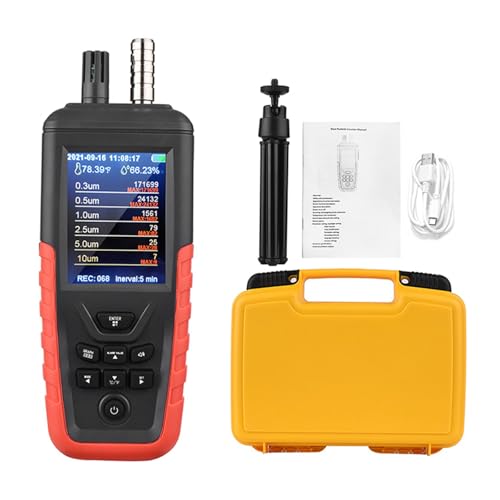
- Measures six particle-size ranges plus PM2.5 and PM10
- Stores 999 records and exports PDF reports via USB
- Includes alarms, tripod, case, and 9+ hour battery
Best For: Cleanroom testing and industrial contamination checks
Best for Radon and Connected Indoor Tracking

- Tracks radon, PM2.5, CO2, VOCs, and climate data
- Offers app alerts, cloud history, and trend analysis
- Battery-powered with customizable eInk display
Best For: Connected indoor radon and air-quality monitoring
Open-Source Choice
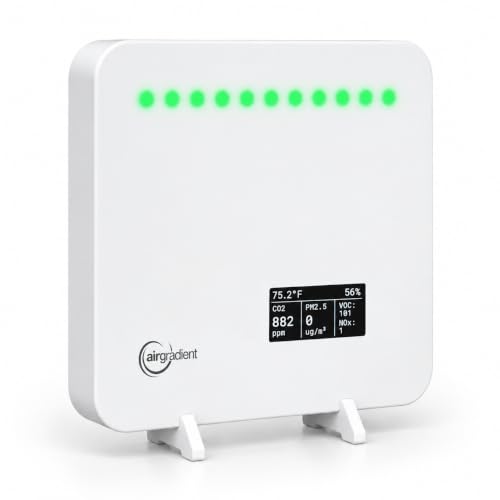
- Measures PM2.5, CO2, TVOC, NOx, temperature, and humidity.
- Subscription-free dashboard, API, and Home Assistant support.
- Individually PM2.5-calibrated with a digital test report.
Best For: Fixed-location commercial monitoring with flexible integrations
Portable Data Logger

- Tracks eight air-quality and environmental measurements.
- Stores up to 50,000 readings with data export.
- Large 3.2-inch color display shows metrics simultaneously.
Best For: Portable surveys and long-term local data collection
Smart Portable Monitor

- Monitors CO2, PM1, PM2.5, PM10, TVOC, HCHO, temperature, and humidity.
- Provides 90-day app history, CSV export, and smart alerts.
- Offers up to six hours of battery use or continuous USB-C operation.
Best For: App-connected monitoring with alerts and portable use
Best Connected Coverage – IQAir AirVisual Air Quality Monitor Bundle
For buyers comparing commercial-grade air quality monitoring systems, the IQAir AirVisual bundle stands out when you need coordinated indoor and outdoor readings. It tracks particulate matter, temperature, and humidity, while the outdoor unit can monitor additional parameters and connect to the IQAir platform for remote viewing.
Best For: Homes, offices, and facilities that need indoor monitoring alongside weatherproof outdoor pollution tracking.
Pros:
- Combines indoor and outdoor air-quality monitoring in one bundle.
- Tracks PM1, PM2.5, PM10, temperature, humidity, and atmospheric pressure; CO2 is available with the optional sensor module.
- Offers Wi-Fi access, customizable alerts, app support, and flexible outdoor mounting.
- Outdoor unit uses two professional-grade laser sensors and includes a 12 m cable.
Cons:
- CO2 monitoring requires an optional sensor module for the outdoor monitor.
- The outdoor unit requires a power adapter and is intended for a fixed installation.
This is a strong choice when broad coverage and connected data access matter more than a compact, handheld format. Its indoor/outdoor pairing provides useful context for local pollution and indoor exposure.
Best for On-Site Inspection – CEM DT-9883M Particle Counter
The CEM DT-9883M is a handheld option for commercial-grade air quality monitoring systems where technicians need particle-size data and portable testing. It measures six particle sizes simultaneously and adds readings for PM2.5/PM10, HCHO, TVOC, and CO2, with onboard storage for field records.
Best For: Cleanrooms, laboratories, hospitals, and environmental departments conducting portable inspections.
Pros:
- Detects particles from 0.3 to 10 micrometers across six size channels.
- Includes PM2.5/PM10 concentration measurements plus HCHO, TVOC, and CO2 functions.
- Stores up to 5,000 records and 20 minutes of video for documentation.
- Handheld design, large display, rechargeable battery, and USB export support field work.
Cons:
- Its upper operating temperature is listed as 40 °C.
- The feature-rich handheld format may be more equipment than needed for simple continuous room display.
Choose this model when measurement detail, portability, and recordkeeping are priorities. The included calibration certificate and multiple particle channels make it particularly suited to inspection-oriented workflows.
Best Simple Pro Monitor – DC1100 Pro Air Quality Monitor
The DC1100 Pro is a straightforward choice for buyers seeking commercial-grade air quality monitoring systems without a long list of documented features. Its compact 120V design can suit a dedicated monitoring location where simple installation and a small footprint are more important than portable testing or network connectivity.
Best For: Users who need a compact, fixed monitor for a 120V environment.
Pros:
- Compact dimensions of 4.5 x 3 x 7 inches.
- Lightweight design at approximately 15.8 ounces.
- Designed for standard 120V use.
Cons:
- Only for use with 120V power.
- The supplied notes do not specify measured pollutants, connectivity, alerts, or data logging.
- Provides less documented functionality than the other products in this roundup.
This model makes the most sense when you want a small, fixed unit and have modest monitoring requirements. Buyers needing detailed pollutant data, records, or remote access should consider a more fully specified alternative.
Best for Smart Buildings – Atmocube Professional Indoor Air Quality Monitor
Atmocube is designed for commercial-grade air quality monitoring systems that need room-by-room visibility and building integration. It measures 12 parameters, includes a wireless e-ink display, and supports Wi-Fi, Ethernet, PoE, cloud trends, alerts, and protocols used with HVAC and building-management systems.
Best For: Offices, schools, healthcare spaces, and professional integrators managing indoor air quality across connected buildings.
Pros:
- Measures CO2, particulate matter, formaldehyde, TVOC, NO2, ozone, noise, light, and environmental conditions.
- Includes a battery-powered wireless e-ink companion display for glanceable readings.
- Provides cloud alerts, historical trends, data exports, and compliance-report support.
- Offers Wi-Fi, Ethernet, PoE, MQTT, Modbus, REST API, and building-system integration.
Cons:
- Its extensive integration features may be unnecessary for basic home monitoring.
- The supplied notes do not specify individual measurement ranges or accuracy figures.
This is the most integration-focused option in the group. Its combination of broad sensing, local display, cloud reporting, and automation protocols makes it a practical fit for facilities that want air-quality data to inform building operations.
Best for Particle Testing – 6-Channel Dust Particle Counter
For commercial-grade air quality monitoring systems focused on particulate contamination, this six-channel counter provides particle-count data across six size ranges, plus PM2.5, PM10, temperature, and humidity readings. Its cleanroom compliance claim, data export, tripod, and configurable alarms make it suited to documented spot checks and fixed-point monitoring.
Best For: Cleanroom testing, filter checks, industrial production, and contamination detection.
Pros:
- Counts particles from 0.3 to 10 µm across six channels.
- Stores up to 999 records and exports historical data as PDF via USB.
- Includes customizable alarms, a pollution indicator, tripod, case, and rechargeable battery rated for 9+ hours.
Cons:
- Its primary focus is particles and basic environmental conditions, rather than gases such as CO2 or VOCs.
- The handheld unit weighs 1.83 pounds, so it is less compact than simple room monitors.
This is the more specialized choice when particle-size distribution and documented measurements matter more than broad household air-quality coverage.
Best for Radon and Connected Indoor Tracking – Airthings View Plus
Among commercial-grade air quality monitoring systems for connected indoor environments, the Airthings View Plus stands out for combining radon detection with PM2.5, CO2, VOC, humidity, temperature, and pressure readings. Its battery-powered design and cloud-connected app support ongoing monitoring without requiring a permanent power cable.
Best For: Offices, homes, and other indoor spaces where radon and broad air-quality trends need remote tracking.
Pros:
- Monitors radon, PM2.5, CO2, VOCs, humidity, temperature, and air pressure.
- Provides live data, trends, notifications, and cloud storage through the Airthings app.
- Battery-powered, cable-free, with a customizable eInk display and up to two-year battery life.
Cons:
- The device requires the Airthings app, an account, and internet access for its connected functions.
- Operating conditions are limited to 4–40°C and below 85% humidity.
Choose this model when radon is a priority and you want a relatively unobtrusive monitor with app-based history and alerts rather than a dedicated particle counter.
Best for Business Reporting – CF-60PP SMART Air Quality Monitor
This CF-60PP SMART is a practical option among commercial-grade air quality monitoring systems for offices, classrooms, and other managed indoor spaces. It displays multiple pollutants and environmental readings together, keeps local trend graphs visible without a phone, and supports longer-term USB export for facility documentation.
Best For: Facility managers and businesses tracking indoor air trends, ventilation concerns, and pollutant thresholds.
Pros:
- Displays PM1.0, PM2.5, PM10, CO2, TVOC, HCHO, AQI, temperature, and humidity.
- Shows local 4-minute, 6-minute, 2-hour, and 12-hour color graphs without requiring a phone.
- Stores up to one year of history and supports USB export, app alerts, and custom thresholds.
Cons:
- Remote monitoring and cloud trends require Wi-Fi and the Smart App.
- Its included battery is a 9V battery, which may be less convenient for continuous facility deployment than a mains-powered design.
It offers the broadest on-device reporting of these three products, making it a strong fit when staff need visible trends and exportable records as well as remote notifications.
Open-Source Choice – AirGradient ONE
For commercial-grade air quality monitoring systems that prioritize broad pollutant coverage and integration flexibility, the AirGradient ONE is a strong option. It measures PM2.5, CO2, TVOC, NOx, temperature, and humidity, while its open-source design supports local control and self-hosting.
Best For: Offices, classrooms, gyms, workshops, and commercial buildings needing detailed readings, Home Assistant integration, and subscription-free data access.
Pros:
- Measures particles, CO2, VOCs, NOx, temperature, and humidity.
- Uses established SenseAir, Plantower, Sensirion, and NDIR sensor technologies.
- Includes a subscription-free dashboard, free API access, and Home Assistant support.
- Individually tested and calibrated for PM2.5 with a digital test report.
Cons:
- Its 1.3-inch OLED display is relatively small for viewing multiple readings.
- Requires USB power rather than offering battery operation.
- Open-source and self-hosting features may appeal more to technical users.
The AirGradient ONE stands out when accuracy evaluation, integration options, and transparent data access matter more than portability. Its wall- or desktop-mountable design also suits fixed-location monitoring.
Portable Data Logger – WapoRich TC-700PRO
The WapoRich TC-700PRO is a practical pick among commercial-grade air quality monitoring systems for users who want broad measurements and substantial onboard storage. It tracks particulate sizes, gases, temperature, and humidity while recording up to 50,000 data sets for later export.
Best For: Portable inspections and longer-term monitoring in offices, laboratories, schools, and other spaces where a large display and exportable records are useful.
Pros:
- Measures CO2, PM1.0, PM2.5, PM10, HCHO, TVOC, temperature, and humidity.
- Stores up to 50,000 sets of readings and supports data report export.
- Shows all measured metrics on a 3.2-inch color display.
- Compact design supports on-the-go testing.
Cons:
- The supplied notes do not specify battery life or charging details.
- The notes do not identify app, cloud, or smart-home integration.
- Its 269 g listed product weight may be less convenient for extended handheld use.
Choose the TC-700PRO when local data capture and easy visual reading are priorities. Its extensive storage makes it especially useful for comparing conditions over time without relying on a subscription dashboard.
Smart Portable Monitor – BREATHE Airmonitor Plus Gen 2
For commercial-grade air quality monitoring systems with app-based history and alerts, the BREATHE Airmonitor Plus Gen 2 combines eight measurements with Wi-Fi connectivity. It monitors CO2, particle sizes, TVOC, formaldehyde, temperature, and humidity, with readings available on the device or in the companion app.
Best For: Homes, offices, classrooms, and bedrooms where users want portable monitoring, remote readings, configurable alerts, and exportable historical data.
Pros:
- Provides eight-in-one monitoring, including CO2, PM1, PM2.5, PM10, TVOC, and HCHO.
- Offers up to 90 days of app history, data export, and configurable CO2 and PM2.5 alerts.
- Rechargeable battery supports up to six hours of portable use.
- Can operate continuously through USB-C power.
Cons:
- Wi-Fi app connectivity is limited to 2.4 GHz networks.
- Six-hour battery life is shorter than a full workday of continuous portable use.
- Advanced historical features depend on pairing with the companion app.
The Gen 2 model is a convenient fit for users who want to connect air-quality changes with daily activities, HVAC operation, or ventilation. Its combination of alerts, history, and portability makes it more versatile than a basic standalone meter.
How We Picked These Commercial-Grade Air Quality Monitoring Systems
We selected systems based on measurement range, sensor coverage, practical usability, and suitability for workplaces or other demanding indoor environments. The list includes dedicated particle counters, connected indoor-air monitors, portable instruments, and systems with specialized measurements such as radon.
We also considered how each device handles data: onboard displays, wireless connectivity, historical logging, alerts, dashboards, and integration options can matter as much as the sensor list. Product claims and specifications should be verified against the latest manufacturer documentation before purchase, especially when measurements will support compliance, remediation, or occupational-health decisions.
Quick Comparison
- Broad indoor monitoring: Look for CO2, particulate matter, VOCs, temperature, and humidity in one system.
- Particle investigation: Choose a particle counter with multiple size channels when identifying dust or contamination sources is the priority.
- Cleanroom work: Use an instrument designed for cleanroom particle counting rather than relying only on a consumer-style indoor monitor.
- Remote visibility: Wireless dashboards, alerts, and integrations are useful for facilities with multiple rooms or sites.
- Radon concerns: Select a model with a dedicated radon sensor if long-term radon tracking is required.
Key Buying Factors for Commercial-Grade Air Quality Monitoring Systems
Sensor Coverage and Measurement Purpose
Start with the pollutants relevant to your building. CO2 helps assess ventilation, PM1.0/PM2.5/PM10 can reveal combustion or particulate issues, and VOC or formaldehyde readings may support investigations involving furnishings, finishes, or cleaning products. Temperature and humidity provide useful context for comfort, condensation, and mold-risk assessments.
Accuracy, Calibration, and Maintenance
Confirm the stated accuracy, operating range, calibration process, sensor lifespan, and replacement costs. Low-cost sensors can identify trends, but critical decisions may require reference-grade verification or periodic comparison with calibrated equipment. A device is only useful if staff can maintain it and interpret its limitations.
Data Access and Deployment
For one room, an onboard screen may be sufficient. Larger facilities usually benefit from network access, centralized dashboards, downloadable records, threshold alerts, and role-based sharing. Check Wi-Fi requirements, cloud fees, local-storage options, battery life, and whether the system continues recording during connectivity outages.
Portability and Physical Design
Portable counters are valuable for spot checks and troubleshooting, while permanently powered monitors are better for continuous coverage. Consider enclosure durability, display readability, mounting options, noise, charging, and whether the device can operate reliably in the intended temperature and humidity range.
Who Should Buy Which Commercial-Grade Air Quality Monitoring Systems?
Facility managers and offices should favor connected monitors with CO2, PM, VOC, temperature, and humidity tracking, plus alerts and historical trends. Schools and healthcare-adjacent spaces may benefit from clear displays and centralized reporting that make ventilation issues easier to identify and communicate.
Cleanroom and industrial users should prioritize multi-channel particle counters, appropriate particle-size thresholds, data logging, and documented calibration support. Researchers, inspectors, and remediation professionals may prefer portable instruments that support repeated measurements and detailed records. Homes or small businesses with radon concerns should choose a system with dedicated radon monitoring rather than assuming a general air-quality monitor covers that need.