Scanning books and paperwork no longer requires a bulky office machine. Today’s budget book scanners range from overhead book-capture devices to compact wand and sheet-fed models, making it easier to digitize pages at home, work, or school.
Our selection includes portable scanners for occasional projects, duplex document scanners for paperwork, and higher-resolution options for photos and bound books. Use the guide below to match the scanner type, workflow, and features to your needs.
Best 10 Budget Book Scanners Picks for 2026
Best Overall

- About one-second page scanning
- A3/A4 overhead scanning with 13MP camera
- OCR and document-camera features
Best For: Fast scanning of thinner books and documents
Best Battery-Powered Value

- Cordless operation with two AA batteries
- 300/600/900 dpi settings
- Includes 16GB microSD storage
Best For: Portable, occasional scanning away from an outlet
Best Compact Document Scanner

- Up to 16 pages per minute
- USB-powered and about one pound
- Works with Windows, Mac, and Linux
Best For: Loose documents, receipts, and mobile office use
Best Handheld Wand

- Scans A4 pages at up to 900 dpi
- Includes 16GB SD card
- Lightweight, battery-powered design
Best For: Portable scanning of pages, photos, and book material
Best Portable Pick

- 9.44-ounce USB-powered design
- Scans pages, receipts, and ID cards
- OCR creates searchable and editable files
Best For: Travelers and loose-document scanning
Best Book-Scanning Value

- Designed to flatten curved book pages
- Scans pages in about two seconds
- Supports materials smaller than A3
Best For: Bound books and larger scanning projects
Best for Receipts
- Scans up to 10 pages per minute
- Extracts and categorizes receipt data
- Exports information to QuickBooks and TurboTax
Best For: Receipt, invoice, and bookkeeping workflows
Best Wireless Wand Scanner

- Rechargeable handheld design with MicroSD storage
- 300/600/1050 dpi scanning with JPEG and PDF output
- Includes OCR and PDF editing software
Best For: Mobile scanning with onboard storage and OCR
Best Feeder Scanner
- Duplex scanning at up to 12 pages per minute
- 20-sheet automatic document feeder
- Built-in software and Windows/Mac compatibility
Best For: Portable batch scanning of everyday documents
Best Entry-Level Wand

- 300/600/900 dpi settings for documents and photos
- Supports JPG/PDF files and MicroSD cards up to 32GB
- Plug-and-play Windows/Mac operation
Best For: Simple receipt, note, and document scanning on the go
Best Overall – CZUR Shine Ultra
For shoppers comparing budget book scanners, the CZUR Shine Ultra is a versatile overhead model that can scan A3 and A4 materials in about one second per page. Its camera-based design is especially useful for books, flat documents, and document-camera presentations.
Best For: Users who want fast overhead scanning, OCR, and document-camera functionality for thinner books and papers.
Pros:
- Scans pages in approximately one second and supports A3 and A4 materials.
- 13MP CMOS camera with auto-cropping, smart paging, and multiple color modes.
- OCR supports more than 180 languages and the unit works with Windows and macOS.
- Foldable, lightweight design includes a foot pedal and adjustable neck.
Cons:
- Not compatible with Android or iOS.
- Curved-page flattening is intended for thinner books; thicker books may require another CZUR series.
- Thai, Hebrew, and Arabic are not currently supported for OCR.
The Shine Ultra offers more features than a basic handheld scanner, making it a strong value for frequent book and document digitization. Its overhead format also avoids feeding pages through a paper path.
Best Battery-Powered Value – Hczrc Portable Scanner
This portable model is a practical choice among budget book scanners for shoppers who want a low-cost, computer-free way to capture book pages, receipts, photos, and documents. It saves JPEG or PDF files directly to the included 16GB microSD card and uses two AA batteries.
Best For: Travelers, students, and occasional users who need cordless scanning and direct memory-card storage.
Pros:
- Works without software installation and stores scans directly to a microSD card.
- Offers selectable 300, 600, and 900 dpi resolutions.
- Saves scans as JPEG or PDF files and includes a 16GB card.
- Compact 9.6-ounce design is easy to carry.
Cons:
- Two AA batteries are required and are not included.
- Handheld scanning requires guiding the device across the page.
- Its listed compatibility is limited to Windows and older macOS versions.
This scanner keeps the setup simple and portable, with no driver installation required. It is best suited to occasional, on-the-go captures rather than high-volume automated scanning.
Best Compact Document Scanner – Brother DS-640
The Brother DS-640 is a compact option for budget book scanners buyers who primarily scan loose pages, receipts, cards, and short documents. It connects through included micro USB 3.0, so it can run from a computer without a separate power outlet.
Best For: Home offices and mobile users who need a dependable, compact scanner for individual pages and receipts.
Pros:
- Scans color and black-and-white documents at up to 16 pages per minute.
- Weighs about one pound and measures less than a foot long.
- Supports Windows, Mac, and Linux, along with several driver standards.
- Includes image optimization and OCR-related software features.
Cons:
- Its one-sheet capacity is less suited to batch scanning.
- Designed for documents and cards rather than bound books.
- Maximum listed resolution is 300 dpi.
The DS-640 is a better fit for document-focused scanning than true book digitization. Its small footprint, USB power, and broad operating-system support make it convenient for desks and travel bags.
Best Handheld Wand – MUNBYN 900 DPI Scanner
For budget book scanners shoppers who want a simple wand-style device, the MUNBYN portable scanner captures photos, documents, and book pages independently at up to 900 dpi. Its small body and included 16GB SD card make it convenient for personal archiving.
Best For: Users digitizing loose pages, photos, and book material while traveling or working away from a desk.
Pros:
- Supports 300, 600, and 900 dpi scanning resolutions.
- Scans up to A4 size and stores files on the included 16GB SD card.
- Lightweight 0.66-pound design is easy to carry.
- Does not require a driver for transferring files by USB.
Cons:
- Requires a pair of AA batteries, sold separately.
- Handheld scanning takes practice to keep movement steady.
- OCR conversion requires separate software.
The MUNBYN is a straightforward choice for users who value portability and high nominal resolution over automated feeding. It can handle book pages without folding them, but results depend on consistent scanning technique.
Best Portable Pick – Epson WorkForce ES-50
If you need budget book scanners for occasional document capture rather than bound books, the Epson WorkForce ES-50 is a compact, USB-powered option. It handles single sheets, receipts, ID cards, and pages up to 8.5 by 72 inches, while included OCR software can create searchable PDFs and editable files.
Best For: Travelers, home offices, and users who primarily scan loose documents and receipts.
Pros:
- Lightweight, portable design weighing 9.44 ounces.
- USB-powered operation requires no batteries or external power supply.
- Scans a page in as little as 5.5 seconds and supports automatic multi-page feeding.
- Includes OCR, cloud scanning, and Windows/Mac compatibility.
Cons:
- Single-sheet capacity means pages must be inserted individually.
- Designed for loose documents, not scanning bound books.
- Requires a computer and USB connection for operation.
The ES-50 is a practical low-cost choice when portability matters most. Its narrow, single-sheet workflow is less suitable for digitizing an entire book, but it is well equipped for everyday paperwork on the go.
Best Book-Scanning Value – CZUR Aura Pro Book Scanner
For shoppers comparing budget book scanners, the CZUR Aura Pro is the most purpose-built option in this group. Its three laser lines help flatten curved book pages, while automatic page detection, two-second scanning, and A3-size support make it suited to larger scanning projects.
Best For: Digitizing bound books, magazines, and other materials up to A3 size.
Pros:
- Laser-based technology helps reproduce curved book pages accurately.
- Scans single or double pages in about two seconds.
- Automatic page-turn detection and optional foot-pedal scanning streamline workflows.
- OCR supports more than 180 languages and the unit doubles as a desk lamp.
Cons:
- At 3.24 kg, it is substantially less portable than mobile scanners.
- Thai, Hebrew, and Arabic are not currently supported by the OCR.
- Sound-controlled lamp functions can be affected by noise and distance.
The Aura Pro is the strongest match here for actual book scanning. Its larger desktop footprint and higher weight are trade-offs for curved-page handling, fast capture, and hands-free scanning features.
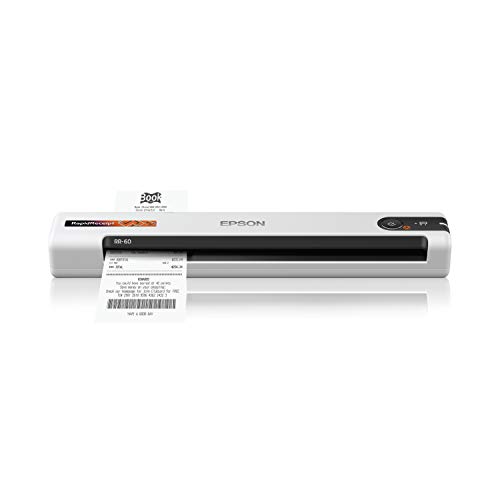
Best for Receipts – Epson RapidReceipt RR-60
Among budget book scanners and document scanners, the Epson RapidReceipt RR-60 stands out for organizing financial paperwork. Its ScanSmart AI PRO software can extract receipt and invoice information, categorize files, and export data to applications such as QuickBooks and TurboTax.
Best For: Home businesses, freelancers, and anyone digitizing receipts, invoices, and financial records.
Pros:
- Scans up to 10 pages per minute in automatic feeding mode.
- Extracts and categorizes data from receipts and invoices.
- Exports organized information to QuickBooks and TurboTax.
- Supports receipts, documents, business cards, ID cards, and pages up to 8.5 by 72 inches.
Cons:
- Its receipt-focused design is not intended for bound books.
- Weighing 16 ounces, it is heavier than the ES-50.
- USB-powered operation requires connection to a computer.
The RR-60 offers the most useful automation for bookkeeping and receipt management in this lineup. Choose it over a general portable scanner when searchable files and financial-data export are more important than book scanning.
Best Wireless Wand Scanner – IRIScan Book 7
For shoppers comparing budget book scanners, the IRIScan Book 7 is a compact handheld option built for scanning documents and photos away from a desk. It supports 300, 600, and 1050 dpi, saves to a supplied MicroSD card, and works with Windows and Mac through USB.
Best For: Travelers, students, lawyers, and anyone who needs a lightweight scanner with onboard storage and OCR software.
Pros:
- Portable, rechargeable design with a color LCD preview/status display.
- Scans to MicroSD or USB and supports JPEG and PDF files.
- Includes Readiris OCR and PDF editing software for Windows and Mac compatibility.
- Offers up to 1050 dpi resolution and can combine multiple scans into one PDF.
Cons:
- It does not support Wi-Fi connectivity.
- Scanning is manual rather than feeder-based.
- An AC adapter is not included.
The IRIScan Book 7 is a flexible budget book scanner for mobile, private scanning. Its SD-card workflow and included software are useful, though users who want automatic page feeding or wireless transfer should consider another design.
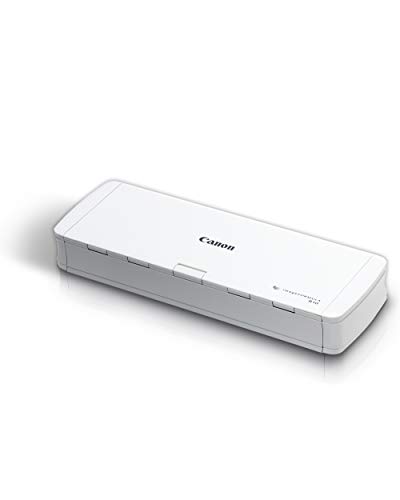
Best Feeder Scanner – Canon imageFORMULA R10
The Canon imageFORMULA R10 stands out among budget book scanners for users who prefer automatic feeding over a handheld wand. This USB-powered portable scanner can scan both sides of a document at once, handles up to 20 sheets, and reaches up to 12 pages per minute.
Best For: Mobile offices, classrooms, and home users digitizing batches of documents, receipts, cards, and reports.
Pros:
- Duplex scanning captures both sides in a single pass.
- 20-sheet automatic feeder supports more efficient batch scanning.
- Handles receipts, business cards, plastic or embossed cards, and legal documents.
- Built-in scanning software works with Windows and Mac without a complicated installation.
Cons:
- It is USB powered and does not offer a battery-based scanning workflow.
- It is not intended for scanning photographs on photo paper or photographic media.
- Its suggested daily volume is 500 scans.
Choose the R10 if productivity and automatic feeding matter more than scanning bound books or loose photos. Its duplex capability and compact size make it a practical document-focused option for portable work.
Best Entry-Level Wand – Portable 900DPI Scanner
This handheld model is a straightforward choice for shoppers seeking budget book scanners for receipts, notes, documents, and occasional photos. It offers selectable 300, 600, and 900 dpi modes, saves JPG or PDF files, and supports MicroSD storage up to 32GB.
Best For: Students, travelers, and users who want a simple plug-and-play scanner for quick personal document capture.
Pros:
- Plug-and-play operation with Windows and Mac systems.
- Three resolution settings balance speed and image detail.
- Supports MicroSD storage up to 32GB without relying on a computer.
- One-button operation and automatic saving simplify scanning on the go.
Cons:
- It uses a manual wand design rather than an automatic document feeder.
- File output is limited to JPG and PDF.
- The supplied notes specify USB connectivity but do not indicate wireless support.
The 900DPI handheld scanner is best suited to occasional, low-complexity scanning. It keeps the process simple and portable, while its MicroSD support helps users capture files when a laptop is not immediately available.
How We Picked the Best Budget Book Scanners
We focused on practical value rather than headline specifications alone. The shortlist includes scanners suited to bound books, loose documents, receipts, photos, and mobile use. We considered scanning method, portability, resolution, file-format support, power requirements, OCR capability, software compatibility, and ease of handling. Because “budget” means different things to different buyers, the lineup spans simple handheld wand scanners, compact sheet-fed models, and more specialized overhead book scanners.
A scanner that is excellent for a stack of invoices may be frustrating for a bound book, so the best choice depends heavily on what you scan most often.
Quick Comparison
| Scanner type | Best for | Main advantage | Potential limitation |
|---|---|---|---|
| Overhead book scanner | Bound books and fragile pages | Scans without feeding pages through rollers | Usually larger and less convenient for travel |
| Handheld wand | Occasional pages, receipts, and photos | Low-cost, lightweight, and flexible | Requires a steady hand and manual passes |
| Sheet-fed mobile scanner | Loose documents and receipts | Fast, consistent page handling | Not designed for bound books |
| Duplex document scanner | Two-sided paperwork | Scans both sides efficiently | Can cost more than basic portable models |
Key Buying Factors for Budget Book Scanners
Choose the Right Scanning Design
For textbooks, notebooks, and other bound material, an overhead scanner is generally the safest and most convenient design. Handheld scanners can work on individual pages but demand careful alignment. Sheet-fed models are better for loose paperwork and should not be used with bound books.
Check Resolution and Real-World Speed
Resolution around 300 dpi is usually sufficient for ordinary documents, while higher settings are useful for photos, small print, or archival work. Higher dpi can create larger files and slower scans, so do not choose a maximum number without considering your workflow.
Consider Power, Storage, and File Handling
USB-powered models are convenient at a desk or with a laptop. Battery-powered scanners are more flexible away from an outlet, especially when they include internal or removable storage. Confirm whether the scanner creates searchable PDFs, supports OCR, and works with your operating system before buying.
Match Feeding and Connectivity to Your Workload
An automatic document feeder or duplex function can save substantial time when processing many loose pages. For occasional scans, a lightweight USB model may be preferable. Wireless connectivity is useful for mobile workflows, but a simple wired connection can be more dependable and easier to set up.
Who Should Buy Which Budget Book Scanners?
Choose an overhead book scanner if your priority is digitizing bound books, magazines, or delicate pages with minimal contact. These are the strongest choices for regular book projects.
Choose a handheld wand scanner if you need the lowest-cost, most portable solution for occasional pages, receipts, photos, or travel documents. They are compact but require slower, steadier operation.
Choose a sheet-fed mobile scanner for loose documents, forms, and receipts. Models with duplex scanning or an automatic feeder are especially worthwhile for frequent office work.
Choose a higher-resolution model if photo quality, small text, or OCR accuracy matters more than the smallest size. Before purchasing, verify software support and the included accessories so the scanner fits your computer and intended workflow.