The best book scanners make it easier to digitize bound books, magazines, receipts, notes, and oversized documents without removing pages. The models in this roundup range from portable document cameras to advanced overhead scanners with OCR and automatic page correction.
We compare capture size, image resolution, software features, portability, and workflow speed so you can choose a book scanner that fits your workspace and the materials you scan most often.
Best 10 Book Scanners Picks for 2026
Best All-Around Book Scanner

- Two-second page scanning with searchable PDF output
- A3/A4 capture with curved-page correction
- Built-in smart lamp with four color temperatures
Best For: Home offices, students, and everyday book digitization
Best for Hands-Free Page Turning
ScanSnap SV600 Overhead Scanner

- Scans books without cutting or damaging them
- Detects page turns for streamlined capture
- Corrects curves and removes captured fingers
Best For: Digitizing intact books, magazines, and newspapers
Best High-Resolution Book Scanner

- 18MP camera with 4896 × 3672 resolution
- Captures documents up to A3 size
- Converts scans into editable OCR files
Best For: Detailed A3 book and document digitization
Best Portable Budget Option

- Lightweight 0.97 kg portable design
- A3 capture with less-than-three-second scanning
- OCR conversion for common Windows file formats
Best For: Portable book and document scanning on a budget
Flexible Classroom Scanner
NetumScan 13MP Book Document Camera

- Automatic correction and batch scanning
- Portable foldable A4 design
- Live projection and video recording
Best For: Teachers and home-office users needing a portable A4 scanner
Portable Book Flattening Scanner
CZUR Shine Ultra Pro 24MP Document Scanner
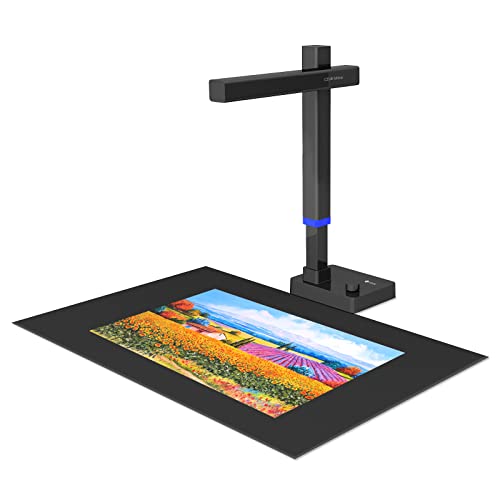
- 24MP high-resolution image capture
- Flattens curved book surfaces
- Exports searchable and editable formats
Best For: Mobile book digitization on Windows or newer macOS
Large-Format AI Scanner
VIISAN S21 Pro 26MP A2/A3 Book Scanner

- Captures interchangeable A2 and A3 formats
- Auto-flattening and fingerprint removal
- 180+ language OCR with AI integration
Best For: Large-format books, maps, newspapers, and archival work
Best All-Around Choice
CZUR Aura Pro Portable Book Scanner

- Flattens curved pages with three laser lines
- Scans pages in about two seconds
- Includes auto-detection, OCR, and a desk lamp
Best For: Home and office users digitizing books and A3 documents
Best for Large Scanning Projects

- 16MP camera captures detailed scans
- Scans at about 1.5 seconds per page
- Handles books, binders, cards, and objects
Best For: Fast digitization of thick books and sizable collections
Best Portable Value
CZUR Shine Ultra Smart Scanner

- Scans at about one second per page
- Folds down and weighs about four pounds
- Works as a scanner and document camera
Best For: Portable scanning of flat papers and thinner books
Best All-Around Book Scanner – CZUR Aura Pro
The CZUR Aura Pro is a versatile choice among book scanners for digitizing A3 and A4 books, documents, and other media. It scans a page in about two seconds, supports multiple output formats, and uses three laser lines to help flatten curved book pages.
Best For: Home offices, students, and readers who want a book scanner that also works as a smart reading lamp.
Pros:
- Scans pages in about two seconds and exports to JPG, Word, PDF, and searchable PDF.
- OCR supports more than 180 languages, excluding Thai, Hebrew, and Arabic.
- Three laser lines help reproduce curved book pages accurately.
- Four color-temperature settings and supplemental lights support scanning and reading.
Cons:
- USB connection is required; it does not use Wi-Fi or Bluetooth.
- Some OCR languages are not supported.
- Mac compatibility requires macOS 12 or later for Intel Macs and macOS 13 or later for Apple Silicon.
The Aura Pro combines fast capture, broad file-format support, and page-flattening technology in a relatively lightweight design. It is a strong general-purpose option when you want one device for book scanning, document conversion, and reading illumination.
Best for Hands-Free Page Turning – ScanSnap SV600 Overhead Scanner
The ScanSnap SV600 is an overhead option for book scanners that lets you scan newspapers, magazines, books, photos, and documents without cutting or damaging them. Its page-turning detection and automatic book correction are designed for efficient batch capture.
Best For: Users digitizing intact books, newspapers, magazines, or mixed document collections with minimal handling.
Pros:
- Scans bound materials directly without cutting or damaging them.
- Automatically flattens book curves and can remove captured fingers with Point Retouch.
- Multi Document Detection can crop and rotate several smaller items in one scan.
- Page Turning Detection and Time Mode support more efficient scanning workflows.
Cons:
- At 6.6 pounds, it is heavier than several portable overhead scanners.
- Its listed connection is USB, so it is not a wireless scanner.
- Compatibility is specified for Windows 10/11 and macOS Monterey 12 or later.
The SV600 stands out for hands-free-style scanning features and automatic image corrections. Choose it when preserving original books and streamlining page-by-page capture matter more than having the lightest possible unit.
Best High-Resolution Book Scanner – CZUR ET18 Pro
The CZUR ET18 Pro is a high-resolution choice among book scanners, pairing an 18MP camera with A3 capture and curved-page flattening. Its OCR software can turn scans into editable Word, Excel, and PDF files, making it suitable for serious document digitization.
Best For: Researchers, offices, and users who need detailed A3 scans and editable OCR documents.
Pros:
- 18MP imaging provides 4896 × 3672 resolution and 275 DPI capture.
- Patented technology flattens curved book pages after image processing.
- OCR supports more than 180 languages and exports to editable PDF, Word, and Excel.
- Scans documents up to A3 size and can reach about two seconds per page.
Cons:
- It requires a cable connection and does not support Wi-Fi.
- Very glary papers are not recommended.
- Thai and Hebrew OCR are unsupported; Arabic OCR is limited by operating system.
The ET18 Pro is a capable choice when image detail and editable output are priorities. Its large-format support and page-flattening technology make it especially useful for books and documents that are too large or curved for a conventional flatbed scanner.
Best Portable Budget Option – JOYUSING 14MP A3 Scanner
The JOYUSING 14MP is a compact option among book scanners for capturing books and documents up to A3 size. It scans in less than three seconds per page, supports OCR, and is designed for books up to 3 cm thick.
Best For: Mobile users and home offices that need an affordable, portable scanner for books and A3 documents.
Pros:
- Portable 14MP design scans pages in less than three seconds.
- Captures documents up to A3 size and books up to 3 cm thick.
- Supports multi-language OCR and converts files to PDF, Word, TXT, or Excel on Windows.
- Three LED light levels help it work in dim environments.
Cons:
- Mac output is limited to PDF according to the supplied notes.
- It requires USB connectivity and software downloaded from the JOYUSING website.
- The black pad must be placed before scanning books.
The JOYUSING model offers useful large-format capability in a lightweight 0.97 kg design. It is a practical fit for users who value portability and basic OCR more than advanced page-flattening features.
Flexible Classroom Scanner – NetumScan 13MP Book Document Camera
The NetumScan 13MP is a practical option among book scanners for teachers, remote instruction, and everyday document digitization. Its automatic correction, batch scanning support, and compatibility with Windows, macOS, and Linux make it useful when speed and flexibility matter.
Best For: Teachers, online educators, and home-office users who need a portable A4 scanner with projection and video capabilities.
Pros:
- One-key automatic correction helps fix skewed images, while mass scanning supports Word, PDF, and text formats.
- 13MP CMOS sensor, built-in LED lighting, autofocus, and adjustable stepless dimming support clear captures.
- Foldable aluminum-alloy body with a retractable bracket is easy to carry and position.
- Supports real-time projection and video recording for lessons, meetings, and demonstrations.
Cons:
- Capture size is limited to A4.
- Requires a USB connection, software installation, and a compatible Windows, macOS, or Linux computer.
The NetumScan is more than a basic book scanner: its live display and recording features make it especially appealing for teaching. Choose it if portability, automatic scanning, and classroom versatility are more important than scanning oversized pages.
Portable Book Flattening Scanner – CZUR Shine Ultra Pro 24MP Document Scanner
The CZUR Shine Ultra Pro is a compact choice among book scanners, combining a 24MP camera with software designed to flatten curved book pages. It can convert documents into common editable and searchable formats while remaining easy to transport.
Best For: Students, researchers, and mobile users digitizing books and documents on Windows or newer macOS systems.
Pros:
- 24MP resolution captures detailed images at 5696 × 4272.
- Pixel transformation helps flatten curved book surfaces for cleaner page results.
- Exports to JPG, PDF, searchable PDF, Word, and Excel.
- 90-degree foldable, height-adjustable design weighs about 2 pounds.
Cons:
- Uses a USB connection rather than a standalone workflow.
- Mac support requires macOS 12 or later for Intel systems and macOS 13 or later for Apple Silicon.
With its high-resolution sensor and book-flattening capability, the Shine Ultra Pro is well suited to users who want cleaner book scans without carrying a full-size scanner. Verify your computer’s operating system before buying.
Large-Format AI Scanner – VIISAN S21 Pro 26MP A2/A3 Book Scanner
The VIISAN S21 Pro is a feature-rich option among book scanners, supporting interchangeable A2 and A3 capture sizes along with automated page correction. Its OCR, AI integration, and foldable design make it suitable for large documents, archives, research, and classroom use.
Best For: Libraries, researchers, educators, and professionals scanning large books, newspapers, maps, and technical documents.
Pros:
- Switches between A2 and A3 formats for large newspapers, maps, books, and documents.
- 26MP sensor with software-enhanced 600 DPI output captures substantial detail.
- Automatically flattens curved pages, removes fingerprints, repairs edges, and separates double-page spreads.
- OCR supports more than 180 languages and exports to PDF, Word, Excel, ePub, and TXT.
Cons:
- Not recommended for highly glossy or glare-prone paper.
- Not compatible with ARM-based devices such as Surface Pro X.
- Advanced features may require the VisualCam Lite web interface and Google Gemini connection.
The S21 Pro stands out when format flexibility and automated book processing are priorities. Its A2 support and extensive OCR capabilities are valuable for oversized materials, while the foldable body keeps the setup more manageable than a bulky overhead scanner.
Best All-Around Choice – CZUR Aura Pro Portable Book Scanner
The CZUR Aura Pro is a versatile option for shoppers comparing book scanners for curved books, loose documents, and A3-size materials. Its page-flattening technology, automatic page detection, and fast two-second-per-page scanning make it practical for digitizing books at home or in an office.
Best For: Users who want a book scanner that also works as a document scanner and adjustable desk lamp.
Pros:
- Three laser lines help flatten curved pages for clearer scans.
- Scans single sheets and double-page books in about two seconds per page.
- Automatic page-turn detection, auto-scanning, and a foot pedal simplify larger projects.
- OCR supports more than 180 languages and the scanner handles materials smaller than A3.
Cons:
- Requires a USB-connected Windows or Mac computer; it does not list mobile-device compatibility.
- Thai, Hebrew, and Arabic are not supported by the stated OCR capabilities.
- Sound-controlled lamp functions may be affected by noise and distance.
The Aura Pro stands out as a balanced pick when you need book-scanning features alongside general document handling. Its software automation and supplemental side lights can reduce hands-on work, while the lamp adds extra desktop utility.
Best for Large Scanning Projects – CZUR ET16 Plus Book Scanner
The CZUR ET16 Plus is designed for demanding book-scanning sessions, combining a 16MP camera with 1.5-second-per-page scanning. Among book scanners, it is especially suited to digitizing books, binders, business cards, vouchers, and other objects with minimal manual page flattening.
Best For: Users scanning thick books or large collections who want high-resolution capture and broad document versatility.
Pros:
- Patented technology digitally flattens curved book pages.
- Its 16MP camera and approximately 1.5-second-per-page speed can handle a 300-page book in about 10 minutes.
- Scans books, binder documents, business cards, vouchers, and physical objects.
- Ten LED lights plus two supplemental lights provide even, shadow-reducing illumination.
Cons:
- Very glossy papers are not recommended.
- Arabic OCR is limited to ET-series use on Windows systems, while Thai and Hebrew are not supported.
- It connects by USB and requires a compatible Windows or Mac computer.
The ET16 Plus is the strongest fit here for speed-focused book digitization and thicker materials. Its camera and lighting system add flexibility, but users working with highly reflective pages should consider the stated paper limitation.
Best Portable Value – CZUR Shine Ultra Smart Scanner
The CZUR Shine Ultra is a lightweight choice for shoppers seeking portable book scanners that also work with flat documents and video conferencing. It scans at about one second per page, folds for transport, and supports materials smaller than A3, making it useful for flexible home, teaching, or office setups.
Best For: Users who want a foldable scanner and document camera for thinner books, flat papers, and remote learning.
Pros:
- Scans pages in about one second and handles documents or objects smaller than A3.
- Foldable, height-adjustable design weighs about four pounds and includes a foot pedal.
- Works as both a document camera for Zoom and Google Meet and a scanner with OCR.
- Includes automatic cropping, smart paging, side combining, stamp mode, and multiple color modes.
Cons:
- The page-flattening technology is intended for thinner books; the notes recommend ET-series scanners for thicker books.
- It is not compatible with Android or iOS devices.
- Thai, Hebrew, and Arabic are not supported by the stated OCR capabilities.
The Shine Ultra makes the most sense when portability and speed matter more than handling thick books. Its document-camera function broadens its usefulness, while the foldable design makes it easier to move between workspaces.
How We Picked the Best Book Scanners
We evaluated these Book Scanners based on the features that matter most in real digitizing workflows: maximum document size, camera resolution, overhead or portable design, page-flattening performance, OCR support, software compatibility, and ease of use. We also considered whether each scanner is better suited to occasional home projects, classroom use, office archiving, or more demanding book-conversion work.
Specifications can vary by software version and operating system, so confirm compatibility before buying. A higher megapixel count does not automatically guarantee better results; lighting, focus, image processing, and page positioning are equally important.
Quick Comparison
| Best For | Look For |
|---|---|
| Home archives | Simple software, automatic correction, and a compact footprint |
| Libraries and serious digitizing | High resolution, fast capture, OCR, and reliable page flattening |
| Classrooms and teaching | Live document-camera features, broad compatibility, and portability |
| Oversized materials | A3 or larger capture areas and a stable overhead design |
| Mobile or shared workspaces | USB portability, lightweight construction, and quick setup |
Key Buying Factors for Book Scanners
Capture Size and Scanner Design
Check whether you need A4, A3, or larger coverage. Overhead scanners are generally more comfortable for bound books because they avoid forcing the spine flat, while portable document cameras are convenient for occasional scanning and demonstrations.
Resolution, Lighting, and Image Quality
Higher resolution can preserve small print, illustrations, and archival details, but consistent lighting and sharp focus are just as important. Models with built-in lights can reduce shadows and improve readability across curved pages.
Page Flattening and Finger Removal
Automatic page flattening, curve correction, and finger removal can substantially reduce editing time. These features are especially valuable when scanning thick books or holding pages open by hand.
OCR and Software Compatibility
OCR converts scanned pages into searchable or editable text. If you plan to create searchable PDFs or export text, verify that the included software supports your preferred Windows, macOS, or Linux workflow.
Speed and Portability
For large projects, consider capture speed, batch processing, and automatic page detection. If you scan in multiple locations, a USB-powered portable model may be more practical than a larger professional unit.
Who Should Buy Which Book Scanners?
Choose a feature-rich overhead model if you are digitizing books regularly and want page correction to handle much of the cleanup. A higher-resolution professional scanner is a better fit for detailed images, archival work, and frequent office use. Teachers and presenters may prefer a document-camera style scanner that can display materials live as well as capture them.
For occasional home scanning, prioritize straightforward software, automatic correction, and a reasonable footprint over maximum resolution. Buyers working with oversized books, maps, or magazines should select an A3 or larger model. Finally, check included accessories, software licensing, warranty coverage, and operating-system support before making your final choice.