Choosing among professional large format scanners means balancing scan size, image quality, throughput, software, and desk space. The right model can streamline everything from CAD archiving and artwork reproduction to oversized document workflows.
This roundup compares 10 strong options across flatbed, sheetfed, wide-format, duplex, and overhead designs so you can match the scanner to your documents, workload, and budget.
Best 10 Professional Large Format Scanners Picks for 2026
Best Sheetfed Choice

- 600 dpi optical resolution
- 120-sheet standard capacity
- 30-bit color depth
Best For: Professional document and card scanning
Best Wide-Format Network Scanner
- 36-inch wide scanning
- 600 dpi resolution
- Ethernet connectivity
Best For: Shared oversized-paper document workflows
Best Photo Flatbed

- 2400 x 4800 dpi resolution
- 48-bit color depth
- 12.2 x 17.2-inch reflective area
Best For: Large photos, artwork, and archival scanning
Best Fast A3 Scanner

- Four-second A3 scan at 200 dpi
- 2400 dpi and 48-bit color
- Frameless edge-to-edge glass
Best For: Fast scanning of flat A3 documents and drawings
Best Overall
- 12-by-17-inch A3 flatbed scan area
- OCR and batch-scanning features
- TWAIN/WIA support for Windows and Mac
Best For: A3 documents, maps, drawings, and bound material
Best for High-Volume Documents

- Wide feed for large and odd-shaped documents
- Straight paper path helps protect originals
- TWAIN, ISIS, and Kofax VRS compatibility
Best For: Business document batches and mixed paper workflows
Best Speed-to-Size Balance

- Fast tabloid scanning at 300 dpi
- Four customizable one-key controls
- 1200 dpi and 48-bit color depth
Best For: Fast, repeatable tabloid flatbed scanning
Best Flatbed A3 Scanner

- Scans documents and graphics up to A3 size
- 1200 dpi with 48-bit color depth
- Includes OCR and one-touch workflow software
Best For: A3 flatbed scanning in schools, libraries, and small offices
Best Overhead A2 Scanner
VIISAN S21 Large Format Scanner

- Captures A2 and A3 books, documents, and objects
- 26MP camera with automated page correction
- OCR exports to PDF and editable formats
Best For: Books, maps, manuscripts, and fragile oversized materials
Best Office Wide-Format Scanner
Plustek S30 Wide-Format Scanner

- Handles documents up to 12 inches wide
- Automatic sizing and blank-page removal
- Supports plans, fragile papers, and mixed media
Best For: Busy offices scanning standard and wide-format documents
Best Sheetfed Choice – Epson WorkForce DS-30000
For professional large format scanners focused on document workflows, the Epson WorkForce DS-30000 is a practical sheetfed option. Its 600 dpi resolution, 120-sheet capacity, and support for cards and passports make it well suited to organized office digitization.
Best For: Offices scanning large document batches, cards, passports, and business records.
Pros:
- Sheetfed design supports efficient document scanning.
- 600 dpi optical resolution handles varied quality needs.
- 30-bit color depth supports accurate color reproduction.
- Three-year manufacturer warranty adds useful coverage.
Cons:
- USB connectivity may be less convenient than network scanning.
- The listed scanner type emphasizes letter and card media rather than wide-format artwork.
The DS-30000 is strongest when productivity and document handling matter more than scanning oversized flat artwork. Its substantial sheet capacity and broad media support make it a sensible professional office choice.
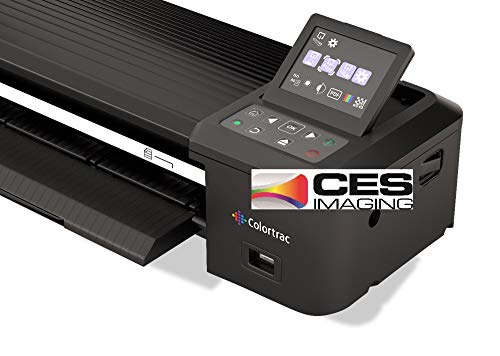
Best Wide-Format Network Scanner – Colortrac SmartLF 36-inch
The Colortrac SmartLF is a dedicated 36-inch wide-format model for professional large format scanners buyers who need to accommodate oversized paper. Its Ethernet connection and CIS sensor make it a practical fit for shared document-scanning environments.
Best For: Offices and workgroups scanning wide paper documents over an Ethernet network.
Pros:
- 36-inch scanning width accommodates genuinely wide documents.
- 600 dpi resolution supports detailed document capture.
- Ethernet connectivity suits shared office workflows.
- LED lighting avoids the need for a warm-up period.
Cons:
- At 31 pounds, it is substantially less portable than compact scanners.
- Its 24 bpp color depth is lower than some photo-oriented models.
- The listed media type is limited to paper.
The SmartLF stands out for width and network usability rather than portable convenience or specialized photo restoration. Choose it when oversized paper documents are the primary scanning requirement.
Best Photo Flatbed – Epson Expression 13000XL
The Epson Expression 13000XL is designed for professional large format scanners users who prioritize image quality. Its 12.2-by-17.2-inch reflective-media area, 2400 dpi resolution, and 48-bit color depth make it especially capable for photos and detailed originals.
Best For: Photographers, archives, and studios digitizing large photos, artwork, and reflective media.
Pros:
- 2400 x 4800 dpi resolution captures fine detail.
- 48-bit color depth supports rich, accurate image files.
- Easy Photo Fix provides one-touch color restoration and dust removal.
- Batch scanning and SilverFast Ai software support productive workflows.
Cons:
- The optional Transparency Unit is sold separately.
- Its 31.5-pound weight and large footprint require dedicated space.
- USB is the listed connection type.
This Epson is the strongest image-focused option in the group. It combines a generous flatbed area with high resolution, color accuracy features, and batch-oriented software for archival and creative work.
Best Fast A3 Scanner – VIISAN VF3240 A3 Scanner
The VIISAN VF3240 offers a compelling balance of speed and size for professional large format scanners shoppers handling A3 documents. It combines a frameless scanning bed, 2400 dpi maximum resolution, and a stated four-second A3 color scan at 200 dpi.
Best For: CAD drawings, blueprints, A3 business documents, school materials, and other flat oversized originals.
Pros:
- Scans A3 color documents in a stated four seconds at 200 dpi.
- 2400 dpi output and 48-bit color support detailed captures.
- Frameless glass enables edge-to-edge scanning.
- Works with Windows and macOS, with a universal 100–240V adapter.
Cons:
- The four-second speed applies to specific 200 dpi A3 color conditions.
- Windows users achieve 1200 dpi for A3 through ViiScan software, while WIA is limited to 600 dpi.
- CIS scanning is intended for flat materials, not 3D objects or irregular items.
The VF3240 is a flexible A3 flatbed for users who value quick routine scans and high-resolution capability. Review the platform-specific resolution limits before buying if maximum A3 detail on Windows is essential.
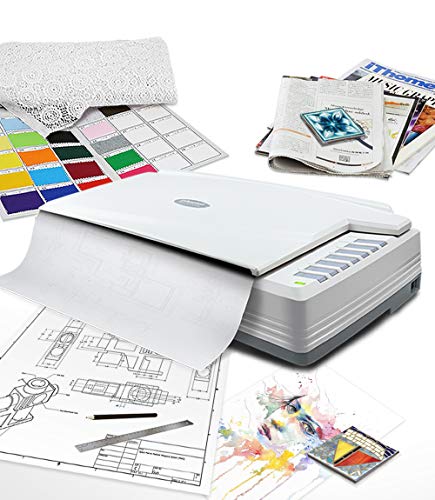
Best Overall – Plustek OpticPro A320E
For professional large format scanners that can handle artwork, maps, drawings, and bound material, the Plustek OpticPro A320E offers a generous 12-by-17-inch A3 scan area. Its flatbed design, batch scanning, OCR, and broad operating-system support make it a flexible choice for office and creative workflows.
Best For: Offices, designers, archivists, and users scanning A3 documents or oversized and odd-shaped originals.
Pros:
- 12-by-17-inch scan area accommodates A3 pages, maps, drawings, and large bound books.
- OCR can create searchable content in scanned PDFs.
- Batch scanning supports multiple printed images and multiple PDF files.
- TWAIN and WIA drivers support compatible scanning software on Windows and Mac.
Cons:
- At 24.53 inches wide, it requires substantial desk space.
- Linux and SANE users should confirm driver availability with the seller before purchase.
- USB is the listed connection type, with no network connection noted.
The A320E is a strong all-purpose pick when flatbed versatility matters more than compact size. Its large bed and document-management features make it especially practical for mixed professional scanning tasks.
Best for High-Volume Documents – RICOH fi-7460
The RICOH fi-7460 is a professional large format scanner built around a wider feed mechanism and straight paper path. It is suited to organizations that need to process large or unusual documents through an automatic document scanner while keeping jams and handling effort under control.
Best For: Businesses scanning mixed document batches, odd-shaped originals, receipts, IDs, and customer paperwork.
Pros:
- Wide feed mechanism handles large and odd-shaped documents.
- Gentle straight paper path helps scan important documents safely.
- Paper-handling technologies are designed to reduce jams and labor costs.
- TWAIN, ISIS, and Kofax VRS compatibility supports broader workflow integration.
Cons:
- The listed 300 dpi resolution is lower than the flatbed models in this roundup.
- Its 100-sheet capacity may require attention during larger jobs.
- The supplied warranty information lists only three months of basic onsite coverage.
The fi-7460 makes the most sense for document-centric operations that value feeding reliability and workflow compatibility. Choose it over a flatbed when throughput and paper handling are the primary concerns.
Best Speed-to-Size Balance – Plustek OpticSlim 1680
The Plustek OpticSlim 1680 is a practical option among professional large format scanners for users who want fast tabloid-size flatbed scanning without moving to a larger feature set. It scans tabloid documents quickly at 300 dpi and adds one-key controls for repeatable everyday jobs.
Best For: Small offices, studios, and users who regularly scan 11.7-by-17-inch documents on Windows or Mac.
Pros:
- Scans tabloid-size documents in about three seconds in 300 dpi grayscale and five seconds in color.
- Four configurable buttons simplify recurring scan-to-file workflows.
- 1200 dpi resolution and 48-bit color depth support detailed image capture.
- TWAIN and ICA support works with many Windows and macOS applications.
Cons:
- It is a flatbed scanner with a listed standard sheet capacity of one, so batch feeding is not provided.
- The 11.7-by-17-inch bed is slightly smaller than the A320E’s 12-by-17-inch area.
- USB is the listed connection type.
The OpticSlim 1680 is a good fit when speed, straightforward controls, and a relatively slim design matter. It is less suitable for automated multi-page batches, but compelling for repeatable tabloid flatbed work.
Best Flatbed A3 Scanner – Plustek OS1180
For buyers comparing professional large format scanners for graphics, documents, schools, libraries, or small offices, the Plustek OS1180 is a practical flatbed option. It scans media up to A3 size, uses an energy-saving LED light source with no warm-up period, and includes shortcut buttons for recurring tasks.
Best For: Digitizing A3 documents, graphics, and other flat media in small offices or educational settings.
Pros:
- Supports documents up to 11.7 × 17 inches, or A3 size.
- Offers 1200 dpi resolution and 48-bit color depth for detailed scans.
- Includes ABBYY FineReader 12, PageManager, and DocAction software.
- One-touch buttons and LED illumination simplify routine scanning.
Cons:
- USB 2.0 is the listed connectivity interface.
- The flatbed design handles one sheet at a time.
- Its 23.18-inch width may require dedicated desk space.
The OS1180 is a strong fit when image quality and A3 flatbed capability matter more than automated multi-page throughput. Its OCR and shortcut software add useful workflow support for document-heavy environments.
Best Overhead A2 Scanner – VIISAN S21 Large Format Scanner
The VIISAN S21 stands out among professional large format scanners for buyers who need to capture oversized books, maps, newspapers, manuscripts, or three-dimensional objects. Its overhead design supports A2 and A3 capture, while the included software helps flatten pages, remove fingers, split spreads, and convert scans into editable files.
Best For: Overhead capture of books, journals, maps, fragile documents, and 3D objects.
Pros:
- Captures A2 media up to 594 × 420 mm and adjusts for A3 scanning.
- Provides up to 26MP still resolution with software-enhanced detail up to 600 dpi.
- Automatically flattens curved pages, removes fingers, repairs edges, and splits double-page spreads.
- OCR can export scans to PDF, Word, Excel, EPUB, and text formats.
Cons:
- Bundled OfficeCam software supports Windows and macOS x64/x86, but not ARM-based devices.
- Very glossy paper is not recommended, and built-in LEDs are not recommended in bright light.
- Overhead capture requires suitable space and positioning around the scanner.
The S21 is more versatile than a conventional flatbed for bound or delicate materials. Buyers should confirm computer architecture compatibility before purchasing, especially if using an ARM-based device.
Best Office Wide-Format Scanner – Plustek S30 Wide-Format Scanner
For offices seeking professional large format scanners without adding a separate machine for occasional wide documents, the Plustek S30 handles media up to 12 inches wide. It is designed for mixed-size office work, including standard documents, blueprints, architectural plans, engineering drawings, receipts, and thin papers.
Best For: Office workflows that combine standard documents with tabloid, ledger, and other wide-format sheets.
Pros:
- Scans documents up to 12 inches wide, including Tabloid, Ledger, and A3 media.
- Automatic paper detection identifies sizes, removes blank pages, and optimizes images.
- Supports fragile or thin documents with a carrier sheet and horizontal scanning mode.
- Job buttons enable one-touch access to frequently used scanning tasks.
Cons:
- The listed resolution is 600 dpi, lower than the OS1180’s 1200 dpi specification.
- Windows 7 is the stated minimum system requirement, so compatibility should be verified for newer setups.
- Its 16-inch width still needs more desk space than a standard document scanner.
The S30 is a sensible space-saving choice for businesses that regularly scan ordinary paperwork but occasionally handle plans or other wide documents. Its automatic sizing, blank-page removal, and job-button features are especially useful for repeat office workflows.
How We Picked the Best Professional Large Format Scanners
We evaluated these scanners by looking at supported media sizes, optical resolution, scanning method, color and document capabilities, speed, automation, connectivity, and likely workplace fit. Because “large format” can mean A3, tabloid, ledger, 36-inch-wide drawings, or oversized books, we included several scanner types rather than treating every model as interchangeable.
We also considered practical ownership factors: whether a scanner is suited to fragile originals, how easily it handles batches, whether duplex scanning is available, and how much workspace its design requires. Published specifications can vary by scan mode, resolution, document size, and software, so confirm current manufacturer details before purchase.
Quick Comparison
| Scanner Type | Best For | Primary Strength |
|---|---|---|
| Wide-format color scanner | CAD drawings and oversized plans | Very wide originals |
| Large flatbed | Photos, artwork, and delicate media | Careful, high-quality capture |
| Sheetfed or duplex scanner | Office batches | Productivity and automation |
| A3 flatbed | Documents, graphics, and tabloid pages | Versatile large-page scanning |
| Overhead book scanner | Books and bound materials | Non-destructive capture |
Key Buying Factors for Professional Large Format Scanners
Maximum Scan Size
Start with the largest original you regularly handle. A3 and 11-by-17-inch scanners suit many office documents, while architectural and engineering workflows may require a genuinely wide-format model. Leave some margin for folders, borders, and occasional larger pages.
Image Quality and Resolution
Optical resolution matters more than an inflated interpolated figure. Higher resolution benefits fine linework, photographs, maps, and artwork, but it also creates larger files and slower scans. For routine records, moderate settings are usually more efficient.
Feeding and Workflow
Choose sheetfed or duplex hardware for recurring document batches. A flatbed is safer for fragile, thick, or irregular originals. Overhead scanners are preferable for bound books when pressing pages against glass could damage them. Automatic cropping, deskew, blank-page removal, and OCR can reduce post-processing.
Color, File Formats, and Software
Graphic and archival work benefits from accurate color handling and flexible export options. Office users should prioritize searchable PDF, OCR, reliable drivers, and compatibility with existing document-management software. Check operating-system support and included applications before buying.
Space and Ongoing Costs
Measure the scanner, lid clearance, paper path, and room needed for oversized originals. Also check warranty coverage, replacement rollers or mats, maintenance requirements, and whether high-volume use affects the recommended duty cycle.
Who Should Buy Which Professional Large Format Scanners?
Choose a wide-format color scanner if you routinely digitize architectural plans, maps, or other very wide drawings. Pick a high-resolution flatbed for photographs, artwork, samples, and delicate originals where careful placement matters more than batch speed.
For offices processing stacks of mixed documents, a sheetfed or duplex model is generally the better fit. A3 flatbeds offer a practical middle ground for schools, libraries, creative departments, and small businesses that need oversized-page support without a specialist wide-format setup. If your priority is books, magazines, or bound records, an overhead model with automatic flattening and page correction can be the most convenient and least damaging option.