Digitizing books and bound documents is much easier with the right overhead or book-friendly scanner. The best models combine high-resolution capture with page-flattening technology, OCR, and software that reduces cleanup time.
We selected 10 premium book scanners for different workloads, from portable document cameras to high-volume professional systems. Use the comparison and buying advice below to narrow the field based on format, speed, software, and budget.
Best 10 Premium Book Scanners Picks for 2026
Premium Power Pick

- 38MP sensor with 410 DPI detail
- Curve-flattening for bound books
- 180+ language OCR and A3 support
Best For: High-volume, high-detail book digitization
Organization Specialist

- 1200 DPI CCD scanning
- BookMaker sorting and tagging tools
- OCR search and editable formats
Best For: Organized research and document archives
Versatile Workstation
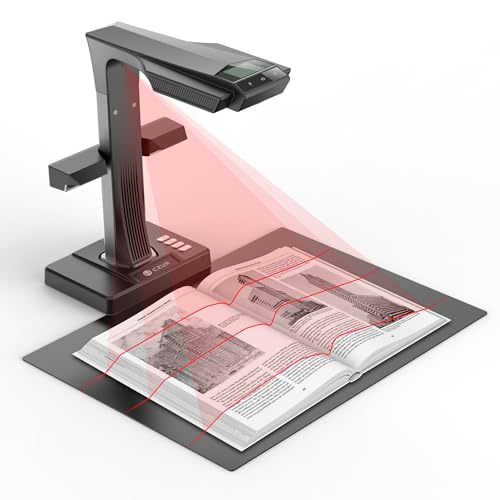
- 24MP camera with 320 DPI
- Three-angle lighting and preview screen
- A3 scanning with OCR and HDMI
Best For: Mixed-material home and professional scanning
Large-Format Flatbed

- Spine-shadow elimination
- 600 DPI CCD scanning
- Traditional USB flatbed design
Best For: Oversized bound books and stationary workspaces
Best Flexible Book Scanner

- Two-second-per-page scanning
- A3/A4 capture with curved-page flattening
- OCR and multiple output formats
Best For: Home book and document digitization
Best Premium Document Scanner

- 45ppm double-sided scanning
- 100-sheet feeder and touchscreen
- Wi-Fi 6, USB-C, and cloud support
Best For: High-volume office document workflows
Best Professional Book Scanner

- Dedicated book-scanning design
- 600-resolution CMOS imaging
- JPG, PDF, and TIFF output
Best For: Professional book digitization projects
Best Overhead Scanner

- Scans bound books without cutting
- Automatically corrects curved pages
- Supports page-turn detection
Best For: Libraries, researchers, and home offices scanning bound books
Best Portable Option
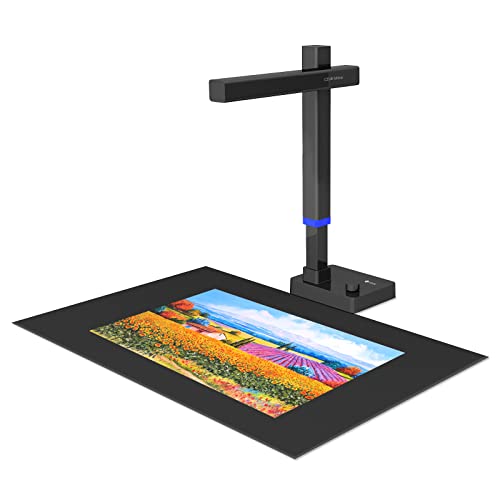
- Lightweight 2-pound foldable design
- Flattens curved book pages
- Creates searchable and editable files
Best For: Students and mobile users scanning books on the go
Best Large-Format Scanner

- Handles both A2 and A3 formats
- Offers 26MP capture and OCR
- Includes automatic page repair features
Best For: Large newspapers, maps, archives, and technical documents
Premium Power Pick – CZUR ET MAX
For demanding digitization projects, the CZUR ET MAX is one of the more capable premium book scanners in this roundup. Its 38MP sensor, curve-flattening technology, A3 scanning area, and OCR support make it well suited to turning bound books and documents into searchable, editable files.
Best For: High-volume book scanning, libraries, archives, educators, and users who need detailed A3 scans with broad OCR support.
Pros:
- 38MP CMOS sensor captures high-resolution 7168 × 5376 images at 410 DPI.
- Curve-flattening technology helps correct distortion in bound books without unbinding them.
- OCR supports more than 180 languages and exports to Word, Excel, and searchable PDFs.
- Supports Windows, macOS, compatible Ubuntu versions, and HDMI output.
Cons:
- Not recommended for glossy or highly reflective materials.
- Arabic OCR support is limited by operating system, while Thai and Hebrew are unsupported.
- Its advanced features may be more than occasional users need.
The ET MAX stands out when scan detail, speed, format flexibility, and book-page correction matter more than a basic setup. Its stated 1.5-second page speed with practiced operation is particularly useful for bulk projects.
Organization Specialist – Plustek OpticBook 4900
The Plustek OpticBook 4900 takes a software-focused approach to premium book scanners. Along with a 1200 DPI CCD scanner, it includes BookMaker tools for sorting books, magazines, notes, and PDFs, making it a practical option for users who need an organized digital library.
Best For: Professionals, researchers, and teams that need searchable archives, tagging, note-taking, and document organization.
Pros:
- BookMaker software supports folder creation, importing, editing, and exporting.
- OCR enables full-text search and editable formats.
- Page tagging and note-taking can help organize reference material.
- Includes one year of free eDoc cloud storage after registration and supports Windows and Mac.
Cons:
- Requires USB connection and software downloads from Plustek.
- The included cloud service requires registration.
- Its feature set is centered on document organization rather than camera-style HDMI projection.
Choose the OpticBook 4900 when managing and retrieving scanned content is as important as capturing it. Its bundled software and OCR workflow give it a clear advantage for structured archives and collaborative reference work.
Versatile Workstation – CZUR ET24 Pro
The CZUR ET24 Pro is a versatile choice among premium book scanners, combining a 24MP camera with page-flattening technology, multi-angle lighting, OCR, and HDMI connectivity. It supports books and documents up to A3 size while adding a real-time preview screen for easier positioning.
Best For: Home offices, educators, researchers, and users scanning mixed materials such as books, receipts, magazines, and artwork.
Pros:
- 24MP camera delivers 5696 × 4272 resolution at 320 DPI.
- Flattening technology helps correct curved book pages.
- Side and head lights provide three-angle illumination to help reduce reflections.
- Supports A3 materials, 180+ OCR languages, HDMI, and Windows, Mac, and compatible Linux systems.
Cons:
- Very glossy papers are not recommended.
- Thai and Hebrew OCR are unsupported, and Arabic support is limited on non-Windows systems.
- At 4.5 kg, it is less portable than lighter document-camera designs.
The ET24 Pro offers a strong balance of capture quality and workflow flexibility. Its preview screen and adjustable lighting are useful practical touches, especially when scanning varied materials rather than only standard book pages.
Large-Format Flatbed – Plustek OpticBook A300 Plus
The Plustek OpticBook A300 Plus is a large-format flatbed option for readers and offices that want a straightforward book-scanning setup. Its CCD sensor, 600 DPI resolution, and spine-shadow elimination are aimed at capturing book pages while reducing a common problem near the binding.
Best For: Users digitizing oversized books and documents who prefer a traditional flatbed scanner with spine-shadow reduction.
Pros:
- Designed to eliminate spine shadow during book scanning.
- Supports 600 DPI scanning with a CCD optical sensor.
- Uses an LED light source and connects through USB.
- Its listed standard sheet capacity is 200.
Cons:
- At 30 pounds, it is considerably heavier than camera-style book scanners.
- Listed resolution is lower than the 1200 DPI OpticBook 4900.
- Minimum system requirements list Windows 7, with no Mac or Linux support noted in the supplied specifications.
The A300 Plus is best viewed as a dedicated, substantial flatbed rather than a portable scanning camera. Its spine-shadow feature makes it worth considering for bound materials, provided you have room for its heavy chassis.
Best Flexible Book Scanner – CZUR Aura Pro
The CZUR Aura Pro is a practical choice among premium book scanners for home offices, students, and anyone digitizing books or documents. It scans a page in about two seconds, supports A3 and A4 formats, and uses laser-assisted technology to flatten curved pages for clearer captures.
Best For: Book scanning, document capture, reading, and users who want OCR and multiple export formats.
Pros:
- Fast two-second-per-page scanning with JPG, Word, PDF, and searchable PDF output.
- OCR supports more than 180 languages, although Thai, Hebrew, and Arabic are excluded.
- Laser lines help flatten curved book pages, while 32 LEDs and supplemental side lights improve illumination.
- Works with supported Windows and macOS systems and doubles as a glare-free smart reading lamp.
Cons:
- It requires a USB connection rather than Wi-Fi or Bluetooth.
- Its OCR does not currently support Thai, Hebrew, or Arabic.
- Mac support requires macOS 12 or later for Intel systems and macOS 13 or later for Apple Silicon.
With fast capture, flexible file output, and built-in lighting, the Aura Pro is a well-rounded premium book scanner for everyday digitization. Its wired setup and OCR language limitations are worth considering before purchase.
Best Premium Document Scanner – ScanSnap iX2500
The ScanSnap iX2500 is a premium scanner aimed at high-volume document workflows rather than bound-book capture. It combines 45-page-per-minute double-sided scanning, a 100-sheet feeder, a large touchscreen, and wireless or USB connectivity for organized office digitization.
Best For: Offices, professionals, and households scanning documents, receipts, photos, business cards, and cards in volume.
Pros:
- Fast 45ppm duplex scanning with a 100-sheet automatic document feeder.
- Built-in Wi-Fi 6 and USB-C support connections to computers, mobile devices, and cloud services.
- Touchscreen profiles and Quick Menu streamline repeat scanning tasks.
- Automatic optimization, naming, and sorting help organize scanned data.
Cons:
- Its document-focused design is less suited to scanning bound books than a dedicated overhead book scanner.
- At 7.7 pounds, it is less portable than lighter scanning options.
- Supported operating systems and mobile platforms have specific minimum-version requirements.
The iX2500 stands out when speed, feeder capacity, connectivity, and file organization matter most. Choose it over a book-focused model when your priority is efficient batch scanning of loose documents and mixed media.
Best Professional Book Scanner – CZUR M3000 Pro V3
The CZUR M3000 Pro V3 is a professional-oriented option among premium book scanners, with a dedicated book-scanning design, 600-resolution capture, and USB connectivity. Its listed output formats include JPG, PDF, and TIFF, making it suitable for structured archival and digitization work.
Best For: Professional book digitization and users who need JPG, PDF, or TIFF output.
Pros:
- Dedicated book scanner design with 600-resolution capture.
- Supports JPG, PDF, and TIFF file formats.
- Uses CMOS imaging, 24-bit color depth, and LED lighting.
- Available through a CES Imaging Platinum CZUR reseller.
Cons:
- USB is the listed connection type, with no wireless connectivity specified.
- The supplied system requirement lists Windows 7, with no macOS support noted.
- Its professional footprint measures 16.73 inches in depth and height.
The M3000 Pro V3 is best considered when dedicated book capture and TIFF support are more important than wireless convenience. Verify workstation compatibility and available space before selecting this larger professional model.
Best Overhead Scanner – ScanSnap SV600
The ScanSnap SV600 is a strong choice among premium book scanners for digitizing books, newspapers, magazines, and loose documents without cutting or damaging originals. Its overhead design combines automatic page correction with page-turn detection for more efficient hands-free scanning.
Best For: Home offices, libraries, and researchers scanning bound books and mixed paper materials.
Pros:
- Scans books and documents directly without cutting or damaging them.
- Auto Book Correction flattens pages and corrects curve distortion.
- Multi Document Detection automatically crops and rotates multiple items in one scan.
- Page Turning Detection and Time Mode support more efficient batch scanning.
Cons:
- At 6.6 pounds, it is less portable than compact foldable models.
- Requires a USB connection and a compatible Windows or macOS computer.
- Finger removal uses the Point Retouch function rather than being fully automatic.
The SV600 stands out when reliable overhead scanning and book preservation matter more than portability. Its dedicated correction and page-management features make it particularly practical for larger scanning projects.
Best Portable Option – CZUR Shine Ultra Pro
The CZUR Shine Ultra Pro is one of the more portable premium book scanners, combining a 24MP camera with a foldable, height-adjustable design. It can flatten curved book pages and convert scans into JPG, PDF, searchable PDF, Word, or Excel files.
Best For: Students, mobile professionals, and users who need a lightweight scanner for books and documents.
Pros:
- Weighs only 2 pounds and folds to support easier transport.
- Uses pixel transformation to flatten curved book pages.
- Exports to searchable PDF and editable Word or Excel formats.
- Supports Windows and newer macOS systems, including Apple Silicon Macs.
Cons:
- Uses a USB connection rather than wireless connectivity.
- Mac compatibility requires macOS 12 or later on Intel systems and macOS 13 or later on Apple Silicon.
- Its compact design may be less suited to oversized materials than large-format scanners.
The Shine Ultra Pro is a practical pick when portability and editable output are priorities. It offers useful book-flattening features without the bulk of a larger overhead scanner.
Best Large-Format Scanner – VIISAN S21 Pro
The VIISAN S21 Pro expands the premium book scanners category with interchangeable A2 and A3 capture sizes, a 26MP sensor, and software-enhanced 600 DPI output. Its automatic flattening, OCR, page repair, and foldable design make it suited to books, newspapers, maps, and technical documents.
Best For: Researchers, educators, offices, and archives handling oversized pages and varied document formats.
Pros:
- Switches between A2 and A3 formats for large newspapers, maps, books, and documents.
- Automatically flattens pages, removes fingerprints, repairs edges, and separates spreads.
- OCR supports more than 180 languages and exports to PDF, Word, Excel, ePub, and TXT.
- Foldable design includes height adjustment, integrated lighting, and video support.
Cons:
- Software-enhanced 600 DPI output is not recommended for highly glossy or glare-prone paper.
- Not compatible with ARM-based devices such as Surface Pro X.
- Requires Chrome for the stated Gemini AI integration.
The S21 Pro is the most versatile option here for oversized material and advanced digital workflows. Its A2/A3 flexibility and broad OCR export support are especially valuable for archival, educational, and technical use.
How We Picked the Best Premium Book Scanners
We focused on scanners designed specifically for books, bound materials, and large document workflows rather than standard office scanners alone. Our evaluation criteria included optical or camera resolution, support for A3 and larger pages, page-flattening performance, book-spine handling, OCR capability, capture speed, software controls, connectivity, and portability.
The lineup includes overhead scanners, flatbed book scanners, wireless document scanners, and large-format camera systems. Because no single design suits every user, we considered how each category handles delicate bindings, loose pages, frequent batch work, and occasional scanning.
Quick Comparison
| Best For | What to Look For |
|---|---|
| High-volume professional work | Fast capture, reliable software, strong flattening, and automatic processing |
| Libraries and archives | Gentle book handling, large-format support, and accurate image correction |
| Home digitization | Simple setup, manageable size, OCR, and good file export options |
| Portable scanning | Compact design, USB power, quick setup, and flexible document support |
| Loose documents and books | A flatbed or hybrid design with dependable page alignment |
Key Buying Factors for Premium Book Scanners
Resolution and Image Quality
Higher megapixel ratings can preserve small print and illustrations, but sensor quality and lighting matter just as much. For ordinary text, a well-designed 12MP to 24MP system may be sufficient; archival images, fine typography, and oversized pages benefit from greater resolution.
Book Flattening and Binding Protection
Overhead scanners are usually better for bound books because they avoid forcing the spine against a glass platen. Look for automatic page flattening, curved-page correction, and finger-removal features. A V-shaped cradle or adjustable book support can be especially helpful for valuable or tightly bound volumes.
Format, Speed, and Workflow
Check the largest supported page size before buying. A3 support covers many books and office documents, while A2-capable cameras suit maps, newspapers, and oversized materials. For large projects, compare capture time, automatic page turning features, batch processing, and whether the software can split facing pages.
OCR, File Formats, and Connectivity
OCR makes scanned books searchable and editable, but accuracy depends on typeface, page condition, language support, and lighting. Confirm that the software exports the formats you need, such as searchable PDF, TIFF, JPEG, or Word. USB is common; wireless connectivity can simplify shared office workflows.
Who Should Buy Which Premium Book Scanners?
Choose a professional overhead model if you are digitizing books regularly, need rapid batch capture, or require advanced flattening and correction tools. Choose a flatbed book scanner when image consistency and careful page positioning matter more than speed. Choose a portable document camera for classrooms, remote work, occasional book projects, or users who need a compact setup. Choose a large-format camera system for oversized books, newspapers, maps, and technical drawings.
Before ordering, verify operating-system compatibility, included software, desk space, lighting requirements, and the scanner’s maximum page dimensions. The best Premium Book Scanners are the ones that match your material and workflow—not simply the model with the highest advertised resolution.