Finding the best budget telephone audio interfaces means balancing clean voice capture, simple connectivity, and reliable monitoring without paying for studio features you will not use.
This roundup compares compact USB and mobile-friendly models for calls, podcasting, streaming, voice work, and basic music recording. Use the buying guide below to narrow the options by inputs, device compatibility, and intended setup.
Best 10 Budget Telephone Audio Interfaces Picks for 2026
Best Overall
Focusrite Scarlett Solo 3rd Gen

- Air mode and capable mic preamp
- 24-bit/192kHz recording support
- Includes recording software bundle
Best For: Solo music, podcast, and voice recording
Best Modern Budget Pick

- USB-C plug-and-play design
- Two combo inputs with phantom power
- Loopback and zero-latency monitoring
Best For: USB-C laptop and mobile recording setups
Best for Podcasting
- Two combo inputs with phantom power
- Zero-latency USB/Direct monitoring
- Includes MPC Beats and Ableton Live Lite
Best For: Beginner podcasting, streaming, and home recording
Best Simple Starter
Behringer UMC22 USB Audio Interface

- Midas-designed microphone preamp
- Direct monitoring with clip indicators
- Compact two-input recording design
Best For: Beginner solo music and microphone recording
Best Mobile Pick

- Dual 3.5mm microphone inputs
- Includes USB-A, USB-C, and Lightning cables
- Zero-latency headphone monitoring
Best For: Mobile creators using 3.5mm microphones
Best Hybrid Setup

- Dual USB connections for computer and phone
- Two XLR inputs with 56dB gain
- Loopback and creator-focused routing
Best For: Podcasting, streaming, and mobile music workflows
Best Simple XLR Value
- XLR/line and instrument inputs
- Phantom power with Crystal preamp
- Zero-latency USB/Direct monitoring
Best For: Beginners recording vocals, guitar, podcasts, or streams
Best Versatile Pick

- 24-bit/192kHz recording
- 48V phantom power and instrument input
- Routing software for streaming
Best For: Beginners and creators needing flexible recording and livestreaming features
Best Starter Value
XTUGA Q-12 USB Audio Interface

- Two-channel XLR and 3.5mm inputs
- 48V phantom power
- USB-powered plug-and-play design
Best For: Students and beginners recording vocals, guitar, karaoke, or streams
Best Overall – Focusrite Scarlett Solo 3rd Gen
For shoppers comparing budget telephone audio interfaces, the Focusrite Scarlett Solo 3rd Gen is a compact, polished option for recording a microphone and guitar or bass. Its Air mode, 24-bit/192kHz converters, and low-noise outputs make it suitable for music, podcasts, and voice recording.
Best For: Solo musicians, podcasters, and creators who want strong recording quality in a small USB interface.
Pros:
- High-performance mic preamp with switchable Air mode
- Dedicated XLR microphone and Hi-Z instrument inputs
- Recording and mixing support up to 24-bit/192kHz
- Includes useful software and a three-year warranty
Cons:
- Provides only one XLR mic preamp
- USB cable is included, but other accessories may be needed for a complete setup
The Scarlett Solo is a strong choice when sound quality and dependable software support matter more than having multiple microphone inputs. Its two-input layout is best suited to individual recording rather than larger sessions.
Best Modern Budget Pick – PIYONE Q28 Alloy Red
Among budget telephone audio interfaces, the PIYONE Q28 stands out for its USB-C, plug-and-play setup and flexible two-channel design. It combines 24-bit/192kHz recording, combo inputs, phantom power, loopback functionality, and direct monitoring in a portable enclosure.
Best For: Laptop and mobile creators who want a modern USB-C interface for vocals, instruments, streaming, or home recording.
Pros:
- USB-C connectivity with bus power and no required drivers for Mac and PC
- Two combo XLR/TRS inputs with 48V phantom power
- 24-bit/192kHz converters for high-resolution recording
- Zero-latency direct monitoring and a 3.5mm headphone jack
Cons:
- Supplied operating-system details list Windows, so compatibility should be confirmed for a specific mobile setup
- Its illuminated controls may not appeal to users seeking a minimal design
The Q28 offers an appealing feature set for creators who value USB-C convenience and flexible monitoring. It is particularly practical for compact laptop-based setups that need two simultaneous inputs.
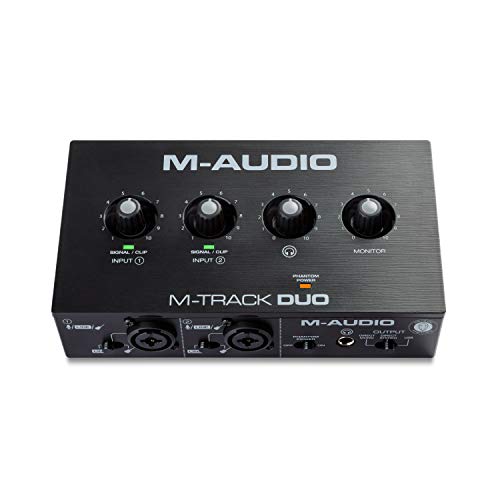
Best for Podcasting – M-AUDIO M-Track Duo
For budget telephone audio interfaces used in podcasts, livestreams, or basic recording, the M-AUDIO M-Track Duo provides two combo inputs and straightforward monitoring controls. It supports microphones, guitars, and line-level sources while including MPC Beats and other software support.
Best For: Beginners who need an affordable two-input interface for podcasting, streaming, vocals, or instruments.
Pros:
- Two combo XLR/line/instrument inputs with phantom power
- USB/Direct switch enables zero-latency monitoring
- Works with Mac, PC, iOS, and Android devices according to the supplied details
- Includes MPC Beats and Ableton Live Lite software support
Cons:
- Maximum sample rate is 48kHz
- Uses USB Type-B rather than USB-C
- Warranty is listed as one year
The M-Track Duo is a practical entry-level choice when ease of use and broad device compatibility are priorities. Its 48kHz limit is sufficient for many podcasts, streams, and everyday recording tasks, though higher-resolution music production may call for another model.
Best Simple Starter – Behringer UMC22 USB Audio Interface
The Behringer UMC22 is a simple, compact option for shoppers seeking budget telephone audio interfaces for basic microphone and instrument recording. It offers a Midas-designed mic preamp, direct monitoring, USB power, and compatibility with popular recording software.
Best For: Solo musicians and beginners who want a straightforward interface for recording one microphone and one instrument.
Pros:
- Midas-designed mic preamp for microphone recording
- Combination input accepts XLR, 1/4-inch TRS, and TS connections
- Separate instrument input and +48V phantom power
- Direct monitoring, status, and clip indicators are built in
Cons:
- Maximum sample rate is listed as 96kHz, while the product title specifies 48kHz
- USB connectivity is described for Mac and Windows rather than mobile devices
- Only one combination microphone input is provided
The UMC22 focuses on essential recording functions instead of an extensive feature set. It is a sensible starter interface for a solo setup, especially when direct monitoring and a dedicated instrument input are more important than advanced connectivity.
Best Mobile Pick – RØDE AI-Micro
For shoppers comparing budget telephone audio interfaces, the RØDE AI-Micro is a highly portable choice for connecting microphones to phones, tablets, and computers. Its dual 3.5mm inputs and included USB-A, USB-C, and Lightning cables make it especially convenient for mobile recording, calls, streaming, and filmmaking.
Best For: Mobile creators using lavalier microphones, VideoMics, wireless systems, or other 3.5mm microphones.
Pros:
- Ultra-compact dual-channel design for computers and mobile devices.
- Auto-sensing TRS/TRRS inputs simplify microphone setup.
- High-power headphone output supports zero-latency monitoring.
- Works with the RØDE app suite and includes multiple device cables.
Cons:
- Designed around 3.5mm microphone connections rather than XLR inputs.
- Maximum sample rate is listed as 20 kHz.
The AI-Micro is a practical budget telephone audio interface for creators who prioritize portability and straightforward phone compatibility. It is less suited to traditional XLR microphone setups, but its compact design and broad cable support make it easy to carry and use across devices.
Best Hybrid Setup – MAONO P2
The MAONO P2 is a flexible option among budget telephone audio interfaces, with dual USB connectivity for using a computer and phone or iPad simultaneously. Its two XLR inputs, 24-bit/192kHz recording, loopback, and creator-focused controls suit podcasting, streaming, music recording, and mobile content workflows.
Best For: Podcasters, streamers, and musicians who need XLR inputs plus simultaneous computer-and-phone connectivity.
Pros:
- Dual USB ports support simultaneous computer and phone or iPad connections.
- Two XLR inputs provide up to 56dB of gain for condenser and dynamic microphones.
- 24-bit/192kHz recording, ASIO support, and direct monitoring support detailed, low-latency work.
- Loopback, mute controls, signal indicators, and creator software add streaming flexibility.
Cons:
- Its broader feature set may be more than needed for simple one-microphone recording.
- Some software features depend on the included ProStudio 2 workflow.
The P2 stands out when a phone is part of the recording or streaming setup rather than an occasional add-on. Its XLR connectivity and routing tools offer room to grow, while the tilted aluminum-alloy design keeps the interface practical for a desk or mobile creator station.
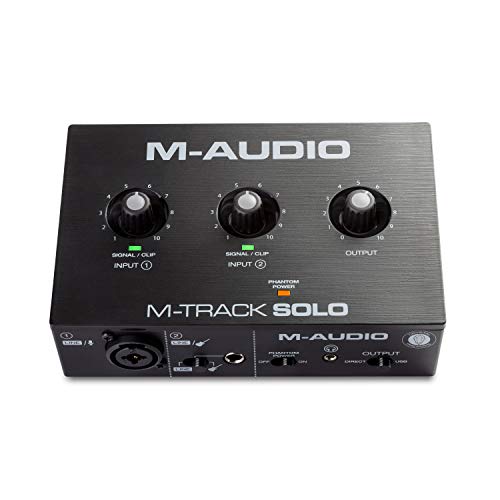
Best Simple XLR Value – M-Audio M-Track Solo
The M-Audio M-Track Solo is a straightforward budget telephone audio interface for recording vocals, guitar, keyboards, and line-level sources on Mac or PC. It combines an XLR/line input, an instrument input, phantom power, and direct monitoring in a compact USB unit.
Best For: Beginners who want an affordable interface for podcasting, vocals, guitar, livestreaming, or basic home recording.
Pros:
- Combo XLR/line input and separate line/instrument input support varied sources.
- Phantom power and a Crystal preamp accommodate condenser microphones.
- USB/Direct switch enables zero-latency monitoring.
- Includes MPC Beats and supports 48kHz recording.
Cons:
- Offers fewer channels and routing features than the MAONO P2.
- Uses USB Type-B connectivity rather than a direct USB-C connection.
The M-Track Solo is a sensible entry point for users who need essential inputs and monitoring without a complex control layout. Its 48kHz limit is adequate for many podcasts, streams, and basic recordings, while the included software helps new users begin producing quickly.
Best Versatile Pick – MAONO PS22 Lite
For shoppers comparing budget telephone audio interfaces for recording, streaming, or voice work, the MAONO PS22 Lite offers a flexible two-in-one setup. It supports 24-bit/192kHz recording, includes microphone and instrument connections, and works with Mac, Windows, and iPads.
Best For: Beginners, podcasters, vocalists, guitarists, and livestreamers who want routing software and broad device compatibility.
Pros:
- 24-bit/192kHz recording with a stated 106dB dynamic range.
- Supports condenser and dynamic microphones with up to 56dB of preamp gain and 48V phantom power.
- Includes instrument input, direct monitoring, and ProStudio Routing Software with virtual channels and loopbacks.
- Compact design and compatibility with Mac, Windows, iPads, and popular DAWs.
Cons:
- Some routing and ASIO features may require software setup.
- Its compact control layout may be less suitable for users wanting a larger desktop interface.
The PS22 Lite is the most feature-rich option here for creators who expect to move between recording, guitar, podcasting, and livestreaming. Its software support adds flexibility, while the plug-and-play design keeps the initial setup approachable.
Best Simple Recording Setup – Kmise USB Audio Interface
The Kmise USB Audio Interface is a straightforward choice among budget telephone audio interfaces for basic home recording. Its two-channel design combines microphone and instrument input with headphone and speaker outputs, while 24-bit/192kHz capability is listed for detailed recording.
Best For: Beginner guitarists, vocalists, podcasters, and streamers who want a compact USB interface with 48V phantom power.
Pros:
- Combines microphone, instrument, headphone, and speaker connections in one unit.
- Provides 48V phantom power for compatible condenser microphones.
- Designed for low-latency monitoring during vocals, guitar, and other recordings.
- Compact, beginner-friendly plug-and-play operation for Mac, PC, and mobile devices.
Cons:
- The supplied details list USB 3.0 Type-A connectivity, which may require an adapter for some devices.
- The listed specifications also state a 48kHz maximum sample rate, so buyers should verify the intended recording mode.
- The warranty description is limited to half a year.
This model focuses on essential connections and easy operation rather than extensive routing features. It can suit a simple vocal, guitar, or podcast workstation, provided your computer or mobile setup supports its USB connection.
Best Starter Value – XTUGA Q-12 USB Audio Interface
For a basic entry point into budget telephone audio interfaces, the XTUGA Q-12 keeps the workflow simple. It offers two inputs, 16-bit/48kHz recording, USB bus power, and plug-and-play operation for computer-based music, karaoke, and streaming.
Best For: Students and beginners who need an affordable two-channel interface for vocals, guitar, karaoke, or home streaming.
Pros:
- Provides XLR and 3.5mm microphone inputs in a two-channel design.
- Includes switchable 48V phantom power for compatible condenser microphones.
- USB-powered with no external adapter required.
- Compatible with Audacity, Ableton Live, FL Studio, and Pro Tools.
Cons:
- Its 16-bit/48kHz specification is less detailed than the higher-resolution alternatives.
- The supplied details specify compatibility with personal computers rather than a wider range of mobile devices.
- Its feature set is aimed at starter workflows, without the advanced routing described for some competing models.
The Q-12 is a practical starter interface when low cost and uncomplicated setup matter most. It covers the core needs of a small home studio, though more demanding recording projects may benefit from a higher-resolution model.
How We Picked These Budget Telephone Audio Interfaces
We focused on affordable interfaces that can connect microphones or instruments to a computer, phone, or tablet while keeping setup practical for voice and telephone audio. The selection includes simple one- and two-input designs, mobile-oriented models, and interfaces with features such as phantom power, headphone monitoring, direct monitoring, and combo XLR/TRS inputs.
We also considered connection type, likely operating-system compatibility, portability, control layout, and value for common use cases. Specifications can vary by retailer or revision, so confirm the included cables and device requirements before buying.
Quick Comparison
- Best all-around starting point: Focusrite Scarlett Solo 3rd Gen.
- Best for two microphones or instruments: M-AUDIO M-Track Duo or MAONO P2.
- Best compact mobile option: RØDE AI-Micro.
- Best for simple solo recording: M-AUDIO M-Track Solo.
- Best for a low-cost desktop setup: Behringer UMC22 or MAONO PS22 Lite.
Key Buying Factors for Budget Telephone Audio Interfaces
Inputs and Microphone Support
Choose a single-input model for one microphone, guitar, or voice channel. Two-input interfaces are more flexible for interviews, two microphones, stereo sources, or simultaneous vocal and instrument recording. If you use a condenser microphone, verify that the interface supplies 48V phantom power.
Telephone, Computer, and Mobile Compatibility
USB interfaces generally suit Windows and Mac computers, but phone and tablet use may require an adapter, powered hub, or compatible USB-C connection. For telephone audio, check whether your calling app supports the interface as an input and output device. An audio interface usually does not connect directly to a traditional analog phone line without separate telephone-interface hardware.
Monitoring and Control
A headphone output with a dedicated volume control makes it easier to check your voice before joining a call. Direct monitoring can reduce distracting latency, while a mix control helps balance live input against computer playback. Separate gain controls are useful when two sources have different output levels.
Portability and Power
Small bus-powered units are convenient for laptops and mobile setups, but some phones and tablets may drain battery power quickly. Confirm whether the interface is USB bus-powered and whether mobile operation needs external power. For a permanent desk setup, larger controls and sturdy construction may matter more than minimum size.
Who Should Buy Which Budget Telephone Audio Interfaces?
Choose a basic single-input interface if you mainly record calls, narration, guitar, or one microphone. The M-Track Solo and similar compact models keep the signal path simple.
Choose a two-input interface if you expect to interview guests, record two sources, or expand beyond solo work. The M-Track Duo, UMC22, MAONO P2, and comparable 2×2 models offer more flexibility.
Choose a mobile-first model if you frequently switch between a computer, phone, and tablet. The RØDE AI-Micro is especially suited to compact mobile recording, while other models may need adapters or additional power.
Choose a better-controlled desktop interface if call clarity, monitoring, and regular recording are priorities. Spend attention on preamp gain, headphone monitoring, and reliable drivers rather than chasing the highest sample-rate number. For telephone audio, clean levels and dependable compatibility usually matter more than maximum recording resolution.