The best conference room cameras make hybrid meetings feel more natural by combining wide-angle video, clear microphones, speakers, and intelligent framing in one system.
This roundup compares 10 conference room cameras for huddle spaces, medium meeting rooms, and larger collaborative environments, with attention to video quality, coverage, audio, connectivity, and setup.
Best 10 Conference Room Cameras Picks for 2026
Best for Hybrid Collaboration

- 360-degree 1080p video and room-wide audio
- AI speaker tracking for more engaging hybrid meetings
- Expandable setup for small to large rooms
Best For: Hybrid meetings needing full-room coverage and automatic speaker focus
Best for Small Rooms
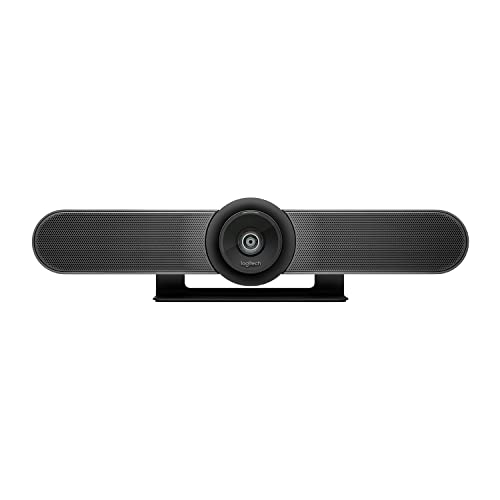
- 4K video with a 120-degree field of view
- Beamforming microphones for small-room audio
- Motorized pan and tilt with flexible mounting
Best For: Huddle rooms and small conference spaces
Best for AI Framing on a Budget
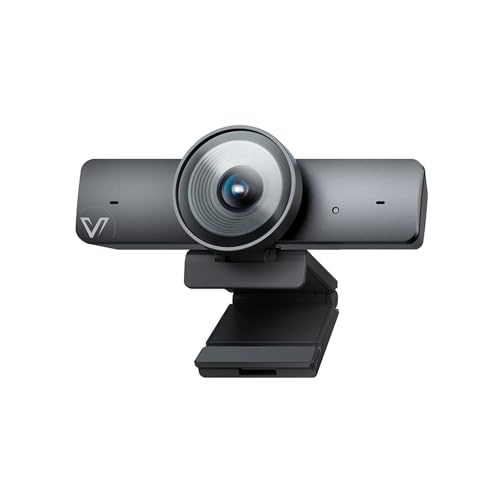
- 4K video from a large 1/1.8-inch CMOS sensor
- AI framing, presenter tracking, and gallery modes
- USB plug-and-play design with built-in microphone
Best For: Small rooms needing automated framing and sharp video
Best for Panoramic Coverage

- Three-camera panoramic video up to 180 degrees
- Automatic framing with integrated microphones and speakers
- Compatible with Teams, Zoom, and leading platforms
Best For: Larger rooms needing wide coverage and integrated room audio
Best Gesture-Controlled Pick
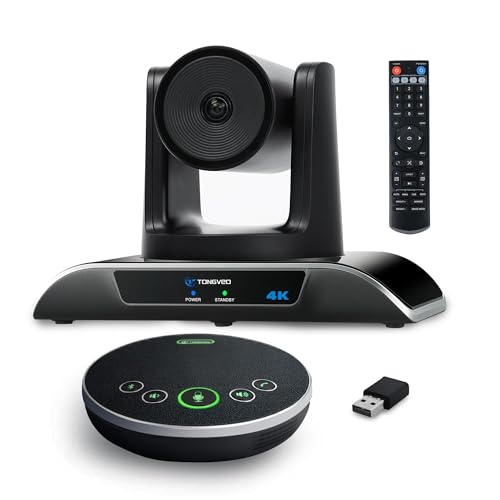
- 4K video with 120° wide-angle coverage
- AI tracking, gestures, presets, and remote control
- Bundled speakerphone with 16.4-foot pickup range
Best For: Hands-free control and flexible small-room conferencing
Best 360-Degree Option
Meeting Owl 4+ 4K Conference Camera

- 4K 360° video and audio up to 18 feet
- Automatically focuses on active speakers
- Plug-and-play with broad platform compatibility
Best For: Hybrid meetings where participants sit around the room
Best Dual-Lens Value
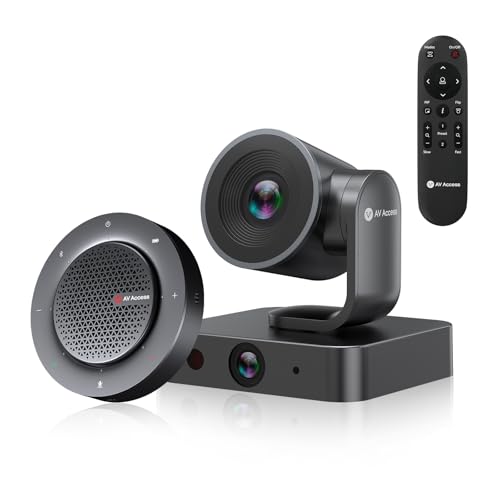
- 4K PTZ plus 1080p panoramic video
- AI framing, presenter tracking, and gallery view
- Bluetooth speakerphone with up to 10 hours of use
Best For: Small to medium rooms needing flexible video and wireless audio
Best 360° Coverage
TOUCAN SC360 Conference Camera
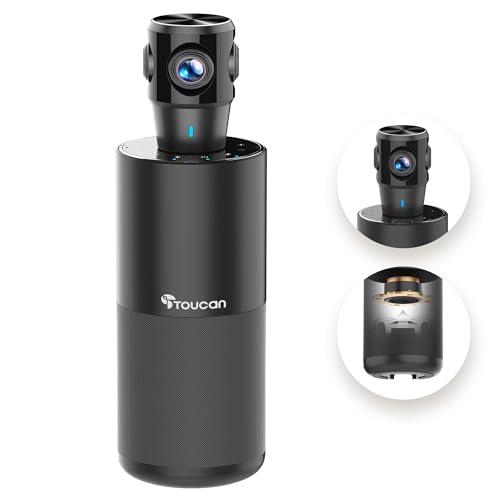
- 360-degree room coverage
- 1080p video with four microphones
- Plug-and-play USB connectivity
Best For: Small offices needing broad participant visibility
Best PTZ System
TONGVEO 4K AI Tracking Camera Kit

- 4K PTZ camera with 3x optical zoom
- AI tracking follows speakers
- Wireless speakerphone with four microphones
Best For: Small-to-medium rooms needing flexible video and audio
Best All-in-One Huddle Camera
Yealink UVC34 4K Conference Camera

- 4K camera with 120° field of view
- Eight-microphone array and 5W speaker
- Plug-and-play design with privacy cap
Best For: Huddle rooms needing integrated video and audio
Best for Hybrid Collaboration – Owl Labs Meeting Owl 3
For teams comparing conference room cameras, the Owl Labs Meeting Owl 3 stands out with 360-degree 1080p video, 360-degree audio pickup up to 18 feet, and automatic speaker tracking. Its plug-and-play USB setup is designed to get meetings running quickly while keeping in-room speakers visible to remote participants.
Best For: Hybrid meetings in small to large rooms where automatic speaker focus and full-room coverage are priorities.
Pros:
- 360-degree 1080p video and audio pickup up to 18 feet.
- Automatically focuses on active speakers using visual and audio cues.
- Supports expansion with additional Meeting Owls, an Owl Bar, or an Expansion Mic.
- Compatible with Microsoft Teams, Zoom, Google Meet, Webex, and other web-based platforms.
Cons:
- Its 1080p maximum resolution is lower than several 4K alternatives.
- Some larger-room configurations require additional Owl Labs hardware.
The Meeting Owl 3 is a flexible choice when natural, room-wide participation matters more than a traditional front-facing camera view. Its ecosystem also gives organizations room to expand as meeting spaces grow.
Best for Small Rooms – Logitech MeetUp 4K
The Logitech MeetUp is a practical option among conference room cameras for huddle rooms and small meeting spaces. It combines a 4K sensor, a 120-degree field of view, beamforming microphones, and motorized pan and tilt in an all-in-one design.
Best For: Small conference rooms and huddle spaces that need a wide view, clear audio, and flexible mounting.
Pros:
- 4K video sensor with a 120-degree field of view and 5x HD zoom.
- Beamforming microphones capture voices up to 4 meters away.
- Motorized pan and tilt can expand viewing coverage up to 170 degrees.
- Supports USB BYOD use and room deployments for Teams Rooms, Zoom Rooms, and Google Meet.
Cons:
- The optional expansion microphone is sold separately.
- Designed primarily for small and huddle rooms rather than large spaces.
MeetUp is a strong fit for organizations that want a conventional front-of-room camera with high-resolution video and straightforward deployment. Its mounting options and remote-management support add flexibility for managed room fleets.
Best for AI Framing on a Budget – AV Access BizEye 90
The AV Access BizEye 90 is a compact conference room camera built around a large 1/1.8-inch CMOS sensor, 4K video, and AI-assisted framing. Its 120-degree lens, ePTZ controls, built-in microphone, and USB plug-and-play connection make it adaptable for meetings, presentations, and smaller collaborative spaces.
Best For: Small meeting rooms and users who want 4K video with automatic framing and presenter tracking.
Pros:
- 1/1.8-inch CMOS sensor is designed to capture detail and perform in low light.
- 4K video at 30fps with backward support for 1080p and 720p.
- AI auto framing, presenter tracking, and individual gallery modes support up to four people.
- USB connection carries video, audio, and power without requiring drivers.
Cons:
- The built-in microphone is specified for voice pickup up to 3 meters.
- Uses fixed focus rather than autofocus.
- Its 5x zoom is digital rather than optical.
BizEye 90 offers a feature-rich setup for teams that value automated framing and sharp video without adding separate room hardware. Its compact mounting options also suit monitor, laptop, or tripod placement.
Best for Panoramic Coverage – Jabra PanaCast 50
Jabra PanaCast 50 180° Panoramic-4K Meeting Room Webcam, 4 Kilopixel Video Resolution, Black
Check Price On AmazonThe Jabra PanaCast 50 is a premium choice among conference room cameras for teams that need an exceptionally wide view. Its three-camera system creates real-time panoramic video, while adjustable 90-, 120-, 140-, and 180-degree fields of view help include participants across the room.
Best For: Larger meeting rooms and teams that need panoramic coverage, intelligent framing, and integrated room audio.
Pros:
- Three 13MP cameras provide real-time stitched panoramic video up to 180 degrees.
- Automatic zoom adjusts framing to include everyone in the room.
- Eight microphones and four speakers support integrated meeting-room audio.
- Plug-and-play USB setup and compatibility with Teams, Zoom, and leading platforms.
Cons:
- The wide bar-style design weighs 7.4 pounds and is less compact than desktop cameras.
- Its stated display resolution is 3840 × 1080 rather than standard 4K UHD dimensions.
- Some safety and room-usage insights may require organizational configuration.
PanaCast 50 is well suited to rooms where a single front-facing angle could leave participants out of frame. Its panoramic video, integrated audio, and room insights make it a comprehensive option for managed meeting spaces.
Best Gesture-Controlled Pick – TONGVEO 4K PTZ Camera System
For buyers comparing conference room cameras with flexible framing and built-in audio, the TONGVEO system combines a 4K PTZ camera with a wireless speakerphone. Its 120° field of view, AI auto-tracking, gesture controls, and USB 3.0 connection make it adaptable for presentations and small to medium meetings.
Best For: Teams that want hands-free camera control, broad room coverage, and a bundled speakerphone.
Pros:
- 4K video at 30 fps with a 120° wide-angle field of view.
- Supports AI auto-tracking, six gestures, remote control, and up to nine preset positions.
- Includes a speakerphone with two noise-reduction microphones and a stated 16.4-foot pickup range.
- Offers USB 3.0 plug-and-play connectivity plus RS232 and RS485 support.
Cons:
- The listed 5x zoom is digital rather than optical.
- The camera and speakerphone require separate connection steps through the computer.
- Some remote focus buttons do not apply to this version.
This is a feature-rich conference room camera system for users who value physical pan/tilt control and gesture-based tracking. Check that your conferencing software and other equipment support 4K, and disable software mirroring if the image appears reversed.
Best 360-Degree Option – Meeting Owl 4+ 4K Conference Camera
The Meeting Owl 4+ is one of the more collaborative conference room cameras for hybrid meetings because it captures the entire room while automatically focusing on the person speaking. It combines 4K video with 360° audio and works as a plug-and-play USB device.
Best For: Hybrid teams that want automatic speaker focus and full-room visibility with minimal setup.
Pros:
- Captures 360° video in 4K and 360° audio up to 18 feet.
- Automatically uses visual and audio cues to focus on in-room speakers.
- Compatible with Microsoft Teams, Zoom, Google Meet, Cisco Webex, and other web-based platforms.
- Supports ecosystem expansion with additional Meeting Owls, an Owl Bar, or an Expansion Mic.
Cons:
- Its wireless connectivity may require more network planning than a strictly USB camera.
- Additional room coverage options require separately paired Owl devices or accessories.
- The 360° design may be more than needed for a simple front-facing setup.
The Meeting Owl 4+ is a strong choice when remote participants need to follow an active, multi-person discussion. Enterprise-oriented features such as Wi-Fi management, a Kensington lock, and optional power over Ethernet add deployment flexibility.
Best Dual-Lens Value – BizEye P30 All-in-One System
Among conference room cameras for small and medium spaces, the BizEye P30 stands out for combining dual-lens video with a separate Bluetooth speakerphone. It provides a 4K PTZ view, a 1080p panoramic lens, AI framing modes, and room audio designed for groups of roughly four to eight participants.
Best For: Small to medium meeting rooms that need flexible framing, gallery views, and portable wireless audio.
Pros:
- Combines a 4K PTZ camera with 3x optical zoom, 5x digital zoom, and a 1080p panoramic lens.
- AI supports auto framing, presenter tracking, and individual gallery views for up to four people.
- Speakerphone includes four omnidirectional microphones with stated 360° pickup, echo cancellation, and noise reduction.
- Supports USB or Bluetooth connections and up to 10 hours of wireless speakerphone use.
Cons:
- The product is positioned for four to eight participants, so larger rooms may need a different solution.
- Its advanced gallery and tracking features may require more configuration than a basic webcam.
- The speakerphone’s stated pickup range is up to 5 meters.
The BizEye P30 is a versatile all-in-one option for teams that want more than a standard single-lens webcam. Its dual-lens design and multiple control methods make it useful for presenter-led meetings, training, and hybrid collaboration without requiring separate audio equipment.
Best 360° Coverage – TOUCAN SC360 Conference Camera
For teams comparing conference room cameras, the TOUCAN SC360 emphasizes room-wide visibility in a compact, plug-and-play design. Its 360-degree capture, 1080p video, four noise-reduction microphones, and built-in speaker can help smaller teams keep conversations visible and audible without complicated setup.
Best For: Small offices and meeting spaces where broad room coverage and simple USB connectivity matter.
Pros:
- 360-degree viewing helps capture participants around the room.
- 1080p video supports clear presentations and video meetings.
- Four noise-reduction microphones and a built-in speaker support two-way audio.
- Plug-and-play USB setup works with PCs, laptops, MacBooks, tablets, Zoom, and Microsoft Teams.
Cons:
- Video resolution is 1080p rather than 4K.
- Fixed-focus and autofocus specifications may not offer the same control as a dedicated PTZ camera.
- The broad 360-degree design may be more than needed for a front-facing meeting setup.
The TOUCAN SC360 is a practical choice when inclusive room coverage is the priority. It offers an uncomplicated way to equip a meeting space with video, microphones, and speaker functionality in one device.
Best PTZ System – TONGVEO 4K AI Tracking Camera Kit
Among conference room cameras, this TONGVEO system stands out for combining a 4K PTZ camera with a wireless Bluetooth speakerphone. AI tracking, 3x optical zoom, HDMI and USB 3.0 outputs, and flexible mounting make it suited to meeting spaces that need detailed video and more adaptable framing.
Best For: Small-to-medium conference rooms, worship spaces, medical settings, and other rooms needing PTZ control plus a separate speakerphone.
Pros:
- 4K 30fps output, 93° wide-angle viewing, and 3x optical zoom support detailed video.
- AI face and human tracking can follow a speaker and maintain framing during movement.
- Bluetooth speakerphone includes four omnidirectional microphones with a stated 16.4-foot pickup distance.
- Supports USB 3.0, HDMI, Bluetooth 5.0, and wireless-dongle connections, with desk, wall, tripod, and ceiling mounting options.
Cons:
- USB output is specified at 1080p, while 4K output is available through HDMI.
- The separate camera and speakerphone components require more setup than an integrated bar.
- The speakerphone’s stated continuous operating time is 6–8 hours.
This kit is a strong fit when a room needs flexible camera positioning, automated speaker tracking, and dedicated wireless audio. Its connection and mounting options also make it easier to adapt as the meeting space changes.
Best All-in-One Huddle Camera – Yealink UVC34 4K Conference Camera
The Yealink UVC34 is an all-in-one option for buyers seeking streamlined conference room cameras for huddle spaces. It combines a 4K camera, eight-microphone array, and 5W speaker, while auto framing, a 120-degree field of view, and automatic brightness optimization help keep small-room meetings clear.
Best For: Huddle meeting rooms that need a compact, plug-and-play video and audio system.
Pros:
- 4K 30fps camera with a 120° field of view and 5x digital zoom.
- Auto framing and AI face enhancement help present participants clearly.
- Eight microphones, noise reduction, dereverberation, full-duplex audio, and a 5W speaker support clear communication.
- USB plug-and-play setup and a motorized privacy lens cap simplify deployment and privacy control.
Cons:
- Designed specifically for huddle and small meeting rooms rather than larger spaces.
- Uses 5x digital zoom instead of optical zoom.
- Remote management requires Yealink USB Control Software.
The UVC34 is a polished choice for teams that value simplicity and integrated audio. Its compact form, automatic framing, and electric lens cap make it especially convenient for regularly used huddle rooms.
How We Picked the Best Conference Room Cameras
We focused on the features that most affect day-to-day meetings: image quality, room coverage, microphone pickup, speaker performance, speaker tracking, compatibility, and installation. The selection includes 360-degree cameras, panoramic models, PTZ systems, all-in-one bars, and compact solutions for huddle rooms.
We also considered practical deployment details, including USB and HDMI connectivity, wireless options, Microsoft Teams and Zoom compatibility, automatic framing, noise reduction, and whether a camera is better suited to a small, medium, or larger room.
Quick Comparison
| Best For | Look For | Recommended Type |
|---|---|---|
| Small huddle rooms | Wide field of view and simple USB setup | Compact all-in-one bar |
| Medium meeting rooms | Strong microphone range and automatic framing | Panoramic or 180-degree camera |
| Large or flexible rooms | Broad coverage, speaker tracking, and zoom | 360-degree or PTZ system |
| High-detail presentations | 4K imaging and reliable framing | 4K webcam or PTZ camera |
Key Buying Factors for Conference Room Cameras
Room Size and Field of View
Measure the room and seating layout before choosing a camera. A wide-angle camera may cover a compact room well, while a 180-degree or 360-degree design can better handle people seated across a broad table. PTZ models are useful when the camera needs to focus on specific areas or presenters.
Video Resolution and Framing
4K capture can provide sharper images and more flexibility for digital cropping, but resolution alone does not guarantee a better meeting. Automatic framing, speaker tracking, low-light performance, and stable exposure often matter more in everyday use.
Microphones and Speakers
Check the microphone pickup range and noise-reduction features, especially in rooms with hard surfaces or background noise. Integrated speakers simplify installation, while larger rooms may benefit from an expandable audio system or a dedicated speakerphone.
Connectivity and Compatibility
USB plug-and-play models are generally easiest to deploy with laptops and meeting-room computers. HDMI, Bluetooth, and wireless support can add flexibility, but confirm compatibility with your preferred platform, operating system, and room-control setup before buying.
Who Should Buy Which Conference Room Cameras?
Choose a compact all-in-one camera for a small huddle room or occasional meeting space. A panoramic camera is a strong choice for medium rooms where several participants need to remain visible without manual adjustment. Choose a 360-degree model when people sit around a central table and automatic speaker focus is important.
PTZ systems are better for larger rooms, training spaces, or presentations that require controlled movement and zoom. If image detail is the priority, select a 4K model with dependable framing and adequate lighting. Finally, prioritize microphone range and platform certification when your meetings depend on clear conversation more than cinematic video.