If your laptop struggles with 4K timelines, noise reduction, color grading, or heavy effects, an external GPU enclosure can add the graphics power your edit bay is missing.
In this roundup, we focus on the best options for compatibility, power delivery, and real-world video editing performance in 2026.
Best 10 External GPU Enclosures for Video Editing Picks for 2026
High-Power Thunderbolt 5 Upgrade
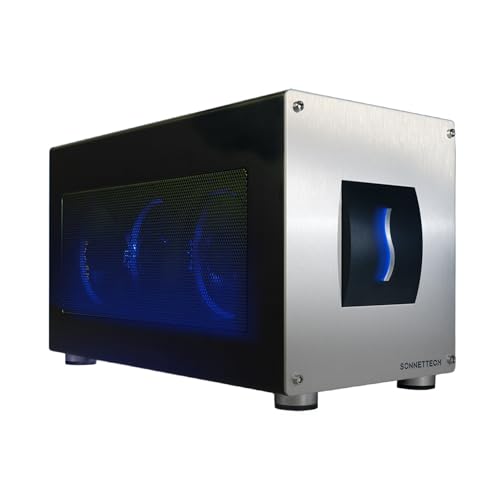
- 80 Gbps Thunderbolt 5 connection
- 850W PSU for demanding GPUs
- Built-in USB and 5GbE ports
Best For: Windows 11 editors needing maximum power and bandwidth
Flexible Build-Your-Own Enclosure
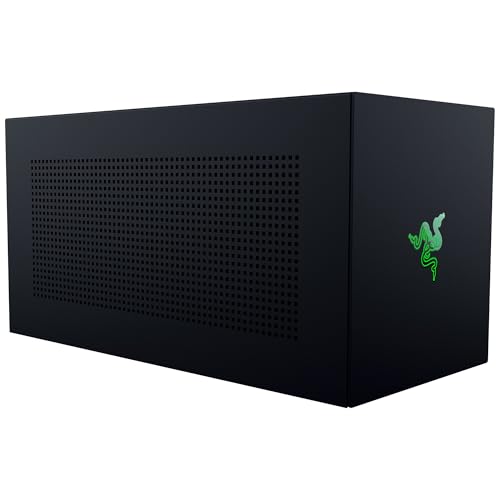
- Thunderbolt 5 up to 80 Gbps
- Fits desktop GPUs up to 4 slots wide
- GPU and PSU sold separately
Best For: Editors who want to choose and swap their own components
Reliable Thunderbolt 3 Workhorse

- Thunderbolt 3 eGPU chassis
- 750W power supply included
- Adds USB and Gigabit Ethernet
Best For: Editors using Thunderbolt 3 systems who want extra ports
Compact Charge-and-Boost Option

- Thunderbolt 3/4 and USB4 support
- 85W pass-through laptop charging
- Very compact aluminum enclosure
Best For: Portable setups that need eGPU power and charging
High-Power Thunderbolt 3 Pick
High-Power Thunderbolt 3 eGPU for Editing

- 750W PSU for high-demand compatible GPUs
- Supports many AMD and NVIDIA card families
- Quiet fan and Thunderbolt 3 connection
Best For: Thunderbolt 3 editors who want a powerful, quiet enclosure for compatible high-end GPUs
USB4/TB4 Open Dock
USB4 eGPU Enclosure for Editors
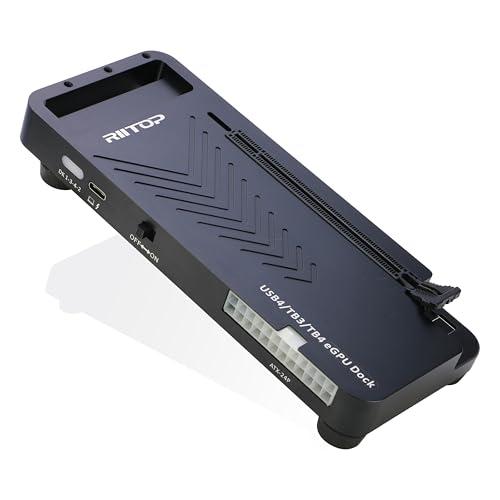
- 40Gbps USB4/Thunderbolt 4 connectivity
- Open design supports large GPUs
- PSU and GPU are not included
Best For: USB4 or Thunderbolt 4 editing setups that need an open dock and supply-your-own power
Ultra-Compact USB4 Pick
Mini eGPU Dock for Mixed GPU Builds

- Certified JHL7440 controller with PCIe 4.0 x4 bandwidth
- Supports Thunderbolt 3/4, USB4, laptops, NUCs, and handhelds
- 85W PD charging plus extra USB/TB ports for dock-like use
Best For: Mobile editors who want a compact, versatile enclosure
OCuLink Speed Pick
PCIe 4.0 x4 Dock for Big Cards

- 64Gbps PCIe 4.0 x4 OCuLink connection
- Fits large GPUs like RTX 4090 and RX 7900 XTX
- Detachable design with shielded flexible cable
Best For: OCuLink users who want maximum link speed and big-card support
Open-Frame Performance Pick
Thunderbolt 4 eGPU Dock with 85W PD

- Certified JHL7540/JHL7440 controller with PCIe 4.0 x16 mode
- Works with Thunderbolt 3/4 and USB4 on Windows, Linux, and select macOS
- Open-frame aluminum build with no graphics card length limit
Best For: Users who want a premium open-frame dock for large GPUs
High-Power Thunderbolt 5 Upgrade – Sonnet Breakaway Box 850 T5
If you want external gpu enclosures for video editing that can keep up with modern Windows workflows, the Sonnet Breakaway Box 850 T5 is built for serious acceleration. Its Thunderbolt 5 connection, large 850W power supply, and built-in dock-style ports make it a strong fit for editing, rendering, color grading, and VFX on compatible laptops.
Best For: Windows 11 editors who want a high-power Thunderbolt 5 eGPU with extra connectivity.
Pros:
- 80 Gbps Thunderbolt 5 bandwidth for GPU-accelerated creative work
- 850W power supply supports power-hungry modern graphics cards
- Fits triple-wide cards and includes a quiet, temperature-controlled fan
- Built-in Thunderbolt 5, USB-A, and 5GbE connectivity
Cons:
- Windows-focused compatibility, not a universal cross-platform pick
- Graphics card is not included
- Larger enclosure than compact portable options
Overall, this is a premium eGPU enclosure for users who prioritize bandwidth, power headroom, and extra ports in one box. It is especially appealing for editors who want one enclosure to handle both GPU acceleration and peripheral connectivity.
Flexible Build-Your-Own Enclosure – Razer Core X V2
Among external gpu enclosures for video editing, the Razer Core X V2 stands out if you want a flexible chassis and already plan to choose your own GPU and power supply. It supports Thunderbolt 5 speeds, works with compatible Thunderbolt 4/5 and USB4 devices, and uses active cooling to help sustain performance during creative workloads.
Best For: Creators who want a Thunderbolt 5 enclosure and prefer to supply their own GPU and PSU.
Pros:
- Up to 80 Gbps Thunderbolt 5 performance
- Supports desktop NVIDIA and AMD cards up to 4 slots wide
- Tool-free install with modular GPU and PSU support
- 120 mm fan and vented steel chassis for active cooling
Cons:
- Graphics card and power supply are sold separately
- Mac devices with M1 or later chips do not support eGPUs
- More of a build-it-yourself solution than an all-in-one kit
This is a strong option for users who want a modern, upgrade-friendly enclosure and already have a preferred graphics card or PSU in mind. For editing rigs that may evolve over time, the modular design is a practical advantage.
Reliable Thunderbolt 3 Workhorse – Sonnet Breakaway Box 750ex
If your workflow is still centered on Thunderbolt 3, the Sonnet eGPU Breakaway Box 750ex remains a practical choice for external gpu enclosures for video editing. It is designed to improve editing, rendering, color grading, animation, and special effects performance, while also adding extra USB and wired Ethernet connectivity.
Best For: Thunderbolt 3 users who want a proven eGPU chassis with added USB and Ethernet ports.
Pros:
- Thunderbolt 3 eGPU chassis with Mac and Windows compatibility
- 750W power supply supports high-performance GPU cards
- Includes four USB Type A ports and a Gigabit Ethernet port
- Built for GPU acceleration in editing and rendering tasks
Cons:
- Uses older Thunderbolt 3 connectivity instead of Thunderbolt 5
- M1 Macs are not compatible with GPUs
- Graphics card is not included
This enclosure makes sense if you want a stable, workstation-style eGPU setup and do not need the newest interface speed. Its extra ports are useful for keeping a desktop editing station tidy and connected.
Compact Charge-and-Boost Option – VK-Y900 Thunderbolt eGPU
For buyers comparing external gpu enclosures for video editing, the VK-Y900 is interesting because it combines broad GPU support with 85W pass-through charging in a very compact design. It works with Thunderbolt 3/4 and USB4 laptops and handhelds, and it includes dual Thunderbolt ports plus a DisplayPort for a cleaner single-cable setup.
Best For: Compact setups that need external GPU performance and laptop charging in one cable.
Pros:
- Supports NVIDIA RTX and AMD Radeon cards across multiple generations
- Thunderbolt 3/4 and USB4 compatibility
- 85W PD charging plus dual Thunderbolt ports
- Very lightweight, portable enclosure with aluminum construction
Cons:
- Uses a bottom-mount ATX power supply design
- More niche than larger workstation-style enclosures
- Notes emphasize AI deep learning use on Apple Silicon Macs, not gaming or 3D rendering
This model is best viewed as a compact, practical dock-style eGPU solution rather than a big desktop replacement. If you value portability and cable simplicity, it offers a useful balance of GPU support and charging.
High-Power Thunderbolt 3 Pick – High-Power Thunderbolt 3 eGPU for Editing
Sonnet eGPU Breakaway Box 750 - External GPU Chassis - Not Compatible with M1 Macs
Check Price On AmazonIf you want external gpu enclosures for video editing with strong power delivery and broad card support, the Sonnet Breakaway Box 750 is built for Thunderbolt 3 workflows. It’s designed to speed up editing, rendering, color grading, animation, and special effects while staying quiet under load.
Best For: Editors on Mac or Windows who need a Thunderbolt 3 eGPU enclosure with lots of PSU headroom for compatible high-end GPUs.
Pros:
- 750W power supply supports demanding compatible GPU cards.
- Compatible with many AMD Radeon and NVIDIA GeForce RTX, TITAN, and Quadro models.
- Quiet, temperature-controlled fan helps keep the enclosure cool.
- Thunderbolt 3 connection is aimed at GPU-accelerated editing and rendering tasks.
Cons:
- Not compatible with M1 Macs.
- Does not work with Thunderbolt 2 or standard USB-C ports.
- GPU card is not included.
For creators already on Thunderbolt 3, this is a straightforward high-power enclosure that focuses on compatibility and cooling. Its biggest strengths are the robust 750W supply and support for a wide range of professional and enthusiast cards.
OCuLink Power Dock – OCuLink eGPU Dock with 800W PSU
For external gpu enclosures for video editing on an OCuLink-equipped system, the AOOSTAR AG01 offers a built-in 800W power supply and an open metal design. It’s aimed at users who want broad graphics card compatibility and enough power for demanding creative workloads.
Best For: OCuLink laptop or desktop owners who want a compact eGPU dock with a high-wattage built-in PSU.
Pros:
- Built-in 800W power supply with up to 600W graphics card power consumption support.
- Compatible with most external graphics boards on the market, per the notes.
- Open metal body with no graphics card length limit.
- Supports Mac and Windows, with Windows 11 22H2 or higher recommended.
Cons:
- Only works with devices that have an OCuLink port.
- OCuLink does not support hot-plugging.
- The built-in power supply is for the dock only, and the AC input is listed as 220V.
This is a practical option if your editing laptop or system already has OCuLink, since the dock emphasizes power and compatibility over universal connectivity. Just be sure your hardware matches the port requirement before buying.
USB4/TB4 Open Dock – USB4 eGPU Enclosure for Editors
If you’re comparing external gpu enclosures for video editing and want a 40Gbps USB4 or Thunderbolt 4 setup, the RIITOP TB4 dock is built for modern laptops and small systems. It supports PCIe 4.0 x16 graphics cards and is positioned for rendering, cinematic work, and other creative workloads.
Best For: USB4 or Thunderbolt 4 users who want an open-style eGPU dock for compatible editing and rendering GPUs.
Pros:
- Supports 40Gbps USB4/TB4 connections for compatible devices.
- Works with many current NVIDIA and AMD GPUs, including RX 7000 and RTX 50-series notes.
- Open design has no graphics card size restrictions.
- Compatible with Windows, Linux, and Mac OS, with AMD support on Mac OS noted.
Cons:
- Requires a full-function Thunderbolt 4 or USB4 port.
- Power supply is not included.
- Windows users may need to update the Thunderbolt Controller Driver.
This dock is a flexible choice if you want to supply your own ATX or SFX PSU and already have a true full-speed USB4 or Thunderbolt 4 port. It’s especially appealing for users who want wide GPU compatibility in an open, easy-to-fit design.
Ultra-Compact USB4 Pick – Mini eGPU Dock for Mixed GPU Builds
If you want external gpu enclosures for video editing and also need a compact dock for a laptop, mini PC, or handheld, the ANQ-L336 is a flexible USB4/TB3/TB4 option. It uses an officially certified JHL7440 controller, supports NVIDIA and AMD cards, and adds 85W PD charging plus hub-style ports for a more practical desktop setup.
Best For: Editors who want a small, versatile enclosure for USB4 or Thunderbolt systems, including handhelds like the ROG Ally X and MSI Claw 8.
Pros:
- Certified JHL7440 controller for high-performance PCIe 4.0 x4 operation
- Works with Thunderbolt 3/4 and USB4 laptops, NUCs, and gaming handhelds
- Supports NVIDIA and AMD GPUs, with strong AMD compatibility including the latest 9000 series
- Includes 85W PD charging and extra USB/TB ports for added flexibility
Cons:
- PSU is not included
- NVIDIA RTX 50-series support is noted as limited
- Best suited to USB4/TB systems only, not generic USB-C ports
Overall, this is a practical choice if you want a compact enclosure that can double as a dock while keeping the setup simple. Its mix of broad compatibility, charging, and extra ports makes it especially appealing for mobile editing workflows.
OCuLink Speed Pick – PCIe 4.0 x4 Dock for Big Cards
For external gpu enclosures for video editing where raw link speed and card support matter, this OCuLink dock is built around PCIe 4.0 x4 at 64Gbps. It includes an SFF-8611 cable, supports large GPUs such as RTX 4090 and RX 7900 XTX, and uses a detachable design that makes storage and transport easier.
Best For: Users with OCuLink-capable laptops or mini PCs who want a high-bandwidth dock for large graphics cards.
Pros:
- OCuLink PCIe 4.0 x4 connection rated up to 64Gbps
- Compatible with large graphics cards, including RTX 4090 and RX 7900 XTX
- Detachable enclosure design improves portability and storage
- Includes a flexible, shielded SFF-8611 cable to help reduce port stress and interference
Cons:
- GPU and power supply are not included
- Requires a standard ATX PSU only
- OCuLink does not support hot plugging, so shutdown is required to disconnect
This is a straightforward pick for users who already have OCuLink hardware and want a serious enclosure for high-end cards. The tradeoff is that it is more specialized than Thunderbolt or USB4 options, but the bandwidth and GPU compatibility are the main appeal.
Open-Frame Performance Pick – Thunderbolt 4 eGPU Dock with 85W PD
If you’re comparing external gpu enclosures for video editing and want a modern Thunderbolt dock with strong power delivery, the MK-L18 is built around certified JHL7540/JHL7440 controllers and PCIe 4.0 x16 mode. It supports Windows, Linux, and select macOS models, adds 85W PD charging, and uses an open-frame aluminum design with no graphics card length limit.
Best For: Editors who want a premium open-frame enclosure with broad TB/USB4 compatibility and room for large GPUs.
Pros:
- Certified controller support with PCIe 4.0 x16 mode and 32Gbps bandwidth
- Compatible with Thunderbolt 3/4 and USB4 systems, plus Windows, Linux, and select macOS models
- 85W PD charging helps power devices like the ROG Ally X while using the enclosure
- Open-frame aluminum build supports unlimited graphics card length and strong airflow
Cons:
- Only works with Thunderbolt/USB4 Type-C ports, not all USB-C ports
- macOS support is limited to select models
- Open-frame design offers less physical protection than a closed enclosure
For users who want a cleaner, more premium-looking enclosure with plenty of breathing room for a large GPU, this model is an attractive option. It leans toward flexibility and stability rather than a fully enclosed, travel-friendly design.
How We Picked the Best External GPU Enclosures for Video Editing
We prioritized enclosures that make sense for editing workloads, not just gaming or bench scores. That means strong host connectivity, reliable power delivery, support for full-size GPUs, and enough physical clearance for modern cards used in Adobe Premiere Pro, DaVinci Resolve, and similar apps.
We also looked for clear compatibility notes, because External GPU Enclosures for Video Editing can vary a lot by laptop port, operating system, GPU size, and power-supply design. Products with broader support for Thunderbolt 3/4, USB4, or OCuLink scored well when they offered stable performance and practical setup options.
Quick Comparison
The right choice usually comes down to your connection type and GPU size. Thunderbolt and USB4 enclosures are the easiest plug-and-play option for most laptops, while OCuLink-based models can offer more direct bandwidth for users who want maximum performance and have the right hardware. Larger desktop-style enclosures are better if you plan to install a high-power GPU and keep the setup in one place.
If you edit on the go, prioritize portability and laptop charging support. If you edit at a desk, prioritize thermal headroom, PSU quality, and room for a card that can handle long export sessions without throttling.
Key Buying Factors for External GPU Enclosures for Video Editing
Connection Standard
Thunderbolt 4 and USB4 are the easiest for broad laptop compatibility. Thunderbolt 5 and OCuLink can offer more bandwidth, but only if your system supports them. Match the enclosure to your laptop’s actual port, not just its marketing specs.
GPU and PSU Support
Check maximum GPU length, thickness, and power draw. Video editing benefits from a capable GPU, but a weak enclosure power supply can limit upgrades or cause instability under sustained renders.
Charging and I/O
Some enclosures can charge the laptop over the same cable, which is convenient for mobile editors. Extra USB ports, Ethernet, and storage options can also reduce desk clutter and improve workflow.
Operating System Compatibility
Not every enclosure works equally well across Windows, macOS, and Linux. Verify support before buying, especially if you use a Mac with Apple silicon or a mixed-device editing setup.
Who Should Buy Which External GPU Enclosures for Video Editing?
If you want the safest all-around choice, pick a Thunderbolt 4 or USB4 enclosure with strong power delivery and good size clearance. If you have a newer high-bandwidth laptop and want top-end performance, consider a Thunderbolt 5 or OCuLink model.
Choose a larger desktop-style enclosure if you plan to install a power-hungry NVIDIA or AMD card for long export sessions. Choose a compact model if your priority is travel, a smaller desk footprint, or occasional GPU acceleration rather than a permanent workstation upgrade.