If you’re looking to boost your network connectivity, fiber media converters are a smart choice. These devices seamlessly connect fiber and copper connections, providing high-speed data transmission for everything from gaming to streaming. With various features available, knowing which converter suits your needs can be tricky. Let’s explore the top options that can elevate your network performance and guarantee reliability for your infrastructure.
Gigabit Single Mode LC Fiber Media Converter with SFP Modules

If you’re looking for a reliable solution to connect your PC to a fiber optic network, the Gigabit Single Mode LC Fiber Media Converter with SFP Modules is an excellent choice. This converter set includes two Gigabit converters with SFP LX modules, enabling seamless fiber-to-Ethernet conversion. You’ll enjoy a stable 1000Mbps connection, with a range of up to 20km. Its plug-and-play design means you won’t need any complicated setup. Plus, the visualized LED indicators make monitoring your network activity easy. With a three-year warranty and lifetime tech support, you can trust this converter to enhance your network connectivity effortlessly.
Best For: This product is best for businesses and IT professionals seeking reliable and high-speed connections to fiber optic networks.
Pros:
- Plug-and-play functionality eliminates the need for complicated setups.
- Supports a stable 1000Mbps connection with a range of up to 20km.
- Comes with a three-year warranty and lifetime technology support for peace of mind.
Cons:
- Limited to single-mode fiber, which may not suit all network types.
- Requires compatible SFP modules, which may need to be purchased separately.
- May not support higher data rates beyond 1Gbps, limiting future scalability.
Bidi Gigabit Multi-Mode Fiber Ethernet Media Converter with Dual Transceiver Module

The Bidi Gigabit Multi-Mode Fiber Ethernet Media Converter with Dual Transceiver Module is an ideal choice for businesses and professionals seeking reliable and high-speed network connections. This plug-and-play device features two Gigabit Multi-Mode Ethernet SFP slot converters and transceivers, supporting distances up to 550m. With a data rate of 1.25Gbps for optical ports and 10/100/1000Mbps for RJ45, you’re set for efficient performance. The robust design includes lightning protection, easy installation with LED indicators, and a UL-certified power supply. Plus, it’s perfect for network extension, remote connectivity, and secure government applications. Enjoy seamless connectivity today!
Best For: Businesses and professionals looking for reliable, high-speed network connections in remote or secure environments.
Pros:
- Plug-and-play installation with LED indicators for easy monitoring of status.
- Supports long-distance connections up to 550m with effective lightning protection.
- Versatile applications for network extension and secure connectivity in government or corporate settings.
Cons:
- Limited to Multi-Mode fiber, which may not suit all networking needs.
- Requires an AC/DC power supply, which may add installation complexity.
- Operating temperature range may not be suitable for extreme environments.
TP-Link Gigabit SFP to RJ45 Fiber Media Converter
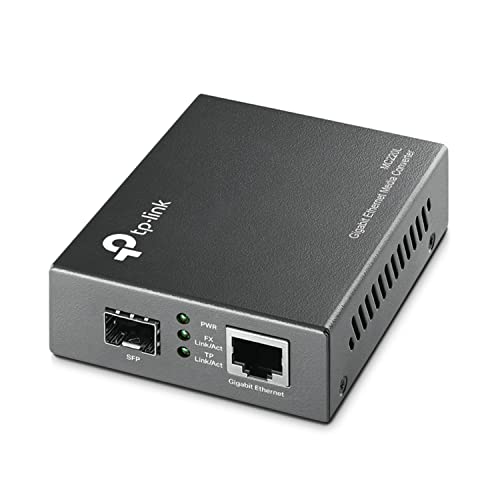
For those looking to seamlessly bridge fiber and Ethernet networks, the TP-Link Gigabit SFP to RJ45 Fiber Media Converter stands out as an excellent solution. This compact device converts 1000BASE-SX/LX fiber to 1000Base-T copper media effortlessly. You’ll appreciate its compatibility with both single-mode and multi-mode SFP modules, supporting impressive transmission distances of up to 12.4 miles for single-mode and 1,800 feet for multi-mode. With a durable metal casing and plug-and-play functionality, setup is a breeze. Just keep in mind that fiber optic connectors aren’t included, and consider surge protectors to safeguard against lightning strikes for peak performance.
Best For: Users seeking a reliable and efficient solution to connect fiber and Ethernet networks, especially in high-speed applications like streaming and gaming.
Pros:
- Plug-and-play functionality allows for easy installation without the need for software.
- Supports long transmission distances, making it versatile for various network setups.
- Durable metal casing ensures longevity and quiet operation.
Cons:
- Does not include a power supply or fiber optic connectors, which must be purchased separately.
- Susceptible to lightning strikes, requiring additional surge protection for safety.
- Initial sync delay may occur when first powering on the device.
10Gtek Gigabit Fiber to Ethernet Media Converter (Pack of 2)

Looking for a reliable solution to connect your Ethernet network over long distances? The 10Gtek Gigabit Fiber to Ethernet Media Converter (Pack of 2) is an excellent choice. With a 1.25G fiber port and a 10/100/1000Mbps RJ-45 port, it offers seamless connectivity. Enjoy consistent performance, even exceeding 900Mbps, and a hassle-free plug-and-play setup. This converter supports distances up to 20km, providing a protective buffer against electrical events. Users praise its ease of use and reliability, though some have noted delivery speed issues. Overall, it’s a solid investment for enhancing your network’s performance and safety.
Best For: Individuals or businesses seeking a reliable and long-distance Ethernet connection with enhanced electrical protection.
Pros:
- Plug-and-play setup allows for easy installation without technical expertise.
- Supports distances up to 20km while maintaining high speeds, often exceeding 900Mbps.
- Provides protection against electrical surges and lightning strikes, safeguarding connected devices.
Cons:
- Some users have reported delays in delivery speed.
- Additional power supply converters may be needed depending on regional plug types, which could complicate setup.
- Installation challenges can arise if incorrect connectors are used, requiring adapters.
StarTech.com Multimode/Single Mode Fiber Media Converter

With its open SFP slot, the StarTech.com Multimode/Single Mode Fiber Media Converter (MCM1110SFP) is perfect for network administrators seeking versatility in fiber optic connections. This converter seamlessly transforms your RJ45 copper Ethernet into fiber optic connections, supporting speeds of 10/100/1000 Mbps. Thanks to its auto-negotiation feature, you can easily bridge various network speeds and devices to a Gigabit fiber network. The compact design guarantees easy mounting, making it ideal for mission-critical applications. Plus, it’s a cost-effective solution for extending your network, accommodating both multimode and single-mode transceivers to suit your specific needs.
Best For: Network administrators and IT professionals looking for a versatile and cost-effective solution to extend their fiber optic networks.
Pros:
- Customizable: Open SFP slot allows use of various MSA-compliant transceivers for tailored network extension.
- High-Speed Compatibility: Supports multiple speeds (10/100/1000 Mbps) with auto-negotiation for seamless integration.
- Compact Design: Lightweight and easy to mount, suitable for diverse installation environments.
Cons:
- Limited Built-in Transceivers: Requires separate purchase of SFP transceivers, which may increase initial setup costs.
- Potential Complexity: Users may need technical expertise to select compatible SFP transceivers.
- No Integrated Power Supply: May require additional considerations for power sourcing in certain installations.
2 Pack Fiber Ethernet Media Converter with SFP Transceiver

The 2 Pack Fiber Ethernet Media Converter, bundled with SFP transceivers, is perfect for small to medium-sized businesses seeking reliable and efficient networking solutions. With a straightforward plug-and-play setup, you can connect the optical and RJ45 ports without software hassles. Each converter supports a 1.25Gbps SFP port and works seamlessly with Multi-Mode LC transceivers up to 550m. Plus, you’ll appreciate the status LEDs for quick network monitoring. Operating within a temperature range of 0°C to 60°C, it’s durable enough for various applications. While reviews vary, its compact size and low power consumption are consistently praised.
Best For: Small to medium-sized businesses seeking reliable and efficient networking solutions.
Pros:
- Plug-and-play setup allows for easy installation without software.
- Compact size and low power consumption make it suitable for various environments.
- Supports a range of fiber setups and operates within a wide temperature range.
Cons:
- Some users reported issues with the power supply and overall reliability.
- Mixed reviews on performance longevity and reliability in industrial applications.
- Limited compatibility with certain fiber setups may restrict usage in specific scenarios.
ipolex Gigabit Single-Mode LC Fiber to Ethernet Media Converter

For network administrators needing reliable long-distance connectivity, the ipolex Gigabit Single-Mode LC Fiber to Ethernet Media Converter stands out. This converter effortlessly bridges 1000BASE-LX Duplex LC fiber with 10/100/1000Base-T RJ-45 copper, offering seamless transmission up to 20 kilometers. Operating at 1310nm, it’s perfect for long-distance applications. With its plug-and-play design, you won’t need to fuss with software installation. The hot-swappable feature allows for easy setup and troubleshooting. Enjoy a dependable auto-negotiation gigabit connection, and rest easy with the included 3-year warranty and technical support. Enhance your network efficiency with this powerful converter today!
Best For: Network administrators seeking reliable long-distance connectivity solutions for their fiber to Ethernet needs.
Pros:
- Plug-and-play design for easy installation without the need for software.
- Hot-swappable feature allows for quick troubleshooting and setup.
- Supports transmission distances up to 20 kilometers, ideal for extensive network applications.
Cons:
- Limited to single-mode fiber, which may not suit all network setups.
- Requires specific SFP modules, which could incur additional costs.
- The maximum transmission distance may not be sufficient for some large-scale deployments.
Multimode ST Gigabit Fiber Media Converter

Ideal for network professionals and small businesses, the Multimode ST Gigabit Fiber Media Converter offers seamless integration of fiber and copper connections. With a built-in ST fiber module, it supports distances up to 550 meters at 850 nm and converts to UTP Cat5e RJ-45. Automatically adapting to various speeds, you can configure it for dual speed via dip switch. The plug-and-play design guarantees quick setup, while features like Jumbo Frame and LLF enhance performance. Users appreciate its ease of use and reliable support, making it a smart choice for boosting your network capabilities today.
Best For: Network professionals and small businesses looking for an efficient solution to integrate fiber and copper connections.
Pros:
- Plug-and-play design allows for easy installation without the need for complex configurations.
- Automatic speed adaptation ensures compatibility with various network speeds (10/100/1000 Mbit/s).
- Enhanced performance features like Jumbo Frame and LLF improve TCP performance, making it suitable for demanding applications.
Cons:
- Some users reported a need for a longer power adapter cord for more flexible placement.
- Limited maximum distance of 550 meters may not meet the needs of larger installations.
- Warranty information is only available upon request, which may deter some users seeking immediate assurance.
10Gtek Mini Gigabit Ethernet Media Converter

Need a compact solution for converting fiber to Ethernet? The Gtek Mini Gigabit Ethernet Media Converter is perfect for you. This mini-sized device measures just 69*50*25mm, making it nearly 50% smaller than traditional converters. It efficiently converts MultiMode Dual LC Fiber to an Ethernet RJ45 connection, supporting speeds up to 1000Mbps. With its SFP MMF 850-nm module, you can enjoy a fiber range of up to 550 meters. Plus, LED indicators provide real-time feedback on your network status. With UL certification and low power requirements, this converter is a reliable choice for enhancing your network connectivity.
Best For: Users seeking a compact and efficient solution for converting fiber to Ethernet in tight spaces or compact setups.
Pros:
- Miniature size: Nearly 50% smaller than traditional converters, making it ideal for space-constrained environments.
- High-speed connectivity: Supports speeds up to 1000Mbps, providing fast data transfer rates.
- Real-time monitoring: LED indicators allow for easy tracking of network status and fault detection.
Cons:
- Limited range: Maximum fiber range of 550 meters may not meet the needs of larger installations.
- Single SFP module: Comes with only one SFP MMF module, requiring additional purchases for different types of connections.
- Power adapter dependency: Requires a specific 5V-1A power adapter, which may need to be sourced separately if lost.
Single Mode SC WDM Single Fiber Bi-Di Gigabit Media Converter
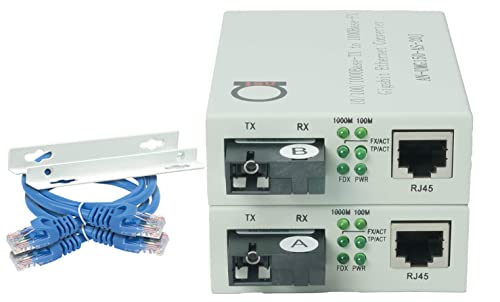
The Single Mode SC WDM Single Fiber Bi-Di Gigabit Media Converter is perfect for users who require reliable, high-speed data transmission over long distances. With a built-in fiber module extending up to 20 km, it supports Ethernet speeds of 10 Mbit/s, 100 Mbit/s, and 1000 Mbit/s without extra configuration. Installation’s a breeze thanks to its plug-and-play functionality and included Cat5e patch cable. Users appreciate its full duplex communication, minimal packet loss, and compatibility with various devices like modems and routers. Overall, it’s a compact, efficient solution that enhances your network without sacrificing performance or reliability.
Best For: Users needing reliable, high-speed data transmission over long distances with minimal configuration.
Pros:
- Supports multiple Ethernet speeds (10 Mbit/s, 100 Mbit/s, 1000 Mbit/s) without additional setup.
- Plug-and-play installation with included Cat5e patch cable, making it user-friendly.
- Full duplex communication with minimal packet loss ensures consistent performance.
Cons:
- Some users have raised concerns about the inline power brick.
- Not designed for converting fiber to Ethernet; limited to extending Ethernet over fiber.
- May require additional mounting hardware for optimal placement in certain environments.
Factors to Consider When Choosing Fiber Media Converters for PC
When choosing a fiber media converter for your PC, you need to evaluate several key factors. Think about compatibility with your existing systems, the required transmission distance, and the type of fiber you’ll be using. Don’t forget to assess data rate requirements and how easy the installation will be, along with the support options available.
Compatibility With Existing Systems
Choosing a fiber media converter for your PC requires careful consideration of its compatibility with your existing systems. First, make sure the converter works with the type of fiber optic cable you’re using, whether it’s single-mode or multi-mode. Next, check for compatibility with networking standards like IEEE802.3ab and IEEE802.3z to guarantee seamless integration. It’s also essential that the data rates match your performance needs—look for 1.25Gbps for optical ports and 10/100/1000Mbps for RJ45 ports. Additionally, verify that the connector type, such as LC, SC, or ST, aligns with your existing cables. Finally, assess the power requirements to make sure the converter’s power supply fits your electrical setup. This way, you’ll avoid potential connectivity issues.
Required Transmission Distance
Compatibility with your existing systems sets the groundwork for your network setup, but understanding the required transmission distance is just as important. When selecting fiber media converters, consider how far your data needs to travel. Multi-mode fiber converters typically support distances up to 550 meters, while single-mode converters can reach up to 20 kilometers. This difference is vital, as single-mode fiber offers lower attenuation, making it ideal for longer runs. Ascertain the converter’s specifications align with your network’s distance requirements to maintain reliable data transmission without signal degradation. Additionally, be aware of environmental factors, like electrical interference, which can impact performance over longer distances. Choosing wisely here enhances your network’s efficiency.
Fiber Type Selection
Selecting the right fiber type is essential for guaranteeing your network operates efficiently and meets your performance needs. When choosing a fiber media converter, you must consider whether to use single-mode or multi-mode fiber. Single-mode fibers are ideal for long-distance communication, reaching up to 20 km, and offer higher bandwidth with lower attenuation. They operate at wavelengths of 1310 nm or 1550 nm. On the other hand, multi-mode fibers are suitable for shorter distances (up to 550 m) and are more affordable and easier to install. However, they experience modal dispersion, limiting their range. Confirm your converter matches your chosen fiber type to assure compatibility and peak performance in your networking setup.
Data Rate Requirements
How can you guarantee your network runs smoothly? Start by matching the data rate of your fiber media converter with your network’s requirements. Common rates include 1.25 Gbps for Gigabit applications and up to 10 Gbps for higher-speed connections. Make certain the converter supports auto-negotiation, allowing it to adapt to the speeds of connected devices, whether 10, 100, or 1000 Mbps. Consider the maximum transmission distance, as some models can extend links up to 20 km for single-mode fiber or 550 m for multi-mode fiber. Additionally, support for jumbo frames can enhance data throughput, and confirm compliance with IEEE standards like 802.3 for compatibility and reliability across your network setup. Choosing wisely can greatly boost performance.
Installation Ease and Support
When you’re setting up your network, ease of installation can make a significant difference in getting everything up and running smoothly. Many fiber media converters offer plug-and-play functionality, letting you start using them right away without complicated configurations. Look for models with visual LED indicators that give real-time feedback on network status, simplifying troubleshooting. Features like auto-negotiation and MDI/MDIX auto-crossover further ease the process by automatically adjusting connection settings. Extensive user manuals and responsive technical support can help you navigate any challenges during installation. Plus, some converters come in compact, wall-mountable designs, allowing flexible placement to optimize your space and accessibility. With these factors in mind, you’ll find installing your fiber media converter a breeze.
Environmental Conditions
While choosing fiber media converters for your PC, it’s crucial to contemplate the environmental conditions they’ll face. Most converters operate effectively between 0°C and 60°C, so consider this range if you’re in a typical indoor setting. Keep in mind that humidity levels should ideally be between 10% and 90% non-condensing to maintain performance. If you’re in a dusty environment, opt for converters with sealed enclosures to prevent signal degradation. For outdoor setups, look for weatherproof housing to shield against rain, UV exposure, and temperature changes. Finally, verify your converters are placed away from electrical interference sources, as this can greatly impact their efficiency and reliability. Making these considerations will maximize your network’s performance.
Budget and Cost Efficiency
After ensuring your fiber media converters can withstand the environmental conditions they’ll encounter, the next step is to focus on budget and cost efficiency. Start by considering the total cost of ownership, which includes the initial purchase price, installation expenses, and ongoing maintenance costs. Look for converters with warranties and lifetime technical support to minimize future repair costs. Evaluate energy consumption, as lower power usage can lead to savings on your electricity bills. Features like plug-and-play functionality can cut down installation time and labor expenses. Finally, compare data transfer speeds and distances; investing in higher-performance options might save you money on additional equipment or upgrades down the line, ensuring you make a wise financial decision.