Professional storage workflows demand more than a basic USB adapter. The right hard drive docking station can simplify drive cloning, accelerate backups, and make testing bare SATA or NVMe drives far more convenient.
We’ve selected 10 docking stations covering single-drive, dual-bay, and multi-bay setups, with options for USB-C, USB 3.0, NVMe, SATA, hot-swapping, and direct drive cloning.
Best 10 Hard Drive Docking Stations for Professionals Picks for 2026
Best Dual-Bay Cloner
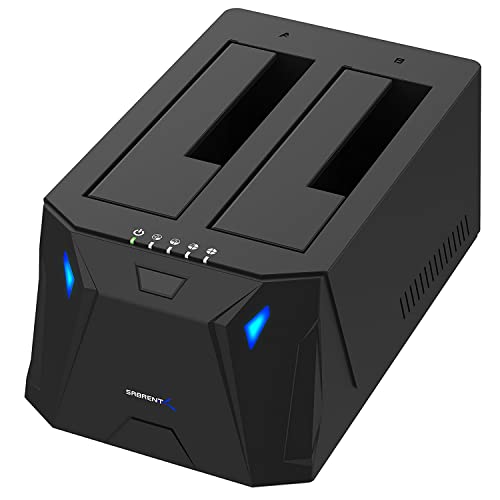
- Dual bays for 2.5-inch and 3.5-inch SATA drives
- Offline cloning without a computer
- Plug-and-play USB 3.0 connectivity
Best For: Routine SATA drive cloning and backups
Best Versatile NVMe/SATA Dock
Sabrent USB-C 10Gbps Lay-Flat Dock

- Reads M.2 NVMe and 2.5/3.5-inch SATA drives
- Includes USB-C and USB-A cables
- Tool-free offline cloning
Best For: Mixed-format drive swaps and migration work
Best High-Capacity Duplicator

- One-to-four offline SATA duplication
- Up to 100TB across five bays
- Aluminum vertical design with status LEDs
Best For: Large SATA media libraries and multi-copy backups
Best Five-Drive DAS
Sabrent USB-C 10Gbps 5-Bay Enclosure

- Five trayless 3.5-inch hot-swap bays
- Independent drive controllers and 10Gbps USB-C
- PWM cooling and per-bay power switches
Best For: Multi-drive JBOD-style desktop storage access
Best Dual-Bay Value

- Dual-bay access for 2.5- and 3.5-inch SATA drives
- Offline cloning without a computer
- USB 3.0 and Windows, Mac, and Linux support
Best For: Budget-conscious professionals handling SATA drive access and cloning
Best USB-C Cloner

- USB-C dual-bay connection for two SATA drives
- Offline cloning at up to 60MBps
- Hot-swappable, tool-free drive installation
Best For: USB-C workstation users performing SATA drive transfers and clones
Best for Multi-Drive Workflows

- Four tool-free bays for 2.5- and 3.5-inch SATA drives
- Hot-swappable design for easier drive replacement
- USB-A/USB-C 3.0 and up to 80TB listed capacity
Best For: Desktop and business users managing several SATA drives
Best Single-Bay Performance
StarTech.com USB 3.1/eSATA SATA Dock

- 10 Gbps USB or 6 Gbps eSATA connectivity
- Supports 2.5/3.5-inch SATA HDDs and SSDs
- Tool-free design with USB-A, USB-C, and eSATA cables
Best For: Single-drive backup, imaging, and data transfer
Best Versatile Cloning Station
ICY BOX Triple-Bay NVMe/SATA Dock

- Three bays support NVMe and 2.5/3.5-inch SATA drives
- One-touch offline cloning without software
- USB 3.2 Gen 2 speeds up to 10 Gbps
Best For: Mixed-format drive migration and multi-drive access
Best Simple Pick

- Four hot-swappable bays for 2.5/3.5-inch SATA drives
- Independent controllers support uninterrupted bay use
- Dual fans provide active drive cooling
Best For: Batch backups, drive comparisons, and multi-drive access
Best Dual-Bay Cloner – Sabrent USB 3.0 HDD Dock
For professionals who need a straightforward solution for reading, cloning, or transferring data, this dual-bay dock supports both 2.5-inch and 3.5-inch SATA hard drives and SSDs. USB 3.0 connectivity and offline cloning make it a practical choice among hard drive docking stations for professionals handling routine backups or drive upgrades.
Best For: Users who need an affordable two-drive SATA dock with offline cloning.
Pros:
- Supports 2.5-inch and 3.5-inch SATA HDDs and SSDs.
- Offline cloning works without a computer.
- Plug-and-play design requires no drivers.
- Supports drives up to 10TB and USB 3.0 transfer rates up to 5Gbps.
Cons:
- Limited to two drives at a time.
- Designed for SATA drives rather than NVMe SSDs.
This is a sensible option for basic duplication and drive access, particularly when you do not need a multi-drive enclosure or newer NVMe compatibility.
Best Versatile NVMe/SATA Dock – Sabrent USB-C 10Gbps Lay-Flat Dock
This Sabrent dock combines M.2 PCIe NVMe support with 2.5-inch and 3.5-inch SATA compatibility in one tool-free enclosure. Its USB 3.2 Gen 2 interface, included USB-C and USB-A cables, and offline cloning make it a flexible pick among hard drive docking stations for professionals working across modern and legacy storage.
Best For: Professionals who regularly swap between NVMe and SATA drives.
Pros:
- Supports M.2 NVMe plus 2.5-inch and 3.5-inch SATA drives.
- 10Gbps USB 3.2 Gen 2 interface supports fast transfers.
- Includes both USB-C-to-USB-C and USB-A-to-USB-C cables.
- Tool-free offline cloning works without a PC.
Cons:
- Offline cloning requires a target drive equal to or larger than the source.
- Only one drive is supported at a time.
Its broad format support is the main advantage: it can serve as a compact workstation tool for drive testing, migration, backups, and quick media access across Windows, macOS, and Linux.
Best High-Capacity Duplicator – ORICO USB-C 5-Bay Dock
With five SATA bays and support for up to 20TB per drive, this ORICO dock is built for professionals managing large collections of photos, video, or other data. Its one-to-four offline duplication feature makes it a notable choice among hard drive docking stations for professionals who need multiple copies without connecting to a computer.
Best For: Photographers and other users who need high-capacity multi-copy SATA duplication.
Pros:
- Duplicates one source drive to four targets with a single button.
- Five bays support up to 100TB total capacity.
- Aluminum construction and vertical design aid heat dissipation.
- Includes USB-C-to-C and USB-C-to-A connectivity.
Cons:
- Supports SATA drives, not M.2 NVMe drives.
- Targets are overwritten during cloning, so backups are needed first.
- USB 3.2 Gen 1 is slower than 10Gbps docks.
This dock prioritizes capacity and duplication efficiency over maximum interface speed. It is a strong fit when producing several SATA copies is more important than using the fastest possible transfer connection.
Best Five-Drive DAS – Sabrent USB-C 10Gbps 5-Bay Enclosure
This five-bay direct-attached storage enclosure gives each installed drive an independent connection through dedicated controllers. For professionals who need ongoing access to several 3.5-inch SATA drives, it stands out among hard drive docking stations for professionals with trayless hot-swap bays, USB-C 10Gbps connectivity, and temperature-controlled cooling.
Best For: Users who need a five-drive JBOD-style DAS enclosure rather than RAID or NAS storage.
Pros:
- Five tool-free 3.5-inch bays support up to 100TB total.
- Independent controllers provide stable connections for each bay.
- 120mm PWM fan adjusts cooling based on drive temperature.
- Includes per-bay power switches, activity LEDs, and USB-C daisy-chaining.
Cons:
- Drives are not included.
- It is not a RAID system or NAS.
- The enclosure is relatively large and weighs 10 pounds.
This is the most suitable choice here for sustained multi-drive access and expansion. Choose it when you want individual drive mounting over USB-C and do not need hardware RAID or network sharing.
Best Dual-Bay Value – FIDECO SATA Hard Drive Dock
For professionals looking for hard drive docking stations for professionals, the FIDECO dual-bay dock offers a straightforward way to access two 2.5- or 3.5-inch SATA HDDs or SSDs. USB 3.0 connectivity, plug-and-play operation, and offline cloning make it practical for drive migration, backups, and routine storage work.
Best For: Professionals who need an affordable dual-bay SATA dock with offline cloning and broad Windows, Mac, and Linux compatibility.
Pros:
- Supports two 2.5- or 3.5-inch SATA HDDs or SSDs simultaneously.
- Offline cloning works without a computer.
- USB 3.0 provides transfer rates up to 5Gbps.
- Plug-and-play compatibility with Windows, Mac OS, and Linux.
Cons:
- Supports SATA drives only; it does not support other drive interfaces.
- New drives may need to be initialized before the computer recognizes them.
- Offline cloning requires the target drive to be suitable for the cloning process.
The FIDECO is a versatile choice for hands-on drive access and occasional cloning. Its dual-bay design is useful for technicians and small-office users, though those needing more than two drives or newer NVMe support should look elsewhere.
Best USB-C Cloner – SABRENT Dual-Bay Drive Dock
The SABRENT EC-CH2B is one of the more convenient hard drive docking stations for professionals who want USB-C connectivity and simple drive duplication. It mounts two SATA drives as separate volumes over USB, while its offline cloner copies one drive to another without a connected computer.
Best For: Professionals with USB-C computers who regularly move files between two bare SATA drives or perform offline one-to-one clones.
Pros:
- Supports bare 2.5- and 3.5-inch SATA HDDs and SSDs.
- Offline cloning requires no computer and runs at up to 60MBps.
- Both bays can be read and written as separate drives when connected to a computer.
- Tool-free, hot-swappable design with individual drive-access LEDs.
Cons:
- Does not support IDE/PATA, M.2, or NVMe drives.
- The included cable is USB-C on the dock end, so a USB-C computer port or separate adapter cable may be needed.
- The target drive must be the same size as or larger than the source for offline cloning.
With its USB-C connection and clearly defined cloning workflow, the SABRENT is well suited to modern laptops and desktop workstations. Its SATA-only design limits compatibility, but it is a focused tool for drive handling and migration.
Best for Multi-Drive Workflows – CENMATE 4-Bay Enclosure
The CENMATE 4-bay enclosure is designed for professionals who need to keep several 2.5- or 3.5-inch SATA drives connected in one external storage system. Its tool-free, hot-swappable bays and included USB-A/USB-C connectivity make it useful for consolidating multiple drives on a desktop or workstation.
Best For: Individuals and businesses that need simultaneous access to up to four SATA HDDs or SSDs with a high combined capacity.
Pros:
- Four bays support 2.5- and 3.5-inch SATA HDDs or SSDs.
- Supports up to 20TB per drive, for up to 80TB listed capacity.
- Hot-swappable and tool-free for faster drive replacement.
- Includes USB-A and USB-C 3.0 connectivity for Windows, Mac, and Linux systems.
Cons:
- USB 3.0 transfer speeds are limited to up to 5Gbps.
- It is intended for SATA drives and does not indicate support for NVMe or M.2 drives.
- The larger four-bay format may be more than needed for occasional two-drive tasks.
The CENMATE stands out when capacity and drive count matter more than a compact footprint. It is a practical desktop storage hub for multi-drive workflows, although users seeking offline cloning should choose a model specifically listing that feature.
Best Single-Bay Performance – StarTech.com USB 3.1/eSATA SATA Dock
For professionals who need a dependable way to access individual drives, this StarTech.com dock is a practical choice among hard drive docking stations for professionals. It supports 2.5- and 3.5-inch SATA HDDs and SSDs, with USB 3.2 Gen 2 speeds up to 10 Gbps or eSATA connectivity up to 6 Gbps.
Best For: IT technicians, backup workflows, drive imaging, and fast access to one SATA drive at a time.
Pros:
- Supports 2.5/3.5-inch SATA drives of any capacity and is 4Kn compatible.
- Offers USB-A, USB-C, and eSATA host connections with included cables.
- Tool-free, top-loading design requires no software or drivers.
- Includes a two-year warranty and lifetime 24/5 multilingual technical assistance.
Cons:
- Only one drive can be docked at a time.
- IDE, mSATA, and M.2 SATA drives require separately sold adapters.
This is a focused, high-speed dock rather than a multi-drive workstation. Its broad SATA compatibility, dual interface options, and straightforward operation make it well suited to professional maintenance and transfer tasks.
Best Versatile Cloning Station – ICY BOX Triple-Bay NVMe/SATA Dock
Professionals managing mixed storage formats may value this ICY BOX model as one of the more flexible hard drive docking stations for professionals. Its three independent bays accommodate M.2 PCIe NVMe drives plus 2.5- and 3.5-inch SATA HDDs or SSDs, while one-touch offline cloning simplifies drive migration.
Best For: Mixed NVMe and SATA workflows, multi-drive access, and software-free offline cloning.
Pros:
- Supports cloning between NVMe and SATA drive types, including NVMe-to-NVMe and SATA-to-NVMe.
- Three independent, tool-free bays allow simultaneous access to multiple drives.
- USB 3.2 Gen 2 provides transfer speeds up to 10 Gbps.
- Includes a USB-C/USB-A combo cable, power adapter, and two-year warranty.
Cons:
- Its plastic enclosure may be less rugged than a metal professional chassis.
- Offline cloning is designed for compatible drive-to-drive workflows rather than general-purpose software management.
The ICY BOX stands out when a professional setup includes both NVMe and SATA media. Its triple-bay layout and one-touch cloning reduce setup steps, while Windows and macOS compatibility supports mixed environments.
Best Simple Pick – StarTech.com 4-Bay SATA Dock
When your workflow involves several SATA drives, this four-bay StarTech.com dock is a strong fit among hard drive docking stations for professionals. It provides tool-free, hot-swappable access to up to four 2.5- or 3.5-inch SATA HDDs or SSDs over USB 3.2 Gen 1.
Best For: IT departments, batch backups, drive comparisons, and workflows requiring multiple SATA drives at once.
Pros:
- Four independently controlled bays support simultaneous drive access and hot swapping.
- Compatible with 2.5/3.5-inch SATA drives of any capacity and 4Kn drives.
- Dual 40mm fans help maintain drive temperature during operation.
- Top-loading, trayless design includes eject buttons and activity LEDs.
Cons:
- USB 3.2 Gen 1 is limited to 5 Gbps, slower than newer 10 Gbps docks.
- It is substantially larger than a single-bay dock.
- IDE drives require a separately sold adapter.
This model prioritizes capacity and operational flexibility over maximum interface speed. Independent controllers, hot swapping, and active cooling make it especially useful for professional teams handling multiple SATA drives in one session.
How We Picked the Best Hard Drive Docking Stations for Professionals
We focused on features that matter in offices, repair benches, studios, laboratories, and data-management workflows: drive compatibility, bay count, interface speed, cloning support, physical access, and ease of repeated use. The lineup includes docks for 2.5-inch and 3.5-inch SATA drives, NVMe SSDs, and mixed-drive environments.
We also considered whether each model suits occasional transfers or sustained professional use. A simple single-bay dock may be ideal for diagnostics, while a four- or five-bay enclosure is better for centralized backups and active drive libraries.
Quick Comparison
- Best for basic cloning: A dual-bay dock with standalone cloning can copy one drive to another without a computer.
- Best for mixed media: Choose an NVMe/SATA model if your workflow includes both M.2 SSDs and conventional SATA drives.
- Best for large libraries: Four- and five-bay docks provide convenient access to multiple drives, though they require more desk space and power.
- Best for fast transfers: USB-C 10Gbps models are preferable when the host computer and drives can use the higher bandwidth.
Key Buying Factors for Hard Drive Docking Stations for Professionals
Drive Compatibility
Confirm the dock supports your exact drive types. SATA docks generally accept 2.5-inch SSDs and laptop drives plus 3.5-inch desktop hard drives, while NVMe support requires a compatible M.2 interface. NVMe keying and protocol support can vary, so check the specifications before buying.
Bay Count and Workflow
Single-bay docks are compact and useful for diagnostics. Dual-bay models are more practical for cloning or source-and-destination transfers. Four- and five-bay systems make rotating backup drives or comparing multiple disks easier, but they add cost, power requirements, and cable clutter.
Speed and Connectivity
USB 3.0 is adequate for many hard drives, but USB-C 10Gbps can reduce transfer bottlenecks with SATA SSDs and fast NVMe storage. The dock cannot exceed the limits of the drive, host port, cable, or file system, so treat advertised speeds as interface ceilings rather than guaranteed results.
Cloning, Hot-Swap, and Reliability
Standalone cloning is valuable when you need repeatable disk duplication without software. Hot-swappable, tool-free bays save time during frequent drive changes. For professional backups, use a dock as part of a verified backup strategy rather than relying on a single copy.
Who Should Buy Which Hard Drive Docking Stations for Professionals?
IT technicians and repair professionals should prioritize dual-bay cloning, broad SATA compatibility, and easy drive insertion. Content creators and archivists may benefit from four- or five-bay docks that keep several project or backup drives accessible. Performance-focused users should choose USB-C 10Gbps and NVMe support when working with SSD-heavy workflows. Occasional home-office users can save money and space with a single-bay or basic dual-bay USB dock.
Before ordering, verify the host computer’s ports, included power supply, supported disk capacities, cloning requirements, and operating-system compatibility. Those checks will help ensure your chosen station fits both your current workflow and the drives you expect to use next.