High-performance rackmount NAS systems give businesses, studios, and IT teams a scalable way to consolidate files, backups, virtualization workloads, and shared applications in a rack-friendly chassis.
This roundup compares 10 notable models across four- to 18-bay configurations, with options for ZFS, 10GbE networking, redundant power supplies, short-depth installations, and included hard drives.
Best 10 High-Performance Rackmount NAS Systems Picks for 2026
Enterprise ZFS Powerhouse
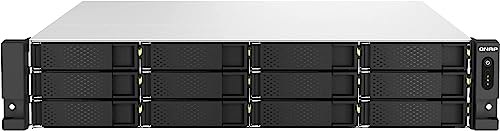
- 18-bay hybrid rackmount design with ZFS
- Xeon processing and up to 128GB ECC RAM
- Dual 10GbE plus PCIe Gen 4 expansion
Best For: Virtualization, intensive file access, and enterprise backup
Compact High-Availability Choice

- Eight-bay diskless rackmount NAS
- Up to 2,315 MB/s read performance
- Supports optional networking and SHA clustering
Best For: Space-constrained multi-user business environments
Balanced Business Workhorse

- 12-bay diskless rackmount chassis
- Dual 2.5GbE and two PCIe Gen3 slots
- Redundant PSU for business continuity
Best For: Growing SMB storage and backup deployments
Quiet ZFS Edge Server

- 12 hot-swap bays with 32GB ECC RAM
- Dual 10GbE and IPMI remote management
- Flexible TrueNAS protocols, plugins, and VMs
Best For: SMB, edge-office, backup, and media workloads
Compact Performance Pick

- 8-core Intel Atom CPU with expandable ECC-capable memory
- Dual 2.5GbE plus two M.2 NVMe slots
- Two PCIe slots for network or storage expansion
Best For: Compact business deployments needing flexible expansion
Enterprise Capacity Powerhouse
Synology RS3621xs+ 12-Bay NAS Bundle

- Xeon D-1541 CPU with 48GB ECC memory
- Includes twelve 16TB drives for 192TB capacity
- Dual 10GbE and four 1GbE ports with failover
Best For: High-capacity SMB and multi-user workloads
Ready-to-Deploy Business Value
Buffalo TeraStation 3430RN 32TB NAS

- Four included 8TB drives with preconfigured RAID 5
- Supports RAID 6, hybrid cloud, and iSCSI
- Includes rail kit, security tools, and three-year warranty
Best For: Small offices wanting simple, bundled rackmount storage
High-Throughput Pick

- Over 2,100/1,500 MB/s sequential read/write performance
- Dual 10GbE ports and ECC memory
- Expandable from 4 to 16 bays
Best For: Demanding business workloads and scalable storage
Ready-to-Deploy Capacity Pick
Buffalo TeraStation 5420RN 80TB

- Four included 20TB NAS-grade drives
- Native 10GbE and RAID flexibility
- Snapshots, encryption, and cloud integration
Best For: Turnkey business storage deployments
Short-Depth Networking Pick

- Short-depth four-bay rackmount design
- Dual 2.5GbE plus dual 10GbE networking
- Dual M.2 NVMe slots and expandable RAM
Best For: Compact business racks and flexible network upgrades
Enterprise ZFS Powerhouse – TS-h1887XU-RP-E2336
For demanding virtualization, backup, and data-intensive workloads, the QNAP TS-h1887XU-RP-E2336 is a high-performance rackmount NAS system with an Intel Xeon processor, ECC memory, ZFS storage, and substantial expansion potential. Its 18-bay hybrid design combines front-access drive capacity with dual 10GbE connectivity.
Best For: Enterprise teams running virtualization, intensive file access, large backups, and disaster-recovery workflows.
Pros:
- Intel Xeon E-2334 or E-2336 processor options deliver up to 4.8GHz burst speeds.
- ECC RAM is available in 16GB or 32GB configurations and supports upgrades up to 128GB.
- Dual 10GbE and dual 2.5GbE ports support fast transfers and demanding network workloads.
- PCIe Gen 4 slots, snapshots, and backup features support expansion and ransomware-aware recovery planning.
Cons:
- Its enterprise-oriented 2U rackmount design may be more capacity and hardware than smaller teams need.
- Drive bays are diskless, so storage media must be purchased separately.
Choose this QNAP when you need high-end processing, fast networking, ECC memory, and flexible ZFS-based storage in one rackmount platform. The three-year warranty adds useful support coverage for business deployments.
Compact High-Availability Choice – Synology RS1221+
The Synology RS1221+ is a compact eight-bay option for businesses seeking a high-performance rackmount NAS system without a deep chassis. It offers strong rated throughput, optional 5x network expansion, and support for pairing two units in a Synology High Availability cluster.
Best For: Multi-user business environments that prioritize compact rack depth and service availability.
Pros:
- Rated performance reaches up to 2,315 MB/s read and 1,147 MB/s write.
- Short 298 mm depth fits space-constrained rack installations.
- Optional PCIe SFP+ or RJ-45 networking can improve network performance by up to 5x.
- Two units can be configured as a Synology High Availability cluster with minute-level failover.
Cons:
- The eight-bay layout provides less drive capacity than the 12- and 18-bay alternatives here.
- The unit is diskless, and faster networking requires a separately selected compatible card.
The RS1221+ is a sensible fit where rack depth and uptime matter as much as raw capacity. Its expansion slot and High Availability support make it easier to build toward a more resilient deployment.
Balanced Business Workhorse – QNAP TS-1273AU-RP
QNAP TS-1273AU-RP-8G-US 12 Bay High-Performance Rackmount NAS with 2 x 2.5GbE Ports, Redundant PSU
Check Price On AmazonThe QNAP TS-1273AU-RP-8G-US balances 12-bay capacity with practical business connectivity, making it a flexible high-performance rackmount NAS system for growing server rooms. Its AMD Ryzen Embedded processor, dual 2.5GbE ports, PCIe expansion, and redundant power supply support everyday business storage needs.
Best For: Small and midsize businesses needing 12 bays, faster-than-gigabit networking, and power redundancy.
Pros:
- AMD Ryzen Embedded V1500B quad-core processor runs at 2.2GHz.
- Twelve 3.5-inch drive bays provide useful room for capacity expansion.
- Dual 2.5GbE ports improve connectivity over standard gigabit networking.
- Two PCIe Gen3 x4 slots allow additional expansion, while the redundant PSU supports resilience.
Cons:
- The included 8GB memory is expandable only up to 32GB.
- It is diskless, so the required drives add to the overall system cost.
This QNAP is a well-rounded choice for organizations that want substantial bay count and business-friendly redundancy without moving to the largest platform in the group. Its expansion slots leave room for future connectivity or application upgrades.
Quiet ZFS Edge Server – TrueNAS Mini R
The TrueNAS Mini R combines 12 hot-swap bays, ZFS-oriented storage capabilities, ECC memory, and dual 10GbE networking in a comparatively quiet rackmount design. It is a versatile high-performance rackmount NAS system for file sharing, backup, surveillance, media processing, and remote or edge deployments.
Best For: Small offices, SMBs, edge sites, and technical users who want flexible TrueNAS software and ZFS storage.
Pros:
- Eight-core 2.2GHz Intel Atom CPU and 32GB ECC RAM provide a solid foundation for storage services.
- Twelve 3.5-inch hot-swap SATA bays and built-in RAID support simplify storage management.
- Dual RJ45 10GbE ports and IPMI remote management suit performance and administration needs.
- Supports SSD caching, VMs, multiple file-sharing protocols, and integrations with cloud services.
Cons:
- The one-year hardware warranty is shorter than the three-year coverage listed for the other products.
- The system is diskless, so drives must be supplied separately.
- Its broad software and protocol feature set may require more hands-on administration than a simpler NAS.
The Mini R stands out for software flexibility and connectivity rather than just bay count. The included short rail kit makes it particularly practical for short racks, while TrueCommand support helps manage multiple TrueNAS systems.
Compact Performance Pick – QNAP TS-855eU-8G-US 8-Bay NAS
The QNAP TS-855eU-8G-US is a practical choice for teams seeking high-performance rackmount NAS systems in a short-depth 2U chassis. Its 8-core Intel Atom processor, expandable memory, dual 2.5GbE networking, NVMe support, and PCIe expansion slots provide a flexible foundation for file sharing and business applications.
Best For: Teams that need compact rackmount storage with flexible networking, caching, and expansion options.
Pros:
- 8-core Intel Atom C5125 processor with 8GB DDR4 RAM, expandable up to 64GB with ECC support.
- Dual 2.5GbE ports support faster file sharing and large transfers.
- Two M.2 PCIe Gen 3 x4 slots and two PCIe Gen 3 x4 slots enable storage and connectivity upgrades.
- Supports backup for Google Workspace and Microsoft 365 accounts through Boxafe.
Cons:
- Drives are not included, so storage must be purchased separately.
- Its 2.5GbE networking may be less suitable than 10GbE for the heaviest transfer workloads.
With its short-depth design and expansion flexibility, the TS-855eU-8G-US is well suited to businesses that want capable rackmount hardware without moving to a larger chassis. The diskless design also lets buyers configure storage around their own capacity and performance needs.
Enterprise Capacity Powerhouse – Synology RS3621xs+ 12-Bay NAS Bundle
The Synology RackStation RS3621xs+ is built for demanding organizations that need high-performance rackmount NAS systems with substantial included capacity. Its 12-bay chassis, Xeon processor, ECC memory, 192TB of included HDD storage, and dual 10GbE ports are aimed at multi-user workloads and data-sensitive environments.
Best For: Small and medium businesses managing large, multi-user data workloads that need high capacity and fast networking.
Pros:
- Eight-core Xeon D-1541 processor and 48GB DDR4 ECC UDIMM memory.
- Includes twelve 16TB SATA hard drives for 192TB of total storage.
- Dual 10GbE ports plus four 1GbE ports support link aggregation and failover.
- Btrfs and iSCSI LUN support provide storage-management and data-protection features.
Cons:
- Hard drives and memory upgrades require installation rather than arriving installed in the chassis.
- The 12-bay enterprise configuration may be more capacity than smaller offices need.
The RS3621xs+ stands out when capacity, ECC memory, and multi-user performance matter more than a compact footprint. Included rail hardware simplifies rack installation, while the 10GbE connectivity helps it serve demanding shared-storage workloads.
Ready-to-Deploy Business Value – Buffalo TeraStation 3430RN 32TB NAS
The Buffalo TeraStation 3430RN is a ready-to-deploy option for small offices comparing high-performance rackmount NAS systems with included storage. Its four pre-tested NAS-grade drives, preconfigured RAID, included rail kit, hybrid-cloud support, and business-focused security features simplify installation and ongoing administration.
Best For: Small businesses that want a preconfigured 4-bay rackmount NAS for up to 40 users.
Pros:
- Includes four 8TB NAS-grade hard drives and ships configured in RAID 5 for 24TB usable capacity.
- Supports RAID 6 for added redundancy or RAID 0 for the full 32TB capacity.
- Includes a rail kit and supports cloud synchronization with Dropbox, Microsoft OneDrive, and Amazon S3.
- Offers 256-bit drive encryption, two-factor authentication, and abnormal activity detection.
Cons:
- Its 2.5Gbps transfer rate and 5,400-rpm mechanical drives may not match faster enterprise storage systems.
- The four-bay design provides less expansion room than larger rackmount NAS models.
The TeraStation 3430RN emphasizes straightforward deployment and included hardware rather than maximum expansion. For a small office, its preconfigured RAID, security controls, support coverage, and three-year warranty make it a convenient business storage package.
High-Throughput Pick – Synology RS1626xs+
The Synology RS1626xs+ is a high-performance rackmount NAS system for demanding business workloads. Its built-in dual 10GbE connectivity, ECC memory, and strong sequential and random I/O figures make it well suited to teams handling large files, intensive applications, and frequent data operations.
Best For: Businesses and technical teams that need high throughput, advanced data protection, and room to expand beyond four drive bays.
Pros:
- Over 2,100/1,500 MB/s sequential read/write performance and more than 84,000 4K random write IOPS.
- Includes dual 10GbE RJ-45 ports for fast network transfers.
- Supports expansion to 16 bays with a Synology RX1225RP unit.
- Hot-swappable drive trays and fans support maintenance without downtime.
Cons:
- Expansion hardware is required to reach the 16-bay capacity.
- Its 1U rackmount design and enterprise-oriented feature set may be more than smaller offices need.
With Snapshot Replication, Hyper Backup, Active Backup Suite, and a five-year limited warranty, the RS1626xs+ is a strong choice when performance and infrastructure resilience matter as much as raw capacity.
Ready-to-Deploy Capacity Pick – Buffalo TeraStation 5420RN 80TB
The Buffalo TeraStation 5420RN is a high-performance rackmount NAS system that arrives with four 20TB NAS-grade hard drives installed. It combines native 10GbE networking with business-focused protection features, making it a practical option for organizations that want substantial storage without sourcing drives separately.
Best For: Businesses seeking an 80TB turnkey NAS with RAID options, snapshots, cloud integration, and included drive coverage.
Pros:
- Includes 80TB across four 20TB hard drives; RAID 5 provides 60TB usable capacity.
- Native 10GbE supports fast file transfers without a cable upgrade.
- 256-bit drive encryption, two-factor authentication, and snapshots support data protection.
- Supports Dropbox, Amazon S3, Microsoft Azure, and OneDrive integration.
Cons:
- The included 5,600 RPM drives may not suit every high-IOPS workload.
- RAID 5 capacity is lower than the advertised raw 80TB, while RAID changes involve trade-offs in redundancy or usable space.
Its included storage, RAID flexibility, snapshot recovery, and three-year warranty make the TeraStation 5420RN especially appealing for teams prioritizing deployment simplicity and built-in protection.
Short-Depth Networking Pick – QNAP TS-435XeU 4-Bay NAS
The QNAP TS-435XeU is a compact high-performance rackmount NAS system for teams that need flexible networking in a short-depth chassis. Its quad-core ARM processor, expandable memory, dual 2.5GbE ports, dual 10GbE connectivity, and M.2 NVMe slots provide a useful foundation for file sharing and accelerated storage.
Best For: Small businesses and teams that need a short-depth four-bay NAS with multiple high-speed network options and SSD caching support.
Pros:
- Dual 2.5GbE ports support faster file sharing and large transfers.
- Dual 10GbE networking provides a future-ready upgrade path.
- Two M.2 PCIe Gen 3 x1 NVMe slots can support cache acceleration or SSD storage pools.
- 4GB DDR4 RAM can be expanded up to 32GB.
Cons:
- Hard drives are not listed as included, so storage costs may be additional.
- Its ARM-based platform may be less suitable than higher-end systems for especially demanding workloads.
The TS-435XeU balances rack efficiency with strong connectivity and upgrade flexibility. Boxafe support for Google Workspace and Microsoft 365 backups further broadens its usefulness for modern business environments.
How We Picked the Best High-Performance Rackmount NAS Systems
We focused on the capabilities that matter most in demanding business and professional environments: drive-bay count, storage expandability, processor class, memory, network performance, redundancy, operating system features, chassis depth, and included accessories. The selection spans diskless systems for customized deployments and preconfigured models for faster installation.
We also considered workload flexibility. Some systems are better suited to virtualization and ZFS storage, while others emphasize straightforward file sharing, backup targets, iSCSI, surveillance, or small-business deployment. Because capacity, drives, and networking requirements vary widely, no single model is ideal for every rack.
Quick Comparison
| Priority | Look for | Best fit |
|---|---|---|
| Maximum capacity | 12 to 18 drive bays and expansion support | Growing businesses and storage-heavy teams |
| Virtualization | Xeon-class CPU, ample memory, ZFS, and fast networking | VMs, containers, and demanding applications |
| Network throughput | 10GbE or multiple high-speed Ethernet ports | Large media files and concurrent users |
| Simple deployment | Included hard drives and a business-focused OS | Small offices with limited IT staff |
| Space-constrained racks | Short-depth or compact 1U/2U chassis | Shallow cabinets and branch locations |
Key Buying Factors for High-Performance Rackmount NAS Systems
Capacity and RAID Planning
Count usable capacity rather than raw drive capacity. RAID level, filesystem overhead, hot spares, and future expansion all reduce available space. More bays provide better growth flexibility and can support separate pools for primary data, backups, and applications.
CPU, Memory, and Storage Architecture
A basic file server may not need a high-end processor, but virtualization, encryption, indexing, media processing, and multiple applications benefit from more cores and memory. ZFS-based systems typically reward additional RAM and careful planning for redundancy and snapshots.
Networking and Resilience
Choose 10GbE when several users move large files simultaneously or when the NAS hosts virtual machines. Link aggregation can improve availability and multi-client performance, but it does not replace a faster single connection. For business continuity, prioritize redundant power supplies, UPS compatibility, snapshots, replication, and tested backups.
Chassis Fit and Operating System
Verify rack depth, rail compatibility, airflow direction, noise tolerance, and power requirements before buying. Compare the management software as well: a polished platform can simplify permissions, backup jobs, alerts, containers, and remote administration.
Who Should Buy Which High-Performance Rackmount NAS Systems?
Choose a high-bay Xeon or ZFS model if you need virtualization, demanding shared storage, or substantial long-term expansion. Midrange 8- to 12-bay systems are a practical balance for offices that need performance and redundancy without moving to a large enterprise platform. Four-bay models work well for smaller teams, branch offices, and backup repositories, particularly when a compact chassis matters. Preconfigured Buffalo systems can reduce deployment effort, while diskless QNAP, Synology, and TrueNAS options offer greater control over drive selection and capacity planning.