Choosing among rackmount NAS systems means balancing drive capacity, network speed, rack depth, expandability, and management features. The right model can centralize files, backups, surveillance footage, and business applications without overbuying.
This roundup compares 10 current options, from compact short-depth appliances to higher-capacity systems built for demanding SMB workloads.
Best 10 Rackmount NAS Systems Picks for 2026
Best Overall
Synology RS1221+ 8-Bay RackStation

- Up to 2,315 MB/s read performance
- Compact 298 mm short-depth chassis
- Optional 5X network upgrade and HA clustering
Best For: Multi-user businesses needing scalable, high-availability storage
Best Compact Value
QNAP TS-433eU 1U Short-Depth NAS

- Short 11.51-inch chassis
- Dual 2.5GbE networking
- Boxafe cloud-account backup support
Best For: Small teams with limited rack space
Best for High-Speed Workloads

- Dual 10GbE ports with 20Gbps aggregate bandwidth
- Intel Core i3 and 8GB DDR5 memory
- Dual NVMe slots plus flexible RAID options
Best For: Performance-focused SMBs and media workloads
Best 8-Bay Connectivity

- Eight 3.5-inch SATA drive bays
- Two 10GbE SFP+ ports
- Two 2.5GbE ports and expandable RAM
Best For: SMBs needing high-capacity storage and flexible networking
Compact Network Essential

- 601/516 MB/s sequential read/write throughput
- Short 327.5 mm rackmount depth
- Dual 1GbE with optional 10GbE upgrade
Best For: Space-conscious small offices and server rooms
Short-Depth Performance Hub

- Intel quad-core CPU and 8GB RAM
- Dual 2.5GbE networking
- M.2 NVMe slots plus 4K HDMI
Best For: Teams needing fast transfers and flexible expansion
High-Speed Data Protection

- Over 2,100/1,500 MB/s sequential performance
- Dual built-in 10GbE RJ-45 ports
- Expandable from 4 to 16 bays
Best For: Intensive workloads and growth-focused business storage
High-Capacity Pick
QNAP TS-855eU-8G-US 8-Bay 2U Rackmount NAS

- Eight drive bays for larger storage deployments
- Dual 2.5GbE and dual M.2 NVMe slots
- Expandable memory and dual PCIe slots
Best For: Growing teams needing rack storage and expansion headroom
Flexible 4-Bay Pick
QNAP TS-435XeU-4G-US Short-Depth Rackmount NAS

- Short-depth four-bay rackmount design
- Dual 2.5GbE plus dual 10GbE networking
- Dual M.2 NVMe slots for cache or SSD pools
Best For: Compact racks needing fast, flexible networking
High-Speed Networking Pick
QNAP TS-432PXU-2G 4-Bay Rackmount NAS
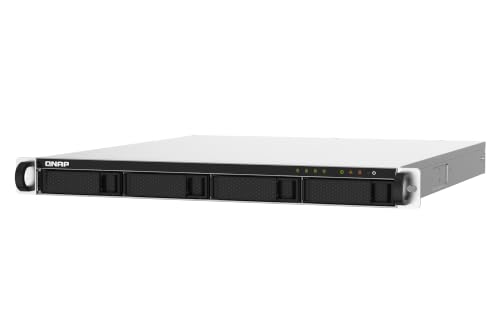
- Four 3.5-inch SATA bays
- Dual 2.5GbE and dual 10GbE SFP+ ports
- 2GB DDR4 RAM, expandable to 16GB
Best For: Four-bay deployments prioritizing high-speed wired networking
Best Overall – Synology RS1221+ 8-Bay RackStation
The Synology RS1221+ is a strong all-around choice among rackmount NAS systems for multi-user offices that need substantial throughput, compact installation depth, and dependable uptime options. It is diskless, so you can configure storage to match your capacity and RAID requirements.
Best For: Multi-user businesses seeking a compact 8-bay NAS with high performance and optional high availability.
Pros:
- Up to 2,315 MB/s read and 1,147 MB/s write performance
- Short 298 mm chassis depth for space-constrained racks
- Supports compatible PCIe SFP+ or RJ-45 cards for up to 5X improved network performance
- Can form a Synology High Availability cluster with a second unit
Cons:
- Diskless design requires separate drive purchases
- High-availability clustering requires a second compatible unit
With eight bays, a three-year warranty, and a short-depth metal enclosure, the RS1221+ balances capacity, speed, and deployment flexibility well for growing teams.
Best Compact Value – QNAP TS-433eU 1U Short-Depth NAS
The QNAP TS-433eU is a practical pick among rackmount NAS systems when rack space is limited and everyday team file sharing is the priority. Its 1U, 292.3 mm chassis and dual 2.5GbE ports suit smaller offices, edge deployments, and compact server racks.
Best For: Small teams that want affordable, short-depth network storage with faster-than-gigabit connectivity.
Pros:
- Compact 1U chassis measuring only 11.51 inches deep
- Dual 2.5GbE ports support 2.5G, 1G, and 100M connections
- 4GB DDR4 memory and a quad-core Cortex-A55 processor
- Boxafe supports backups of Google Workspace and Microsoft 365 accounts and files
Cons:
- Only four bays, providing less expansion room than 8-bay alternatives
- Diskless configuration requires separately purchased drives
This QNAP focuses on efficient edge storage and straightforward business backups rather than maximum capacity, making its compact footprint a central advantage.
Best for High-Speed Workloads – TERRAMASTER U4-500 4-Bay NAS
The TERRAMASTER U4-500 stands out among rackmount NAS systems for performance-focused SMBs, combining a 12th-generation Intel Core i3 processor, 8GB of DDR5 memory, dual NVMe slots, and dual 10GbE connectivity. Its four bays support flexible RAID and hybrid SSD/HDD configurations.
Best For: SMBs handling fast backups, 4K video production, virtualization, or demanding file transfers.
Pros:
- Six-core Intel Core i3-1215U processor with up to 4.4GHz turbo speed
- Dual 10GbE ports provide 20Gbps aggregate bandwidth
- Dual M.2 NVMe slots support Hyper Cache acceleration
- Supports RAID 0/1/5/6/10, TRAID, and TRAID+ configurations
Cons:
- Four bays offer less raw drive capacity than 8-bay systems
- Two-year warranty is shorter than several competing options listed
- Diskless enclosure requires separate storage purchases
With support for up to 96TB using four 24TB drives, Btrfs or EXT4, and an extensive backup suite, the U4-500 is tailored to users who can take advantage of its high-speed hardware.
Best 8-Bay Connectivity – QNAP TS-832PXU-4G NAS
The QNAP TS-832PXU-4G is a sensible choice among rackmount NAS systems for organizations that need eight drive bays and built-in high-speed networking. It combines two 10GbE SFP+ ports with two 2.5GbE ports, giving teams multiple options for fast file transfers and network deployment.
Best For: SMBs needing high-capacity rack storage with integrated 10GbE and 2.5GbE connectivity.
Pros:
- Eight 3.5-inch SATA drive bays support larger storage pools
- Two 10GbE SFP+ ports enable high-speed network connections
- Two 2.5GbE ports provide additional flexible connectivity
- 4GB DDR4 memory can be expanded to 16GB
Cons:
- Diskless configuration requires separate drives
- Quad-core ARM processor is less powerful on paper than the Intel-based option in this roundup
Its eight-bay layout and varied network ports make the TS-832PXU-4G a capacity-oriented option for businesses building a fast shared-storage environment without an included disk set.
Compact Network Essential – Synology RS422+
The Synology RS422+ is a practical choice for businesses seeking rackmount NAS systems in a compact, short-depth 4-bay design. It delivers over 601/516 MB/s sequential read/write throughput, while dual 1GbE ports support failover and load balancing.
Best For: Small offices and server rooms that need dependable, space-conscious network storage with room for a 10GbE upgrade.
Pros:
- Over 601/516 MB/s sequential read/write throughput
- Compact 327.5 mm depth with handles installed
- Dual 1GbE ports support network failover and load balancing
- Optional plug-and-play 10GbE RJ-45 network upgrades
Cons:
- Ships diskless, so drives must be purchased separately
- Built-in networking is 1GbE unless upgraded
With its metal enclosure, rack-mount form factor, three-year warranty, and upgradeable networking, the RS422+ offers a balanced foundation for everyday file storage and sharing.
Short-Depth Performance Hub – QNAP TS-464eU-8G
The QNAP TS-464eU-8G is a versatile 4-bay option for rackmount NAS systems, combining an Intel quad-core processor, 8GB of RAM, and dual 2.5GbE connectivity. Its short-depth 1U chassis is suited to installations where rack space is limited.
Best For: Teams that need faster-than-gigabit file sharing, NVMe cache options, and flexible USB or HDMI connectivity.
Pros:
- Intel quad-core CPU with burst speeds up to 2.9 GHz and 8GB RAM
- Dual 2.5GbE ports support faster file transfers
- Dual M.2 PCIe Gen 3 x1 slots support cache or SSD storage pools
- USB 3.2 Gen 2 ports and 4K HDMI output add flexibility
Cons:
- Ships diskless, requiring separate drive purchases
- HDMI output is limited to 4K at 30Hz
The TS-464eU-8G stands out for combining a short rackmount chassis with 2.5GbE networking, NVMe expansion, and multimedia features, making it a flexible choice for mixed office workloads.
High-Speed Data Protection – Synology RS1626xs+
The Synology RS1626xs+ is a high-performance 1U choice among rackmount NAS systems, with built-in dual 10GbE ports and more than 2,100/1,500 MB/s sequential read/write performance. It also supports expansion to 16 bays and includes hot-swappable trays and fans for easier maintenance.
Best For: Businesses handling intensive workloads that need high-speed networking, strong data-protection tools, and a path to larger storage capacity.
Pros:
- Over 2,100/1,500 MB/s sequential read/write performance
- Dual built-in 10GbE RJ-45 ports
- Expansion support up to 16 bays with an RX1225RP unit
- Hot-swappable trays and fans plus license-free protection tools
Cons:
- Higher-capacity expansion requires a separate RX1225RP unit
- At 29 pounds, it is heavier than more compact rackmount options
With 16GB of DDR4 ECC RDIMM memory, high I/O performance, Snapshot Replication, Hyper Backup, and Active Backup Suite, the RS1626xs+ is built for demanding storage environments where resilience matters.
High-Capacity Pick – QNAP TS-855eU-8G-US 8-Bay 2U Rackmount NAS
For teams needing substantial rack storage, the QNAP TS-855eU-8G-US is one of the more capable rackmount NAS systems in this lineup. It combines eight drive bays with an eight-core Intel Atom processor, 8GB of memory, dual 2.5GbE ports, and expansion options for networking, storage, or Fibre Channel connectivity.
Best For: Teams that need eight-bay capacity, faster-than-gigabit file sharing, and room for future expansion.
Pros:
- Eight-bay rackmount design supports larger storage deployments.
- Eight-core Intel Atom C5125 processor and 8GB DDR4 RAM, expandable to 64GB with ECC support.
- Dual 2.5GbE ports and dual M.2 NVMe slots support faster transfers and cache or SSD storage pools.
- Dual PCIe slots accommodate additional network, QM2, or Fibre Channel cards.
Cons:
- Diskless design requires separate drive purchases.
- The 2U chassis may require more rack space than compact rackmount models.
- Its broader expansion capability may be more than smaller deployments need.
Choose this model when capacity and upgrade flexibility matter more than minimizing rack space. Its eight bays, expandable memory, NVMe support, and PCIe slots give it a strong platform for growing teams and demanding file-sharing workloads.
Flexible 4-Bay Pick – QNAP TS-435XeU-4G-US Short-Depth Rackmount NAS
The QNAP TS-435XeU-4G-US is a practical choice for buyers seeking rackmount NAS systems without a full-depth chassis. Its four bays, short-depth design, dual 2.5GbE ports, and dual 10GbE connectivity make it suitable for compact racks that still need high-speed networking.
Best For: Small businesses and compact rack environments that need four-bay storage with 10GbE-ready networking.
Pros:
- Short-depth four-bay rackmount format fits space-conscious installations.
- Dual 2.5GbE ports support faster file sharing than standard gigabit networking.
- Dual 10GbE networking provides a future-ready connectivity option.
- Dual M.2 NVMe slots support cache acceleration or SSD storage pools.
Cons:
- Four bays provide less expansion capacity than eight-bay systems.
- Ships diskless, so storage drives are an additional purchase.
- The ARM-based quad-core processor and 4GB starting memory are less substantial than the higher-end eight-bay option.
This model balances rack efficiency and networking flexibility. It is especially appealing when a short chassis is important but the installation still benefits from dual 10GbE and NVMe support.
High-Speed Networking Pick – QNAP TS-432PXU-2G 4-Bay Rackmount NAS
The QNAP TS-432PXU-2G focuses on fast network connectivity in a four-bay rackmount chassis. It provides dual 2.5GbE ports and two 10GbE SFP+ ports, making it a useful option for rack environments where high-speed wired transfers are a priority.
Best For: Users who need four-bay rack storage with both 2.5GbE and 10GbE SFP+ connections.
Pros:
- Four 3.5-inch SATA drive bays support a straightforward rack storage setup.
- Two 2.5GbE ports support faster-than-gigabit network transfers.
- Two 10GbE SFP+ ports provide high-speed connectivity for compatible network infrastructure.
- Three-year warranty is included.
Cons:
- Only 2GB of DDR4 memory is included, with a listed maximum of 16GB.
- Ships diskless and requires separate SATA drive purchases.
- Its 1.7GHz quad-core ARM processor is more modest than the processor in the higher-end eight-bay model.
The TS-432PXU-2G is a focused choice for buyers who value network throughput over extensive expansion features. Its combination of 2.5GbE and dual 10GbE SFP+ ports makes it particularly compelling for existing high-speed network environments.
How We Picked These Rackmount NAS Systems
We selected these models to cover the main buying scenarios for rack-based storage: compact offices, growing businesses, media and backup workloads, and installations that need higher networking performance. We considered bay count, processor capability, memory, network connectivity, rack depth, expansion potential, software ecosystem, and ease of deployment.
Because most of these units are sold diskless, the comparison focuses on the NAS hardware and platform rather than included storage. Drive compatibility, RAID planning, and warranty terms should be verified before purchase.
Quick Comparison
| Priority | What to Look For | Best-Fit Models |
|---|---|---|
| Compact rack installation | 1U chassis and short depth | QNAP TS-433eU, TS-464eU, TS-435XeU |
| Four-drive capacity | Lower entry cost and efficient expansion | Synology RS422+, QNAP TS-432PXU |
| Eight-drive capacity | More usable space and flexible RAID layouts | Synology RS1221+, QNAP TS-832PXU, TS-855eU |
| High-speed networking | 10GbE or multiple faster network ports | QNAP TS-832PXU and TS-855eU |
| General-purpose performance | Stronger CPU and modern memory | TERRAMASTER U4-500 and Synology RS1626xs+ |
Key Buying Factors for Rackmount NAS Systems
Drive Bays and RAID Capacity
Four-bay units are often sufficient for departmental files, backups, and modest media libraries. Eight-bay systems provide more usable capacity and greater flexibility for RAID configurations, but they cost more to populate. Account for redundancy: RAID protects availability, not against accidental deletion, malware, or site loss, so maintain separate backups.
Rack Depth and Installation Space
Short-depth models are easier to install in shallow cabinets, wall-mounted racks, or crowded wiring closets. Confirm chassis depth, rail requirements, front and rear clearance, power connections, and ventilation before ordering. A standard 1U or 2U label does not guarantee compatibility with every cabinet.
Networking and Workload Performance
Gigabit Ethernet works for ordinary file sharing, but 2.5GbE, 10GbE, link aggregation, and multiple network ports can improve large transfers and support more concurrent users. Faster networking only helps when switches, cabling, client devices, and storage arrays can match it.
Software, Memory, and Expansion
Compare the operating system, snapshot support, cloud synchronization, surveillance licensing, container or virtualization support, and mobile administration tools. More memory and a stronger processor matter for encryption, indexing, databases, virtual machines, and multiple applications. Check whether RAM and network expansion are user-upgradable.
Who Should Buy Which Rackmount NAS Systems?
Choose a compact QNAP short-depth model if rack space is limited or you need practical storage for a small office. A four-bay Synology or QNAP is a sensible starting point for teams that want straightforward file sharing, backups, and redundancy without the cost of an eight-bay chassis.
Move to an eight-bay model when capacity growth, larger backup repositories, or more flexible RAID planning are priorities. Models with 10GbE are better suited to media teams, virtualization hosts, and workgroups moving large files. The TERRAMASTER U4-500 is worth considering when modern CPU performance and memory are more important than choosing the most established software ecosystem.
Before buying, estimate usable capacity after redundancy, leave room for growth, confirm drive support, and match the NAS to your switch and backup strategy. That approach will usually matter more than selecting the model with the highest raw specification.