The best high-performance USB power meters make charging behavior easier to understand. They can reveal voltage, current, power delivery, capacity, and cable or charger performance that ordinary battery indicators cannot show.
This roundup compares 10 USB testers spanning USB-C PD monitoring, USB-A measurement, dual-port designs, protocol support, capacity testing, and compact everyday diagnostics. Use the guide below to match features and measurement limits to your testing needs.
Best 10 High-Performance USB Power Meters Picks for 2026
High-Current Protocol Specialist

- Measures 4–30V and up to 12A
- Supports numerous fast-charging protocols
- Includes curve tracking and color display
Best For: Testing USB-C chargers, power banks, and fast-charging devices
High-Wattage USB-C Monitor
Plugable 240W USB-C Power Meter

- Monitors USB-C power up to 240W
- Supports bidirectional connections and EPR
- Passes through USB data and Alt Mode video
Best For: High-power USB-C laptops, docks, chargers, and accessories
Versatile USB-A Analyzer

- Measures 3.2–30V and up to 5A
- Offers seven display modes
- Adds dual outputs and safety alarms
Best For: USB-A chargers, power banks, solar panels, and battery testing
Compact 240W Future-Ready Meter

- Supports USB-C testing up to 240W
- Measures charging and discharge current
- Uses a compact metal shell and color display
Best For: USB-C phones, laptops, chargers, and power banks
Feature-Rich Pick

- Measures 3.2–30V and up to 5A
- Seven modes for voltage, current, power, and capacity
- USB-A/USB-C with PD and QC 3.0 support
Best For: Detailed charging and power-source monitoring
Rugged Professional Pick
Klein Tools ET920 USB Power Meter

- Measures up to 20V and 5A on USB-C
- Monitors energy, capacity, resistance, voltage, and current
- Stores 10 readings and has 6.6-foot drop protection
Best For: Technicians needing durable USB diagnostics
Simple Budget Pick
diymore USB Voltage and Current Tester
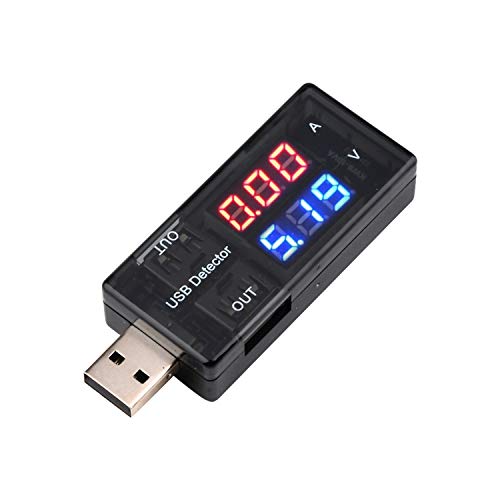
- Measures 3.0–7.5V and up to 2.5A
- Color display shows voltage and current clearly
- Compact plug-in design needs no separate power source
Best For: Basic USB charger and cable checks
Best All-Rounder

- 4–24V and 0–5A measurement range
- Tracks capacity, energy, impedance, and temperature
- Supports USB-A, USB-C, and common QC modes
Best For: Everyday charger, cable, and power-bank testing
Best High-Current USB-C Pick

- Measures 3.6–32V and up to 8A
- Supports PD, QC, and BC1.2 protocols
- Includes multiple display modes and safety protections
Best For: High-current USB-C charging diagnostics
Best Protocol Coverage

- Supports PD, QC 2.0/3.0/4.0, and MTK
- Rotating display with two-way insertion detection
- Visual alarms for temperature, voltage, and current
Best For: Multi-standard fast-charge testing
High-Current Protocol Specialist – KWS-2303C USB-C Power Meter
For shoppers comparing high-performance USB power meters, the KWS-2303C stands out with a 0–12A current range, 4–30V voltage range, and broad fast-charging protocol support. Its color display and curve function make it useful for checking charging behavior over time.
Best For: Electronics enthusiasts and digital-device users testing USB-C chargers, power banks, cables, and fast-charging performance.
Pros:
- Measures up to 12A and 30V.
- Supports PD, QC, FCP, SCP, AFC, DASH, VOOC, and Super VOOC protocols.
- Tracks voltage and current curves across selectable time periods.
- Displays voltage, current, power, capacity, energy, time, and other readings.
Cons:
- Designed around USB-C connections and compatible charging protocols.
- Its extensive features may be more than casual users need.
The KWS-2303C is a feature-rich choice when high current capacity and protocol detection matter. The included storage case is a useful addition for keeping the tester protected between measurements.
High-Wattage USB-C Monitor – Plugable 240W USB-C Power Meter
The Plugable USB C Power Meter is a strong candidate among high-performance USB power meters for modern laptops, docks, and chargers. It monitors USB-C connections up to 240W, supports bidirectional use, and preserves USB data and Alt Mode video pass-through.
Best For: Users checking high-power USB-C charging setups, docking stations, laptops, accessories, and chargers.
Pros:
- Monitors charging up to 240W with voltage and amperage readings.
- Supports 5–48V EPR voltage and up to 6.5A within its operating range.
- Provides USB data pass-through and USB-C Alt Mode video support.
- Compact design and reinforced USB-C connections improve portability and durability.
Cons:
- Not compatible with Thunderbolt 3 devices.
- It is focused on USB-C rather than USB-A connections.
With its high power rating, reversible connection, and readable OLED display, the Plugable is well suited to evaluating current USB-C ecosystems. Check the Thunderbolt 3 limitation before buying.
Versatile USB-A Analyzer – DROK 7-Mode USB Tester
The DROK USB Tester offers a practical way to monitor USB-A charging and power sources. It measures 3.2–30V and up to 5A, provides seven display modes, and adds dual USB outputs with PD and QC 3.0 support.
Best For: Users testing USB-A chargers, power banks, solar panels, battery chargers, and cables.
Pros:
- Displays voltage, current, power, and capacity in seven selectable modes.
- Supports 3.2–30V and up to 5A measurements.
- Dual USB outputs support PD and QC 3.0 fast charging.
- Includes over-voltage, under-voltage, over-current, and short-circuit alarms.
Cons:
- Uses USB-A rather than USB-C connections.
- Output II is for charging only and does not support data transfer.
This DROK model is a sensible choice for broad USB-A testing and straightforward readouts. Its one-button control keeps operation simple, while the alarm functions add useful protection when checking power sources.
Compact 240W Future-Ready Meter – ChargerLAB Power-Z C240
The ChargerLAB Power-Z C240 is a compact option for shoppers seeking high-performance USB power meters with current USB-C capabilities. It supports up to 240W, USB 2.0, bidirectional current testing, and a color display that shows key charging metrics.
Best For: Users testing USB-C phones, laptops, chargers, and power banks, including both charging and discharge scenarios.
Pros:
- Supports power testing up to 240W.
- Measures bidirectional current for charging and power-bank discharge tests.
- Displays voltage, current, power, direction, energy, timer, D+, D-, and CC data.
- Small metal housing is designed for portability and durability.
Cons:
- USB-A testing requires a separate USB-C-to-USB-A adapter.
- The manufacturer recommends a higher model for professional use or stricter accuracy requirements.
The C240 balances a high 240W rating with a compact metal design and useful bidirectional monitoring. It is particularly appealing for everyday USB-C testing, though demanding professional users may want to consider the recommended alternative.
Feature-Rich Pick – DROK 7-Mode USB Power Meter
For shoppers comparing high-performance USB power meters, the DROK stands out with broad measurement capability, a color display, and support for USB-A and USB-C connections. It measures 3.2–30V and up to 5A, while its seven display modes show voltage, current, power, and capacity during charging.
Best For: Monitoring chargers, power banks, solar panels, and other USB power sources where flexible readings and fast-charge protocol support are useful.
Pros:
- Seven display modes provide voltage, current, power, and capacity readings.
- Supports USB-A and USB-C input with dual USB 2.0 outputs.
- Works with PD and QC 3.0 fast-charge protocols and supports 3.2–30V, 0–5A testing.
- Includes over-voltage, under-voltage, over-current, and short-circuit alarms.
Cons:
- Some combined display modes cycle rather than remaining fixed.
- USB-C input with USB-A output requires a button press to start output.
The DROK is a versatile choice when you want more than basic voltage and current checks. Its wide range and capacity monitoring suit troubleshooting and charging analysis, though the controls and cycling modes may require a brief learning period.
Rugged Professional Pick – Klein Tools ET920 USB Power Meter
The Klein Tools ET920 is a strong option among high-performance USB power meters for users who want extended monitoring and stored readings. It measures voltage, current, charge delivered, energy, and calculated resistance, with USB-A and USB-C current ranges suited to common ports and Qualcomm Quick Charge devices.
Best For: Technicians and DIY users who need durable, repeatable USB measurements and the ability to review previous readings.
Pros:
- Measures 3–20V DC, with current ranges up to 3A on USB-A and 5A on USB-C.
- Monitors capacity, energy, resistance, voltage, and current for up to 1,000 hours.
- Stores and recalls up to 10 readings for comparison.
- Rugged pocket-sized design includes 6.6-foot drop protection.
Cons:
- Its voltage range is narrower than meters designed for higher-voltage applications.
- Resistance is calculated rather than directly measured.
The ET920 balances measurement depth with jobsite durability. Its data storage and long monitoring duration are particularly useful for troubleshooting, while the 3–20V range keeps it focused on common USB applications.
Simple Budget Pick – diymore USB Voltage and Current Tester
The diymore tester offers a straightforward entry point for shoppers seeking high-performance USB power meters for basic charger and cable checks. Its color LED display shows voltage and current clearly, while the compact plug-in design requires no separate battery or setup.
Best For: Quick testing of USB chargers, phone charging equipment, cables, and other USB-powered devices.
Pros:
- Displays voltage and current simultaneously with contrasting colors.
- Measures 3.0–7.5V and up to 2.5A.
- Compact plug-in design starts measuring immediately.
- Designed for stable readings with stated anti-interference performance.
Cons:
- Does not provide the broader voltage range or advanced capacity features of the other meters.
- Listed as a USB-A tester, limiting connection flexibility.
The diymore is best suited to everyday USB troubleshooting rather than advanced power analysis. Its simple operation and readable display make it practical for checking whether a charger or port is delivering expected voltage and current.
Best All-Rounder – DROK USB Power Meter
The DROK is a versatile choice among high-performance USB power meters, combining USB-A and USB-C testing with broad 4–24V and 0–5A measurement ranges. Its color display tracks charging data, capacity, energy, impedance, and temperature in real time.
Best For: Users testing chargers, cables, smartphones, tablets, and power banks across common fast-charging standards.
Pros:
- Measures voltage, current, capacity, energy, impedance, power, and temperature.
- Supports QC 2.0/3.0, Apple charging modes, Android DCP, and Samsung protocols.
- Rotating 1.44-inch color LCD improves readability during testing.
- Works with compatible DROK load testers for output testing.
Cons:
- Current measurement is limited to 5A.
- Fast-charge protocol identification is for reference and may not reflect newer phone updates.
- Does not support Bluetooth connectivity.
With its broad measurement functions and readable rotating display, this DROK model is a practical general-purpose tester for USB charging diagnostics.
Best High-Current USB-C Pick – YOJOCK USB C Tester
For demanding USB-C diagnostics, the YOJOCK stands out among high-performance USB power meters with a 3.6–32V range and current measurement up to 8A. Its IPS display offers multiple viewing interfaces, while built-in protections add reassurance during testing.
Best For: USB-C users checking PD and QC chargers, power banks, cables, and higher-current charging setups.
Pros:
- Measures up to 32V and 8A, exceeding many compact USB testers.
- Tracks voltage, current, capacity, energy, power, temperature, resistance, and charging time.
- Supports PD 2.0/3.0, QC 2.0/3.0, BC1.2, and USB-A or USB-C connections.
- Includes over-voltage, over-current, under-voltage, and low-energy protection.
Cons:
- Power-bank capacity testing requires a full charge, data reset, and continuous discharge setup.
- Capacity calculations vary with the discharge voltage.
- Its strongest compatibility focus is USB-C and supported fast-charge protocols.
The YOJOCK is a strong fit when higher current capacity, USB-C compatibility, and safety protections matter more than a minimal tester design.
Best Protocol Coverage – MakerHawk USB Multimeter
The MakerHawk combines a compact form with broad fast-charge support, making it a useful option among high-performance USB power meters. It adds two-way insertion detection, a rotating 1.44-inch display, and alerts for temperature, voltage, and current conditions.
Best For: Users comparing USB chargers, power banks, cables, computers, and Type-C PD or QC charging equipment.
Pros:
- Supports Type-C PD plus QC 2.0, 3.0, and 4.0, along with MTK protocols.
- Two-way insertion detection indicates current direction.
- 360-degree screen rotation supports viewing from different connection angles.
- Temperature, voltage, and current alerts provide quick visual warnings.
Cons:
- The voltage alarm flashes below 3.8V or above 30V, and the current alarm flashes above 3A.
- Type-C PD testing may require reversing the connector when the screen does not turn on.
- The supplied notes do not specify capacity, energy, or resistance measurement ranges.
Its protocol support and visual alerts make the MakerHawk especially appealing for users who frequently evaluate fast-charging hardware from multiple standards.
How We Picked These High-Performance USB Power Meters
We focused on meters that provide useful electrical readings rather than simple charging indicators. The selection covers USB-A and USB-C compatibility, voltage and current measurement, power or energy displays, battery-capacity testing, and support for modern charging standards such as USB Power Delivery and Quick Charge.
We also considered practical differences between models: maximum voltage and current, stated wattage limits, display readability, measurement modes, connector layout, portability, and whether the meter is better suited to occasional troubleshooting or repeated bench testing. Always verify the manufacturer’s specifications before testing a setup near its maximum rating.
Quick Comparison
| Best For | Look For | Why It Matters |
|---|---|---|
| USB-C laptop and PD testing | Up to 240W and PD3.1 support | Handles higher-power modern chargers and devices |
| Basic charger or cable checks | Voltage, current, and power readings | Quickly identifies obvious charging problems |
| Battery capacity testing | Capacity, energy, and elapsed measurement modes | Helps compare power banks and rechargeable devices |
| Mixed USB equipment | USB-A and USB-C compatibility | Reduces the need for separate testers |
| Portable troubleshooting | Compact design and clear display | Makes field checks faster and easier |
Key Buying Factors for High-Performance USB Power Meters
Voltage, Current, and Wattage Range
Choose a meter with comfortable headroom above your intended load. A tester rated for higher current and power is generally more suitable for USB-C laptop chargers, while a lower-range model may be adequate for phones, accessories, and power banks.
Connector and Protocol Support
USB-C PD testing requires more than a USB-C-shaped plug. Look for support appropriate to your equipment, including PD3.0 or PD3.1 and other listed fast-charging standards. USB-A compatibility remains useful for older chargers and accessories.
Measurement Functions
Voltage and current are the essentials, but capacity, energy, resistance, elapsed time, and peak readings can make a tester much more useful. Multiple display modes are valuable when comparing cables, chargers, and batteries.
Display and Usability
A color or backlit display can be easier to read, especially when several values are shown at once. Consider viewing angle, button controls, connector orientation, and whether the meter can remain inline without stressing a cable or port.
Who Should Buy Which High-Performance USB Power Meters?
Choose a high-power USB-C tester with broad PD support if you test laptop chargers, docks, power banks, or high-wattage cables. A compact USB-A/USB-C meter is the better all-around choice for household troubleshooting and mixed-device use.
For power-bank comparisons, prioritize capacity and energy modes over headline wattage alone. Makers and repair users may prefer a model with more measurement screens, wider ranges, and protocol visibility. If you only need to confirm whether a charger is delivering expected voltage and current, a simpler meter can save money and be easier to operate.