Premium USB power meters make it easier to verify charging speed, measure voltage and current, and troubleshoot USB-C power delivery problems with real-time data.
We selected 10 standout testers covering high-wattage USB-C systems, USB-A devices, E-Marker detection, portable diagnostics, and everyday charger checks.
Best 10 Premium USB Power Meters Picks for 2026
Top Premium USB Power Meter

- PD3.2 support with up to 240W PD measurement
- E-marker, PDO, capacity, and protocol testing
- Large rotating display with PC analysis support
Best For: Advanced USB-C charging and protocol analysis
Most Versatile Premium USB Power Meter

- USB-A, Micro-USB, and USB-C interfaces
- Broad fast-charge protocol detection and triggering
- Graphs, ripple monitoring, and app/PC recording
Best For: Multi-port charging diagnostics and protocol testing
Best Plug-and-Read Premium USB Power Meter

- Monitors USB-C connections up to 240W
- Bidirectional design with readable OLED display
- Passes USB data and USB-C Alt Mode video
Best For: Straightforward high-power USB-C monitoring
Best Budget-Friendly Premium USB Power Meter

- Seven display modes for voltage, current, power, and capacity
- Dual USB-A outputs with PD/QC 3.0 support
- Built-in electrical fault alarms
Best For: Everyday USB-A charging and power-bank testing
Protocol-Savvy Tester
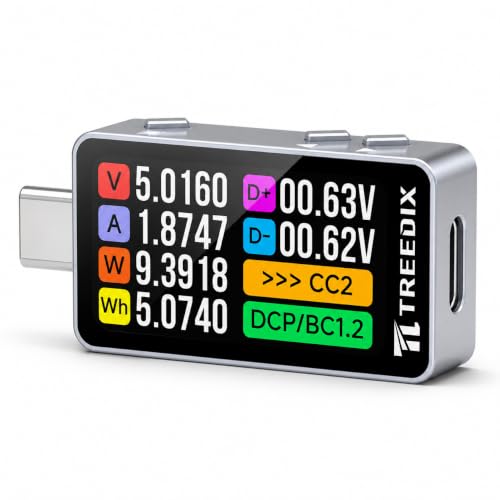
- ±1% accuracy with 4–32V and 0–6A measurement
- Detects major PD, QC, AFC, and other protocols
- Reads E-Marker cable information and plots power curves
Best For: Detailed USB-C charger, cable, and power-bank testing
Professional EPR Diagnostic Tool

- Measures up to 50V and 6.5A in either direction
- Supports USB PD 3.1 EPR up to 240W
- Passes USB 10Gbps data and DP Alt Mode
Best For: IT and high-power USB-C troubleshooting
Compact High-Power Monitor

- Tests USB-C systems up to 240W
- Measures bidirectional charging and discharge
- Small metal-bodied tester with color display
Best For: Portable USB-C charger and power-bank monitoring
Advanced Lab Tester

- 0–26V and 0–6A measurement
- Fast-charge protocol triggering
- PC logging, ripple viewing, and Lua support
Best For: Advanced electronics testing and charger diagnosis
High-Current Type-C Pick

- Measures 4–30V and up to 12A
- Supports multiple USB-C fast-charge protocols
- Records voltage and current curves
Best For: Higher-current USB-C charger and power-bank testing
Everyday Type-C Monitor

- Measures 3.6–32V and up to 8A
- Tracks capacity, power, temperature, and resistance
- Includes USB-A/USB-C support and safety protections
Best For: Routine charger, cable, and power-bank testing
Top Premium USB Power Meter – ChargerLAB KM003C
For buyers seeking premium USB power meters, the ChargerLAB POWER-Z KM003C is a USB-C-focused tester built for detailed charging analysis. Its large display, broad measurement range, and PC software support make it suitable for troubleshooting modern high-power USB-C equipment.
Best For: USB-C protocol analysis, high-power chargers, power banks, cables, and professional troubleshooting.
Pros:
- Supports PD3.2 and measures up to 50V and 6A, with up to 240W in PD use.
- Performs voltage, current, capacity, energy, E-marker, PDO, and protocol tests.
- Uses a 1.54-inch rotating display and supports PC data analysis.
Cons:
- Designed for USB-C, so it is less suitable for USB-A-only setups.
- Advanced features may require downloading the manual and PC software.
The KM003C stands out among premium USB power meters when protocol visibility and high-power USB-C testing matter more than basic plug-and-read measurements.
Most Versatile Premium USB Power Meter – FNIRSI FNB58 USB Tester
The FNIRSI FNB58 is one of the more versatile premium USB power meters for shoppers who need multi-port testing and fast-charge protocol coverage. It combines a color TFT display with app and PC features for monitoring, triggering, and recording charging behavior.
Best For: Multi-port testing, fast-charge protocol detection, cable checks, ripple monitoring, and parameter recording.
Pros:
- Includes USB-A, Micro-USB, and USB-C interfaces with a 2-inch TFT display.
- Supports PD, QC, FCP/SCP, AFC, VOOC/WARP, Super VOOC, and other protocols.
- Measures voltage, current, power, resistance, capacity, ripple, and cable data.
Cons:
- Does not include a printed manual; documentation is accessed through the package QR code.
- Incorrect port or protocol settings can cause the tester to default to 5V.
- Its upper temperature rating is 40°C.
Choose the FNB58 if you want a feature-rich premium USB power meter that covers more connector types and charging standards than a basic USB-C monitor.
Best Plug-and-Read Premium USB Power Meter – Plugable 240W USB-C Tester
The Plugable USB-C Power Meter is a practical choice among premium USB power meters for monitoring high-power USB-C connections without adding complicated software. Its bidirectional design, updated OLED, and data pass-through make it useful across chargers, cables, docks, and compatible devices.
Best For: Simple USB-C power monitoring, 240W charging setups, docks, chargers, and USB-C cable checks.
Pros:
- Monitors USB-C power up to 240W across a 4.5V–50V and 50mA–6.5A operating range.
- Works in either orientation and includes a screen-rotation button.
- Supports USB data pass-through and USB-C Alt Mode video.
Cons:
- Not compatible with Thunderbolt 3 devices.
- Focuses on voltage, amperage, and power flow rather than advanced protocol analysis.
The Plugable meter is a strong fit for buyers who want durable, straightforward USB-C measurements and broad connection compatibility instead of a lab-style feature set.
Best Budget-Friendly Premium USB Power Meter – DROK USB-A Tester
The DROK USB Tester offers a simpler, USB-A-based approach to premium USB power meters. Its seven display modes, dual outputs, and built-in alarms provide convenient visibility into voltage, current, power, and capacity for everyday charging and low-voltage power projects.
Best For: USB-A chargers, power banks, solar panels, battery chargers, and basic capacity or charging checks.
Pros:
- Displays voltage, current, power, and capacity through seven selectable modes.
- Supports USB-A input and dual USB 2.0 outputs, with PD/QC 3.0 identification.
- Includes over-voltage, under-voltage, over-current, and short-circuit alarms.
Cons:
- Its USB-A design is less suitable for newer high-power USB-C systems.
- Measures up to 30V and 5A, below the range of the USB-C models here.
- One output is for charging only and does not support data transfer.
For basic USB-A monitoring, the DROK is an accessible premium USB power meter alternative with useful safeguards and an easy one-button interface.
Protocol-Savvy Tester – Treedix USB-C Power Meter
For shoppers comparing premium USB power meters, the Treedix USB-C Tester stands out for broad protocol support and detailed cable diagnostics. It measures 4–32V and 0–6A, with up to ±1% accuracy, while its color display tracks voltage, current, power, capacity, energy, and operating time.
Best For: Users who want detailed USB-C charger, cable, fast-charging protocol, and power-bank testing.
Pros:
- Supports PD2.0, PD3.0, PD3.1 Fixed, AVS, EPR, QC2.0/3.0, FCP, and AFC detection.
- Reads compatible E-Marker cable details, including rated voltage, current, data rate, and cable type.
- Offers dynamic voltage and current curves plus power-off data storage.
- Measures up to 32V and 6A, with 10A maximum current noted in the product details.
Cons:
- Its broad feature set may be more than casual users need.
- The listed operating range begins at 4V, so it is not intended for lower-voltage testing.
This is a feature-rich choice for troubleshooting modern USB-C charging systems, especially when cable identification and protocol detection matter as much as basic voltage and current readings.
Professional EPR Diagnostic Tool – StarTech USB-C Power Tester
The StarTech USB-C Power Tester is one of the more capable premium USB power meters for high-power USB-C troubleshooting. Its bi-directional design measures voltage, current, and wattage up to 50V and 6.5A, while supporting USB PD 3.1 EPR applications up to 240W.
Best For: IT professionals testing USB-C docks, chargers, hubs, cables, and high-power devices.
Pros:
- Supports USB Power Delivery 3.1 EPR up to 240W.
- Bi-directional measurement works for power flow in either direction.
- 180-degree display rotation improves readability in different setups.
- Passes USB data up to 10Gbps, including DP Alt Mode video.
Cons:
- It is not compatible with Thunderbolt 3 devices.
- It provides a focused digital readout rather than the broader curve and cable-information features of some testers.
With its wide measurement range, reversible readings, data pass-through, and two-year warranty, this is a practical professional tester for diagnosing USB-C power and port issues without interrupting supported data functions.
Compact High-Power Monitor – ChargerLAB Power-Z C240
The ChargerLAB Power-Z C240 is a compact option for shoppers seeking premium USB power meters that can handle current-generation charging hardware. It supports testing up to 240W and displays voltage, current, power, energy, timer, current direction, and USB-C signaling information on a color screen.
Best For: USB-C users who need portable bidirectional testing for chargers, laptops, phones, and power banks.
Pros:
- Supports up to 240W and USB PD 3.1 and QC5.0 testing.
- Bidirectional current measurement covers both charger output and power-bank discharge.
- Compact 11.61-gram design with a durable metal shell.
- Color display shows voltage, current, power, energy, timer, D+/D−, and CC data.
Cons:
- USB 2.0 is supported, rather than higher-speed USB data pass-through.
- A USB-C-to-USB-A adapter is required for testing USB-A devices and is not included.
- The manufacturer recommends the KM003C for professional use or higher data-accuracy requirements.
The C240 balances high-power capability with a small, rugged design. It is a strong everyday choice for monitoring USB-C charging and power-bank behavior, provided you do not need advanced high-speed data testing.
Advanced Lab Tester – Programmable USB Power Meter
For demanding electronics work, this premium USB power meter combines 0–26V and 0–6A measurement with fast-charge protocol testing, data logging, and programmable control. Its high-resolution display and PC-connected tools make it suited to detailed charger and device diagnosis.
Best For: Advanced electronics enthusiasts, developers, and technicians who need protocol triggering, ripple analysis, or custom Lua scripts.
Pros:
- Measures voltage up to 26V and current up to 6A with stated 0.1% maximum gain error.
- Supports PD with PPS, QC 2.0–4.0, Huawei, Samsung, VOOC, and other fast-charge protocols.
- Offers up to 1000 samples per second of data logging, a 3.2Msps ripple viewer, and Lua programmability.
- Includes capacity and energy accumulation alongside its 1.77-inch TFT display.
Cons:
- Its extensive programmable and PC-based features may be more than casual users need.
- Current measurement is limited to 6A, below some higher-current USB testers.
This is the most technically capable option in the group, particularly for repeatable bench testing and diagnostics. Choose it when programmability and signal-level analysis matter more than simple plug-and-check readings.
High-Current Type-C Pick – 12A USB-C Power Meter
This premium USB power meter is a practical choice for USB-C testing where a broad voltage range and higher current capacity are priorities. It measures 4–30V and up to 12A, while its color display and curve function help track charging behavior over time.
Best For: USB-C users, digital enthusiasts, and testers evaluating chargers, power banks, cables, and other Type-C devices.
Pros:
- Provides a 4–30V measurement range and supports current measurement up to 12A.
- Detects PD 2.0/3.0, QC 2.0/3.0, FCP, SCP, AFC, PE, DASH, VOOC, and Super VOOC protocols.
- Curve views can record voltage and current over selectable 5-minute to 2-hour periods.
- Displays power, capacity, energy, time, maximum readings, current direction, and CPU temperature.
Cons:
- The stated measurement accuracy is ±(1%+5), less precise than the most specialized lab-oriented option here.
- Designed around USB-C connections rather than broad general-purpose USB testing.
Its standout advantage is the 12A terminal, making it the strongest fit for higher-current Type-C measurements. The curve function also adds useful context when a single instantaneous reading is not enough.
Everyday Type-C Monitor – YOJOCK USB Power Meter
For everyday charging checks, this premium USB power meter covers voltage, current, power, capacity, temperature, resistance, and charging time in a compact Type-C tester. Its 3.6–32V range, color display, OTG adapter, and built-in protections make it versatile for common USB and USB-C devices.
Best For: Home users and electronics enthusiasts checking chargers, cables, power banks, and Type-C devices.
Pros:
- Measures 3.6–32V and up to 8A while tracking capacity, energy, power, temperature, and resistance.
- Offers eight IPS color display interfaces with a larger-font viewing mode.
- Supports PD 2.0/3.0, QC 2.0/3.0, BC1.2, and USB-A or USB-C connections with the included OTG adapter.
- Includes over-voltage, over-current, under-voltage, and low-energy protection.
Cons:
- Its 8A current ceiling is lower than the 12A capacity of the KWS-2303C.
- Advanced PC logging, ripple viewing, and Lua programming are not listed among its features.
This is a well-rounded monitor for routine charging diagnostics and power-bank capacity checks. It offers more measurement categories and protective functions than a basic meter without focusing on advanced programmable analysis.
How We Picked the Best Premium USB Power Meters
We focused on measurement range, supported charging standards, connector compatibility, display clarity, portability, and the practical features that help users diagnose real charging setups. Models supporting USB Power Delivery, USB-C, QC, E-Marker reading, or high-wattage testing received particular attention. We also considered whether each tester suits routine checks, electronics work, battery testing, or professional troubleshooting.
Specifications can vary by connection type and test conditions, so treat maximum voltage, current, and wattage ratings as limits rather than guaranteed performance in every configuration.
Quick Comparison
| Best For | Look For |
|---|---|
| USB-C laptop and high-power chargers | PD 3.1 support and ratings up to 240W |
| Protocol and cable diagnostics | E-Marker reading and PD/QC detection |
| General USB-A testing | Dual ports, readable display, and multiple modes |
| Portable troubleshooting | Compact design, broad voltage range, and simple controls |
| Advanced electronics work | Higher current capacity, data logging, or programmable features |
Key Buying Factors for Premium USB Power Meters
Voltage, Current, and Wattage Range
Choose a meter with headroom above your intended load. Basic phone testing may require only a modest range, while USB-C laptops, power stations, and modern chargers benefit from support for 28V or more and high current limits. A 240W rating is useful for newer USB-C PD 3.1 equipment, but it does not make every setup deliver 240W.
Protocols and E-Marker Support
PD, QC, and E-Marker features help identify how a charger, cable, and device negotiate power. If you troubleshoot USB-C cables or multi-standard chargers, protocol visibility is often more valuable than a basic voltage-and-current readout.
Connector Layout and Compatibility
Check whether the meter supports USB-C, USB-A, or both, and confirm its orientation and pass-through design fit your cables. Some testers are optimized for USB-C laptops and chargers, while others are more convenient for legacy USB-A accessories and power banks.
Display and Measurement Features
A color screen, multiple readout modes, accumulated capacity, peak values, and live wattage can make testing faster. Advanced users may also value data logging, calibration options, or programmable load-related functions.
Who Should Buy Which Premium USB Power Meters?
Choose a high-wattage USB-C tester if you work with laptops, docks, GaN chargers, or USB-C power stations. A model with E-Marker and protocol analysis is the better choice for cable validation and charging-negotiation problems. For simple power-bank, phone, and USB-A checks, a multi-mode tester with a clear display offers the best value. Electronics hobbyists and repair technicians should prioritize broad measurement ranges, stronger current handling, detailed readings, and advanced diagnostic controls.
Before buying, match the tester’s maximum ratings and connector design to your equipment. The best Premium USB Power Meters are the ones that provide useful diagnostics without becoming more complicated than your testing needs require.