The right USB power meter makes charging problems easier to diagnose. These compact testers can reveal voltage, current draw, power delivery, and—in some cases—cumulative capacity without relying on guesswork.
We selected 10 portable USB power meters covering USB-A and USB-C connections, USB Power Delivery testing, color displays, battery-capacity measurements, and higher-power charging setups.
Best 10 Portable USB Power Meters Picks for 2026
Best Rugged Option
Klein Tools ET920 USB Power Meter

- USB-A and USB-C testing
- Stores up to 10 readings
- 6.6-foot drop protection
Best For: Jobsite and workshop USB diagnostics
Best High-Power USB-C Meter

- Monitors charging up to 240W
- Bidirectional USB-C connection
- Data and Alt Mode pass-through
Best For: High-power USB-C chargers and laptops
Best Display Flexibility

- Eight color display interfaces
- Measures up to 30V and 5.1A
- Includes multiple protection features
Best For: Detailed USB-C charger and power-bank testing
Best Dual-Port Monitor

- USB-A and USB-C inputs
- Seven display modes
- PD and QC 3.0 support
Best For: Mixed-port charger, power-bank, and solar testing
Best Compact USB-A Tester
Simple Voltage and Current Meter
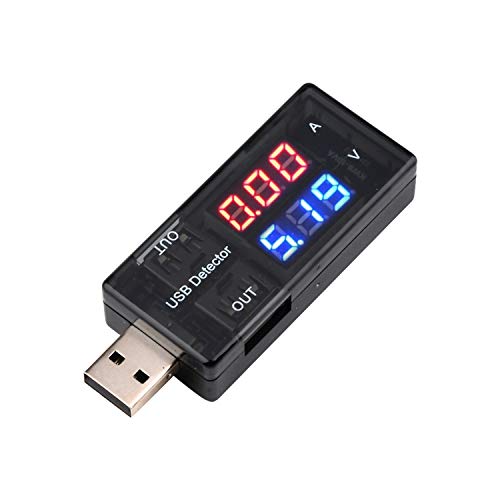
- Measures 3.0–7.5V and 0–2.5A
- Large color-coded voltage/current display
- Compact, plug-in USB-A design
Best For: Basic USB-A charger and cable checks
Best Multifunction USB Power Meter

- Measures voltage, current, power, and capacity
- Supports 3.2–30V and up to 5A
- Dual outputs support PD and QC 3.0
Best For: Detailed charger, power-bank, and solar-panel testing
Best USB-C Protocol Tester

- Supports PD, QC 2.0/3.0/4.0, and MTK
- Rotating 1.44-inch LCD for flexible viewing
- Temperature, voltage, and current alerts
Best For: USB-C fast-charge and protocol troubleshooting
High-Current Choice

- Measures 4–30V and up to 12A
- Supports multiple fast-charging protocols
- Includes color display and curve monitoring
Best For: Higher-current USB-C testing and charging diagnostics
Protected Dual-Port Pick

- Measures 3.6–32V and up to 8A
- Works with USB-A and USB-C setups
- Adds protective cutoff and capacity testing
Best For: General charger, cable, and power-bank testing
Feature-Rich Value Pick

- Measures voltage, current, power, and capacity
- Adds resistance, temperature, and time readings
- Includes USB-A adapter and safety protections
Best For: Multifunctional everyday charging diagnostics
Best Rugged Option – Klein Tools ET920 USB Power Meter
The Klein Tools ET920 is a practical choice among portable USB power meters for users who want broad USB-A and USB-C testing in a durable, pocket-sized design. It measures voltage, current, capacity, energy, and calculated resistance, while supporting extended monitoring and stored readings.
Best For: Jobsite troubleshooting, USB-A and USB-C testing, and users who want rugged construction with data storage.
Pros:
- Measures 3–20V DC and up to 3A through USB-A or 5A through USB-C.
- Monitors voltage, current, capacity, energy, and calculated resistance for up to 1,000 hours.
- Stores and recalls up to 10 readings.
- Includes overload detection, a high-resolution LCD, and 6.6-foot drop protection.
Cons:
- Its current and voltage ranges are narrower than those of the high-power USB-C tester in this roundup.
- Resistance is calculated rather than directly measured.
The ET920 stands out when durability and flexible everyday USB diagnostics matter. Its dual-connector support and memory functions make it especially useful for repeated comparisons in field or workshop settings.
Best High-Power USB-C Meter – Plugable USB C Power Meter
The Plugable USB C Power Meter is one of the more capable portable USB power meters for monitoring modern USB-C charging. It supports power measurements up to 240W, displays current direction, and passes through USB data and USB-C Alt Mode video.
Best For: High-power USB-C chargers, laptops, docking stations, and users who need bidirectional testing.
Pros:
- Monitors USB-C power and charging up to 240W.
- Supports EPR voltage from 5–48V with a stated operating range of 4.5–50V and 50mA–6.5A.
- Works bidirectionally and includes a screen-rotation button.
- Supports USB data pass-through and USB-C Alt Mode video.
Cons:
- It is not compatible with Thunderbolt 3 devices.
- It is designed for USB-C rather than USB-A connections.
Choose the Plugable when your testing involves higher-wattage USB-C equipment. Its compact, reinforced design also fits many phones and tablets without removing protective cases.
Best Display Flexibility – Eversame 2-in-1 USB-C Tester
The Eversame 2-in-1 USB-C tester is a feature-rich option among portable USB power meters, combining a color display with broad charging diagnostics. It measures voltage, current, capacity, energy, power, load impedance, and D+/D− voltage across multiple display modes.
Best For: Testing USB-C chargers, cables, power banks, wireless chargers, and quick-charging devices.
Pros:
- Measures 3.6–30V DC and up to 5.1A.
- Supports QC3.0, QC2.0, BC1.2, and PD quick-charging measurement.
- Offers eight color-screen interfaces for monitoring multiple readings.
- Includes over-voltage, over-current, under-voltage, low-energy protection, and an alarm system.
Cons:
- Some USB-C PD setups may require the included small adapter to trigger charging.
- The supplied notes identify it primarily as a USB-C tester, limiting connector versatility.
The Eversame is a strong fit for users who want more than basic voltage and current readings. Its safety features and broad measurement set are useful for comparing chargers and checking power-bank performance.
Best Dual-Port Monitor – DROK USB Tester
The DROK USB Tester is a versatile pick among portable USB power meters for monitoring chargers, power banks, laptops, and solar-panel setups. Its USB-A and USB-C inputs, dual USB outputs, color display, and seven viewing modes make everyday testing straightforward.
Best For: Users who need USB-A and USB-C connectivity, fast-charge support, and capacity monitoring in one compact tester.
Pros:
- Supports devices and sources from 3.2–30V and 0–5A.
- Provides seven display modes for voltage, current, power, and capacity.
- Supports PD and QC 3.0 fast charging from 3.6–12V at up to 3A.
- Includes over-voltage, under-voltage, over-current, short-circuit, and capacity functions.
Cons:
- USB-C input to USB-A output requires a long press to start output.
- One output is designated for charging only and does not support data transfer.
- The supplied notes do not list included components beyond the tester itself.
The DROK offers useful connector flexibility and clear on-device monitoring for routine charging checks. It is particularly practical for comparing power banks, chargers, cables, and lower-voltage solar-panel applications.
Best Compact USB-A Tester – Simple Voltage and Current Meter
For shoppers comparing portable USB power meters, the diymore USB Tester is a straightforward USB-A option for checking charger output. It measures 3.0–7.5V and 0–2.5A, with separate red current and blue voltage readings on its color display.
Best For: Quickly checking USB-A chargers, cables, phones, and other USB-powered equipment.
Pros:
- Measures both voltage and current without requiring a separate power source.
- Color-coded, large-number display is easy to read.
- Compact design is convenient for portable testing.
- Designed to help evaluate charger output and charging performance.
Cons:
- Measurement range is limited to 3.0–7.5V and 0–2.5A.
- Listed as a USB-A tester rather than a dedicated USB-C meter.
This is a practical pick when you want a small, uncomplicated meter for everyday USB-A troubleshooting. Its limited range makes it less suitable for higher-current or broader-voltage testing.
Best Multifunction USB Power Meter – DROK 7-Mode Tester
The DROK USB Tester is a versatile choice among portable USB power meters, combining voltage, current, power, and capacity monitoring in seven selectable display modes. It supports devices from 3.2–30V and up to 5A, making it useful for chargers, power banks, and compatible solar-panel setups.
Best For: Users who want detailed charging and power measurements across a broad range of USB-powered equipment.
Pros:
- Displays voltage, current, power, and capacity in seven selectable combinations.
- Supports 3.2–30V and 0–5A testing.
- Dual USB-A output ports support PD and QC 3.0 fast-charge protocols.
- Includes over-voltage, under-voltage, over-current, and short-circuit alarms.
Cons:
- More feature-rich than necessary for simple voltage-only checks.
- Its listed USB-A 2.0 connections may not suit every newer connector setup.
With its wider measurement range, capacity tracking, alarms, and dual outputs, this model is the strongest all-around option here for more involved testing. The single-button interface keeps mode changes relatively simple.
Best USB-C Protocol Tester – MakerHawk Rotating LCD Meter
For buyers seeking portable USB power meters with USB-C fast-charge support, the MakerHawk USB Multimeter offers broad protocol compatibility and a more adjustable display. It supports PD, QC 2.0/3.0/4.0, and other listed protocols, while its screen rotates 360 degrees for easier viewing.
Best For: Testing USB-C chargers, fast-charge connections, power banks, cables, and other digital devices.
Pros:
- Supports USB-C PD and Qualcomm QC 2.0, 3.0, and 4.0 protocols, plus MTK.
- 360-degree rotating 1.44-inch LCD improves readability at different connection angles.
- Provides temperature, voltage, and current warnings.
- Two-way insertion detection indicates current direction.
Cons:
- The listed voltage alarm range and current alarm threshold may limit some testing scenarios.
- USB-C PD testing can require flipping the connector or using the specified connection arrangement.
- Its multiple ports and buttons may involve a steeper learning curve than a basic tester.
This MakerHawk model is a strong fit for fast-charge troubleshooting where connector orientation, protocol support, and display positioning matter. Pay attention to the supplied connection notes when testing USB-C PD equipment.
High-Current Choice – KWS-2303C USB-C Power Meter
For shoppers comparing portable USB power meters, the KWS-2303C stands out with a 0–12A current range, 4–30V voltage range, and support for several fast-charging protocols. Its color display and curve mode make it useful for checking chargers, cables, phones, tablets, and power banks.
Best For: Electronics enthusiasts who need higher-current USB-C testing and real-time charging graphs.
Pros:
- Measures up to 12A and 30V.
- Supports PD, QC, FCP, SCP, AFC, DASH, VOOC, and Super VOOC protocols.
- Displays voltage, current, power, capacity, energy, time, and temperature.
- Includes adjustable 5-minute to 2-hour curve monitoring.
Cons:
- Designed around USB-C connections rather than a broad mix of connector adapters.
- Its extensive features may be more than casual users need.
The 12A rating is the main reason to choose this model over lower-current meters. The curve function and detailed ISP display also make it a strong option for troubleshooting charging behavior over time.
Protected Dual-Port Pick – YEREADW UT003 USB Tester
The YEREADW UT003 is one of the more versatile portable USB power meters for checking USB-A and USB-C charging setups. It measures 3.6–32V and up to 8A, while its safety protections and capacity-testing functions help users evaluate chargers, cables, and power banks.
Best For: Buyers who want USB-A and USB-C compatibility with built-in protection features.
Pros:
- Measures 3.6–32V and 0–8A.
- Supports PD 2.0/3.0, QC 2.0/3.0, and BC1.2.
- Offers over-voltage, over-current, under-voltage, and low-energy protection.
- Includes eight color-screen interfaces and power-bank capacity calculations.
Cons:
- Its 8A maximum is lower than the 12A rating of some specialized USB-C meters.
- Capacity results require the user to follow the stated charging and calculation process.
This is a practical all-around tester for mixed USB setups. The included Micro USB adapter and protective cutoff design add flexibility, while the display provides useful measurements without requiring separate equipment.
Feature-Rich Value Pick – YOJOCK USB-C Power Meter
The YOJOCK USB-C tester is a compact option among portable USB power meters, combining voltage and current measurement with readings for capacity, power, resistance, temperature, and charging time. Its included A OTG adapter supports testing across USB-A and USB-C charging equipment.
Best For: Users seeking a compact, multifunctional tester for everyday charging checks and power-bank evaluation.
Pros:
- Measures 3.6–32V and 0–8A.
- Displays voltage, current, capacity, power, resistance, temperature, and charging time.
- Supports PD, QC, and BC1.2 charging standards.
- Includes over-voltage, over-current, under-voltage, and low-energy protection.
Cons:
- Its 8A current limit may not suit higher-current testing.
- The supplied capacity procedure requires continuous discharge and manual calculation.
- Compatibility details and examples are centered on earlier listed device models.
The YOJOCK is appealing when measurement variety matters more than maximum current capacity. Its eight IPS display interfaces and adapter make it a useful everyday diagnostic tool for chargers, cables, and power banks.
How We Picked the Best Portable USB Power Meters
We focused on meters that provide useful electrical readings in a compact, inline design. Key considerations included USB-A and USB-C compatibility, supported voltage and current ranges, USB Power Delivery and Quick Charge support, display readability, measurement modes, and practical features such as capacity tracking or pass-through charging.
Because these testers vary considerably, we also considered the type of connection each one is designed to monitor. A basic USB-A meter may be ideal for older chargers and power banks, while a USB-C model with PD support is better suited to modern laptops, phones, docks, and high-wattage chargers.
Quick Comparison
- Best for general troubleshooting: Choose a straightforward USB-A or USB-C meter that clearly shows voltage and current.
- Best for modern USB-C charging: Look for USB-C Power Delivery support and a power rating that exceeds your charger’s output.
- Best for capacity testing: Select a model with accumulated mAh or Wh readings and suitable pass-through connections.
- Best for frequent bench work: Prioritize a bright display, multiple measurement modes, broad voltage range, and durable connectors.
Key Buying Factors for Portable USB Power Meters
Connector and Protocol Compatibility
Confirm whether the meter uses USB-A, USB-C, or both. USB-C compatibility alone does not guarantee USB PD testing, so check the listed protocol support if you need to inspect fast-charging negotiation.
Measurement Range and Accuracy
Match the meter’s voltage and current limits to your intended equipment. A model rated for ordinary phone charging may not be appropriate for laptops or high-output power banks. For meaningful comparisons, accuracy and display resolution matter as much as the maximum range.
What the Display Measures
At minimum, look for voltage and current. Power in watts is useful for quickly judging charging performance, while accumulated capacity in mAh or energy in Wh helps evaluate power banks and batteries over a complete discharge cycle.
Pass-Through Design and Safety
Verify that the meter supports the charging direction and cable arrangement you plan to use. Do not exceed its stated voltage or current rating, and remember that a USB meter is a diagnostic tool—not a substitute for a regulated load tester or professional electrical instrument.
Who Should Buy Which Portable USB Power Meters?
Casual users should choose a simple, readable meter for checking whether a charger or cable delivers expected power. Phone and tablet owners will benefit from USB-C support, fast-charging compatibility, and wattage readings. Power-bank testers should prioritize capacity and energy tracking. PC builders, repair technicians, and electronics hobbyists should select the broadest measurement range available, preferably with USB-C PD support, multiple modes, and a display that remains easy to read while equipment is connected.