Choosing your first soldering camera can make electronics repair much easier, especially when small pads, wires, and components are difficult to see with the naked eye. The best beginner-friendly models combine a sharp display, steady stand, useful working distance, and simple controls.
We selected 10 microscope soldering cameras for beginners across several formats, including HDMI digital microscopes, autofocus models, flexible-arm systems, and dual-lens 3D designs. Use the guide below to match features such as resolution, screen size, lighting, magnification, and adjustability to your workbench and budget.
Best 10 Microscope Soldering Cameras for Beginners Picks for 2026
Most Complete Starter Station

- Three lenses cover soldering, general inspection, and slides
- 2160P HDMI output with a 7-inch monitor
- Includes helping hands, tool holder, mat, storage, and 32GB card
Best For: Beginners wanting a versatile, organized soldering workstation
Easiest Focusing
Elikliv EM4K-AF Autofocus Microscope

- Autofocus and TOF sensing reduce manual focusing
- 4K video, 52MP images, and an 8-inch IPS screen
- Battery, HDMI/USB outputs, and 10-inch stand add flexibility
Best For: Beginners who want fast focusing and a large, clear display
Best Large-Screen Kit

- Large 10.1-inch monitor with 2160P HDMI video
- Three lenses support soldering, general inspection, and slides
- Includes station accessories, helping hands, mat, and 32GB card
Best For: Beginners who prefer a large screen and complete bench setup
Best Simple Value Pick

- 7-inch screen with 1080P video and 12MP photos
- Stable metal base and adjustable 8.5-inch stand
- Flexible lighting, computer connection, and 16GB storage
Best For: Beginners needing a simple microscope for light soldering and inspection
Best Complete Soldering Station

- Includes flexible arm and heat-resistant soldering mat
- Three lenses support soldering, coins, and more
- 10.1-inch display with HDMI and USB outputs
Best For: Beginners wanting an accessory-rich, multipurpose station
Best All-Purpose Kit
Andonstar AD210 Digital Microscope

- 10.1-inch IPS display with 1080p video
- Adjustable 1cm–26cm working distance
- Includes slide stage, prepared slides, and 32GB card
Best For: Beginners wanting one setup for soldering, coins, and slides
Best 3D View
TOMLOV TM3K-3D 3K Digital Soldering Microscope
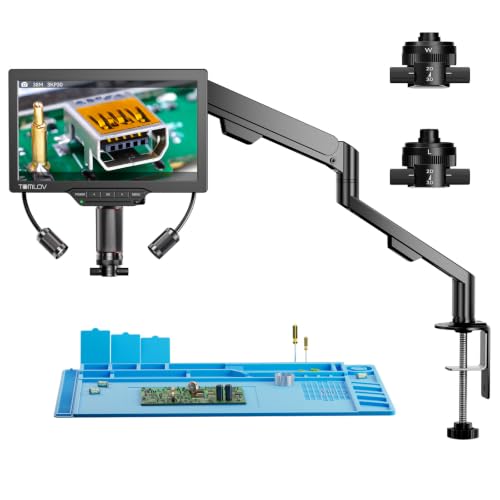
- 3D side-viewing with 360-degree rotation
- Magnetic long-distance and wide-angle lenses
- 3K display with HDMI and USB output
Best For: Beginners needing multi-angle PCB and component inspection
Best 4K Starter Kit
LINKMICRO LM208S-A 4K Soldering Microscope
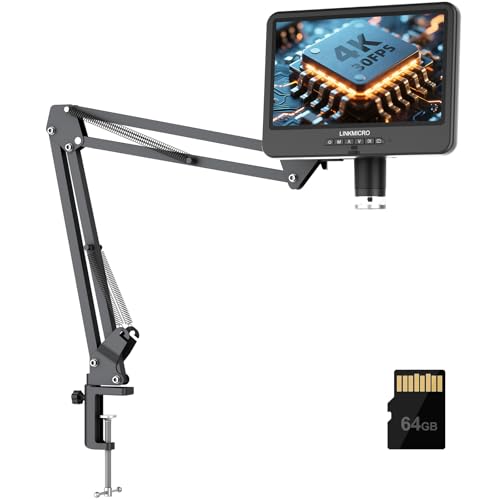
- 4K 30FPS imaging with a 10.1-inch IPS screen
- Flexible arm offers up to 70 cm of reach
- Includes 64GB card, remote, cables, and accessories
Best For: Beginners wanting large-screen PCB work and recording
Best Budget-Friendly Basics
TOMLOV DM9B 7-Inch Digital Microscope

- Stable metal base for light soldering and inspection
- 7-inch screen with adjustable LED and gooseneck lighting
- Captures 12MP photos and 1080P video
Best For: Beginners seeking stable general-purpose close-up viewing
Most Complete Starter Station – Andonstar AD246S-M Plus
For beginners comparing microscope soldering cameras for beginners, the Andonstar AD246S-M Plus is a versatile workstation with a 7-inch monitor, three interchangeable lenses, and practical soldering accessories. Its 2160P HDMI output, adjustable lighting, and included helping hands make it suitable for learning, repair, and broader close-up exploration.
Best For: Beginners who want an all-in-one soldering station that can also handle coins, plants, stones, and biological slides.
Pros:
- Includes Lens L for soldering, Lens A for general subjects, and Lens D for slides.
- 2160P video, HDMI connectivity, and a 7-inch monitor support clear viewing.
- Comes with helping hands, a tool holder, extension base, storage boxes, mat, and 32GB card.
- Windows measurement software supports photos, videos, and measurements.
Cons:
- Manual lens changes and focus adjustments may take practice.
- The extensive accessory set may be more than beginners need for basic soldering.
The AD246S-M Plus stands out when workspace organization and versatility matter as much as image quality. It is a strong starter choice for users who expect to explore more than electronics repair.
Easiest Focusing – Elikliv EM4K-AF Autofocus Microscope
The Elikliv EM4K-AF is a compelling option among microscope soldering cameras for beginners because its autofocus system reduces the need for constant manual adjustment. It combines 4K video, a large 8-inch IPS screen, HDMI/USB outputs, and a tall stand for a comfortable electronics inspection setup.
Best For: Beginners who prioritize quick focusing, a large display, and detailed viewing for soldering, coins, and watchmaking.
Pros:
- Autofocus uses AI algorithms and a TOF sensor to adjust focus quickly.
- 4K video, 52MP still images, and a 1280 x 800P IPS display provide detailed viewing.
- Includes a 10-inch stand, broad base, side lighting, controller, and 16GB card.
- Built-in battery supports portable inspections away from a fixed outlet.
Cons:
- Its advanced autofocus and display features may be unnecessary for simple beginner projects.
- The included warranty is listed as one year.
With autofocus and a generous screen, the EM4K-AF is designed to make the initial learning curve less demanding. It is especially appealing if you want a modern, flexible microscope for both bench work and portable inspection.
Best Large-Screen Kit – Andonstar AD249S-M Plus
For beginners shopping microscope soldering cameras for beginners, the Andonstar AD249S-M Plus offers the same broad three-lens concept as a complete repair station while adding a larger 10.1-inch monitor. Its 2160P HDMI video, helping hands, storage, and adjustable LEDs create a practical setup for hands-on learning.
Best For: Beginners who want a larger built-in screen and a ready-to-use workstation for electronics repair and general inspection.
Pros:
- Three lenses cover soldering, general magnification, and biological slides.
- 10.1-inch display, 2160P video, and HDMI support make viewing and demonstrations easier.
- Includes a metal stand, helping hands, tool holder, extension base, soldering mat, and 32GB card.
- Remote control and Windows measurement software support convenient operation and documentation.
Cons:
- Interchangeable lenses require manual installation and focusing.
- The larger station requires more bench space than a simpler microscope.
The AD249S-M Plus is a good fit when screen size and a complete soldering workspace are priorities. Its broad accessory package also gives beginners room to move from basic repairs into other inspection tasks.
Best Simple Value Pick – TOMLOV DM9 Digital Microscope
The TOMLOV DM9 is a straightforward choice for beginners evaluating microscope soldering cameras for beginners. It provides a 7-inch screen, 1080P video, 12MP photos, adjustable lighting, and a stable metal stand for small PCB work, light soldering, coin inspection, and other close-up projects.
Best For: Beginners and hobbyists who want an uncomplicated digital microscope for coins, small electronics, crafts, and occasional light soldering.
Pros:
- 7-inch LCD screen provides a comfortable direct-viewing area.
- Metal base and 8.5-inch adjustable stand help keep the setup stable.
- Eight built-in LEDs and two flexible gooseneck lights allow varied illumination.
- Captures 12MP photos and 1080P video, with Windows/Mac computer connection and 16GB storage.
Cons:
- It offers lower video resolution than the 2160P and 4K models in this roundup.
- The notes describe the metal base as supporting light soldering, so it may be less suited to demanding repair work.
The DM9 keeps the feature set approachable while still offering useful documentation and lighting controls. Choose it if you want a stable, beginner-friendly inspection tool without the broader multi-lens station design.
Best Flexible-Arm Pick – Andonstar AD109 for Soldering
For beginners comparing microscope soldering cameras for beginners, the Andonstar AD109 is a practical choice when workspace and positioning flexibility matter. Its 10.1-inch IPS screen, 1080p video, 12MP photos, and long boom arm provide a clear, comfortable view over larger electronics projects.
Best For: Beginners who want generous working room for PCB soldering, electronics repair, and coin inspection.
Pros:
- Long 27.56-inch boom arm with 360-degree rotation and 170-degree tilt range
- Large 10.1-inch IPS display with 178-degree viewing angle
- USB-C connectivity for Windows and Mac, plus a 32GB SD card
- Adjustable built-in and ring-light illumination
Cons:
- The remote control requires batteries, which are not included
- Its large boom-arm footprint may be more than a compact bench setup needs
The AD109 stands out for its unobstructed reach and flexible height adjustment. It is especially appealing if you solder with several tools around a large PCB or want one camera for both electronics and coins.
Best Complete Soldering Station – TOMLOV DM602 Flex
The TOMLOV DM602 Flex is a versatile option for beginners exploring microscope soldering cameras for beginners, combining a flexible arm, 10.1-inch screen, interchangeable lenses, and a heat-resistant soldering mat. Its HDMI and USB outputs also make sharing the view straightforward.
Best For: Beginners who want a multifunction setup for micro-soldering, coin viewing, and occasional slide observation.
Pros:
- Flexible arm offers 360-degree base rotation plus horizontal and vertical movement
- Three interchangeable lenses cover soldering, coin viewing, and higher-magnification uses
- Includes a 932°F heat-resistant silicone mat with ruler and parts compartments
- 10.1-inch IPS screen with HDMI and USB connectivity
Cons:
- The three-lens system may be more equipment than a beginner needs for basic soldering
- Its listed warranty is 12 months
With its included mat and lens selection, the DM602 Flex is closer to a ready-made workbench station than a basic camera microscope. Choose it if versatility and included accessories are more important than keeping the setup minimal.
Best All-Purpose Kit – Andonstar AD210 Digital Microscope
For beginners searching microscope soldering cameras for beginners that can also handle coins and slides, the Andonstar AD210 offers a broad working range and several lighting options. Its 10.1-inch IPS monitor, metal stand, remote, and included slide accessories make it a flexible home-workbench tool.
Best For: Beginners who want one microscope for electronics repair, coin collecting, and basic biological slide viewing.
Pros:
- 10.1-inch IPS display supports 1080p video and 12MP photos
- Adjustable working distance from 1cm to 26cm
- Includes top, side, and bottom LED illumination with adjustable brightness
- Comes with a 32GB card, card reader, bottom-light stage, and prepared slides
Cons:
- The conventional metal stand offers less reach than a long boom arm
- The broad accessory set may be unnecessary for soldering-only users
The AD210 is a strong general-purpose choice rather than a narrowly focused soldering camera. Its adjustable stand and multiple lighting modes let beginners experiment with electronics, coins, and slides without buying separate equipment.
Best 3D View – TOMLOV TM3K-3D 3K Digital Soldering Microscope
For beginners comparing microscope soldering cameras, the TOMLOV TM3K-3D stands out for its side-viewing design and flexible inspection setup. Its 3K image, built-in 7-inch screen, magnetic lenses, and adjustable arm make it suitable for learning PCB repair while also handling coins, jewelry, and other detailed projects.
Best For: Beginners who want multi-angle soldering inspection and a versatile microscope for electronics and hobbies.
Pros:
- 3D side-viewing and 360-degree rotation help reveal solder joints and components from multiple angles.
- Magnetic L and W lenses switch without tools for either longer working distance or wider viewing.
- 3K resolution, a 7-inch IPS screen, HDMI, and USB provide flexible viewing options.
- Flexible arm and adjustable gooseneck lighting support hands-on repair work.
Cons:
- The advanced 3D feature set may be more than beginners need for basic inspection.
- The supplied notes do not specify autofocus or automated measurement features.
This is a strong choice when viewing angle and workspace flexibility matter as much as image quality. Beginners focused only on straightforward soldering may prefer a simpler setup, but the TM3K-3D offers room to grow into more detailed inspection tasks.
Best 4K Starter Kit – LINKMICRO LM208S-A 4K Soldering Microscope
Among microscope soldering cameras for beginners, the LINKMICRO LM208S-A is a practical option for users who want a large display and smooth real-time video. Its 4K 30FPS output, 10.1-inch screen, generous flexible-arm reach, and included accessories make it ready for PCB repair, demonstrations, and recording.
Best For: Beginners who want a large-screen 4K microscope with plenty of working clearance and recording options.
Pros:
- 4K 30FPS output is available on the built-in screen and external HDMI displays.
- The flexible arm reaches up to 70 cm and provides up to 60 cm of working height for larger projects.
- USB and HDMI connectivity support computer viewing, recording, and sharing.
- Includes a 64GB microSD card, remote, cables, and other setup accessories.
Cons:
- The larger stand and 10.1-inch display require more workspace than compact beginner models.
- Its expanded recording and display features may be unnecessary for simple soldering tasks.
The LM208S-A is especially appealing if you plan to document repairs, teach others, or work on larger boards. Its spacious arm design gives beginners more room for tools, while the included accessories reduce the need for immediate add-ons.
Best Budget-Friendly Basics – TOMLOV DM9B 7-Inch Digital Microscope
The TOMLOV DM9B is a straightforward choice for beginners shopping for microscope soldering cameras and close-up inspection tools. It combines a stable metal base, 7-inch screen, adjustable lighting, and photo and video capture, making it useful for light soldering, small PCB checks, coin viewing, and hobby projects.
Best For: Beginners who want a stable, easy-to-view microscope for light soldering and general close-up inspection.
Pros:
- Solid metal base and adjustable stand help reduce shaking during inspection.
- Built-in 7-inch screen provides a comfortable enlarged view without requiring a computer.
- 12MP photos, 1080P video, PC connection, and included 16GB storage support documentation.
- Adjustable LEDs and flexible gooseneck lights help manage shadows and glare.
Cons:
- It is intended for light soldering tasks rather than large or highly complex repair work.
- The supplied notes do not indicate 4K output or HDMI connectivity.
- The included 16GB card provides less storage than some larger-capacity kits.
The DM9B makes sense for a first microscope when stability and a built-in viewing screen are priorities. Its coin-focused design adds versatility, while the adjustable lighting and computer connection give beginners useful ways to inspect and save their work.
How We Picked the Best Microscope Soldering Cameras for Beginners
We focused on the features that matter most when learning or regularly performing electronics repair: image clarity, display convenience, usable working distance, stand stability, lighting control, focusing ease, and connection options. The selection includes models with built-in screens for standalone use, HDMI output for larger monitors, flexible arms for positioning, and multiple lenses for changing perspective or magnification.
Advertised magnification numbers can vary widely between manufacturers, so we gave more weight to practical usability than to the highest stated figure. A camera that provides a clear, steady view while leaving room for a soldering iron is generally more useful than one with extreme magnification but limited workspace.
Quick Comparison
| Feature | What to look for | Why it matters |
|---|---|---|
| Display | 7-inch or larger LCD, or HDMI output | Makes fine details easier to inspect without using an eyepiece |
| Resolution | 1080p minimum; 4K for finer detail | Improves visibility of solder joints, traces, and component markings |
| Stand | Rigid base, adjustable arm, or flexible arm | Helps maintain a steady image and comfortable working angle |
| Focus | Manual precision focus or reliable autofocus | Reduces setup time and keeps the repair area clear |
| Lighting | Adjustable LED illumination | Reveals details while limiting glare on shiny solder |
Key Buying Factors for Microscope Soldering Cameras for Beginners
Choose Practical Magnification
For soldering, the most useful setup is usually one that balances magnification with working distance. You need enough room to maneuver a tip, tweezers, and components beneath the lens. Multi-lens systems can be useful if you want both a wider inspection view and closer detail.
Prioritize a Clear, Comfortable Image
A larger built-in screen can be easier for beginners than a small monitor or eyepiece. A 4K camera may show more detail, but 1080p can still be sufficient for many repairs when the lighting and focus are good. HDMI output is valuable if you prefer a larger external display or want to record demonstrations.
Check the Stand and Working Clearance
Stand design directly affects usability. A rigid stand offers stability, while a flexible arm makes it easier to position the camera over unusually shaped boards. Confirm that the arm provides enough height and reach for your typical projects.
Consider Lighting and Extras
Adjustable LEDs are important because bare circuit boards and solder can reflect light. Extra features such as photo and video capture, remote controls, measurement overlays, and interchangeable lenses are helpful, but they should not outweigh image stability and workspace clearance.
Who Should Buy Which Microscope Soldering Cameras for Beginners?
- First-time users: Choose a standalone 7-inch or 10.1-inch LCD model with straightforward controls and a stable base.
- Detail-focused repairers: Consider a 4K or autofocus model if you inspect dense boards, small components, or fine solder joints.
- Flexible workbench setups: A flex-arm model is useful when board sizes and viewing angles change frequently.
- Users wanting multiple perspectives: Dual-lens or 3D models can provide more viewing flexibility for inspection and rework.
- Monitor and recording users: Select a model with HDMI output and confirm that its supported resolution matches your display or capture equipment.