The right microscope camera can turn close-up soldering, repair, and electronics work into clear, watchable content. This roundup compares 10 options ranging from compact HDMI microscopes to higher-resolution camera systems with flexible stands and creator-friendly viewing setups.
Focus on more than headline magnification: video smoothness, working distance, lighting control, mounting stability, and compatibility with your recording workflow often matter more when you are filming real projects.
Best 10 Microscope Soldering Cameras for Content Creators Picks for 2026
Best Autofocus Pick
Elikliv EM4K-AF 4K Digital Microscope

- AI-assisted autofocus with TOF sensing
- 4K video and 52MP image capture
- HDMI/USB outputs and 8-inch IPS screen
Best For: Creators who want quick refocusing and detailed soldering footage
Most Versatile Lens Kit
Andonstar AD246S-M 3-Lens Microscope

- Includes soldering, general-purpose, and biological lenses
- 2160P recording with HDMI output
- Adjustable boom arm and measurement software support
Best For: Creators producing varied electronics, coin, and educational content
Best for Smooth 4K Video
LINKMICRO LM210S 4K 60FPS Microscope
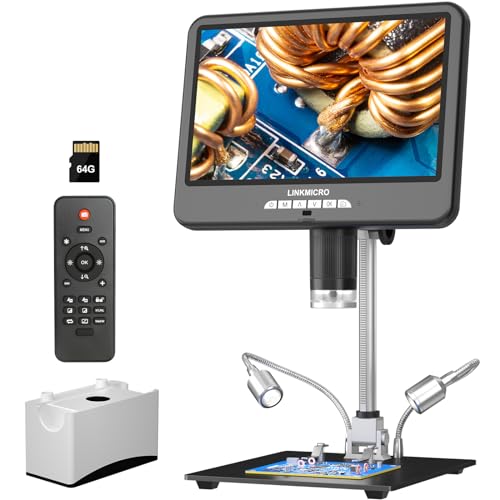
- 4K 60FPS display and recording
- Built-in microphone for tutorials
- 10.1-inch screen and tall 12.6-inch stand
Best For: Creators making smooth repair videos and livestream-style demonstrations
Best 4K Flex-Arm Pick
LM115A-4K Digital Soldering Microscope

- 4K 30 fps HDMI output for detailed live footage
- 360° flex arm with desk clamp and 27.5-inch reach
- USB connectivity plus 4K video and 10MP photo capture
Best For: Creators documenting detailed PCB repair and soldering work
Best Complete Soldering Station

- 2160P HDMI video with a built-in 7-inch monitor
- Three interchangeable lenses for soldering and general inspection
- Includes helping hands, tool holder, mat, extension base, and 32GB card
Best For: Creators wanting a fully equipped repair and demonstration station
Best Budget-Friendly Display

- Large 7-inch screen with 1080P video and 12MP photos
- Eight built-in LEDs plus two adjustable side lights
- Windows and Mac connectivity with a stable metal base
Best For: Beginners creating practical soldering and inspection demonstrations
Best Overall
Andonstar AD210S-Pro 4K Microscope

- 4K 60FPS video with integrated audio recording
- 64MP photos and HDMI/PC output
- Rotatable metal boom arm with 13-inch working distance
Best For: High-resolution soldering tutorials and demonstrations
Best Budget HDMI/VGA Option

- 1080P output through HDMI and VGA
- 150X lens with up to 1000mm working distance
- Foldable stand and adjustable 56-LED ring light
Best For: Beginners and workshop creators using 1080P displays
Best Autofocus Pick – Elikliv EM4K-AF 4K Digital Microscope
For content creators seeking microscope soldering cameras, the Elikliv EM4K-AF combines autofocus convenience with 4K video, 52MP imaging, and an 8-inch IPS display. Its HDMI and USB outputs, included controller, and rechargeable battery make it well suited to recording detailed electronics work with minimal manual refocusing.
Best For: Creators who want autofocus, high-resolution capture, and a built-in screen for soldering demonstrations and close-up inspection.
Pros:
- AI-assisted autofocus and TOF sensing can refocus in about two seconds.
- Records 4K UHD video and saves 52MP images.
- Includes HDMI/USB outputs, a controller, and a 16GB microSD card.
- The 10-inch stand and broad base provide useful working room.
Cons:
- The supplied display is 1280 x 800 rather than 4K.
- Its many modes and accessories may be more than casual users need.
The EM4K-AF is a feature-rich choice when fast focusing and high-resolution recording matter more than a simple, compact setup. Freeze and split-screen functions also support comparison-focused content.
Most Versatile Lens Kit – Andonstar AD246S-M 3-Lens Microscope
The Andonstar AD246S-M stands out among microscope soldering cameras for content creators who cover more than electronics. Its dedicated soldering lens, general-purpose lens, and biological lens support varied demonstrations, while 2160P recording, HDMI output, and a pro boom arm provide a flexible filming setup.
Best For: Multitopic creators who switch between PCB repair, coin inspection, and biological or educational demonstrations.
Pros:
- Three interchangeable lenses cover soldering, general observation, and biological slides.
- Supports 2160P video recording and HDMI display output.
- Adjustable metal boom arm provides a larger work envelope.
- Includes measurement software support, remote control, and a 32GB microSD card.
Cons:
- Changing lenses and manually adjusting focus takes more setup than autofocus models.
- The highest stated magnification depends on the lens, display, and digital zoom combination.
This is a strong all-purpose package for creators who need one camera system for several types of content. Its interchangeable optics add flexibility, though they also make the workflow less immediate than a fixed-lens design.
Best for Smooth 4K Video – LINKMICRO LM210S 4K 60FPS Microscope
For creators prioritizing fluid footage, the LINKMICRO LM210S is one of the more video-focused microscope soldering cameras for content creators. It can display and record 4K at 60FPS, includes a built-in microphone, and pairs a 10.1-inch screen with HDMI output for tutorials, livestreams, and repair demonstrations.
Best For: Video-first creators making smooth soldering tutorials, watch-restoration content, or livestream-style demonstrations.
Pros:
- Supports simultaneous 4K 60FPS display and recording.
- Built-in microphone is designed for tutorials and live broadcasts.
- Includes a taller 12.6-inch stand for more working distance.
- Saves 64MP images and includes a 64GB memory card.
Cons:
- Full 4K 60FPS HDMI output requires a compatible HDMI 2.0 display.
- The setup is relatively specialized for users who do not need high-frame-rate recording.
The LM210S is the clearest fit for creators who value motion smoothness and integrated audio alongside magnified detail. Its tall stand also leaves room for larger repair projects and full-coin views.
Best Large-Workspace Setup – Andonstar AD109 Flexible-Arm Microscope
The Andonstar AD109 is a practical option among microscope soldering cameras for content creators who need room to work around the subject. Its 27.56-inch flexible boom arm, 10.1-inch IPS display, USB-C connectivity, and external ring light support unobstructed PCB filming and easy computer capture.
Best For: Creators working on large PCBs or multi-tool benches who need flexible camera positioning and Mac or Windows connectivity.
Pros:
- The boom arm extends to 27.56 inches, rotates 360 degrees, and tilts up to 170 degrees.
- USB-C connectivity supports plug-and-play imaging with Mac and Windows computers.
- 1080p video and 12MP photos display on a wide-view 10.1-inch IPS screen.
- Dual LED lighting combines built-in LEDs with a 56-LED ring light.
Cons:
- It records 1080p video rather than 4K.
- The stated maximum magnification is 260x, lower than some specialized models.
- The remote control requires batteries, which are not included.
The AD109 favors workspace flexibility over maximum resolution. It makes sense for creators who need to reposition the camera around substantial projects and want straightforward computer connectivity for editing or sharing.
Best 4K Flex-Arm Pick – LM115A-4K Digital Soldering Microscope
For content creators seeking microscope soldering cameras for content creators, the LM115A-4K stands out with 4K HDMI video, a flexible desk-clamp arm, and computer connectivity. It is designed to show fine PCB details clearly while supporting hands-free soldering and video documentation.
Best For: Creators and electronics hobbyists who want high-resolution live footage, a flexible workspace, and easy recording or capture.
Pros:
- Captures 3840×2160 video at 30 fps through HDMI.
- Flexible arm rotates 360 degrees, clamps to a desk, and extends up to 27.5 inches.
- Supports USB connection to Windows and Mac computers for live viewing, capture, and file transfer.
- Offers 4K video recording and 10MP photo capture.
Cons:
- The supplied notes do not mention an included monitor or memory card.
- A 4K external display is needed to view the full HDMI resolution.
This is the strongest fit for creators who prioritize sharp, real-time PCB footage and a configurable stand. Its fold-flat design and handheld mode also add useful flexibility for compact workspaces or portable demonstrations.
Best Complete Soldering Station – Andonstar AD246S-M Plus
The Andonstar AD246S-M Plus is a versatile option for creators comparing microscope soldering cameras for content creators. Its 2160P HDMI output, 7-inch monitor, three interchangeable lenses, and built-in soldering accessories make it suitable for both filming repairs and demonstrating different types of inspection.
Best For: Creators who want an all-in-one soldering station with multiple lenses, onboard recording, and included workspace accessories.
Pros:
- Records 2160P video and supports HDMI viewing on larger displays.
- Includes soldering helping hands, tool holder, extension base, anti-static mat, and component storage boxes.
- Three lenses cover soldering, general inspection, and biological slides.
- Includes a 32GB SD card, remote control, and Windows measurement software support.
Cons:
- The extensive station and accessory set may take more desk space than a simple microscope.
- Lens changes require removing and installing screws.
This is the most feature-rich choice in the group for creators who want a ready-made filming and repair setup. The included accessories reduce the need for add-ons, while the interchangeable lenses broaden its use beyond electronics.
Best Budget-Friendly Display – Dcorn 7-Inch 1080P Microscope
The Dcorn 7-inch digital microscope offers a straightforward entry point for microscope soldering cameras for content creators. Its large built-in screen, 1080P video support, PC compatibility, and adjustable lighting provide a practical setup for recording or showing soldering and inspection work.
Best For: Beginners and hobbyist creators who want a large screen, basic recording features, and a stable metal stand without moving to a 4K system.
Pros:
- 7-inch display supports up to 1080P video and 12MP photos.
- Includes eight built-in LEDs plus two adjustable side lights.
- Connects to Windows 10 and Mac systems for larger viewing and recording.
- Metal base and adjustable screen height and angle support steadier observation.
Cons:
- Video resolution is limited to 1080P rather than 4K.
- Memory card is not included.
- The supplied notes do not specify HDMI output.
The Dcorn is a sensible choice when a large onboard display and simple PC viewing matter more than maximum resolution. It can cover soldering, coins, plants, and other close-up subjects, making it a flexible starter tool for instructional content.
Best Overall – Andonstar AD210S-Pro 4K Microscope
For content creators comparing microscope soldering cameras, the Andonstar AD210S-Pro stands out with 4K recording at 60 frames per second, built-in audio capture, and a large 10.1-inch IPS display. Its boom-arm design and multiple lighting options also make it practical for filming electronics work.
Best For: Creators who want high-resolution soldering tutorials, demonstrations, and close-up inspection videos.
Pros:
- Records 4K 60FPS video with simultaneous audio through the integrated microphone.
- Captures 64MP photos and supports HDMI and PC output for sharing or editing.
- Includes a 360-degree rotatable metal boom arm with up to 13 inches of working distance.
- Offers top, side, and bottom adjustable LED lighting plus a remote control.
Cons:
- The extensive stand and accessory package may take more workspace than a compact setup.
- Higher-end features may be more than casual users need.
Choose this model when smooth 4K footage and recorded narration are central to your content. The included 64GB card, HDMI cable, slides kit, and flexible boom arm make it especially well equipped for a dedicated creator workstation.
Best High-Resolution Value – NICE-POWER 48MP 4K Microscope
The NICE-POWER 48MP model is a strong option among microscope soldering cameras for content creators who want 4K recording and detailed still images without stepping up to the larger Andonstar configuration. Its C-mount lens, foldable stand, and bright ring light suit electronics repair filming.
Best For: Creators needing 4K video, high-resolution photos, and an adjustable setup for repair demonstrations.
Pros:
- Supports 4K video recording and 48MP photos up to 8000×6000 pixels.
- Provides HDMI and Type-C 1080P output with storage support for up to a 64GB TF card.
- Includes a 150X zoom C-mount lens with up to 1000mm of working distance.
- Its 56-LED ring light reaches up to 60,000 lux and has adjustable brightness.
Cons:
- The remote control works only when using HDMI output.
- The remote control battery is not included.
- It has a one-year warranty, shorter than the Andonstar’s listed two-year warranty.
This model balances recording resolution, flexible positioning, and strong illumination. It is particularly appealing for creators who need room around a circuit board while keeping the camera useful for coins and other close-up subjects.
Best Budget HDMI/VGA Option – NICE-POWER 13MP Microscope
For creators who primarily need a straightforward live view, the NICE-POWER 13MP model offers 1080P output through both HDMI and VGA. It keeps the useful 150X C-mount lens, foldable stand, and adjustable ring light while using a simpler camera configuration than the brand’s 48MP version.
Best For: Beginners and repair-focused creators who want flexible display connectivity for 1080P soldering footage.
Pros:
- Outputs 1080P video through HDMI or VGA for compatibility with suitable displays.
- Uses a 150X zoom C-mount lens with up to 1000mm of working distance.
- Includes a foldable, multi-angle stand and HDMI-mode remote control.
- The 56-LED ring light provides adjustable brightness and up to 60,000 lux.
Cons:
- Its 13MP camera and 1080P output provide less detail than the 48MP 4K model.
- The remote control works only in HDMI mode, and its battery is not included.
- The enclosure is listed as plastic rather than metal.
This is a practical choice when reliable 1080P viewing matters more than 4K recording or ultra-high-resolution stills. HDMI and VGA support can also make it easier to fit into an existing workshop or streaming display setup.
How We Picked These Microscope Soldering Cameras for Content Creators
We selected models that combine practical electronics magnification with features useful for filming and livestreaming. The lineup includes 4K and 1080p systems, HDMI and USB connectivity, built-in or adjustable displays, autofocus and fixed-focus designs, flexible arms, C-clamps, metal stands, and C-mount camera configurations.
Our priorities were usable image quality, smooth motion, a stable working setup, adequate clearance for soldering tools, and straightforward content capture. Specifications such as resolution and zoom were considered alongside the overall design, because a high-numbered zoom claim is not helpful if the image becomes soft or the camera sits too close to the board.
Quick Comparison
| Feature | What to look for | Why it matters |
|---|---|---|
| Video output | 4K, 2160p, 1080p, HDMI, USB, or Type-C | Determines recording quality and connection options |
| Frame rate | 60fps where available | Makes hand movements and solder flow look smoother |
| Display | Built-in 5-inch, 7-inch, 8-inch, or 10.1-inch screen | Lets you work without occupying a laptop or monitor |
| Mount | Metal base, flex arm, C-clamp, or foldable stand | Affects stability, clearance, and portability |
| Focus system | Autofocus or manual/fixed focus | Balances convenience against control during close work |
Key Buying Factors for Microscope Soldering Cameras for Content Creators
Image Quality and Frame Rate
Choose 4K when you plan to crop footage, show tiny components, or publish detailed tutorials. A 1080p camera can still be suitable for livestreams and general repair videos. If you frequently move a soldering iron or tweezers through the frame, 60fps can make the footage easier to follow.
Working Distance and Camera Position
Prioritize enough space between the lens and work surface for your hands, tools, and lighting. Flexible-arm and C-clamp models can be useful on crowded benches, while a heavier metal stand is usually better when stability matters more than portability.
Connectivity and Recording Workflow
HDMI is useful for a low-latency connection to a monitor, capture card, or streaming setup. USB and Type-C can simplify computer recording, but confirm compatibility with your operating system and preferred software. Built-in screens are convenient for bench work but do not automatically replace an external capture device.
Lighting and Focus Control
Adjustable LED lighting helps reduce shadows around components, but ring lights can create glare on solder and glossy boards. Autofocus is convenient for changing subjects; manual focus may provide a steadier image when the camera remains fixed over one project.
Who Should Buy Which Microscope Soldering Cameras for Content Creators?
Choose a 4K or 4K 60fps model if detailed tutorials, close crops, or polished repair videos are your priority. Choose a large-screen HDMI microscope if you want an all-in-one bench station with minimal computer dependence. Choose a flex-arm or C-clamp design for a small workspace or unusual camera angles. Choose a C-mount industrial camera if you already have a preferred lens, monitor, capture card, or more advanced studio workflow.
Before buying, verify the included stand, lens, remote, cables, and lighting controls. Also measure your bench and confirm that the camera can stay far enough above the board for comfortable soldering. For most creators, the best option is the one that delivers a stable, clear view with the fewest interruptions—not necessarily the model with the largest magnification number.