Remote electronics work demands more than high magnification. The right microscope camera should deliver a clear, low-latency view, stable positioning, and simple connections for a monitor, laptop, or video call.
These 10 options cover HDMI microscope systems, USB-capable cameras, adjustable stands, LCD displays, and soldering-focused features for home labs and distributed repair teams.
Best 10 Microscope Soldering Cameras for Remote Work Picks for 2026
Best Overall
Andonstar AD246S-M Plus 2160P Soldering Microscope

- 2160P HDMI output with a 7-inch display
- Three lenses for soldering and general inspection
- Expanded station with helping hands and storage
Best For: Remote demonstrations and versatile electronics work
Best for Beginners
TOMLOV DM9 1080P Digital Soldering Microscope

- 7-inch screen for comfortable direct viewing
- PC connection with 1080P video and 12MP photos
- Stable metal stand with adjustable multi-angle lighting
Best For: Hobby repairs, coin inspection, and remote learning
Best Industrial Camera
QUEMARQUE 60FPS HDMI/VGA Microscope Camera

- Smooth 60FPS video for live inspection
- HDMI and VGA connectivity for flexible displays
- Crosshairs and up to 130x digital magnification
Best For: Workshop inspection stations with an existing monitor
Best Value 4K-Style Kit
Andonstar AD246S-M 3-Lens Microscope

- 2160P recording with HDMI output
- Three lenses for soldering, coins, and slides
- Boom arm, remote, lighting, and measurement software
Best For: Multi-purpose remote demonstrations and electronics repair
Compact PC-Ready Pick
5" C-Clamp Soldering Microscope

- Built-in 5-inch IPS display
- PC Camera mode for Windows and Mac
- C-clamp keeps both hands free
Best For: Compact electronics repair and remote computer viewing
Industrial HDMI Choice

- 1080p HDMI and VGA output
- 150X zoom with up to 1000mm working distance
- Adjustable 56-LED ring light
Best For: Bench setups using HDMI or VGA displays
Long-Reach Precision Pick
NICE-POWER 60MP 4K Soldering Microscope

- 4K HDMI and USB output for live viewing
- 150X zoom with up to 1000mm working distance
- Adjustable ring light and four-part stand
Best For: Remote PCB repair and soldering demonstrations
All-in-One Remote Teaching Pick
LINKMICRO LM208S-A 4K Microscope
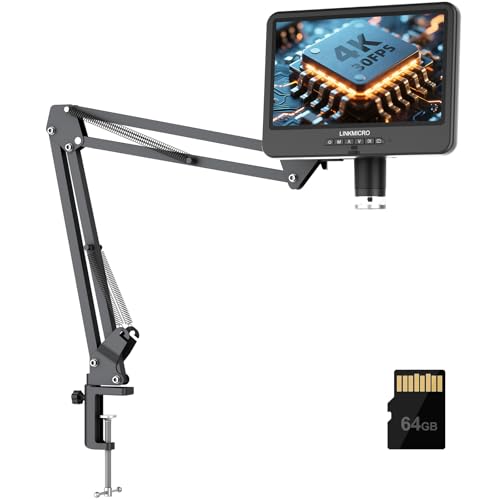
- Built-in 10.1-inch IPS display
- 4K 30FPS output with audio recording
- 70cm flexible arm reach and 64GB card
Best For: Online lessons, tutorials, and larger repair projects
Best Overall – Andonstar AD246S-M Plus 2160P Soldering Microscope
For shoppers comparing microscope soldering cameras for remote work, the Andonstar AD246S-M Plus stands out as a complete, highly configurable workstation. Its 7-inch display, 2160P HDMI output, three interchangeable lenses, and expanded soldering setup support both hands-on repairs and clear demonstrations.
Best For: Remote demonstrations, electronics repair, and users who want one microscope for soldering, coins, and biological slides.
Pros:
- Includes Lens L for soldering, Lens A for general close-up viewing, and Lens D for biological slides.
- 2160P video, HDMI output, Windows measurement software, and a supplied 32GB card support documentation and sharing.
- Expanded base, tool holder, storage boxes, soldering mat, and rotatable helping hands create a more organized work area.
- Remote control and eight LED brightness levels make operation and lighting adjustments convenient.
Cons:
- The many accessories and three-lens design may be more setup than casual users need.
- It is a corded system, so placement depends on access to power.
This is the strongest all-in-one choice when remote work includes teaching, collaboration, or frequent bench repairs. The included station accessories add practical value beyond the camera itself.
Best for Beginners – TOMLOV DM9 1080P Digital Soldering Microscope
The TOMLOV DM9 is a practical option among microscope soldering cameras for remote work when comfortable viewing and simple documentation matter most. Its built-in 7-inch screen, adjustable stand, PC connection, and flexible lighting make small repair tasks easier to observe and share.
Best For: Beginners, hobby electronics users, coin collectors, and remote demonstrations using a Windows or Mac computer.
Pros:
- 7-inch LCD provides a comfortable direct view for extended inspection and shared demonstrations.
- 12MP still images, 1080P video, and a 16GB card support project records and sharing.
- Stable metal base, adjustable stand, and heat-resistant platform support light soldering work.
- Eight built-in LEDs plus two flexible gooseneck lights help illuminate subjects from different angles.
Cons:
- Its 1080P video output is lower resolution than the 2160P models in this roundup.
- The notes describe support for Windows/Mac PC viewing but do not specify HDMI output.
The DM9 favors ease of use over a specialized industrial setup. It is a sensible starting point for remote instruction, hobby repairs, and inspection tasks that benefit from a large built-in screen.
Best Industrial Camera – QUEMARQUE 60FPS HDMI/VGA Microscope Camera
For microscope soldering cameras for remote work in a workshop or inspection station, this QUEMARQUE camera emphasizes smooth live video and flexible display connectivity. Its 60FPS 2MP output, HDMI/VGA ports, adjustable magnification, and on-screen crosshairs suit PCB, jewelry, soldering, and repair workflows.
Best For: Technicians who already have a compatible monitor or projector and need a portable inspection camera with measurement overlays.
Pros:
- 60FPS video is designed for smooth real-time inspection and quality-control viewing.
- HDMI and VGA outputs support integration with different monitors and projectors.
- Adjustable 2x optical to 130x digital magnification covers varied inspection tasks.
- Customizable crosshairs assist with alignment and dimensional analysis.
Cons:
- The camera is listed as a standalone unit, so a monitor and other setup components may be needed.
- At 2MP, it offers less stated image resolution than the 2160P Andonstar systems.
- The supplied notes do not specify built-in lighting or a soldering stand.
This is a focused choice for users building around an existing display and workshop infrastructure. Its dual outputs and smooth frame rate are particularly useful when live inspection takes priority over an all-in-one kit.
Best Value 4K-Style Kit – Andonstar AD246S-M 3-Lens Microscope
The original Andonstar AD246S-M offers a broad feature set for microscope soldering cameras for remote work without the Plus model’s expanded extension base. It combines 2160P recording, HDMI output, a pro boom arm, three lenses, remote operation, and Windows measurement software for repair and demonstration use.
Best For: Users who want high-resolution remote viewing and multi-purpose magnification with a sturdy boom-arm stand.
Pros:
- 2160P video and HDMI output support detailed viewing on the included screen or a larger display.
- Lens L covers soldering and repair, while Lens A and Lens D extend the system to coins and slides.
- Adjustable pro boom arm and metal construction support a larger work envelope and high-temperature tasks.
- Remote control, eight LED intensity levels, SD recording, and Windows measurement software add workflow flexibility.
Cons:
- It does not list the Plus model’s extension base, storage boxes, tool holder, or helping hands.
- Users must change lenses manually using the mounting screws.
The AD246S-M is a capable middle ground for remote instruction and electronics repair. Choose it when image quality and lens versatility matter more than having the most complete soldering-station accessories.
Compact PC-Ready Pick – 5" C-Clamp Soldering Microscope
For shoppers comparing microscope soldering cameras for remote work, this compact 5-inch model offers a straightforward way to inspect solder joints on its built-in screen or connect to a computer. Its C-clamp and flexible arm help keep both hands available, while PC Camera mode works with Windows Camera or Mac Photo Booth without extra driver downloads.
Best For: Electronics repairers who want a compact, computer-compatible microscope with hands-free clamping.
Pros:
- 5-inch IPS display can be used without a computer.
- C-clamp and flexible arm help position the camera over a work area.
- Plug-and-play PC viewing through Windows Camera or Mac Photo Booth.
- Adjustable LED lighting and up to 1000x digital magnification are suited to detailed solder-joint inspection.
Cons:
- It is not autofocus; focus and magnification require physical-distance and focus-wheel adjustments.
- A Micro SD card, not included, is required for saving 1080p videos and larger photo batches.
- The design is intended for small details rather than full-screen views of large objects.
This is a practical option when simple remote viewing and a small footprint matter more than advanced camera controls. Be prepared to focus manually and supply a compatible Micro SD card if recording is important.
Industrial HDMI Choice – 13MP 150X Microscope Camera
Among microscope soldering cameras for remote work, the NICE-POWER model stands out for its HDMI and VGA output, flexible foldable stand, and industrial-style controls. Its 13MP camera provides 1080p output, while the long-working-distance 150X C-mount lens and adjustable ring light support electronics repair and inspection tasks.
Best For: Users who need HDMI or VGA display connectivity, a flexible stand, and strong adjustable illumination.
Pros:
- 13MP camera outputs 1080p video through HDMI and VGA.
- 150X zoom lens offers a working distance of up to 1000mm.
- 56-LED ring light has adjustable brightness and up to 60,000 lux illumination.
- Four-part adjustable stand and included remote support flexible positioning and hands-off control.
Cons:
- The remote control works only when using HDMI output.
- The remote-control battery is not included.
- It weighs 3.6 pounds, making it less portable than lighter desktop models.
This model is a strong fit for a more permanent bench setup or a remote-work station built around an HDMI display. Its connectivity and lighting are versatile, though buyers should account for the HDMI-only remote function and missing battery.
Remote-Controlled Large-View Pick – 7" Soldering Microscope with Remote
For remote collaboration, training, or documenting repairs, this 7-inch microscope combines a larger IPS viewing area with PC Camera mode and a vibration-free remote. Its adjustable-height stand leaves room for soldering irons and tweezers, while separate side lamps help reduce glare and shadows on reflective circuit boards.
Best For: Microsoldering, repair documentation, and remote demonstrations where a large screen and hands-off controls are useful.
Pros:
- 7-inch IPS screen provides lag-free 1080p feedback and a wider viewing area.
- High-clearance adjustable stand accommodates soldering tools and tweezers.
- Dual flexible side lights help manage hotspots and shadows on PCBs.
- Remote can capture 16MP photos, record video, and adjust digital zoom without touching the unit.
Cons:
- The unit uses digital rather than stated optical zoom, with a maximum listed magnification of 1200x.
- PC Camera connectivity requires a USB Type-C connection and compatible Windows or Mac software.
- The supplied built-in media list does not mention a memory card, so storage options should be confirmed before recording.
This is the most collaboration-friendly choice of the three if you value a large local display, side lighting, and remote operation. It is especially compelling for showing defects to customers or teams, provided your computer setup supports its PC Camera mode.
Long-Reach Precision Pick – NICE-POWER 60MP 4K Soldering Microscope
If you need microscope soldering cameras for remote work, this NICE-POWER model is built for detailed live viewing and hands-free electronics repair. It combines 4K HDMI and USB output with a 150X zoom lens, a long working distance, and an adjustable stand, making it practical for sharing inspections or working while viewing a larger screen.
Best For: Remote soldering demonstrations, PCB inspection, and electronics repair where generous tool clearance matters.
Pros:
- 4K HDMI/USB video output and 60MP still-image capability support detailed inspection and documentation.
- 150X continuous zoom and a working distance of up to 1000mm leave room for soldering tools.
- Adjustable 56-LED ring light and four-part stand help reduce glare and position the camera for hands-free work.
Cons:
- Remote control operation is limited to HDMI mode.
- The remote control battery is not included.
Choose this model when flexibility and working space are more important than having a built-in monitor. Its HDMI connection is especially useful for displaying the feed on a shared screen during remote instruction or review.
All-in-One Remote Teaching Pick – LINKMICRO LM208S-A 4K Microscope
Among microscope soldering cameras for remote work, the LINKMICRO LM208S-A stands out for its built-in 10.1-inch display, smooth 4K 30FPS output, and included flexible arm stand. USB and HDMI connectivity support computer viewing, recording, and external-screen sharing, while the microphone adds synchronized audio for demonstrations and lessons.
Best For: Online teaching, repair tutorials, live demonstrations, and larger electronics projects requiring an extended arm.
Pros:
- 4K 30FPS output is available on the built-in IPS screen and external HDMI monitors.
- Built-in microphone supports synchronized audio and video recording for tutorials or remote instruction.
- Flexible arm reaches up to 70cm with up to 60cm of working height, providing useful clearance around larger repairs.
- Includes a 64GB microSD card, remote control, HDMI cable, USB cable, and other core accessories.
Cons:
- The supplied feature set is more extensive than necessary for simple bench inspection.
- Its 1500X specification includes digital magnification, so maximum zoom may not represent optical detail.
This is the strongest fit when remote communication is part of the job. The integrated screen allows local viewing, while HDMI, USB, audio recording, and the flexible arm make it well suited to shared repair workflows.
Flexible Storage Pick – NICE-POWER 48MP 4K USB Microscope
This NICE-POWER camera is a practical option for microscope soldering cameras for remote work when you want HDMI or computer connectivity without a dedicated built-in display. It records 4K video, captures up to 48MP stills, and pairs a 150X C-mount lens with a foldable adjustable stand for electronics repair and PCB observation.
Best For: Remote inspections, computer-based repair work, and users who want onboard recording through a TF card.
Pros:
- Supports 1080P HDMI and Type-C output, plus 4K video recording and up to 48MP photos.
- 150X zoom and up to 1000mm working distance provide room for soldering and inspection tools.
- 56-LED adjustable ring light reaches up to 60,000 Lux and helps illuminate working surfaces.
- Supports up to 64GB TF-card storage and includes a remote control for HDMI-mode operation.
Cons:
- HDMI output is specified as 1080P rather than 4K live output.
- Remote control functionality is available only in HDMI mode.
- The remote control battery is not included.
Consider this model if recording flexibility and a long working distance are priorities. It is less compelling for users who need a 4K live feed to a monitor, but its camera recording, Type-C connection, and adjustable stand suit many remote repair setups.
How We Picked the Best Microscope Soldering Cameras for Remote Work
We selected these Microscope Soldering Cameras for Remote Work based on the features that matter most in a shared or home workspace: live-video clarity, output options, focusing control, working distance, lighting, stand stability, and ease of setup. Resolution claims are only one part of the picture, so we also considered whether each design supports practical PCB inspection and hands-on soldering without forcing the user into an awkward viewing position.
Models with HDMI, USB, VGA, or Type-C connectivity can fit different remote-work setups, while built-in LCD screens may allow independent work without occupying a computer display. Adjustable magnification and flexible lighting are especially useful when moving between tiny components, board-level inspection, and broader demonstrations.
Quick Comparison
| Feature | Why It Matters | What to Look For |
|---|---|---|
| Video output | Determines monitor and computer compatibility | HDMI for low-latency display; USB or Type-C for capture and calls |
| Resolution and frame rate | Affects detail and motion clarity | 4K for fine inspection; 30–60 fps for smoother live work |
| Working distance | Provides room for a soldering iron and tools | A longer, adjustable distance is usually more useful than extreme zoom |
| Lighting | Reveals joints, markings, and surface defects | Dimmable ring or side lights with controllable reflections |
| Stand design | Controls vibration and framing | Rigid bases, clamps, or flex arms suited to your bench |
Key Buying Factors for Microscope Soldering Cameras for Remote Work
Choose the Right Connection
HDMI is often the simplest choice for a dedicated monitor because it generally provides a direct, low-delay feed. USB and Type-C connections are more convenient when the camera must appear in conferencing, recording, or screen-sharing software, but compatibility can vary by operating system and capture hardware. VGA is useful mainly with older displays.
Prioritize Usable Detail
High megapixel or 4K specifications can help with documentation and close inspection, but lens quality, sensor performance, focus adjustment, and lighting have equal importance. For live soldering, a stable frame rate and responsive controls may be more valuable than the highest still-image resolution.
Check the Mechanical Setup
A microscope that looks impressive on paper can be frustrating if its stand flexes or leaves too little room for tools. Compare the base footprint, clamp range, arm movement, focus travel, and stated working distance before buying. Side lights or a movable lamp can reduce glare on reflective solder joints.
Who Should Buy Which Microscope Soldering Cameras for Remote Work?
Choose an HDMI model with a built-in LCD if you want a self-contained bench station for repair and inspection. A USB- or Type-C-capable camera is better for remote demonstrations, online training, and sharing a live view with collaborators. Consider a flex-arm or clamp-mounted design when bench space is limited, but choose a heavier rigid stand for frequent soldering. If you document repairs or inspect very small components, prioritize 4K capture, fine focusing, and adjustable illumination over headline magnification alone.