Choosing the right camera microscope can make soldering, inspection, and rework faster and more comfortable. The best commercial-grade microscope soldering cameras combine clear imaging with stable stands, useful working distance, responsive controls, and dependable video output.
This roundup compares 10 options ranging from compact HDMI digital microscopes to trinocular stereo systems. Use the buying guide below to match image quality, magnification, ergonomics, and connectivity to your bench setup.
Best 10 Commercial-Grade Microscope Soldering Cameras Picks for 2026
Flexible HDMI Workbench Pick
NICE-POWER 13MP Industrial Microscope

- 1080P HDMI/VGA output
- 150X zoom with long working distance
- Adjustable 56-LED ring light
Best For: Flexible electronics-repair workstations
High-Frame-Rate Pro Pick
Andonstar AD210S-Pro 4K Microscope

- 4K 60FPS HDMI output
- 64MP photos and audio recording
- Metal 360° boom-arm stand
Best For: Soldering demonstrations and content creation
True Stereo Repair Station
HengTianMei TX-350E Trinocular Microscope

- 4K trinocular camera
- 7X-50X stereo zoom
- Large work floor with fume extractor
Best For: Bench-based electronics and watch repair
Multi-Lens Versatility Pick
Andonstar AD246S-M Digital Microscope

- Three lenses for varied inspection
- 2160P HDMI video output
- Windows measurement software
Best For: Soldering, coins, and educational microscopy
Best Flexible-Arm 4K Pick
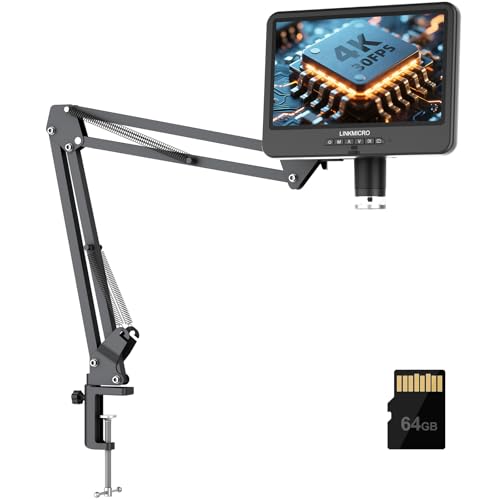
- 4K 30FPS HDMI and IPS-screen output
- 70cm arm reach with large working clearance
- USB, HDMI, audio recording, and 64GB card
Best For: Large PCB repairs, demonstrations, and coin inspection
Best Industrial-Style Rail Stand

- Large sliding-rail work area
- Metal rails and dual C-clamp support
- 2160P microscope plus 3D endoscope
Best For: Large PCB and industrial inspection work
Best Stable Desktop Value

- 4K recording and 48MP still images
- 150X lens with 300mm working distance
- Large base and adjustable 56-LED ring light
Best For: Stable electronics repair and general bench inspection
Best Value HDMI Camera
HAYEAR 14MP 180x C-Mount Microscope Camera

- 14MP Color CMOS still-image resolution
- HDMI and USB 1080p output
- TF-card JPG and MP4 recording
Best For: Bench inspection with direct monitor viewing and local recording
Best High-Resolution Option
NICE-POWER 60MP 4K 150x Microscope

- 60MP photos with 4K HDMI/USB video
- 1000mm maximum working distance
- Adjustable 56-LED, 60,000-lux ring light
Best For: Detailed PCB work and soldering with ample tool clearance
Flexible HDMI Workbench Pick – NICE-POWER 13MP Industrial Microscope
For shoppers comparing commercial-grade microscope soldering cameras, the NICE-POWER combines HDMI/VGA output, a long-working-distance zoom lens, and a flexible foldable stand. Its 150X C-mount lens and adjustable ring light make it suited to electronics repair and other close-up inspection tasks.
Best For: Electronics repairers who want a flexible stand, direct display output, and generous working distance.
Pros:
- 13MP camera outputs 1080P video through HDMI and VGA.
- 150X zoom lens offers up to a stated 1000mm working distance.
- 56-LED ring light reaches up to 60,000 lux with adjustable brightness.
- Four-part foldable stand allows multiple viewing angles.
Cons:
- Remote-control operation is available only in HDMI mode.
- Remote-control battery is not included.
- Maximum display magnification is lower than some higher-magnification options.
This is a practical choice when workspace flexibility and bright subject lighting matter more than advanced recording features. Confirm that 1080P output and the included plastic-bodied stand fit your workflow.
High-Frame-Rate Pro Pick – Andonstar AD210S-Pro 4K Microscope
The Andonstar AD210S-Pro stands out among commercial-grade microscope soldering cameras for its 4K 60FPS HDMI output, integrated microphone, and metal boom-arm stand. It also includes a built-in 10.1-inch screen, multiple lighting zones, and recording support for detailed repair demonstrations.
Best For: Soldering professionals and content creators who need smooth 4K video, audio recording, and a roomy boom-arm setup.
Pros:
- Supports 4K 60FPS output and 64MP still photos.
- 360-degree rotatable metal boom arm provides an extended working distance up to 13 inches.
- Top, side, and bottom LED lighting can be adjusted for different subjects.
- Includes a 10.1-inch IPS screen, 64GB card, remote, and HDMI cable.
Cons:
- The feature-rich system may be more than needed for basic inspection.
- Its stated higher magnification depends on HDMI connection to a larger 4K display.
- It is corded electric and uses a substantial metal stand.
Choose this model when video quality, smooth motion, and presentation-ready recording are priorities. Its boom arm and lighting arrangement are especially useful for larger PCB workspaces and demonstrations.
True Stereo Repair Station – HengTianMei TX-350E Trinocular Microscope
Unlike purely screen-based commercial-grade microscope soldering cameras, the HengTianMei TX-350E pairs conventional stereo viewing with a 4K trinocular camera. Its 7X-50X zoom, large work floor, fume extractor, and LED illumination create a complete repair-oriented station.
Best For: Repair technicians who prefer eyepiece-based stereo depth perception while also needing 4K camera capture.
Pros:
- Trinocular design includes WF10x/23 eyepieces with adjustable interpupillary distance.
- 7X-50X variable magnification supports different repair tasks.
- 4K camera records 4K at 30FPS or 1080P at 60FPS.
- Large 14.7-by-9.6-inch work floor includes a smoke exhaust fan and LED illuminator.
Cons:
- Maximum stated magnification is 50X, below several digital-only alternatives.
- At 5.78 kg, it is less portable than compact microscope systems.
- The setup requires installation and eyepiece/camera adjustment.
This is the strongest fit for users who value natural stereo observation and an integrated solder-fume solution. It is a substantial workstation, so measure your bench before buying.
Multi-Lens Versatility Pick – Andonstar AD246S-M Digital Microscope
The Andonstar AD246S-M gives commercial-grade microscope soldering cameras a broad-use angle with three interchangeable lenses. The dedicated soldering lens handles circuit-board and phone repair, while the other lenses support coins, specimens, and biological slides.
Best For: Users who want one camera system for soldering, general inspection, and educational microscopy.
Pros:
- Includes separate lenses for soldering, general viewing, and biological slides.
- Records 2160P video and supports HDMI output to a larger screen.
- Metal adjustable boom-arm stand suits larger work envelopes and high-temperature soldering areas.
- Windows measurement software supports length, area, photo, and video functions.
Cons:
- Changing lenses requires removing and installing screws.
- The highest stated magnification applies to the biological lens and larger HDMI display.
- The included 7-inch screen is smaller than the display supplied with some competing models.
This is a versatile package for mixed-use benches, classrooms, and hobby spaces. Select it if interchangeable optics and measurement tools are more valuable to you than a single-purpose stereo microscope.
Best Flexible-Arm 4K Pick – Long-Reach LM208S-A
For buyers comparing commercial-grade microscope soldering cameras, the LINKMICRO LM208S-A stands out for its 4K 30FPS output, generous working clearance, and flexible arm. It is built to keep soldering work visible on its 10.1-inch IPS screen while also supporting HDMI and USB computer viewing.
Best For: PCB repair, motherboard work, electronics inspection, demonstrations, and collectors who need room for larger coins or projects.
Pros:
- Real-time 4K 30FPS output on the built-in display and external HDMI monitors.
- Flexible arm reaches up to 27.5 inches with up to 23.6 inches of working height.
- Includes HDMI and USB connectivity, microphone audio recording, remote control, and a 64GB microSD card.
Cons:
- The feature-rich setup may be more than casual users need.
- USB computer viewing is specified for Windows and Mac, while the listed end-to-end workflow depends on compatible software such as Windows Camera or Mac Photo Booth.
The LM208S-A is a strong choice when workspace, smooth 4K video, and flexible positioning matter more than a compact footprint. Its foldable arm also makes storage easier after larger repair jobs.
Best Industrial-Style Rail Stand – Andonstar AD409 SA
The Andonstar AD409 SA is a compelling option among commercial-grade microscope soldering cameras for technicians who want a broad, stable work area. Its sliding rail arm, dual C-clamps, metal construction, and UV-filtered lens are designed for controlled positioning around active soldering work.
Best For: Large PCBs, precision soldering, industrial inspection, automotive work, and users who can benefit from the integrated 3D endoscope.
Pros:
- Sliding rail stand provides a work area up to 25 x 18.3 x 18.1 inches.
- Metal rails and dual C-clamps support steady positioning on workbenches up to 3.9 inches thick.
- Combines a 2160P digital microscope with a 3D endoscope, HDMI, Windows PC, and Wi-Fi output options.
Cons:
- The endoscope is not supported when connected to a Windows PC.
- The rail-and-clamp stand is likely less convenient for compact desks than a simple desktop base.
Choose the AD409 SA when stability and movement range are priorities. The measurement software and included soldering mat add practical value, while the endoscope broadens its usefulness beyond straightforward PCB viewing.
Best Stable Desktop Value – NICE-POWER 4K Microscope
The NICE-POWER digital microscope is a practical contender among commercial-grade microscope soldering cameras for bench users who prefer a stable desktop base. Its 4K video support, 48MP still images, adjustable 150X lens, and bright ring light cover routine electronics repair without requiring a rail-arm setup.
Best For: Electronics repair, coin viewing, specimen observation, and bench work where a large fixed base and adjustable illumination are useful.
Pros:
- Supports 4K video recording and still images up to 48MP.
- 150X zoom lens offers up to a 300mm working distance and 1–150X display magnification.
- Large 10 x 15-inch base, adjustable slider, fixing screws, and 56-LED ring light provide a stable, well-lit setup.
Cons:
- HDMI and Type-C output are listed as 1080P despite 4K recording support.
- The package does not include a battery for the remote control.
- Its 12-month warranty is shorter than the 24-month warranty listed for the Andonstar model.
This NICE-POWER model makes sense for users who want a straightforward, space-conscious bench microscope with strong lighting and a stable base. It is less suited to jobs that require the expansive repositioning range of a sliding rail arm.
Best Value HDMI Camera – HAYEAR 14MP 180x C-Mount Microscope Camera
For shoppers comparing commercial-grade microscope soldering cameras, the HAYEAR offers a practical HDMI/USB setup with a 14MP sensor, manual 180x zoom lens, and standalone TF-card capture. Its 1080p output is suited to electronics inspection and live viewing on a monitor or TV.
Best For: Electronics repairers who want HDMI viewing, USB connectivity, and onboard image or video recording.
Pros:
- 14MP Color CMOS sensor supports high-resolution still images up to 4320×3240.
- HDMI output provides 1080p video at up to 60 frames per second when recording to TF card.
- Supports TF-card JPG and MP4 capture, plus USB 1080p video at 30 frames per second.
- Includes multi-color movable horizontal and vertical guide lines.
Cons:
- Manual focus and manual zoom require hands-on adjustment.
- USB output is limited to 1080p at 30 frames per second, and camera parameters cannot be adjusted through USB.
- TF card and other accessories may require separate confirmation before purchase.
The HAYEAR is a flexible choice when direct HDMI display and local recording matter more than automated controls. It is particularly useful for bench inspection, though its manual operation and USB limitations should be weighed against newer alternatives.
Best High-Resolution Option – NICE-POWER 60MP 4K 150x Microscope
Among commercial-grade microscope soldering cameras, this NICE-POWER model stands out for its claimed 60MP still imaging, 4K HDMI/USB video, and long 1000mm working distance. The adjustable stand and ring light are designed to leave room for soldering tools beneath the lens.
Best For: Detailed PCB inspection, soldering, rework, training, and situations requiring generous tool clearance.
Pros:
- Supports 60MP photos and 4K HDMI/USB video for detailed inspection views.
- 150x continuous zoom lens offers adjustable magnification from 1x to 150x.
- Up to 1000mm working distance provides substantial room for tweezers and soldering irons.
- 56-LED ring light offers adjustable brightness and up to 60,000 lux illumination.
Cons:
- Remote control works in HDMI mode only.
- The remote-control battery is not included.
- The 3.5-pound setup may be less convenient to move than a compact camera-only system.
This is the strongest fit for users prioritizing image detail, illumination control, and working space. Its 4K output and flexible stand also make it practical for demonstrations or shared inspection, provided HDMI-mode remote operation meets your workflow.
Best Storage-Friendly Setup – NICE-POWER 48MP 4K 150x Microscope
This NICE-POWER model is a capable option among commercial-grade microscope soldering cameras, combining 48MP still capture, 4K recording, 1080p HDMI/Type-C output, and a 150x C-mount lens. Its TF-card support and adjustable stand suit electronics repairers who want both live viewing and saved inspection files.
Best For: Electronics repair, PCB observation, and users who want local storage alongside HDMI or Type-C connectivity.
Pros:
- Captures up to 48MP still images at 8000×6000 pixels.
- Supports 4K video recording and 1080p output through HDMI and Type-C.
- Accepts TF cards up to 64GB for storing photos and video.
- 150x zoom lens, 1000mm working distance, adjustable 56-LED ring light, and four-part stand support bench work.
Cons:
- Remote-control functionality is available only in HDMI output mode.
- The remote-control battery is not included.
- The listed HDMI and Type-C live output is 1080p, despite 4K recording support.
The combination of onboard storage and multiple outputs makes this a well-rounded bench camera. It is a sensible pick for documenting repairs, while buyers should distinguish between its 4K recording capability and its specified 1080p live output.
How We Picked the Best Commercial-Grade Microscope Soldering Cameras
We focused on features that matter during real electronics work rather than relying on headline magnification alone. The selection includes HDMI and USB models, 4K-capable cameras, C-mount systems, articulated and foldable stands, stereo microscopes, and units with integrated screens or endoscopes. We considered image clarity, likely usability at the soldering bench, working distance, stand stability, viewing flexibility, and the practicality of connecting to a monitor or computer.
Because specifications can vary by configuration, verify the included lens, camera resolution, mount type, display, and accessories before ordering.
Quick Comparison
| Best for | Features to prioritize | Good fit |
|---|---|---|
| Everyday soldering | Low-latency HDMI, adjustable lighting, stable stand | Digital HDMI microscopes with integrated displays |
| Fine-pitch inspection | Sharp optics, consistent focus, long working distance | 4K systems or trinocular stereo microscopes |
| Documentation | High-resolution capture, USB or TF storage, software support | Camera-focused C-mount models |
| Flexible bench layouts | Articulated arm, foldable stand, or compact footprint | Flex-arm and foldable models |
Key Buying Factors for Commercial-Grade Microscope Soldering Cameras
Resolution and Latency
4K can reveal small joints and component markings, but smooth, low-latency output is just as important when positioning a soldering iron. HDMI viewing is often preferable to a wireless or computer-only workflow because it reduces distractions and keeps the live image responsive.
Optics, Magnification, and Working Distance
Advertised magnification numbers are not directly comparable across products. Look for a usable zoom range, sharp focus across the field, and enough clearance to maneuver tools. A 150X or 2000X claim may describe digital enlargement rather than practical optical detail.
Stand Stability and Ergonomics
A heavy base or rigid boom helps prevent vibration when you touch the board. Flex arms offer positioning freedom, while foldable stands save space. Check whether the stand provides enough vertical adjustment for your largest boards and whether the camera can tilt without drifting.
Lighting and Viewing Options
An adjustable LED ring is useful for general inspection, but glare can obscure shiny solder. Diffusers, side lighting, and adjustable intensity improve control. Integrated screens are convenient; HDMI, USB, and Type-C connections are better when you want a larger monitor, recording, or computer capture.
Who Should Buy Which Commercial-Grade Microscope Soldering Cameras?
Choose an integrated HDMI microscope if you want a straightforward soldering station with minimal setup. Choose a C-mount camera system if you already own a suitable stand or need flexible recording and monitor options. Choose a trinocular stereo microscope if natural depth perception and extended bench sessions matter more than compactness. Choose a flex-arm or foldable model for limited workspaces or frequently changing board positions. For demanding inspection, prioritize optical clarity, stability, and low-latency live viewing over the largest advertised magnification.