Choosing among professional microscope soldering cameras means balancing image clarity, working distance, magnification, screen size, and hands-on usability. The right setup should reveal fine solder joints without making repairs awkward or fatiguing.
This roundup compares 10 camera-equipped digital and trinocular microscope systems, including HDMI models, 4K options, adjustable stands, and flexible camera configurations for electronics work.
Best 10 Professional Microscope Soldering Cameras Picks for 2026
Best Trinocular Setup
HengTianMei TX-350E 4K Microscope

- Integrated 4K camera with HDMI-recommended connection
- 7X–50X stereo zoom magnification
- Large work floor with fume extraction and LED lighting
Best For: Electronics repair, watches, and bench work requiring a trinocular camera setup
Best Feature-Rich Kit
Andonstar AD249S-M 2160P Microscope

- Three lenses for soldering, general viewing, and slides
- 2160P recording with HDMI output
- Boom arm, measurement software, remote, and microSD card included
Best For: Multi-purpose inspection, electronics repair, and educational demonstrations
Best Built-In Display
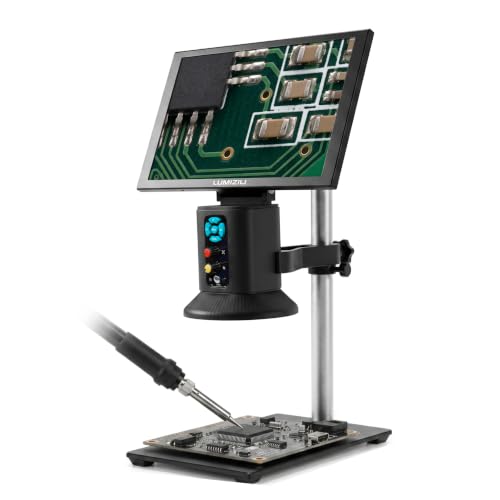
- 10.1-inch screen for real-time repair viewing
- 8.29MP sensor with 4K HDMI output
- Remote focus and LED illumination for inspection
Best For: PCB soldering and screen-based electronics inspection
Best Value Multi-Lens Option
Andonstar AD246S-M Digital Microscope

- Three interchangeable lenses, including a soldering lens
- 2160P video with HDMI output
- 7-inch LCD, boom arm, remote, and 32GB card included
Best For: Repair benches needing soldering and general-purpose inspection in one kit
Best HDMI/VGA Value
60FPS Industrial Microscope Camera

- 60FPS 2MP video output
- HDMI and VGA connectivity
- 2x-130x viewing range
Best For: Portable PCB, jewelry, and repair inspection
Best Complete Soldering Station

- 2160P HDMI microscope with 7-inch monitor
- Three lenses for soldering and varied subjects
- Helping hands, tools, mat, and storage included
Best For: Dedicated electronics repair benches
Best Long-Working-Distance Camera
NICE-POWER XVH2003 150X Microscope Camera

- 13MP camera with 1080P HDMI/VGA output
- Up to 1000mm lens working distance
- 56-LED adjustable ring light
Best For: Repair work needing tool clearance and flexible positioning
Top 4K Choice

- 4K 60FPS video with audio recording
- 360° boom arm with about 13-inch working distance
- 10.1-inch display plus HDMI and PC outputs
Best For: Professionals and creators needing smooth video and flexible soldering access
High-Resolution Repair Pick

- 60MP photos with 4K HDMI and USB video
- 150X zoom and up to 1000mm working distance
- Adjustable 56-LED ring light and four-part stand
Best For: PCB repair and inspection requiring high-resolution images and tool clearance
Best Trinocular Setup – HengTianMei TX-350E 4K Microscope
For buyers seeking professional microscope soldering cameras, the HengTianMei TX-350E combines a trinocular stereo zoom microscope with a 4K camera, adjustable 7X–50X magnification, and a generous work surface. Its HDMI-recommended camera connection is suited to detailed repair work and live viewing.
Best For: Electronics repair, watch work, and users who want a trinocular microscope with an integrated 4K camera.
Pros:
- 4K camera records at 4K 30 fps and 1080p 60 fps.
- 7X–50X variable magnification supports different repair tasks.
- Large 14.7-by-9.6-inch working floor accommodates larger projects.
- Includes a smoke exhaust fan and touch LED illuminator.
Cons:
- The camera setup is recommended for HDMI connection, which may require compatible display equipment.
- The unit weighs about 5.78 kg and uses corded power.
The TX-350E is a strong choice when camera quality, stereo viewing, and workspace matter more than compactness. Its included accessories make it especially practical for a dedicated repair bench.
Best Feature-Rich Kit – Andonstar AD249S-M 2160P Microscope
The Andonstar AD249S-M is a versatile option among professional microscope soldering cameras, pairing a 2160P digital camera system with three interchangeable lenses and an adjustable boom-arm stand. It can handle soldering, general inspection, and biological viewing without requiring separate microscopes.
Best For: Users who want one camera microscope for electronics repair, coins, biological slides, and demonstrations.
Pros:
- Lens L is designed for soldering and repair, while lenses A and D cover broader observation tasks.
- 2160P recording and HDMI output support detailed viewing on a larger screen.
- Adjustable metal boom arm provides a larger work envelope for soldering.
- Includes measurement software compatibility, remote control, adjustable LEDs, and a 32GB microSD card.
Cons:
- Changing lenses requires removing and installing screws.
- The very high stated magnification depends on lens choice and digital zoom.
- The multi-purpose design may be more equipment than a soldering-only workspace needs.
Choose the AD249S-M if flexibility is a priority. Its three-lens system and measurement features broaden its usefulness, while the boom arm and HDMI output keep it practical for hands-on repair and shared viewing.
Best Built-In Display – LUMIZILI 4K PCB Microscope
For straightforward PCB inspection, the LUMIZILI 4K Macro Explorer offers an 8.29MP sensor, 4K HDMI output, and a 10.1-inch built-in screen. This makes it a convenient choice among professional microscope soldering cameras for viewing enlarged details directly at the repair bench.
Best For: PCB soldering, electronics inspection, and users who prefer a dedicated screen with remote focus control.
Pros:
- 10.1-inch display provides real-time viewing while repairing.
- 8.29MP sensor supports 4K HDMI output without requiring a computer for direct viewing.
- Adjustable focus and LED illumination suit electronics, jewelry, watches, and hobby projects.
- Metal stand and enclosure support a stable bench setup.
Cons:
- The listed maximum magnification is 85X, lower than some multi-lens digital microscope kits.
- The specified 15-degree real angle of view may provide a more focused viewing area.
- Its built-in display may be less flexible than a binocular or trinocular eyepiece system.
The LUMIZILI is best when quick, screen-based inspection is more important than interchangeable optics. Its dedicated display, HDMI output, and remote focus make it a focused option for PCB work.
Best Value Multi-Lens Option – Andonstar AD246S-M Digital Microscope
The Andonstar AD246S-M gives buyers a broad set of features for professional microscope soldering cameras, including 2160P video, HDMI output, three lenses, and a 7-inch LCD screen. Its Lens L is intended for soldering and repair, while the other lenses support coins, plants, stones, and biological slides.
Best For: Electronics repairers and hobbyists who want soldering capability alongside general-purpose magnification.
Pros:
- Lens L covers circuit-board and mobile-phone repair applications.
- 2160P video recording and HDMI output support detailed external viewing.
- Adjustable boom arm and metal construction suit a larger soldering work area.
- Includes remote control, eight LED brightness levels, measurement software compatibility, and a 32GB microSD card.
Cons:
- The 7-inch display is smaller than the 10.1-inch screen on some alternatives.
- Lens changes require removing and installing screws.
- Stated magnification varies substantially by lens and includes digital zoom.
The AD246S-M is a practical all-around kit for users who want a dedicated soldering lens without giving up broader observation options. Its smaller screen may suit more compact benches, while HDMI output supports larger displays when needed.
Best HDMI/VGA Value – 60FPS Industrial Microscope Camera
For shoppers comparing professional microscope soldering cameras, this QUEMARQUE model emphasizes smooth 60FPS viewing, flexible HDMI/VGA connectivity, and adjustable magnification for PCB inspection, soldering, jewelry, and repair work.
Best For: Technicians who need a portable industrial camera with HDMI and VGA monitor compatibility.
Pros:
- 60FPS video with 2MP clarity for fluid inspection footage.
- HDMI and VGA outputs support varied workshop displays.
- Adjustable 2x optical magnification and digital zoom up to 130x.
- Customizable on-screen crosshairs assist alignment and dimensional checks.
Cons:
- It is a camera-based system, so a separate display may be needed for viewing.
- The supplied notes do not identify a built-in light source.
This is a practical choice when smooth video and legacy display connectivity matter more than an all-in-one microscope station. Its metal housing and compact 1.2-pound design also suit workspaces where equipment needs to be moved between inspection areas.
Best Complete Soldering Station – Andonstar AD246S-M Plus
The Andonstar AD246S-M Plus stands out among professional microscope soldering cameras as a complete 2160P workstation, combining a 7-inch monitor, three interchangeable lenses, helping hands, tool storage, and a soldering mat.
Best For: Electronics repairers who want an integrated soldering and inspection station with broad magnification options.
Pros:
- 2160P video output and a 7-inch microscope monitor provide detailed viewing.
- Three lenses cover soldering, general objects, and biological slides.
- Helping hands, tool holder, extension base, storage boxes, and anti-static mat support organized repair work.
- Includes remote control, 32GB SD card, adjustable LED lighting, and Windows measurement software support.
Cons:
- The multi-part station has a larger footprint than a camera-only setup.
- Some of the highest magnification ranges are intended for specialized viewing rather than routine soldering.
Choose this model if you want more than a camera and lens. Its bundled accessories make it especially suitable for a dedicated bench, while the interchangeable lenses add flexibility for projects beyond electronics repair.
Best Long-Working-Distance Camera – NICE-POWER XVH2003 150X Microscope Camera
For professional microscope soldering cameras that prioritize workspace flexibility, the NICE-POWER XVH2003 combines a 13MP sensor, 1080P HDMI/VGA output, a 150X C-mount zoom lens, and a foldable adjustable stand.
Best For: Electronics repair users who need generous clearance and adjustable positioning around a workpiece.
Pros:
- 13MP camera sensor with 1080P HDMI and VGA output.
- 150X zoom lens offers display magnification from 1x to 150x.
- Lens working distance can reach 1000mm, leaving room for tools and components.
- 56-LED ring light provides adjustable brightness up to 60,000 lux.
Cons:
- The package does not include a battery for the remote control.
- Its plastic enclosure may feel less rugged than a metal-bodied industrial camera.
- Remote-control functionality is available only in HDMI output mode.
This model is a strong fit for soldering tasks where hand access and camera clearance are important. The foldable, multi-angle stand and bright adjustable ring light add practical flexibility, although users should plan on supplying a compatible display.
Top 4K Choice – Andonstar AD210S-Pro
For shoppers comparing professional microscope soldering cameras, the Andonstar AD210S-Pro stands out with 4K at 60FPS, a generous 10.1-inch display, and a boom-arm design built around hands-on electronics work. Its extended working distance and multiple lighting options make it suitable for both soldering and general inspection.
Best For: Professionals and content creators who want smooth 4K video, audio recording, and a flexible soldering workspace.
Pros:
- 4K 60FPS video output with simultaneous audio recording and 64MP photos.
- Pro boom arm rotates 360 degrees and provides up to approximately 13 inches of working distance.
- Includes HDMI and PC outputs, adjustable top/side/bottom lighting, remote control, and a 64GB SD card.
Cons:
- Its larger 10.1-inch display and metal boom-arm setup may require more bench space.
- Higher magnification figures depend on the external 32-inch 4K monitor and digital zoom.
This is the most feature-rich option of the three for users who prioritize fluid live viewing, recording, and a versatile stand. It is especially compelling for demonstrations, tutorials, and detailed PCB work where workspace flexibility matters.
Flexible Stand Pick – NICE-POWER 48MP 4K Microscope
The NICE-POWER 48MP model is a practical option among professional microscope soldering cameras, combining 4K recording, a 150X continuous-zoom C-mount lens, and a foldable adjustable stand. Its long working distance leaves room for tools, while the bright ring light supports clearer viewing of electronics and other small objects.
Best For: Electronics repair users who want a compact, adjustable setup with strong lighting and flexible magnification.
Pros:
- Captures up to 48MP photos and supports 4K recording, with 1080P HDMI and Type-C output.
- 150X zoom lens offers up to 1000mm of working distance and 1–150X display magnification.
- 56-LED ring light reaches up to 60,000 Lux and includes brightness adjustment.
- Four-part foldable stand supports adjustable positioning for hands-free work.
Cons:
- Remote control operation is available only in HDMI output mode.
- The remote control battery is not included.
- It has a one-year warranty, shorter than the two-year warranty listed for the Andonstar.
Choose this model if stand flexibility and a long working distance are more important than an integrated monitor. It offers a useful balance of high-resolution capture, adjustable illumination, and tool access for repair benches.
High-Resolution Repair Pick – NICE-POWER 60MP 4K Microscope
For detailed PCB inspection, the NICE-POWER 60MP model offers a high-resolution take on professional microscope soldering cameras. It combines 60MP photos, 4K HDMI/USB video, continuous 1–150X zoom, and a long working distance that leaves room for soldering tools under the lens.
Best For: PCB repair, soldering, and inspection tasks where maximum listed photo resolution and tool clearance are priorities.
Pros:
- Captures 60MP photos and provides 4K video output through HDMI and USB.
- 150X continuous zoom and up to 1000mm working distance support close inspection with room to work.
- Adjustable 56-LED ring light delivers up to 60,000 Lux with brightness control.
- Four-part adjustable stand enables hands-free positioning for soldering and assembly.
Cons:
- Remote control operation is limited to HDMI mode.
- The remote control battery is not included.
- No built-in monitor is listed in the supplied specifications.
This is the strongest fit for buyers who value the highest listed still-image resolution and direct HDMI/USB connectivity. Its long working distance and adjustable stand also make it well suited to detailed repair work without crowding the workspace.
How We Picked These Professional Microscope Soldering Cameras
We focused on features that matter during real PCB inspection and repair rather than treating maximum advertised magnification as the deciding factor. The selection emphasizes image resolution, live-view performance, output options, lighting, stand flexibility, working distance, and suitability for prolonged bench work.
We also included different formats: trinocular stereo microscopes for users who want optical viewing, integrated digital microscopes with built-in displays, and C-mount systems that offer more camera and lens flexibility. Because product specifications can vary by configuration, verify the included lens, screen, stand, and output accessories before ordering.
Quick Comparison
| Type | Best For | Important Strength |
|---|---|---|
| Trinocular stereo system | Detailed repair and extended bench sessions | Optical viewing with camera documentation |
| Integrated HDMI microscope | Accessible live inspection | Built-in screen and straightforward setup |
| 4K digital microscope | Large-screen detail and recording | High-resolution image output |
| C-mount industrial camera system | Flexible installations | Adjustable camera and stand configuration |
Key Buying Factors for Professional Microscope Soldering Cameras
Resolution and Frame Rate
4K can make small pads, traces, and solder bridges easier to inspect, especially on a larger external monitor. Frame rate matters just as much for live soldering: a responsive 60fps feed generally feels more natural than a delayed or choppy image. Check whether the stated resolution applies to HDMI output, USB recording, or still images.
Magnification and Working Distance
A very high zoom number is not automatically better. Soldering requires enough clearance for an iron, tweezers, and airflow tools. Look for a usable low-to-high range and a stand that keeps the lens safely above the board. Optical magnification and digital zoom should be distinguished when comparing models.
Viewing and Connectivity
HDMI is useful for a low-latency monitor connection, while USB or USB-C can support recording and computer viewing. VGA may help with older displays. A built-in screen simplifies setup, but an external monitor can provide a larger image and more comfortable viewing distance.
Lighting, Stability, and Ergonomics
An adjustable LED ring or supplemental lighting helps reduce shadows on reflective solder. Prioritize a rigid stand, smooth height adjustment, adequate base space, and controls that can be reached without disturbing the camera. For frequent work, binocular optical viewing may reduce eye strain compared with relying solely on a screen.
Who Should Buy Which Professional Microscope Soldering Cameras?
Choose a trinocular stereo model if tactile repair work, depth perception, and long sessions are your priorities, with the camera used for documentation or a shared display.
Choose an integrated HDMI digital microscope if you want a compact, approachable system for inspection, hobby electronics, and occasional soldering with minimal setup.
Choose a 4K or high-frame-rate system if you regularly inspect fine-pitch components, demonstrate repairs, or record detailed bench work.
Choose a C-mount industrial setup if you value modularity and want to change lenses, displays, or mounting arrangements as your workflow develops. Before buying, confirm the camera’s actual output resolution, included accessories, and the stand’s available working distance.