The best network video recorders for small businesses make it easier to centralize camera feeds, record continuously, and review incidents without relying entirely on cloud subscriptions. The right model depends on your camera count, storage needs, network setup, and plans for future expansion.
This roundup compares 10 PoE and IP camera recorders ranging from compact four-channel units to high-capacity systems with 36 or more channels. Use the guide below to narrow the choices by capacity, video resolution, detection features, and installation requirements.
Best 10 Network Video Recorders for Small Businesses Picks for 2026
Best for Reolink Expansion

- Manages up to 36 Reolink IP cameras
- Three bays support up to 48TB
- Requires external PoE switches and hard drives
Best For: Large, all-Reolink camera systems
Best High-Capacity Choice

- Supports up to 64 IP cameras
- Offers 400 Mbps bidirectional bandwidth
- Provides SATA, eSATA, HDMI, and VGA expansion
Best For: Large or rapidly expanding IP-camera systems
Best Hybrid Value

- Supports multiple analog formats plus two IP cameras
- Includes a 2TB hard drive
- Adds human and vehicle detection
Best For: Mixed analog-and-IP camera systems
Best Integrated PoE Option
Instant Network Video Recorder

- Includes a built-in six-port PoE switch
- Supports six 4K or 15 Full HD cameras
- Requires a Gateway or Layer 3 switch
Best For: Compact Ubiquiti camera deployments
Best Compact Reolink NVR

- 8-channel support for Reolink PoE cameras
- Pre-installed 2TB hard drive
- Local and remote viewing without monthly fees
Best For: Small businesses using up to eight Reolink cameras
Best High-Capacity NVR

- Supports up to 32 IP cameras
- Four SATA interfaces support up to 32TB
- AI detection for people, vehicles, lines, and intrusions
Best For: Expanding business systems using separate PoE switches
Best Mid-Size Reolink NVR
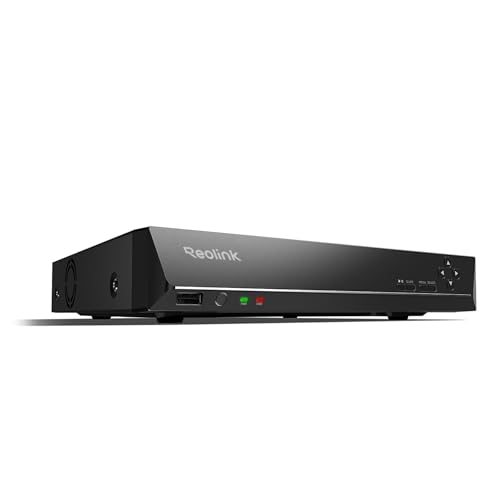
- Supports up to 16 Reolink PoE cameras
- Pre-installed 4TB hard drive
- Built-in detection integration and free remote-viewing apps
Best For: Growing businesses needing up to 16 Reolink cameras
ANNKE 12MP PoE Value Pick

- Supports ANNKE cameras up to 12MP
- Eight PoE ports for one-cable setup
- H.265+ storage-efficient recording
Best For: ANNKE-based small-business camera systems
Hiseeu Expandable System Pick

- Eight built-in PoE ports
- Expandable from 8 to 16 channels
- Supports up to 4K/8MP cameras
Best For: Growing installations that may need 16 channels
REOLINK Local-Search Pick

- Up to 8TB local HDD storage
- Local AI search for people and vehicles
- Four PoE ports plus two compatible Wi-Fi cameras
Best For: Compact REOLINK-based business security systems
Best for Reolink Expansion – 36-Channel PoE NVR
For small businesses already using Reolink cameras—or planning a larger Reolink system—the RLN36 is a centralized recorder with room for up to 36 IP cameras. It offers substantial storage expansion, but remember that it has no built-in PoE ports and requires compatible external Reolink PoE switches.
Best For: Small businesses building a large, all-Reolink camera system with centralized recording.
Pros:
- Supports up to 36 compatible Reolink IP cameras.
- Three drive bays support up to 48TB total storage, with hard drives sold separately.
- Includes human and vehicle detection integration, 24/7 recording, and USB 3.0 backup.
- Supports two-way talk with compatible Reolink cameras and connected audio equipment.
Cons:
- Works only with Reolink IP cameras.
- Has no built-in PoE ports, so external Reolink PoE switches are required.
- Hard drives are not included.
The RLN36 is a strong choice when capacity and camera count matter more than plug-and-play simplicity. Its expandable storage and 36-channel design suit growing small-business installations, provided you are comfortable supplying the switches, cameras, and hard drives separately.
Best High-Capacity Choice – 64-Channel 8K NVR
Businesses comparing network video recorders for small businesses may want the DS-7764NI-M4 when future expansion and high-resolution monitoring are priorities. This 64-channel recorder supports substantial bandwidth, multiple display outputs, and expandable storage, though it does not include hard drives or built-in PoE.
Best For: Small businesses with extensive IP-camera deployments or plans for significant expansion.
Pros:
- Supports up to 64 IP camera channels.
- 400 Mbps incoming and outgoing bandwidth supports centralized video handling.
- Four SATA interfaces and one eSATA interface provide flexible storage expansion.
- Supports 8K single-display or dual-4K output through two HDMI ports and one VGA port.
Cons:
- Hard drives are not included.
- Has no built-in PoE ports.
- The large channel capacity may exceed the needs of smaller installations.
This recorder is best viewed as an expansion-focused platform rather than a simple starter kit. Its bandwidth, decoding capability, and storage interfaces make it suitable for demanding multi-camera sites, but setup requires separate cameras, storage, and PoE equipment.
Best Hybrid Value – 16-Channel Security DVR
The ANNKE 3K Lite is a practical option for small businesses that need a recorder for a mixed camera setup. Its hybrid design supports up to 16 analog cameras plus two IP cameras, while the included 2TB hard drive and human/vehicle detection make it easier to deploy than storage-free NVR units.
Best For: Small businesses upgrading or managing a mixed analog-and-IP camera system.
Pros:
- Supports TVI, AHD, CVI, CVBS, and up to two additional IP cameras.
- Includes a 2TB security-grade hard drive.
- Human and vehicle detection can reduce alerts from animals, leaves, and other motion.
- Remote access is available through the ANNKE Vision app and compatible browsers.
Cons:
- IP-camera support is limited to two cameras.
- Its BNC-focused design is less suitable for an all-IP installation.
- It has one USB port.
Choose the ANNKE when compatibility with existing coaxial cameras is more important than maximizing IP channels. The included storage, remote access, and detection features create a convenient small-business package for hybrid surveillance environments.
Best Integrated PoE Option – Instant Network Video Recorder
For small businesses seeking a compact network video recorder with simpler camera connectivity, Ubiquiti’s UNVR-Instant combines recording with a built-in six-port PoE switch. It supports up to six 4K or 15 Full HD cameras, but it must link to a Gateway or Layer 3 switch and requires a compatible 3.5-inch hard drive.
Best For: Small Ubiquiti camera deployments that benefit from integrated PoE and local HDMI viewing.
Pros:
- Built-in six-port PoE switch simplifies camera connections.
- Supports up to six 4K or 15 Full HD cameras.
- Includes an HDMI viewing port for local monitoring.
- Accepts a 3.5-inch hard drive.
Cons:
- Requires a Gateway or Layer 3 switch.
- Hard-drive capacity is not specified in the supplied details.
- Its camera capacity is lower than larger multi-channel recorders.
The UNVR-Instant is appealing when integrated PoE and a compact Ubiquiti-oriented setup are priorities. Verify the required network equipment and storage before buying, especially if your business expects to add cameras beyond the supported limits.
Best Compact Reolink NVR – 8-Channel PoE Recorder
For small businesses building a focused camera network, this 8-channel Reolink NVR offers a straightforward way to record and manage up to eight compatible PoE cameras. It includes a 2TB hard drive, supports 24/7 recording, and can operate locally with or without an internet connection.
Best For: Small businesses using Reolink cameras that need an easy-to-deploy, compact recording system.
Pros:
- Supports up to eight Reolink PoE cameras with one Ethernet cable for power and data.
- Includes a pre-installed 2TB hard drive for 24/7 recording.
- Offers human, vehicle, and animal detection integration with compatible Reolink cameras.
- Provides free mobile and desktop apps for local or remote viewing without monthly fees.
Cons:
- Works only with Reolink IP cameras, not third-party cameras.
- The system has eight channels, which may limit future expansion.
- Additional storage requires a separately added drive through the eSATA port.
The RLN8-410 is a practical choice when eight camera channels are sufficient and the business already uses, or plans to use, Reolink cameras. Its built-in storage and plug-and-play PoE design simplify installation, while compatibility limitations should be considered before purchasing.
Best High-Capacity NVR – ANNKE 32-Channel AI Recorder
This ANNKE 32-channel NVR is designed for small businesses that need room to cover a larger property or expand over time. It supports high-resolution IP cameras, AI motion detection, H.265+ compression, and up to 32TB of storage, but it does not include a hard drive or built-in PoE ports.
Best For: Businesses planning a larger multi-camera system with separate PoE switches and expandable storage.
Pros:
- Supports up to 32 IP cameras and resolutions up to 12MP, depending on the camera and setup.
- Includes human and vehicle detection plus line-crossing and intrusion detection.
- Four SATA interfaces support up to 32TB total storage, with drives purchased separately.
- H.265+ compression can reduce storage use and support smoother streaming.
Cons:
- Includes no hard drive, so storage must be purchased and installed separately.
- Has no built-in PoE ports; two 16-port PoE switches are needed for full 32-camera coverage.
- ANNKE cameras are recommended to help avoid compatibility issues.
The ANNKE N84PBH is a flexible foundation for businesses that expect to grow beyond a basic camera installation. Its channel count and storage expansion are strong advantages, but the added cost and setup work for PoE switches and hard drives make it better suited to planned installations than quick plug-and-play deployments.
Best Mid-Size Reolink NVR – 16-Channel PoE Recorder
For small businesses that need more coverage than an eight-channel recorder provides, this 16-channel Reolink NVR combines built-in PoE connectivity with a 4TB hard drive. It supports 24/7 recording for up to 16 compatible Reolink cameras and enables local or remote access through Reolink apps.
Best For: Growing businesses that want a simple Reolink-based system with capacity for up to 16 cameras.
Pros:
- Manages up to 16 Reolink PoE cameras using one Ethernet cable per camera.
- Includes a pre-installed 4TB hard drive for continuous recording.
- Integrates human, vehicle, and pet detection with compatible Reolink cameras.
- Supports free Reolink apps and clients for iOS, Android, Windows, and Mac.
Cons:
- Compatible only with Reolink IP cameras.
- Expanding storage requires an additional drive through the eSATA connection.
- The 16-channel limit may not suit larger future deployments.
The RLN16-410 is a strong middle-ground option among network video recorders for small businesses that need broad coverage without managing separate PoE hardware. Its 4TB drive and 16-camera capacity make it more suitable for expansion than an eight-channel unit, provided the business is comfortable committing to the Reolink ecosystem.
ANNKE 12MP PoE Value Pick – 8-Channel AI-Compatible NVR
For small businesses already using ANNKE cameras, this 8-channel NVR offers a straightforward foundation for network video recorders for small businesses. It supports ANNKE cameras up to 12MP, uses PoE for one-cable power and data, and includes H.265+ compression for more efficient storage. The unit does not include a hard drive, so storage must be added separately.
Best For: Small businesses building or expanding an ANNKE-based camera system with up to eight PoE cameras.
Pros:
- Supports ANNKE 12MP, 8MP, 4K, 5MP, 4MP, and 3MP IP cameras.
- Eight PoE ports provide power and data over a single Ethernet cable.
- H.265+ can reduce storage usage by up to 75% compared with H.264.
- Free ANNKE Vision remote access is available without a monthly fee.
Cons:
- Designed primarily for ANNKE cameras; third-party compatibility should be confirmed with support.
- No hard drive is included.
- The NVR itself has no built-in AI functions; AI features depend on compatible ANNKE cameras.
This is a practical choice when compatibility with ANNKE cameras is the priority. Its eight-channel capacity and flexible 2.5- or 3.5-inch drive support suit smaller installations, but buyers should budget for a hard drive and avoid assuming broad third-party camera support.
Hiseeu Expandable System Pick – 4K 8-Port NVR
Businesses that may outgrow an eight-camera installation can consider this Hiseeu unit among network video recorders for small businesses. It has eight built-in PoE ports and can expand to 16 channels through an additional PoE switch. It supports cameras up to 4K/8MP, but the NVR ships without a hard drive and third-party camera setup is not fully plug-and-play.
Best For: Small businesses planning to expand from eight PoE cameras to as many as 16 channels.
Pros:
- Eight integrated PoE ports can power eight cameras over Ethernet.
- Expandable to 16 channels with a separate PoE switch.
- Supports up to 16 4K/8MP cameras when expanded.
- Remote viewing is available through the free Guard Live app and Guard Station software.
Cons:
- Third-party cameras require configuration and are not fully plug-and-play.
- No hard drive is included, and recording playback requires one.
- An additional PoE switch is needed for expansion beyond the built-in ports.
The Hiseeu stands out for its expansion potential and support for high-resolution cameras. It makes the most sense for buyers who expect their surveillance needs to grow, provided they are comfortable adding storage and handling extra configuration for non-Hiseeu cameras.
REOLINK Local-Search Pick – Compact 4-Channel PoE NVR
For a compact setup, this REOLINK recorder provides a focused option among network video recorders for small businesses. It supports up to four PoE REOLINK cameras, with room for two additional DC or Wi-Fi cameras, and records locally without a subscription when paired with a compatible internal hard drive. Local AI search can help locate people, vehicles, or events without manually reviewing the entire timeline.
Best For: Small businesses using REOLINK cameras that need compact local recording and easier footage searches.
Pros:
- Supports continuous local recording with an added surveillance-grade HDD up to 8TB.
- PoE provides power and data through one Ethernet cable.
- Local AI search helps find people, vehicles, or events in recorded footage.
- Supports simultaneous multi-user viewing and permission management.
Cons:
- Works only with REOLINK IP cameras.
- HDD and microSD card are not included.
- PoE capacity is limited to four cameras, with support for up to six total cameras when two compatible Wi-Fi cameras are added.
This is a good fit for a small, REOLINK-centered deployment where local storage, wired stability, and quick footage searches matter. Its limited camera compatibility and four PoE ports make it less suitable for mixed-brand systems or larger expansions.
How We Picked These Network Video Recorders for Small Businesses
We focused on practical features that affect daily surveillance management: channel capacity, PoE connectivity, supported resolution, recording bandwidth, storage configuration, motion or person detection, and upgrade potential. The selection includes compact recorders for small offices and larger systems suited to retail locations, warehouses, multi-site properties, or businesses adding cameras over time.
We also considered whether a recorder includes a hard drive, supports expandable storage, or requires buyers to supply compatible surveillance-grade drives. Because compatibility varies between recorder brands and cameras, confirm ONVIF support, app features, and camera-resolution limits before ordering.
Quick Comparison
- For small installations: Four- and eight-channel recorders are typically easier to configure and may cost less, especially when only a few cameras are needed.
- For growth: Sixteen-, 32-, and 36-channel NVRs provide room for additional cameras without replacing the recorder.
- For high-resolution cameras: Check decoding capability and incoming bandwidth, not just the advertised channel count.
- For simpler installations: Built-in PoE ports can power compatible cameras and reduce the need for a separate PoE switch.
- For storage flexibility: No-HDD models let you choose capacity, while bundled-drive systems can be quicker to deploy.
Key Buying Factors for Network Video Recorders for Small Businesses
Channel Count and Expansion
Choose based on the number of cameras you need today plus realistic future additions. A recorder with exactly enough ports may be economical, but leaving unused channels can prevent an expensive replacement later.
Resolution and Recording Bandwidth
Higher-resolution cameras require more processing, network capacity, and storage. Review the recorder’s supported resolution, incoming bandwidth, simultaneous playback limits, and HDMI output capabilities to ensure it can handle your camera mix.
PoE and Network Design
Integrated PoE ports simplify cabling for nearby cameras, but a separate PoE switch may be better for larger buildings or long cable runs. Check the port speed, power budget, and maximum Ethernet distance before installation.
Storage and Retention
Retention time depends on camera count, resolution, frame rate, compression, and whether recording is continuous or event-based. Select a compatible surveillance hard drive and verify drive bays or capacity limits. Redundant storage can be valuable where footage is business-critical.
Detection, Remote Access, and Security
Human and vehicle detection can reduce false alerts compared with basic motion sensing. Also evaluate mobile applications, user permissions, firmware support, secure remote access, and whether the recorder remains useful if internet service is interrupted.
Who Should Buy Which Network Video Recorders for Small Businesses?
Choose a four- or eight-channel NVR for a small office, shop, or home-based business with a limited camera plan. These models are a sensible fit when straightforward installation matters more than extensive expansion.
Choose a 16-channel model for growing businesses that need coverage for entrances, work areas, parking, storage, and customer-facing spaces. It offers a useful balance of capacity and cost.
Choose a 32- or 36-channel recorder for larger premises, multiple buildings, or buyers who expect substantial expansion. Confirm network bandwidth and storage requirements before pairing one with many high-resolution cameras.
Choose a recorder with AI detection when reducing unnecessary notifications is a priority. For demanding deployments, prioritize supported camera features, reliable remote access, and a clear storage-retention plan over channel count alone.