Finding heat-related faults early can save time, reduce guesswork, and help prevent expensive automotive repairs. The best thermal cameras for cars make it easier to spot abnormal temperatures in electrical systems, batteries, brakes, cooling components, and HVAC systems.
This roundup compares 10 options across handheld, smartphone, and vehicle-focused designs, with attention to image quality, portability, connectivity, and practical diagnostic features.
Best 10 Professional Thermal Imaging Cameras for Cars Picks for 2026
Best for Detailed Shop Diagnostics

- 240×180 TISR thermal detail
- Windows PC analysis and reports
- -4°F to 1022°F measurement range
Best For: Automotive engine inspections and professional mechanical diagnostics
Best for Long-Range Driving Awareness

- 656-foot thermal detection range
- AI alerts for vehicles, people, and animals
- App control with lifetime OTA updates
Best For: Nighttime road hazard awareness in cars, trucks, SUVs, and RVs
Best Compact Inspection Camera

- 240×240 TISR-enhanced resolution
- Up to 15 hours of runtime
- Automatic capture for temperature alerts
Best For: Portable automotive, electrical, and mechanical troubleshooting
Best Integrated Automotive Night Vision

- 328-yard stated thermal viewing range
- Thermal, visible, and fusion modes
- AI collision warnings with voice control
Best For: Installed night-vision assistance for cars, trucks, RVs, and buses
Professional Detail Pick
- 480×360 super-resolution output
- MSX thermal and visual image overlay
- 1.5-meter drop-rated design
Best For: iPhone-based automotive inspections
Dedicated Night-Driving System

- 656-foot thermal detection claim
- AI alerts for people, vehicles, and animals
- 6.25-inch display with 12V installation
Best For: Night driving and low-visibility road awareness
Compact Inspection Value

- 240×180 super-resolution output
- MSX image enhancement
- Compact and 1.5-meter drop-rated
Best For: Occasional iPhone-based automotive checks
Professional Power Pick

- 160 × 120 thermal resolution with MSX
- -20°C to 400°C measurement range
- Wi-Fi and FLIR Ignite Cloud connectivity
Best For: Professional technicians needing high-resolution diagnostics and documentation
Compact Value Choice
- Lightweight 6.72-ounce compact design
- 128 × 96 thermal resolution with MSX
- Wi-Fi and FLIR Ignite report sharing
Best For: Mobile inspections where portability and documentation are priorities
Rugged Compact Upgrade

- 160 × 120 thermal resolution with MSX
- -20°C to 400°C measurement range
- Waterproof body with Wi-Fi and Ignite
Best For: Field technicians wanting compact, higher-resolution thermal inspections
Best for Detailed Shop Diagnostics – FOXWELL RT280
For mechanics and technicians comparing professional thermal imaging cameras for cars, the FOXWELL RT280 emphasizes detailed inspection work. Its enhanced 240×180 TISR resolution, broad temperature range, alarms, and PC analysis tools make it useful for investigating automotive engine and mechanical issues.
Best For: Automotive engine inspections, mechanical fault diagnosis, and technicians who want PC-based reporting.
Pros:
- 240×180 effective resolution with a 320×240 display and 25Hz refresh rate
- Measures from -4°F to 1022°F with high, low, and center-point detection
- Windows software supports point, line, area, 2D/3D, and report analysis
- Stores more than 20,000 images and videos on built-in 8GB eMMC storage
Cons:
- PC analysis software is not compatible with Mac
- Its broader inspection feature set may be more than casual users need
The RT280 is a strong choice when documentation and post-inspection analysis matter. Its rugged IP54, drop-resistant design, laser, LED light, and temperature alarms also suit demanding shop environments.
Best for Long-Range Driving Awareness – Robofinity InsightDrive
Drivers seeking professional thermal imaging cameras for cars will find the Robofinity InsightDrive focused on road visibility rather than handheld shop diagnostics. This hood- or grille-mounted system combines thermal night vision, AI recognition, and app customization to help identify hazards in difficult driving conditions.
Best For: Night driving in cars, SUVs, trucks, and RVs where long-range hazard detection is the priority.
Pros:
- Thermal detection range rated up to 656 feet
- Designed to operate in darkness, rain, snow, fog, and glare
- AI recognizes vehicles, pedestrians, and animals and provides real-time alerts
- Plug-and-play installation, iOS/Android app support, and lifetime OTA updates
Cons:
- 720p video resolution is oriented toward driving assistance rather than detailed bench inspection
- Requires vehicle mounting and app-based setup
- Its 40-degree field of view may not suit every installation preference
InsightDrive is best viewed as an automotive night-vision and warning system. The included 32GB card, 6.25-inch IPS touchscreen, and 30 FPS capture add practical usability for drivers who want a dedicated forward-facing thermal view.
Best Compact Inspection Camera – TOPDON TC004 Mini
The TOPDON TC004 Mini is a practical option for buyers who want professional thermal imaging cameras for cars in a compact handheld format. TISR enhancement, temperature alarms, automatic photo capture, and a long stated runtime make it suitable for quick automotive, electrical, and mechanical checks.
Best For: Portable troubleshooting, under-hood checks, electrical inspections, and users who value long battery life.
Pros:
- Enhances 128×128 thermal data to 240×240 with TISR technology
- Measures -4°F to 842°F and automatically identifies high, low, and center temperatures
- Automatic photo capture can document temperature-limit alerts
- Up to 15 hours of runtime, IP54 protection, and drop resistance up to 2 meters
Cons:
- 512MB storage holds up to 8,000 photos, less than some larger inspection cameras
- Only five color palettes are provided
- Charging cable is included, but a charging head is not
Its pocket-friendly design and straightforward alerts make the TC004 Mini easy to keep in a toolbox or service vehicle. It is a sensible fit for routine diagnostics where portability and endurance matter more than advanced computer reporting.
Best Integrated Automotive Night Vision – Thermal Master NV300 Max
For motorists comparing professional thermal imaging cameras for cars, the Thermal Master NV300 Max is an integrated driving-assistance system with a built-in display. Its long-range thermal view, three viewing modes, AI collision warnings, and voice control are designed for low-visibility road conditions.
Best For: Drivers of cars, trucks, RVs, and buses who want an installed thermal night-vision system with its own screen.
Pros:
- Thermal vision reaches up to 328 yards in the supplied specifications
- Visible, infrared thermal, and fusion display modes provide viewing flexibility
- AI detects vehicles, pedestrians, animals, and other obstacles with visual and audible alerts
- 6.4-inch display, voice control, quick installation, and included OBD functionality
Cons:
- Roof-mount installation may require more planning than a handheld camera
- Its 25-degree listed field of view is narrower than some inspection-oriented cameras
- Designed for driving assistance, not close-up component temperature analysis
The NV300 Max stands out when the goal is safer visibility ahead rather than diagnosing individual car components. Its built-in display, magnetic 3D adjustment, SD-card media, and two-year warranty support ongoing vehicle use.
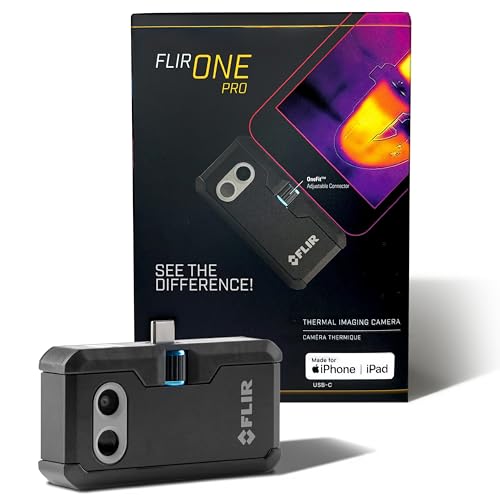
Professional Detail Pick – FLIR ONE Pro for iPhone
For iPhone 15 and newer users seeking professional thermal imaging cameras for cars, the FLIR ONE Pro is a compact inspection tool with enhanced image detail and phone-based convenience. Its 160×120 native IR sensor is upscaled to 480×360, while MSX overlays thermal data with visual details to help identify automotive and machinery issues.
Best For: iPhone users who want a portable thermal camera for automotive inspections and other maintenance tasks.
Pros:
- 480×360 super-resolution output from a 160×120 native IR sensor
- MSX technology combines thermal and visual imagery for clearer context
- Includes step-by-step inspection guides in the FLIR ONE app
- Drop-rated to 1.5 meters and designed for jobsite use
Cons:
- Compatible with iPhones using USB-C, including iPhone 15 and newer
- Requires a smartphone and the FLIR ONE app for operation
- Temperature accuracy is specified within stated operating ranges
The FLIR ONE Pro is a strong choice when image detail and broad inspection capability matter more than having a dedicated in-vehicle display. Its compact design makes it convenient for checking automotive components, though compatibility should be confirmed before purchase.
Dedicated Night-Driving System – EVIL ENERGY Thermal Camera
Drivers looking for professional thermal imaging cameras for cars may prefer the EVIL ENERGY system’s dedicated setup rather than a phone attachment. It pairs a 256×192 thermal sensor with a 6.25-inch HD display, AI target recognition, and detection claimed up to 656 feet for nighttime and low-visibility driving.
Best For: Drivers who want continuous thermal night vision with on-screen alerts and a no-wire-cutting installation.
Pros:
- Detects pedestrians, vehicles, and animals up to 656 feet away
- AI recognition covers pedestrians, vehicles, and nine listed animal species
- Includes a dedicated 6.25-inch HD display with audio and visual alerts
- Uses a 12V cigarette-lighter connection and is rated IP67
Cons:
- Installation requires mounting hardware and several included components
- Image sharpness may gradually decrease between automatic shutter calibrations
- Warranty description lists a one-month period
This is the most vehicle-focused option in the group, with long-range detection, a dedicated screen, and simple 12V power. It is better suited to ongoing night-driving awareness than close-up temperature troubleshooting.
Compact Inspection Value – FLIR ONE for iPhone
The FLIR ONE offers a more accessible entry point for iPhone 15 and newer owners comparing professional thermal imaging cameras for cars. Its 80×60 native IR sensor produces 240×180 super-resolution imagery, and MSX processing adds visual outlines to make thermal findings easier to interpret.
Best For: iPhone users who need a compact thermal inspection camera for occasional automotive checks and general maintenance.
Pros:
- 240×180 super-resolution output from an 80×60 native IR sensor
- MSX technology adds visual detail to thermal images
- App-based inspection guides support common troubleshooting tasks
- Compact, lightweight body is rated for a 1.5-meter drop
Cons:
- Limited to iPhones with USB-C, including iPhone 15 and newer
- Lower native and super-resolution image specifications than the FLIR ONE Pro
- Requires a compatible smartphone and app
The standard FLIR ONE is a practical choice for basic automotive inspections when portability and straightforward phone integration are priorities. Choose the Pro model instead if you expect to need its higher image resolution and finer thermal detail.
Professional Power Pick – FLIR E5 Pro
For demanding automotive inspections, the FLIR E5 Pro is one of the more capable professional thermal imaging cameras for cars. Its 160 × 120 thermal resolution, MSX image enhancement, and broad -20°C to 400°C measurement range support clearer troubleshooting of heat-related faults.
Best For: Professional technicians who want higher resolution, cloud connectivity, and a wide temperature range.
Pros:
- 160 × 120 thermal resolution with MSX for sharper, easier-to-read images.
- Measures temperatures from -20°C to 400°C (-4°F to 752°F).
- FLIR Ignite Cloud supports automatic storage, editing, sharing, and reports through the app.
- Includes a two-year camera warranty and 10-year detector coverage.
Cons:
- Its handheld design is heavier than the compact C-series models listed here.
- May offer more capability than casual or occasional users need.
The E5 Pro is a strong fit when diagnostic clarity, documentation, and operating range matter more than having the smallest camera. Over-the-air updates also help keep its features current.
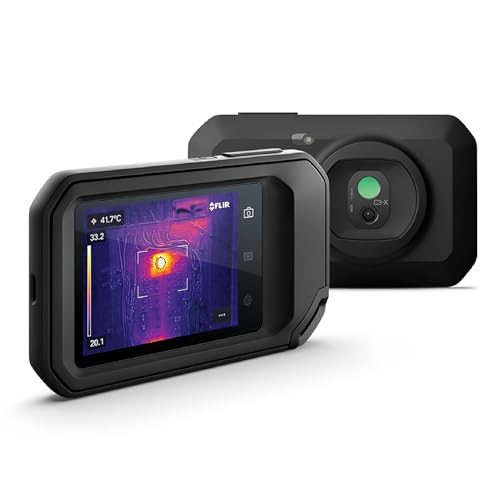
Compact Value Choice – FLIR C3-X
The FLIR C3-X is a lightweight option for users seeking professional thermal imaging cameras for cars in a compact format. It combines 128 × 96 thermal resolution with MSX enhancement, Wi-Fi, and FLIR Ignite connectivity for documenting and sharing findings.
Best For: Mobile inspectors and technicians who prioritize portability and straightforward image sharing.
Pros:
- Compact 6.72-ounce design is easy to carry between inspections.
- 128 × 96 true thermal resolution and MSX help reveal and clarify hidden faults.
- Wi-Fi and FLIR Ignite support direct uploads, professional reports, and email sharing.
- Measures temperatures from -20°C to 300°C (-4°F to 572°F).
Cons:
- Its thermal resolution is lower than the FLIR E5 Pro and C5.
- The 300°C maximum measurement temperature is narrower than those 400°C models.
- Fixed focus may be less flexible for varied inspection distances.
The C3-X makes sense when portability and report sharing are central to your workflow. It still provides true thermal imaging and MSX detail, though its resolution and temperature range are more limited.
Rugged Compact Upgrade – FLIR C5
The FLIR C5 offers a useful middle ground for professional thermal imaging cameras for cars, pairing a compact body with 160 × 120 thermal resolution. Its MSX processing, Wi-Fi, Ignite cloud connectivity, and waterproof construction support practical inspections and customer-ready documentation.
Best For: Technicians who want compact handling without giving up higher thermal resolution.
Pros:
- 160 × 120 thermal resolution with MSX produces clearer diagnostic images.
- Measures temperatures from -20°C to 400°C (-4°F to 752°F).
- Wi-Fi and FLIR Ignite allow direct uploads, reports, and email sharing.
- Waterproof construction and a 3.5-inch LCD screen suit hands-on field work.
Cons:
- Fixed focus may limit flexibility when inspecting at different distances.
- The compact screen and camera format may not replace a larger professional display for every workflow.
The C5 is a compelling compact choice when you want the E5 Pro’s stated thermal resolution and temperature range in a smaller form. Its waterproof construction adds practical flexibility for field inspections.
How We Picked the Best Professional Thermal Imaging Cameras for Cars
We focused on cameras that can support real automotive troubleshooting rather than general-purpose temperature checks alone. Key considerations included infrared resolution, image enhancement, temperature measurement features, display or phone compatibility, storage and connectivity, viewing ergonomics, and suitability for workshop or roadside use.
The selection includes dedicated handheld cameras, compact smartphone accessories, and vehicle-oriented thermal night-vision products. Because automotive jobs vary widely, the “best” choice depends on whether you prioritize detailed component inspection, portability, live driving visibility, or a straightforward standalone workflow.
Quick Comparison: Automotive Thermal Cameras
- Highest-detail inspection: Look for higher native infrared resolution and enhanced image modes, especially when examining small connectors, fuses, circuit boards, or battery modules.
- Most portable: Smartphone-connected cameras are easy to carry and can be useful for occasional diagnostics, provided your phone has the correct connector and operating-system support.
- Best standalone workflow: Handheld units with built-in screens reduce setup time and remain usable when a phone is unavailable or inconvenient.
- Best for driving visibility: Vehicle-focused thermal cameras and dashcam-style systems are designed for forward-looking nighttime awareness rather than close component inspection.
Key Buying Factors for Professional Thermal Imaging Cameras for Cars
Resolution and Image Clarity
Native infrared resolution matters more than an enhanced or “super resolution” label when you need to distinguish nearby hot spots. Higher resolution generally produces clearer images of small automotive parts, although image processing can improve usability and edge definition.
Temperature Range and Measurement Tools
Check the stated temperature range and whether the camera provides spot measurements, minimum and maximum markers, area readings, emissivity adjustment, or temperature alarms. These tools help turn a visible heat pattern into a more useful diagnostic observation.
Connectivity and Documentation
Wi-Fi, USB connectivity, image transfer, and cloud or app support can simplify reports and before-and-after comparisons. Confirm compatibility with your phone model—particularly USB-C requirements for newer iPhones—and review whether files can be exported in a format your workflow supports.
Ruggedness and Operating Convenience
For shop use, consider grip comfort, screen visibility, battery life, protective construction, focus requirements, and controls that can be operated while wearing gloves. A compact camera may be convenient, but a dedicated display can be faster during repeated inspections.
Who Should Buy Which Professional Thermal Imaging Cameras for Cars?
Professional technicians and busy workshops should favor a dedicated handheld with dependable measurements, a clear display, and enough resolution for component-level troubleshooting. DIY mechanics may get better value from a compact phone-connected model for checking overheating brakes, fuses, relays, connectors, and cooling-system patterns.
EV owners and specialists should prioritize measurement range, image detail, and documentation features for battery, charging, and high-current electrical inspections. Drivers seeking nighttime awareness should choose a vehicle-oriented thermal night-vision system rather than a close-range inspection camera. Before buying, verify connector compatibility, software support, warranty coverage, and whether the camera’s measurement accuracy matches the temperatures you expect to encounter.