Choosing the right air monitor can make a real difference in comfort, productivity, and peace of mind. For homes, offices, classrooms, and other shared spaces, the best devices do more than display a number—they help you spot trends and act early.
This roundup of professional indoor air quality monitors focuses on practical performance, useful alerts, and the measurements that matter most in real-world indoor environments.
Best 10 Professional Indoor Air Quality Monitors Picks for 2026
Wireless CO2 Specialist
Aranet4 Indoor Air Quality Monitor
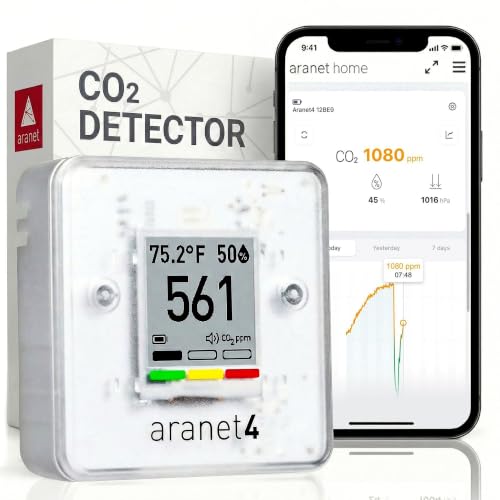
- CO2, temperature, humidity, and pressure tracking
- NDIR sensor with wireless e-ink display
- Up to 4-year battery life and 90-day app history
Best For: Users who mainly want accurate CO2 monitoring with minimal upkeep
Alexa-Connected Smart Monitor
Amazon Smart Air Quality Monitor

- Tracks PM2.5, VOCs, CO, humidity, and temperature
- Alexa app scoring plus phone and Echo alerts
- Can trigger compatible air purifiers, fans, and dehumidifiers
Best For: Alexa households that want alerts and automation from one monitor
Professional Multi-Sensor Pick

- Tracks CO2, PM1/2.5/10, TVOC, HCHO, temp, and humidity
- 90-day history with export in the Breathe Tech app
- Portable rechargeable design with up to 6 hours of use
Best For: Shoppers who want broad, app-connected pollutant monitoring
Budget-Friendly Multi-Index Monitor
16-in-1 Indoor Air Quality Monitor

- Tracks PM1.0, PM2.5, PM10, CO2, TVOC, HCHO, temp, and humidity
- Large HD screen refreshes readings every 3 seconds
- Portable design with Type-C charging and simple controls
Best For: People who want a simple portable monitor for everyday room checks
Home IAQ Multi-Sensor Pick
AcuRite 17012M Wi‑Fi Indoor Air Quality Monitor

- Tracks CO2, PM1.0/2.5/10, HCHO, and TVOC
- Wi‑Fi app access with remote monitoring
- Color IAQ meter plus audible alerts
Best For: Homes and workspaces that need broad air-quality coverage and simple alerts
Reporting-Friendly Smart Pick
CF-60PP SMART Air Quality Monitor

- Tracks PM, CO2, TVOC, HCHO, pollen, and AQI
- Cloud sync plus phone alerts for live oversight
- USB export and one-year data storage support reports
Best For: Users who need monitoring plus documented air-quality reporting
Data Export Precision Pick
Temtop LKC-1000S+ Air Quality Monitor

- 7-in-1 monitor with PM2.5, PM10, HCHO, VOCs, and AQI
- Excel export and 12-hour trend histogram
- Portable battery mode or continuous plugged-in use
Best For: Trend-focused users who want exportable readings for analysis and reporting
Large-Display AQI Tracker

- Tracks CO2, PM, HCHO, TVOC, temp, humidity, and AQI
- 7.2-inch screen with adjustable brightness
- Rechargeable and designed for cordless room-to-room use
Best For: Families and allergy-sensitive homes that want a big, readable monitor with flexible alerts
Real-Time 7-Inch AQI Monitor

- Shows CO2, PM, HCHO, TVOC, temp, humidity, AQI, and time
- 7-inch display with 3 brightness settings
- External sensors and 7 alert buzzers for quick warnings
Best For: Shoppers who want precise sensing, a large screen, and audible alert options
Wireless CO2 Specialist – Aranet4 Indoor Air Quality Monitor
If you want a professional indoor air quality monitor focused on ventilation and CO2 control, the Aranet4 is built around reliable day-to-day tracking. It measures CO2, temperature, humidity, and atmospheric pressure in real time, with a clear e-ink display and app history for reviewing trends over time.
Best For: Homes, offices, and classrooms where CO2 awareness and long battery life matter most.
Pros:
- Measures CO2, temperature, relative humidity, and atmospheric pressure.
- Uses NDIR sensor technology for precise CO2 readings.
- Wireless design with e-ink display and up to 4-year battery life.
- App stores up to 90 days of historical data with graphs.
Cons:
- Focused more on CO2 and comfort metrics than broader pollutant coverage.
- Does not list PM, VOC, or formaldehyde measurement in the supplied notes.
The Aranet4 is a strong pick if your main goal is understanding when a space needs more fresh air. Its simple display, long battery life, and historical app view make it practical for regular monitoring without a lot of setup.
Alexa-Connected Smart Monitor – Amazon Smart Air Quality Monitor
This Amazon Smart Air Quality Monitor is a practical choice if you want a connected professional indoor air quality monitor that works closely with Alexa. It tracks five key factors—PM2.5, VOCs, carbon monoxide, humidity, and temperature—and turns those readings into alerts, app updates, and automation options.
Best For: Alexa users who want simple smart-home alerts and automatic climate control.
Pros:
- Tracks PM2.5, VOCs, carbon monoxide, humidity, and temperature.
- Color-coded LED plus an easy-to-read air quality score in the Alexa app.
- Real-time alerts can appear on your phone or Echo devices.
- Supports routines for compatible purifiers, dehumidifiers, and fans.
Cons:
- Best suited to Alexa-based homes rather than standalone use.
- Needs the Alexa app for the most detailed information and setup.
For buyers already invested in Alexa, this monitor makes indoor air tracking feel straightforward and actionable. The combination of sensor readings, notifications, and routine-based automation helps turn air quality data into immediate responses.
Professional Multi-Sensor Pick – BREATHE Airmonitor Plus Gen 2
The BREATHE Airmonitor Plus Gen 2 is aimed at buyers who want a more complete professional indoor air quality monitor with broad pollutant coverage. It combines CO2, PM1, PM2.5, PM10, TVOC, formaldehyde, temperature, and humidity monitoring, plus app-based history and export tools for deeper review.
Best For: Detailed home, office, bedroom, or classroom monitoring with broad pollutant tracking.
Pros:
- Measures CO2, PM1, PM2.5, PM10, TVOC, formaldehyde, temperature, and humidity.
- NDIR CO2 sensor plus laser particle sensing for mixed-gas and particle tracking.
- 90-day app history with data export for long-term analysis.
- Portable rechargeable design with up to 6 hours of battery life.
Cons:
- Portable battery life is limited compared with always-plugged monitors.
- Requires 2.4 GHz Wi-Fi for app connectivity and remote readings.
This model stands out when you want more than basic air readings and need a fuller picture of indoor conditions. The combination of multiple sensors, alerts, and exportable history makes it especially useful for tracking patterns over time.
Budget-Friendly Multi-Index Monitor – 16-in-1 Indoor Air Quality Monitor
If you want a versatile professional indoor air quality monitor with a simple daily-use layout, this 16-in-1 model covers the core basics well. It tracks PM1.0, PM2.5, PM10, CO2, TVOC, HCHO, temperature, and humidity, and the large color screen updates every 3 seconds for quick checks.
Best For: Users who want a portable multi-parameter monitor for routine room-by-room checks.
Pros:
- Measures PM1.0, PM2.5, PM10, CO2, TVOC, HCHO, temperature, and humidity.
- 3-second data refresh and a large HD color screen.
- Single-button operation with dimmable lights for easier everyday use.
- Includes Type-C charging accessories and can be moved across rooms easily.
Cons:
- No alert or alarm functions are included.
- Less app-driven than more advanced smart monitors.
This is a straightforward option for people who want broad readings without a complicated interface. Its fast refresh rate, portability, and simple controls make it a practical pick for bedrooms, offices, nurseries, and temporary spaces.
Home IAQ Multi-Sensor Pick – AcuRite 17012M Wi‑Fi Indoor Air Quality Monitor
If you want professional indoor air quality monitors for everyday use, the AcuRite 17012M packs a broad sensor set into a compact Wi‑Fi unit. It tracks CO2, PM1.0, PM2.5, PM10, formaldehyde, total VOCs, temperature, and humidity, then simplifies everything with a quick-glance green, orange, or red status meter.
Best For: Homes, offices, garages, basements, or studios where you want broad indoor air tracking with simple visual alerts.
Pros:
- Measures CO2, PM1.0, PM2.5, PM10, formaldehyde, TVOC, temperature, and humidity.
- Wi‑Fi monitoring with remote access through the AcuRite NOW app.
- Audible unhealthy air alerts can be disabled in the app.
- Color-coded IAQ meter makes status easy to read at a glance.
Cons:
- No historical export or reporting features are listed in the supplied notes.
- App-based features are tied to the AcuRite NOW ecosystem.
Overall, this is a strong option if you want a broad, practical indoor monitor that emphasizes fast awareness over deep reporting tools. It is a good fit for users who want actionable alerts and clear status feedback without a complicated setup.
Reporting-Friendly Smart Pick – CF-60PP SMART Air Quality Monitor
The CF-60PP is aimed at buyers who want professional indoor air quality monitors with more than just instant readings. It tracks PM1.0, PM2.5, PM10, CO2, TVOC, HCHO, pollen, AQI, temperature, humidity, date, and time, while also syncing live data to the app and cloud for trend review.
Best For: Homes, classrooms, offices, and facility managers who want live monitoring plus exportable reporting.
Pros:
- Tracks a wide set of indicators, including pollen and mold-related humidity conditions.
- App and cloud sync let you review weekly or monthly trends remotely.
- USB export and up to one year of stored data support reporting needs.
- Custom alarm thresholds can trigger both local alerts and phone notifications.
Cons:
- More reporting-oriented than a simple plug-and-play basic monitor.
- Some advanced features depend on the app and cloud workflow.
This model stands out if you need documentation, trend analysis, or a monitor that can support building-level decision making. Its combination of local display, app visibility, and export tools makes it especially practical for users who need proof, not just a snapshot.
Data Export Precision Pick – Temtop LKC-1000S+ Air Quality Monitor
The Temtop LKC-1000S+ is a practical choice for professional indoor air quality monitors when accuracy and data review matter. It measures PM2.5, PM10, HCHO, VOCs, humidity, temperature, and AQI, and uses a laser particle sensor plus an electrochemical HCHO sensor for lab-tested accuracy.
Best For: Users who want trend-focused monitoring with Excel export for renovation, health, or ventilation checks.
Pros:
- 7-in-1 monitoring covers particles, formaldehyde, VOCs, temperature, humidity, and AQI.
- USB data export to Excel supports longer-term analysis and sharing.
- 12-hour trend histogram helps identify peaks from cooking, incense, or renovation fumes.
- Works as a portable spot-check device or a plugged-in continuous monitor.
Cons:
- Does not detect gas or CO leaks.
- Needs a 10-minute warm-up after temperature changes for stable readings.
- Accuracy guidance recommends avoiding sprays and strong cleaners near the device during testing.
For users focused on trend detection and clean data exports, this Temtop model offers a balanced mix of portability, display clarity, and reporting-friendly tools. It is especially useful when you want to document air changes over time rather than rely on a single reading.
Portable 10-in-1 Air Monitor – 10-in-1 Smart Tester
If you want a straightforward professional indoor air quality monitor for everyday room-by-room checks, this portable 10-in-1 unit covers the core basics in one compact display. It measures CO2, HCHO, TVOC, AQI, temperature, humidity, and PM levels in real time, making it useful for quick checks in bedrooms, offices, cars, and other indoor spaces.
Best For: Homeowners, renters, and commuters who want a compact multi-parameter monitor for general indoor air tracking.
Pros:
- Tracks 10 parameters, including CO2, HCHO, TVOC, AQI, temperature, humidity, PM1.0, PM2.5, and PM10
- High-definition color screen with a 3-color visualization system for fast reading checks
- Uses smart calibration and dedicated sensor technology for stable, long-term readings
- Portable design suited to bedrooms, kitchens, offices, cars, and similar spaces
Cons:
- Battery life and wireless runtime are not highlighted in the supplied notes
- More basic screen layout than larger-display rivals
This model is a practical pick if you want broad indoor air coverage without extra setup. It focuses on the essential measurements and clear visual alerts, which makes it a simple, useful option for monitoring air quality across different rooms.
Large-Display AQI Tracker – 16-in-1 VOC Meter
This professional indoor air quality monitor is aimed at users who want a larger screen and fast, real-time feedback across multiple air factors. It tracks CO2, PM, HCHO, TVOC, temperature, humidity, and AQI, while its alert system helps make changing room conditions easier to spot at a glance.
Best For: Families, allergy-sensitive households, and anyone who prefers a big display with highly visible alerts.
Pros:
- Tracks 9 key indicators with 7 user-defined alert thresholds
- 7.2-inch display with three brightness levels for easy viewing across a room
- High-precision sensor samples every 1.5 seconds and refreshes quickly
- Rechargeable 2500mAh battery supports cordless placement and up to 8 hours of use
Cons:
- Only the supplied notes mention up to 8 hours of wireless use, so it may need frequent charging
- Bulkier than smaller portable monitors because of the large screen
For buyers who value visibility and customizable alerts, this model stands out. Its large display, fast response, and easy setup make it a strong choice for monitoring indoor air in living spaces, bedrooms, nurseries, and offices.
Real-Time 7-Inch AQI Monitor – 16-in-1 Air Quality Monitor
If you are comparing professional indoor air quality monitors for a clear display and strong alerting, this 7-inch model is built around quick visibility. It provides real-time readings for CO2, PM2.5, PM1.0, PM10, HCHO, TVOC, temperature, humidity, AQI, and time, all on a large LED screen with brightness options.
Best For: Buyers who want a large, easy-to-read monitor with external sensors and audible AQI alerts.
Pros:
- Real-time monitoring for 9 key parameters plus time
- 7-inch LED display with three brightness settings
- External high-precision sensors with 0.001 accuracy and direct air sampling
- 7 AQI alert buzzers plus a mute button for quieter operation
Cons:
- Supplied notes warn against touching sensors or exposing them to perfumes/strong odors
- Time setting requires a few manual button steps
This is a good fit if you want a monitor that prioritizes fast visual checks and precise sensing. The external sensor setup and large display make it especially useful for spaces where you want immediate, easy-to-see air quality feedback.
How We Picked These Professional Indoor Air Quality Monitors
We focused on monitors that provide meaningful indoor data rather than basic novelty readings. Priority went to models that measure important pollutants such as CO2, PM2.5, VOCs, formaldehyde, temperature, and humidity, with clear displays or app support for easier day-to-day use.
We also looked for devices that fit common buyer needs: accurate-enough trend tracking, fast response times, readable screens, portable or wall-friendly formats, and smart features such as alerts, logging, or Wi-Fi connectivity.
Quick Comparison: What Different Monitor Types Are Best for
If you mainly want to track ventilation and occupancy, a CO2-focused monitor is often the most useful and cost-effective choice. If dust, smoke, or fine particle pollution is the concern, choose a unit with PM2.5 and PM10 sensing. For renovation projects, new furnishings, or odor complaints, VOC and formaldehyde monitoring can add important context.
Multi-parameter models are often the best fit for buyers who want one screen to cover multiple risks at once. These are especially useful when comparing rooms or documenting conditions over time.
Key Buying Factors for Professional Indoor Air Quality Monitors
Sensor Coverage
Start with the pollutants you actually need to track. Professional Indoor Air Quality Monitors are most valuable when the sensor suite matches your environment, whether that means CO2, particulate matter, VOCs, HCHO, temperature, or humidity.
Display, Alerts, and Logging
Look for a display that is easy to read across the room and alerts that are noticeable without being disruptive. App notifications, CSV exports, and history charts are especially helpful if you want to document air quality for workspaces, rentals, or building management.
Accuracy and Stability
For indoor monitoring, stable trends matter more than flashy claims. A good monitor should react consistently, avoid wild fluctuations, and give you enough confidence to compare readings before and after ventilation, filtration, or occupancy changes.
Portability and Placement
Desk placement, wall mounting, and battery or plug-in operation can all affect convenience. Choose the format that best matches how often you will move the device and where you need the readings.
Who Should Buy Which Professional Indoor Air Quality Monitors?
Homeowners and renters usually do well with a simple, reliable monitor that highlights CO2, PM2.5, and basic comfort factors. Office managers, facility teams, and landlords may benefit more from models with smart alerts, data logging, and broader sensing for shared spaces.
If you are comparing Professional Indoor Air Quality Monitors for technical troubleshooting or documentation, prioritize multi-sensor coverage, exportable data, and a display that makes patterns easy to interpret. If convenience is the main goal, choose the clearest interface and the fewest features you will actually use.