A reliable dock can turn a laptop into a more capable home-office workstation, connecting monitors, keyboards, storage, networking, and other peripherals through one cable.
These 10 USB docking stations for remote work cover simple dual-display setups, high-port-count workstations, and options with powerful USB-C charging. Use the guide below to match the right dock to your laptop and daily workflow.
Best 10 USB Docking Stations for Remote Work Picks for 2026
Best Dual-HDMI Value

- Dual HDMI supports up to 1920x1200 at 60Hz
- Gigabit Ethernet, audio, and six USB ports
- Does not charge the host laptop
Best For: HD dual-monitor productivity desks
Best for Triple-Monitor Desks
- Supports up to three extended HDMI displays
- Up to 100W laptop and 20W accessory charging
- Includes 13 ports for office peripherals
Best For: Triple-monitor home offices and business deployments
Best High-Power USB-C Dock

- 160W total output with multiple USB-C charging ports
- Dual HDMI supports up to 2K at 60Hz
- Up to 10Gbps data with Ethernet and audio
Best For: High-connectivity Windows and ChromeOS workstations
Best Compact Universal Dock

- Works with HP and non-HP USB-C laptops
- Supports up to three displays
- Compact design with HDMI, DisplayPort, Ethernet, and USB
Best For: Small, uncluttered multi-display workspaces
Best Compact Dual-Display Hub
Anker 8-in-1 Dual Monitor Dock

- Dual HDMI supports one 4K display at 60Hz or two at 30Hz
- Up to 85W pass-through charging
- Includes Ethernet, USB-A, SD, and microSD ports
Best For: Compact home-office setups with dual displays
Best for Managed Workplaces
- Up to 100W laptop power delivery
- Supports up to four high-resolution displays
- Business-focused manageability and three-year warranty
Best For: IT-managed home offices and multi-monitor workstations
Best High-Port-Count Dock
TobenONE 19-in-1 Docking Station

- 19 ports, including 10 USB connections
- Dual 4K HDMI and up to 100W PD charging
- Adds Ethernet, card readers, and 3.5mm audio
Best For: Peripheral-heavy dual-monitor workstations
Best for Port Variety
LIONWEI 13-in-1 Dual-Monitor Dock

- Dual HDMI plus DisplayPort outputs
- 10Gbps USB and Gigabit Ethernet
- 100W PD input with up to 87W laptop power
Best For: Windows home offices with multiple monitors and peripherals
Best for Simplicity and Security

- Dual HDMI supports up to 4K@60Hz
- SD and MicroSD readers included
- Up to 90W laptop charging and a lock button
Best For: Compact dual-monitor desks with card-reader needs
Best for Maximum Expansion
VVB 14-in-1 Triple-Display Dock

- 14 ports with HDMI, DisplayPort, Ethernet, and card readers
- 10Gbps USB-C and USB-A data ports
- Windows dual- or triple-display support
Best For: Windows workstations needing many connections and displays
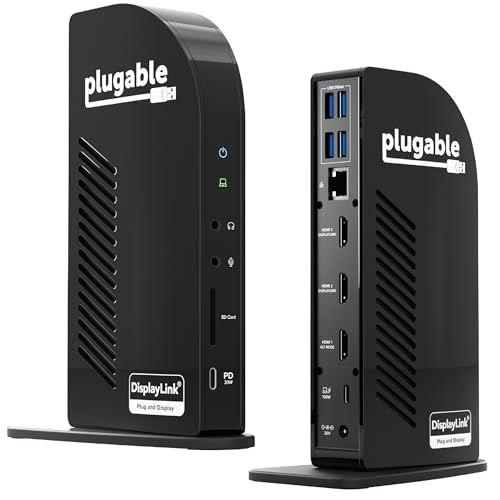
Best Dual-HDMI Value – Plugable UD-3900 USB 3.0 Dock
For shoppers comparing USB docking stations for remote work, the Plugable UD-3900 is a practical choice for adding displays, wired networking, audio, and multiple USB accessories through one connection. It supports two HDMI monitors at up to 1920×1200 at 60Hz, but it does not charge the host laptop.
Best For: Windows, ChromeOS, and compatible Mac users who need dual HD monitors and plenty of peripheral ports for productivity work.
Pros:
- Supports two HDMI displays at up to 1920×1200 at 60Hz.
- Includes Gigabit Ethernet, audio jacks, two USB 3.0 ports, and four USB 2.0 ports.
- Works with Windows, ChromeOS, and macOS with the appropriate driver setup; includes two-year coverage and lifetime support.
Cons:
- Does not charge the connected laptop.
- Requires DisplayLink installation on macOS and is not compatible with Linux or Unix.
- Not designed for gaming, 4K displays, DisplayPort connections, or HDCP-protected streaming content.
The UD-3900 focuses on dependable office expansion rather than high-end video or laptop charging. It is a sensible fit for a stationary remote-work desk using HD monitors and conventional USB accessories.
Best for Triple-Monitor Desks – Plugable 13-in-1 USB-C Dock
The Plugable 13-in-1 dock is built for remote workers who want a single-cable setup with laptop charging, three external displays, and a broad selection of office ports. Its DisplayLink design supports up to three extended HDMI monitors, with resolutions and macOS requirements varying by port and system.
Best For: Multi-monitor home offices, business deployments, and USB-C laptops that need up to 100W charging and extensive connectivity.
Pros:
- Supports up to three extended HDMI displays, including up to 4K at 30Hz on HDMI 1.
- Provides up to 100W laptop charging and 20W charging for a phone or accessory.
- Offers 13 ports, including USB-A, HDMI, SD, Gigabit Ethernet, and audio connections.
- Compatible with Windows 10+, macOS 11+, and ChromeOS systems with suitable USB-C, USB4, or Thunderbolt ports.
Cons:
- DisplayLink Manager is required for multiple displays on macOS.
- Does not support HDCP-protected playback such as Netflix or Hulu.
- Requires a full-featured USB-C connection for the listed laptop and display functions.
This dock is a strong all-in-one option when three-screen productivity and laptop charging matter more than a minimal port count. It also suits organizations standardizing desks across different laptop models.
Best High-Power USB-C Dock – Anker Prime 14-in-1 Dock
The Anker Prime 14-in-1 is a high-power option among USB docking stations for remote work, combining dual HDMI output, fast data ports, and charging for several devices. It supports dual displays up to 2K at 60Hz with a DP 1.4 laptop, while macOS mirrors the same image across both external monitors.
Best For: Windows and ChromeOS users who want high charging capacity, fast USB data transfers, and dual-display connectivity from a USB-C, USB4, or Thunderbolt laptop.
Pros:
- Offers 160W total output, with up to 100W available through each of three USB-C ports and 12W through USB-A.
- Provides 14-in-1 connectivity with data speeds up to 10Gbps, dual HDMI, audio, and Ethernet.
- Supports dual displays up to 2K at 60Hz with a DP 1.4 laptop.
Cons:
- macOS mirrors the same image on both external monitors rather than providing separate extended desktops.
- Not compatible with Linux and does not support a 5120×1440 monitor.
- Display capability depends on the laptop’s DP Alt Mode version.
The Anker Prime emphasizes charging and fast connectivity in a substantial 14-port package. It is most compelling for compatible Windows or ChromeOS setups where dual-screen output and multi-device charging are priorities.
Best Compact Universal Dock – HP USB-C G5 Essential Dock
The HP USB-C G5 Essential Dock offers a compact way to connect accessories, networking, and displays while charging a compatible laptop over one USB-C cable. It works with HP and non-HP USB-C or Thunderbolt-enabled laptops and supports up to three displays, making it useful for a flexible remote-work desk.
Best For: Users who want a small universal dock for USB-C or Thunderbolt laptops, multiple displays, and a less cluttered workspace.
Pros:
- Works with both HP and non-HP USB-C and Thunderbolt-enabled laptops.
- Supports up to three displays through a single USB-C connection.
- Combines HDMI, DisplayPort, Ethernet, USB, USB-C, and 3.5mm audio connectivity.
- Compact footprint measures approximately 5 by 5 inches and includes a power supply.
Cons:
- Provides only one HDMI port, so additional displays may need DisplayPort connections.
- Full functionality depends on a compatible USB-C or Thunderbolt-enabled laptop.
- Includes a one-year limited HP warranty.
This HP dock is a space-conscious choice for a mixed-device household or office. Its combination of display support, charging, and broad compatibility makes it a practical everyday hub, provided the laptop supports the required USB-C features.
Best Compact Dual-Display Hub – Anker 8-in-1 Dual Monitor Dock
If you need USB docking stations for remote work without adding much bulk to your desk, the Anker 8-in-1 hub offers a practical mix of display, networking, storage, and charging connections through one USB-C port. It supports one 4K display at 60Hz or two displays at 4K and 30Hz, though macOS mirrors the same image on both external monitors.
Best For: Remote workers who want a compact dock for dual monitors, wired networking, memory cards, and USB accessories.
Pros:
- Includes dual HDMI, Gigabit Ethernet, USB-A, SD, and microSD connections.
- Supports up to 85W USB-C Power Delivery pass-through charging.
- Works with USB-C, USB4, and Thunderbolt connections on compatible Windows and ChromeOS systems.
Cons:
- Requires a 100W PD wall charger and USB-C cable, which are not included.
- macOS mirrors the same content across both external monitors.
- Not compatible with Linux.
The Anker is a strong choice when portability and essential workstation expansion matter more than a large port count. Confirm that your laptop supports DisplayPort Alt Mode and Power Delivery before buying.
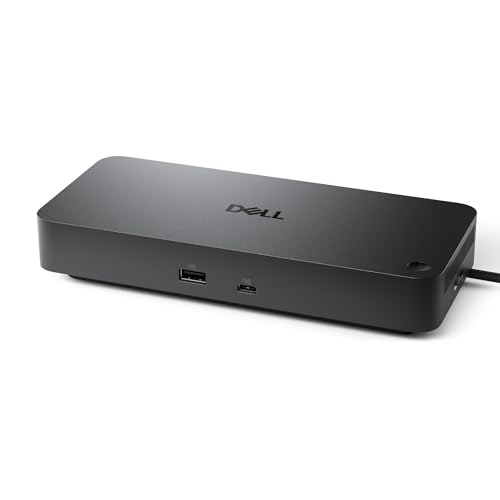
Best for Managed Workplaces – Dell Pro Dock WD25
For organizations comparing USB docking stations for remote work, the Dell Pro Dock WD25 focuses on broad compatibility, workplace manageability, and high-power charging. It delivers up to 100W to compatible Dell and non-Dell PCs and supports up to four high-resolution displays.
Best For: Remote employees and IT-managed workspaces that need a business-oriented universal dock with multi-display support.
Pros:
- Provides up to 100W of power for compatible laptops.
- Supports up to four high-resolution displays.
- Works with Windows, Ubuntu, Red Hat Enterprise Linux, and ChromeOS systems listed by Dell.
- Includes Ethernet, USB-A, USB-C, DisplayPort, and HDMI connectivity.
Cons:
- Its 1.2-pound, desktop-oriented design is less portable than a small USB-C hub.
- Only one HDMI port is listed, so additional displays may require DisplayPort connections or adapters.
- Power delivery and display capabilities depend on the connected computer and setup.
The WD25 makes the most sense for users who value reliable desk connectivity and fleet-level management features. Its three-year limited hardware warranty with Advanced Exchange is also useful for business deployments.
Best High-Port-Count Dock – TobenONE 19-in-1 Docking Station
The TobenONE 19-in-1 is built for remote workers who want to leave many peripherals connected at once. It combines 10 USB ports, dual 4K HDMI outputs, Gigabit Ethernet, SD and microSD readers, audio, and up to 100W Power Delivery through a single USB-C connection.
Best For: Windows and ChromeOS users with multiple monitors, storage devices, printers, accessories, and other desk peripherals.
Pros:
- Offers an extensive 19-port setup with 10 USB ports.
- Supports two 4K monitors and up to 100W laptop charging.
- Includes Gigabit Ethernet, SD, microSD, and 3.5mm audio connections.
- Supports file transfers at up to 5Gbps on applicable ports.
Cons:
- Requires a laptop with a full-featured USB-C port for complete functionality.
- The supplied compatibility information emphasizes Windows and ChromeOS; verify support for your specific computer.
- Its large port selection may be excessive for users with only basic connectivity needs.
Choose the TobenONE when minimizing cable swapping is a priority. It is especially well suited to a permanent workstation with two displays and numerous USB accessories, provided your laptop supports the required USB-C features.
Best for Port Variety – LIONWEI 13-in-1 Dual-Monitor Dock
For remote workers who need USB docking stations for remote work with extensive connectivity, this LIONWEI 13-in-1 model combines dual HDMI, DisplayPort, fast USB ports, Ethernet, audio, and card-free peripheral expansion in one compact hub. It supports up to 100W PD input, with up to 87W available for the laptop after the dock’s own power use.
Best For: Windows users building a multi-monitor home-office setup with numerous USB peripherals.
Pros:
- Offers dual HDMI and DisplayPort outputs, with up to 4K@60Hz supported on compatible Windows setups.
- Includes 10Gbps USB-C and USB 3.1 connectivity alongside three USB 3.0 and two USB 2.0 ports.
- Adds Gigabit Ethernet, a 3.5mm audio/mic jack, and 100W PD charging support.
Cons:
- On macOS, the dock can extend only one external monitor.
- The dock uses 13W, leaving up to 87W for laptop charging.
- Display features depend on the laptop’s operating system and source capabilities.
This is a flexible choice when your desk includes several accessories and wired networking. Its broad port selection is especially useful for Windows users, while Mac users should confirm the single-extended-monitor limitation before buying.
Best for Simplicity and Security – Acer 9-in-1 Dual-HDMI Dock
This Acer dock is a streamlined option among USB docking stations for remote work, pairing two HDMI outputs with USB-A and USB-C ports, SD and MicroSD readers, and laptop charging support. Its aluminum body, built-in cable, and lock button suit a tidy workstation or shared office.
Best For: Remote workers who want dual 4K display support, memory-card access, and a compact Acer-branded dock.
Pros:
- Supports dual HDMI displays at up to 4K@60Hz on compatible systems.
- Provides three USB-A and one USB-C port at up to 5Gbps, plus SD and MicroSD slots rated up to 104Mbps.
- Accepts up to 100W input and delivers up to 90W to the laptop.
- Includes a 0.65-foot built-in cable, aluminum enclosure, and lock button.
Cons:
- macOS mirrors the same content across external monitors rather than providing independent extended displays.
- It requires a full-featured USB-C port supporting display, charging, and data.
- The listed USB and card-reader speeds are lower than the 10Gbps ports on some larger docks.
The Acer is a balanced pick for a conventional dual-monitor desk, particularly if you regularly move photos or files with SD cards. Check your laptop’s USB-C capabilities and operating-system display behavior before purchasing.
Best for Maximum Expansion – VVB 14-in-1 Triple-Display Dock
For users who want USB docking stations for remote work with a particularly broad mix of ports, this VVB 14-in-1 dock includes dual HDMI, DisplayPort, Ethernet, USB-C and USB-A connections, SD and MicroSD readers, audio, and 100W PD input. It is designed for compatible USB-C or Thunderbolt systems and supports multi-display setups on Windows.
Best For: Windows laptop users who need extensive connectivity and occasional triple-display expansion.
Pros:
- Provides 14 ports, including dual HDMI, DisplayPort, Gigabit Ethernet, SD/MicroSD, and 3.5mm audio.
- Offers 10Gbps USB-C and USB-A 3.1 ports for fast file transfers.
- Supports up to 100W input, with charging output limited to 87W.
- Can support dual or triple displays on Windows, depending on the source and selected outputs.
Cons:
- Display configurations have different limits: dual monitors may run at 4K@30Hz and 1080P@60Hz, while triple displays are 1080P.
- A charging cable and adapter are not included.
- Not every USB-C device supports the dock’s HDMI or DisplayPort functions.
This dock is a strong fit for a connectivity-heavy workstation, especially when wired networking, memory cards, audio, and several USB devices must share one laptop connection. Its display limits and power-accessory requirements make compatibility checking essential.
How We Picked the Best USB Docking Stations for Remote Work
We focused on the features that matter most in a home office: dependable monitor support, useful port selection, charging capability, broad laptop compatibility, and straightforward setup. The lineup includes USB-A and USB-C docks, multi-monitor models, and higher-end options designed for demanding desk setups.
We also considered whether each dock suits common remote-work tasks such as video calls, document work, spreadsheets, content creation, external storage, and wired networking. A dock should reduce cable clutter without introducing avoidable compatibility or performance problems.
Quick Comparison
| What to Compare | Why It Matters |
|---|---|
| Host connection | USB-C is generally more versatile, while USB-A docks can work with older laptops. |
| Display outputs | Check the number, connector type, resolution, and refresh-rate limits. |
| Power delivery | Higher wattage helps charge compatible laptops while you work. |
| Port mix | USB-A, USB-C, HDMI, DisplayPort, Ethernet, audio, and card readers serve different setups. |
| Operating-system support | Windows and macOS may handle multiple external displays differently. |
Key Buying Factors for USB Docking Stations for Remote Work
Compatibility and Display Support
First, confirm that your laptop supports the dock’s connection standard and display features. USB-C does not automatically mean USB4, Thunderbolt, DisplayPort Alt Mode, or laptop charging support. For two or three monitors, check the dock’s exact resolution limits and whether your operating system requires DisplayLink software.
Ports and Desk Workflow
Count the devices you actually use. A remote-work setup may need a webcam, microphone, keyboard, mouse, external SSD, printer, Ethernet cable, and headset. Fast USB ports are useful for storage, while additional USB-A ports help keep older accessories connected. Ethernet is valuable for stable video calls and large file transfers.
Charging and Power Requirements
Some docks pass power to the laptop, but the charger may be sold separately or may not provide enough wattage for every computer. Compare the dock’s advertised power-delivery rating with your laptop’s original charger, especially for larger business laptops or systems used under heavy load.
Ease of Use and Reliability
Look for a dock with a stable connection, sensible port spacing, a durable cable, and clear operating-system support. If you frequently disconnect your laptop, a single-cable setup is especially convenient. Keep ventilation in mind because docks can become warm when driving displays and several peripherals.
Who Should Buy Which USB Docking Stations for Remote Work?
- Basic home-office users: Choose a straightforward USB dock with HDMI, several USB ports, and Ethernet for one monitor and everyday peripherals.
- Dual-monitor workers: Prioritize two independent display outputs and verify support for your laptop and operating system before buying.
- Power users: Consider a high-port-count USB-C dock with strong power delivery, fast data ports, and multiple display options.
- Older laptops: A USB 3.0 universal dock can add displays and peripherals without requiring a newer USB-C computer.
- MacBook owners: Confirm native multi-display compatibility and any required DisplayLink software; specifications can differ substantially from Windows setups.
The best USB Docking Stations for Remote Work are not necessarily the ones with the most ports. Choose the model that matches your laptop’s display capabilities, charging needs, and the accessories you use every day.