The best commercial-grade USB docking stations turn a laptop into a dependable desktop workspace, adding monitors, wired networking, peripherals, and power through one organized connection.
We selected 10 options spanning USB-C, USB 3.0, DisplayLink, dual-display, triple-display, and quad-4K designs so you can match performance, compatibility, and deployment needs.
Best 10 Commercial-Grade USB Docking Stations Picks for 2026
Best for IT-Managed Workplaces
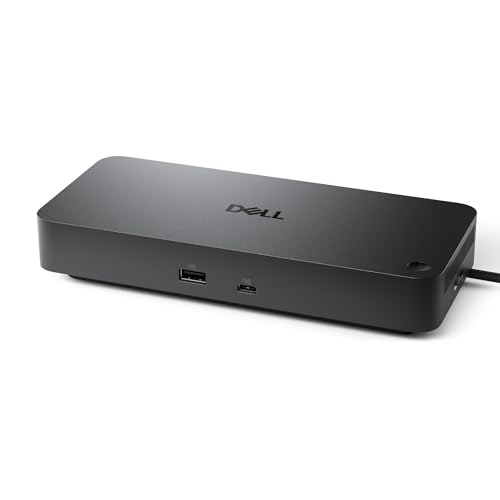
- Up to 100W power delivery
- Supports up to four high-resolution displays
- Commercial manageability and 3-year warranty
Best For: Business users and IT teams standardizing office workstations
Best for Quad-Display Expansion

- Supports one 5K or four 4K displays
- Up to 100W Power Delivery 2.0
- Includes legacy-host adapters and lock slot
Best For: Multi-monitor offices with mixed laptop generations
Best for Dual-Monitor Charging Hubs

- Dual HDMI display support
- 160W total output with up to 100W USB-C charging
- 14-in-1 connectivity and up to 10Gbps data
Best For: Windows and ChromeOS dual-monitor workstations
Best for Enterprise Triple-Display Workstations

- Supports up to three HDMI displays with DisplayLink.
- Includes 100W charging, Gigabit Ethernet, six USB 3.0 ports, and audio.
- Broad Windows, macOS, and ChromeOS compatibility; Linux is unsupported.
Best For: Managed offices and mixed-device enterprise fleets
Best Secure Dual-Display Hub

- Supports two displays up to 4K at 60Hz.
- Combines 100W charging with 10Gbps data and Gigabit Ethernet.
- Adds VESA mounting, Kensington Lock compatibility, and multiple safety protections.
Best For: Secure dual-monitor office workstations
Best for Fleet Deployment
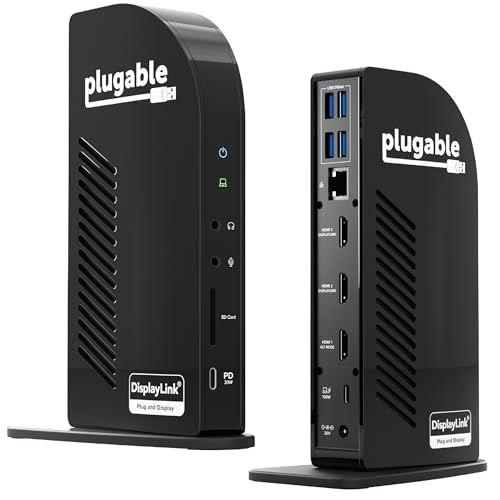
- Connects up to three HDMI displays with DisplayLink.
- Provides 100W laptop charging and 20W front USB-C accessory charging.
- Includes compliance credentials, broad ports, and lifetime North American support.
Best For: Standardized office, education, and government deployments
Best Workstation-Style Pick
Lenovo 40AY0090US Dual-Monitor Dock

- 90W adapter supports power delivery
- Includes HDMI and DisplayPort cables
- 11 ports with 4K display support
Best For: Lenovo ThinkPad workstations and dual-display offices
Best Budget Productivity Dock

- Dual HDMI up to 1920x1200
- Six USB ports plus Ethernet and audio
- Two-year warranty and lifetime support
Best For: Office users needing dual HD displays and peripherals
Best Dual-4K Display Option
Plugable UD-6950Z DisplayLink Dock

- Drives two 4K displays at 60Hz
- HDMI, DisplayPort, Ethernet, and six USB ports
- Supports USB-C and USB 3.0 hosts
Best For: High-resolution office and multitasking workstations
Best for IT-Managed Workplaces – Dell Pro WD25
For organizations evaluating commercial-grade USB docking stations, the Dell Pro WD25 emphasizes broad compatibility, enterprise manageability, and dependable desk expansion. It delivers up to 100W to compatible laptops, supports up to four high-resolution displays, and includes Ethernet, USB, HDMI, and DisplayPort connectivity.
Best For: Business users and IT teams standardizing mixed Dell and non-Dell Windows, Linux, or ChromeOS workstations.
Pros:
- Supports up to four high-resolution displays.
- Provides up to 100W of laptop power delivery.
- Offers commercial manageability features and a 3-year limited hardware warranty with advanced exchange.
- Uses an ambidextrous USB-C cable design and includes at least 65% postconsumer recycled materials.
Cons:
- The listed operating-system compatibility is more focused on business platforms than universal device support.
- The dock’s 10-port configuration may provide fewer connections than some 14-in-1 alternatives.
The WD25 is a strong fit when fleet management, display expansion, warranty coverage, and workplace durability matter more than having the highest port count. Its quad-display support and 100W delivery make it particularly practical for multi-monitor office setups.
Best for Triple-4K Windows Setups – Anker Prime DL7400
The Anker Prime DL7400 is a feature-dense choice among commercial-grade USB docking stations, pairing 14 connections with DisplayLink-powered triple-display support. It can provide up to 140W through the upstream port, includes 2.5Gbps Ethernet, and adds a smart display and active cooling system for monitoring performance.
Best For: Windows 10 and 11 users who need three 4K external monitors and extensive high-speed connectivity.
Pros:
- Supports three external 4K displays through DisplayLink.
- Includes 14 ports, SD and TF card readers, audio, and 2.5Gbps Ethernet.
- Provides up to 140W through the upstream USB-C port.
- Smart display, built-in fan, and ActiveShield 3.0 help monitor and manage operating conditions.
Cons:
- Requires the latest DisplayLink driver for display operation.
- DRM-protected streaming services may show a black screen through DisplayLink.
- Front USB-C ports do not support USB-C monitor display connections.
This dock stands out for Windows users building a demanding multi-monitor desk with substantial peripheral and storage needs. DisplayLink requirements and streaming limitations should be checked before deployment, especially in mixed-use environments.
Best for Quad-Display Expansion – Targus QV4K Dock
Targus USB-C Universal Quad 4K (QV4K) Docking Station with 100W Power Delivery, Black (DOCK570USZ)
Check Price On AmazonThe Targus QV4K is a practical commercial-grade USB docking station for businesses that need extensive display expansion and broad laptop compatibility. It supports a single 5K screen or up to four 4K displays, delivers up to 100W through Power Delivery 2.0, and includes adapters for legacy hosts.
Best For: Offices needing four-monitor workstations, legacy laptop support, and a security-lock option.
Pros:
- Supports one 5K or four 4K displays through DisplayPort, HDMI, or a combination.
- Delivers up to 100W Power Delivery 2.0.
- Includes USB-C to USB-A host support, power tips, Gigabit Ethernet, and audio.
- Integrated lock slot and optional VESA mounting support suit managed workspaces.
Cons:
- Its listed port configuration is less extensive than the 14-in-1 Anker docks.
- Four-monitor HDMI output is specified at up to 4K 50Hz, while DisplayPort is listed at 4K 60Hz.
- A security lock and VESA bracket are sold separately.
The QV4K is compelling for fixed office desks where multiple displays and compatibility with older systems are priorities. Its included host adapter and charging tips can simplify deployment across a mixed laptop fleet.
Best for Dual-Monitor Charging Hubs – Anker Prime A83B6
The Anker Prime A83B6 combines 14-in-1 connectivity with high-output charging for users comparing commercial-grade USB docking stations. It supports dual HDMI displays, provides up to 160W total output, and offers up to 10Gbps data transfer across compatible ports.
Best For: Windows or ChromeOS users who need dual-monitor connectivity, fast peripherals, and simultaneous device charging.
Pros:
- Supports two HDMI displays at up to 2K 60Hz with a DP 1.4 laptop.
- Offers up to 160W total output, including up to 100W from three USB-C ports.
- Provides 14-in-1 connectivity with Ethernet, audio, and ports reaching 10Gbps.
- Works with USB-C, USB4, and Thunderbolt connections on compatible systems.
Cons:
- macOS mirrors the same image across both external monitors.
- It is not compatible with Linux.
- Display support depends on the laptop’s DP Alt Mode version, and 5120×1440 monitors are not supported.
The A83B6 is a sensible dual-display workstation hub when charging capacity and broad peripheral connectivity are more important than quad-monitor output. Confirm operating-system and display requirements before purchasing, particularly for Mac, Linux, or ultrawide-monitor setups.
Best for Enterprise Triple-Display Workstations – Triple Display USB-C Dock
For organizations standardizing hot desks or hybrid-work setups, this commercial-grade USB docking station combines triple-monitor support with wired networking, six USB 3.0 ports, audio, and up to 100W laptop charging. DisplayLink helps extend up to three HDMI displays, including on supported Apple Silicon MacBooks, though macOS requires driver installation.
Best For: Enterprise and managed-office deployments that need broad compatibility and three-monitor productivity.
Pros:
- Supports up to three extended HDMI displays: one 4K at 30Hz and two 1080p at 60Hz.
- Provides 100W USB-C Power Delivery, Gigabit Ethernet, six USB 3.0 ports, and audio connectivity.
- Works with compatible Windows, macOS, and ChromeOS systems, including many Dell, HP, Lenovo, and MacBook models.
- Includes North American-based technical support and a compatibility guarantee.
Cons:
- Not compatible with Linux.
- DisplayLink driver installation is required on macOS.
- HDCP is not supported.
This is a strong fit when deployment flexibility and three-display expansion matter more than Linux or protected-content compatibility. Its enterprise-oriented support and wide device coverage make it practical for mixed laptop fleets.
Best Secure Dual-Display Hub – Belkin Dual Display Dock
This commercial-grade USB docking station turns one USB-C connection into a 14-port workstation with dual-display support, 100W Power Delivery, 10Gbps data transfer, Gigabit Ethernet, and legacy-device support. Its VESA-mountable design, Kensington Lock compatibility, and built-in safety protections suit organized office environments.
Best For: Office users who want dual 4K displays, fast peripheral connections, and added desk security.
Pros:
- Supports up to two displays at resolutions up to 4K at 60Hz through HDMI or DisplayPort.
- Offers 100W laptop charging and USB 3.2 Gen 2 data speeds up to 10Gbps.
- Includes Gigabit Ethernet, a USB-C-to-USB-A adapter, VESA mounting, and Kensington Lock compatibility.
- Provides over-voltage, overload, overcurrent, short-circuit, and fire-resistant protection features.
Cons:
- DisplayLink installation is required on macOS.
- The feature set is centered on dual displays rather than triple-monitor expansion.
- Full functionality requires a compatible full-featured USB-C, USB4, or Thunderbolt connection.
Belkin’s dock is a well-rounded choice for a secure, polished workstation with two high-resolution displays. It is especially appealing where mounting options, legacy-device support, and safety features are useful alongside everyday productivity performance.
Best for Fleet Deployment – 13-in-1 Triple Monitor Dock
Built for office, education, and government rollouts, this commercial-grade USB docking station offers 13 ports, triple HDMI output, 100W laptop charging, 20W front USB-C charging, Gigabit Ethernet, SD card access, and audio. It also includes TAA, NDAA, and Section 889 compliance for deployments with specific procurement requirements.
Best For: IT departments standardizing triple-monitor desks across Windows, macOS, and ChromeOS environments.
Pros:
- Supports three extended HDMI displays, with up to 4K at 30Hz on HDMI 1 and 1920×1200 at 60Hz on HDMI 2 and 3.
- Delivers up to 100W to the laptop and 20W through the front USB-C port for accessories.
- Includes four USB-A 5Gbps ports, Gigabit Ethernet, an SD card reader, audio in/out, and three HDMI ports.
- Offers TAA, NDAA, and Section 889 compliance plus lifetime North American support.
Cons:
- macOS requires DisplayLink Manager installation for multiple displays.
- HDMI 2 and HDMI 3 are limited to 1920×1200 at 60Hz.
- HDCP-protected content such as Netflix and Hulu is not supported.
This Plugable model is particularly compelling for repeatable deployments where port variety, charging, and procurement compliance are priorities. Its three-display layout is productive, but buyers should account for the lower resolution on two outputs and the DisplayLink requirements.
Best Workstation-Style Pick – Lenovo 40AY0090US Dual-Monitor Dock
For buyers seeking commercial-grade USB docking stations with strong power delivery, this workstation-style dock combines HDMI, DisplayPort, USB-C, Ethernet, and six total USB ports. It includes a 90W AC adapter and cables for connecting compatible displays and peripherals.
Best For: Lenovo ThinkPad users who need 4K display support, broad connectivity, and host-device charging from a single dock.
Pros:
- Includes HDMI and DisplayPort cables for convenient setup.
- 90W AC adapter provides stable power delivery.
- Supports compatible 4K displays and offers 11 total ports.
- Includes USB-C connectivity, Ethernet, HDMI, and DisplayPort.
Cons:
- Compatibility depends on a USB-C or Thunderbolt-compatible computer.
- The listed compatibility information focuses heavily on Lenovo ThinkPad models.
- Firmware updates may be needed for some computers.
This is the strongest fit for a Lenovo-centered office or workstation setup, particularly when display connectivity and power delivery matter more than universal plug-and-play simplicity.
Best Budget Productivity Dock – Plugable UD-3900 USB 3.0 Dock
This Plugable model is one of the more accessible commercial-grade USB docking stations for expanding a laptop with dual HDMI displays, Gigabit Ethernet, audio, and six USB ports. It uses a hybrid USB 3.0/USB-C host cable and is designed for office and productivity work rather than gaming.
Best For: Windows, macOS, and ChromeOS users who want dual HD monitors and extra peripherals without host-laptop charging.
Pros:
- Supports two HDMI displays up to 1920×1200 at 60Hz.
- Provides Gigabit Ethernet, audio jacks, two USB 3.0 ports, and four USB 2.0 ports.
- Works with USB 3.0 or USB-C host connections.
- Includes a two-year warranty and lifetime support.
Cons:
- Does not support 4K display output.
- Does not charge the host laptop.
- Requires a DisplayLink driver on macOS and is not compatible with Linux or Unix systems.
The UD-3900 is a practical choice for conventional office setups, especially when dual HD screens and peripheral expansion are more important than 4K output or laptop charging.
Best Dual-4K Display Option – Plugable UD-6950Z DisplayLink Dock
For commercial-grade USB docking stations aimed at high-resolution productivity, the Plugable UD-6950Z supports two 4K monitors through HDMI and DisplayPort. It also adds Gigabit Ethernet, audio, and six USB 3.0 ports while accepting either USB-C or USB 3.0 host connections.
Best For: Professionals who need dual 4K productivity displays and broad peripheral connectivity on compatible Windows, macOS, or ChromeOS systems.
Pros:
- Supports two 4K monitors at 3840×2160 and 60Hz through DisplayPort or HDMI.
- Offers dual HDMI and DisplayPort outputs, Ethernet, audio, and six USB 3.0 ports.
- Supports USB-C and USB 3.0 host connections.
- Works with Windows, macOS, and ChromeOS, with drivers required in some cases.
Cons:
- Does not charge the host computer.
- Not intended for gaming or HDCP-protected streaming content.
- Not compatible with Linux; macOS requires manual driver installation.
This dock is a strong productivity-focused option when dual 4K output is the priority. Its lack of host charging and DisplayLink-related limitations should be considered before purchase.
How We Picked These Commercial-Grade USB Docking Stations
We evaluated these docks by the factors that matter most in business environments: host compatibility, display support, charging capacity, port selection, driver requirements, network readiness, physical reliability, and ease of deployment. Models with DisplayLink technology can provide flexible multi-monitor support across more computers, while native USB-C or Thunderbolt-style video paths may offer a simpler experience when the laptop supports the required alternate mode.
We also considered whether each dock is suited to a single professional workstation, a shared desk, a multi-monitor office, or a larger managed deployment. Product specifications can vary by computer, operating system, cables, and monitor configuration, so confirm the manufacturer’s compatibility list before ordering in volume.
Quick Comparison
| Best For | What to Prioritize | Recommended Type |
|---|---|---|
| One or two office monitors | Reliable video, Ethernet, and power delivery | Dual-display USB-C dock |
| Three or four monitors | DisplayLink support, bandwidth, and driver compatibility | Triple- or quad-display dock |
| USB-C laptop fleets | 100W charging and broad host compatibility | Universal USB-C dock |
| Older USB-A computers | USB 3.0 compatibility and included power adapter | Universal USB 3.0 dock |
| Mixed office environments | Manageable drivers and consistent port layout | Commercial universal dock |
Key Buying Factors for Commercial-Grade USB Docking Stations
Host and Operating-System Compatibility
Check whether your laptops support USB-C DisplayPort Alt Mode, USB4, Thunderbolt, or only USB-A. DisplayLink models typically require software and may be the better choice for multiple monitors, but corporate security policies can affect driver installation and updates.
Display Capacity and Resolution
Count the monitors, refresh rates, and resolutions you need now—not just the number of video outputs. “4K” support may differ by port, operating system, and simultaneous-display configuration. Verify whether HDMI, DisplayPort, or adapters are required.
Power Delivery and Connectivity
For modern business laptops, 90W or 100W USB-C Power Delivery can reduce charger clutter, but high-performance systems may need their original adapter. Look for Gigabit Ethernet, multiple USB ports, audio, and fast data connections that match your peripherals.
Deployment and Reliability
A good office dock should have stable firmware, clear driver support, a robust power supply, and a practical footprint. For shared desks, prioritize consistent one-cable connection and simple troubleshooting. For larger fleets, confirm warranty, replacement availability, and management documentation.
Who Should Buy Which Commercial-Grade USB Docking Stations?
Choose a native USB-C dock for a straightforward laptop-to-desk setup when your computers already support the required video standard. Choose a DisplayLink dock when you need flexible dual-, triple-, or quad-monitor support across mixed systems and can manage drivers. Choose a USB 3.0 model for older laptops or cost-conscious workstations, while users with demanding displays should favor higher-power USB-C models with confirmed resolution and bandwidth support.