The right dock can turn a laptop into a practical content-creation workstation, adding displays, card readers, storage, networking, and charging through a single connection.
We compared 10 USB docking stations for content creators with different monitor, power, port, and compatibility needs so you can choose a setup that fits your workflow.
Best 10 USB Docking Stations for Content Creators Picks for 2026
Best Compact Dual-Display Pick

- Dual HDMI supports up to one 4K60 or two 4K30 displays
- SD and microSD readers simplify media transfers
- Up to 85W pass-through charging and Gigabit Ethernet
Best For: Windows creators who want a compact dual-monitor hub
Best for Triple-Monitor Workstations
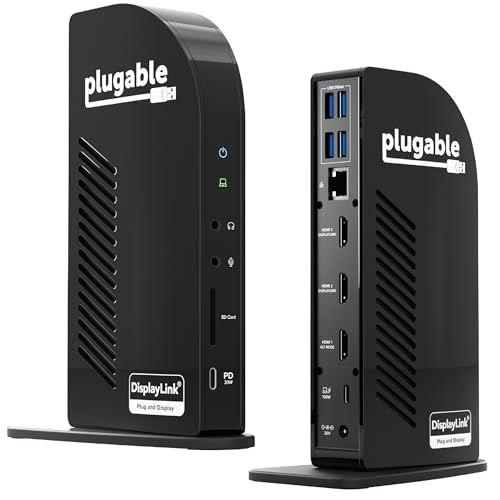
Plugable 13-in-1 DisplayLink Dock
- Connects up to three extended HDMI displays
- Delivers up to 100W laptop and 20W accessory charging
- Includes USB-A, SD, Ethernet, and audio connectivity
Best For: Creators building a three-monitor desktop workstation
Best Desk-and-Travel Hybrid

- Detachable 6-in-1 hub supports mobile use
- Offers triple-display connectivity with HDMI and DisplayPort
- Adds 10Gbps data, card readers, audio, and 100W charging
Best For: Creators splitting time between a studio desk and travel
Best Triple-Display Powerhouse
Acer 13-in-1 Triple-Display Dock

- Three-display output for compatible Windows laptops
- SD/TF readers and Gigabit Ethernet included
- 100W laptop charging with 110W adapter
Best For: Windows creators building a triple-monitor workstation
Best High-Power Dual-Display Dock

- 160W total output for charging multiple devices
- Dual HDMI display support up to 2K at 60Hz
- 10Gbps data ports plus Ethernet and audio
Best For: Windows or ChromeOS creators managing dual displays and many peripherals
Best for 8K Output and Fast Media Transfers
- DisplayPort supports up to 8K at 30Hz
- Fast USB-C ports and 104Mbps SD/TF readers
- Triple-display support with up to 85W laptop charging
Best For: Photographers and editors handling high-resolution displays and camera cards
Best Budget Dual-Display Dock

- Dual HDMI output up to 1920×1200 at 60Hz
- Six USB ports plus Ethernet and audio
- No 4K output or host-laptop charging
Best For: Basic dual-monitor productivity and content workflows
Best Power-User Workstation Dock

- Up to three 1080p displays on Windows
- 85W laptop charging with 135W adapter included
- SD/microSD readers and 10Gbps USB-C data
Best For: Windows creators with multi-display and media-transfer needs
Best Multi-Display Flexibility

- Two HDMI and two DisplayPort outputs
- SD/microSD readers plus Gigabit Ethernet
- Up to 100W USB-C Power Delivery
Best For: Creators needing flexible monitors and card-reader connectivity
Best Compact Dual-Display Pick – Anker 8-in-1 USB-C Dock
For creators who need a straightforward workstation upgrade, this Anker hub is a compact option among USB docking stations for content creators. It combines dual HDMI, SD and microSD readers, Gigabit Ethernet, USB-A ports, and up to 85W pass-through charging in one USB-C connection.
Best For: Content creators using a Windows laptop who need dual-display support and convenient card-reader access.
Pros:
- Supports one 4K display at 60Hz or two displays at 4K at 30Hz.
- Includes both SD and microSD card readers for transferring media.
- Offers Ethernet and up to 85W USB-C Power Delivery pass-through.
Cons:
- macOS mirrors the same image on both external monitors.
- A 100W wall charger and USB-C cable are required for pass-through charging.
- Not compatible with Linux.
This is a practical, lightweight choice for a creator desk that prioritizes card access and two-monitor connectivity without needing a larger desktop dock.
Best for Triple-Monitor Workstations – Plugable 13-in-1 DisplayLink Dock
This Plugable model is built for creators who want a more expansive desk setup. As USB docking stations for content creators go, it offers three HDMI outputs, DisplayLink support, 100W laptop charging, a 20W front USB-C charging port, storage-card access, Ethernet, and multiple USB ports.
Best For: Windows or Mac users building a three-monitor editing, research, or production workstation.
Pros:
- Supports up to three extended HDMI displays, including multi-monitor expansion on supported Macs.
- Provides up to 100W laptop charging and 20W charging for accessories.
- Includes three HDMI ports, four USB-A 5Gbps ports, SD card access, Gigabit Ethernet, and audio I/O.
Cons:
- DisplayLink Manager installation is required for multiple displays on macOS.
- HDMI 2 and HDMI 3 require the DisplayLink driver on Mac.
- Does not support protected-content playback such as Netflix or Hulu.
Choose this dock when multi-monitor productivity matters more than a driver-free setup. Its broad port selection also makes it suitable for a permanent home studio or office desk.
Best Desk-and-Travel Hybrid – Anker Nano 13-in-1 Dock
Anker’s Nano dock stands out for creators who alternate between a home setup and mobile work. Its detachable 6-in-1 USB-C hub separates from the 13-in-1 desktop dock, while the main unit adds triple-display support, fast data connections, card readers, audio, Ethernet, and 100W charging.
Best For: Creators who need a full desktop dock but also want to carry a smaller hub for travel.
Pros:
- Detachable 6-in-1 hub provides a convenient portable option.
- Supports one 4K60 display, dual 2K60 displays, or triple 1080p60 displays.
- Includes 10Gbps USB-C data, SD and TF slots, Gigabit Ethernet, audio, and a 140W power adapter.
Cons:
- macOS supports mirrored mode only for multiple external displays.
- The dock requires a connected laptop to activate its ports.
- Compatibility is focused on full-function USB-C and Thunderbolt laptops.
This is a flexible choice for creators who do not want to buy separate home and travel accessories. It offers the most useful balance here between desk connectivity and portability.
Best High-Speed Creative Workstation – TobenONE 16-in-1 Dock
For demanding Windows-based studios, this TobenONE dock emphasizes bandwidth and expansion. It pairs three HDMI outputs with 10Gbps USB-C ports, fast SD and microSD readers, 2.5Gbps Ethernet, 100W laptop charging, and a 150W power supply—an especially capable configuration among USB docking stations for content creators.
Best For: Video editors, photographers, and other Windows creators moving large files while using multiple displays and peripherals.
Pros:
- Supports triple 4K60 monitors with a compatible DP1.4 and DSC source, or one display up to 2K144Hz.
- Offers 10Gbps USB-C ports and SD/microSD 4.0 readers rated up to 312MB/s.
- Includes 2.5Gbps Ethernet, 100W laptop charging, and a 150W power supply.
Cons:
- Its stated triple-4K capabilities are designed for compatible Windows systems and sources.
- The extensive port array may be more than a basic creator setup requires.
- USB 2.0 ports are intended for lower-bandwidth peripherals rather than fast storage.
This dock makes the most sense when fast media transfers, high-speed networking, and multiple displays are central to the workflow. Verify the laptop’s display capabilities before relying on the highest supported resolutions.
Best Triple-Display Powerhouse – Acer 13-in-1 Triple-Display Dock
For content creators building a multi-screen workstation, this USB docking station for content creators combines triple-display output, card readers, wired networking, audio, and high-power laptop charging in one aluminum enclosure. It includes a 110W adapter and supports up to 100W delivery to compatible laptops.
Best For: Windows-based creators who need three independent monitors, SD and microSD workflow support, and sustained power for demanding desk setups.
Pros:
- Offers 2 HDMI ports and 1 DisplayPort for triple-display setups on compatible Windows laptops.
- Includes SD and TF readers that can read and write cards simultaneously.
- Provides Gigabit Ethernet, 3.5mm audio, USB expansion, and up to 100W laptop power delivery.
- Includes a 110W power adapter and a security slot for cable-lock support.
Cons:
- macOS supports mirroring across multiple displays rather than extended desktop mode.
- Triple 4K at 30Hz requires a compatible Windows laptop or GPU with DSC support.
This is a strong all-in-one choice when your priority is a Windows triple-monitor editing or production desk. Mac users and buyers without DSC-capable hardware should verify display limitations before choosing it.
Best High-Power Dual-Display Dock – Anker Prime 14-in-1 Dock
This USB docking station for content creators focuses on high charging capacity, fast data connections, and dual-monitor support. The Anker Prime dock provides 14-in-1 connectivity, multiple USB-C ports, dual HDMI output, Ethernet, audio, and up to 10Gbps data transfer.
Best For: Creators using compatible Windows or ChromeOS laptops who want a powerful dual-display hub with enough connectivity for several peripherals and devices.
Pros:
- Supports dual HDMI displays up to 2K at 60Hz with a DP 1.4 laptop.
- Offers 160W total output, with three USB-C ports rated up to 100W each and one USB-A charging port up to 12W.
- Provides 11 data ports with speeds up to 10Gbps, plus Ethernet and audio connectivity.
- Works with USB-C, USB4, and Thunderbolt connections and includes a 24-month warranty.
Cons:
- macOS mirrors the same image on both external monitors rather than extending them independently.
- It is not compatible with Linux, and it does not support a 5120×1440 monitor.
The Anker is well suited to creators who value charging capacity and fast peripheral access more than triple-monitor output. Check your laptop’s display mode and operating-system compatibility, especially if you use macOS or Linux.
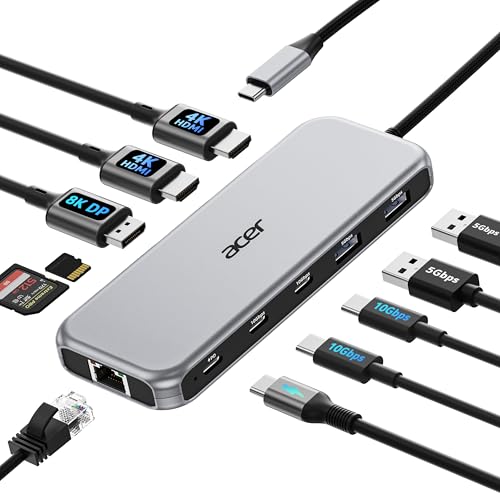
Best for 8K Output and Fast Media Transfers – Acer 11-in-1 USB-C Dock
Photographers, video editors, and designers can use this USB docking station for content creators to connect displays, storage, memory cards, wired networking, and charging through one USB-C connection. It pairs an 8K-capable DisplayPort with dual HDMI outputs, fast USB-C data ports, and SD/microSD readers.
Best For: Creators who need high-resolution display output and faster access to camera cards and USB storage on a compatible full-featured USB-C laptop.
Pros:
- Supports up to 8K at 30Hz through DisplayPort and 4K at 60Hz through HDMI for single-display use.
- Supports triple-display output up to 4K at 60Hz, 4K at 60Hz, and 1080p at 60Hz.
- Includes two 10Gbps USB-C ports, two 5Gbps USB-A ports, and SD/microSD slots rated up to 104Mbps.
- Provides Gigabit Ethernet and up to 85W laptop charging from a 100W input.
Cons:
- The laptop must have a full-featured USB-C port with DisplayPort Alt Mode and charging support.
- A 100W power adapter is needed for stable operation, and the adapter is not listed as included in the supplied notes.
- Triple-display performance depends on the host laptop and connection specifications.
This dock is a practical fit for creators moving files from memory cards while driving multiple displays. Its strongest advantages are fast media connectivity and flexible video output, but confirm your laptop’s USB-C capabilities and provide a suitable power adapter.
Best Budget Dual-Display Dock – Plugable UD-3900
For content creators who need a straightforward way to connect displays and accessories, the Plugable UD-3900 is a practical USB docking station for content creators. It adds dual HDMI outputs, Gigabit Ethernet, audio connections, and six USB ports through one host connection, although it is aimed at productivity rather than high-resolution video work.
Best For: Windows, macOS, or ChromeOS users building a basic dual-monitor editing, writing, or productivity setup.
Pros:
- Supports two HDMI displays up to 1920×1200 at 60Hz.
- Provides Gigabit Ethernet, headphone and microphone jacks, and six USB ports.
- Includes a hybrid USB 3.0/USB-C host cable, two-year coverage, and lifetime support.
Cons:
- Does not support 4K, DisplayPort connections, gaming, or HDCP-protected streaming content.
- Requires DisplayLink driver installation on macOS 14 or later.
- Does not charge the host laptop.
The UD-3900 makes sense when dependable connectivity and two HD screens matter more than 4K output or laptop charging. Its broad port selection is useful for everyday creator workflows, but demanding video professionals should look for a dock with newer display and power-delivery capabilities.
Best Power-User Workstation Dock – Anker 13-in-1 Triple Display
The Anker 13-in-1 is a strong all-around USB docking station for content creators who want display expansion, fast storage access, and laptop charging from one cable. Its 85W host charging, SD and microSD readers, 10Gbps USB-C data, and included 135W adapter suit a more demanding desktop-style setup.
Best For: Windows creators who need triple 1080p displays, fast file transfers, card readers, and high-wattage laptop charging.
Pros:
- Offers 13 ports, including dual HDMI, DisplayPort, SD/microSD, Ethernet, audio, and USB-C.
- Supports up to three 1080p displays at 60Hz on Windows and a single 4K display through HDMI or DisplayPort.
- Delivers up to 85W to the laptop and includes a 135W power adapter.
Cons:
- macOS limits external monitors to mirror mode rather than extended displays.
- Requires a full-function USB-C connection with DisplayPort Alt Mode and Power Delivery.
- Triple-display support is specified for Windows 10/11 and ChromeOS with MST.
With its integrated card readers, fast USB connectivity, and included power supply, the Anker dock is well suited to creators who regularly move media and run several screens. Mac users can still use its charging and data features, but its multi-monitor advantages are primarily designed for Windows and compatible ChromeOS systems.
Best Multi-Display Flexibility – MOKiN 14-in-1 Dock
The MOKiN 14-in-1 is a versatile USB docking station for content creators who want several display-output options and built-in card readers. It combines two HDMI ports, two DisplayPort ports, SD and microSD slots, Gigabit Ethernet, and up to 100W USB-C Power Delivery in one powered dock.
Best For: Windows or macOS laptop users who need flexible multi-monitor connections, card access, wired networking, and laptop charging.
Pros:
- Provides two HDMI and two DisplayPort outputs for flexible monitor combinations.
- Includes SD/microSD readers, 5Gbps USB ports, Gigabit Ethernet, and a screen-off button.
- Supports up to 100W USB-C Power Delivery for the laptop while in use.
Cons:
- Requires a compatible USB-C connection and a laptop that supports the needed display functions.
- The supplied notes specify Windows 10 as the minimum required operating system; verify compatibility for your particular setup.
- USB data ports are rated at 5Gbps rather than 10Gbps.
The MOKiN is appealing when monitor flexibility is more important than maximum USB transfer speed. Its four video outputs and card readers can simplify a creator desk, while the screen-lock button and wired networking add useful convenience for shared or productivity-focused workspaces.
How We Picked the Best USB Docking Stations for Content Creators
We focused on the features that matter during editing, production, and file management: display support, resolution and refresh-rate potential, USB bandwidth, charging capability, port variety, operating-system compatibility, and overall flexibility. The selection includes compact USB-C hubs, full desktop docks, universal USB 3.0 models, and multi-monitor stations for creators who work with photo, video, audio, or livestreaming tools.
Because advertised performance depends on the laptop, host port, operating system, cables, and connected displays, treat maximum specifications as potential rather than a guarantee. Check your computer’s video-output and charging support before ordering.
Quick Comparison
| What to compare | Best for | What to check |
|---|---|---|
| Display outputs | Timeline editing and multitasking | Number of screens, HDMI or DisplayPort support, resolution, and refresh rate |
| Power delivery | Replacing a laptop charger at the desk | Maximum wattage and whether a power adapter is included |
| USB ports | Drives, cameras, audio gear, and peripherals | USB 3.x speeds, USB-C data support, and port placement |
| Universal compatibility | Shared or mixed-computer workspaces | Windows, macOS, ChromeOS, drivers, and display limitations |
Key Buying Factors for USB Docking Stations for Content Creators
Monitor Support
Creators often benefit from one display for the canvas or timeline and another for bins, scripts, scopes, or communication. Confirm whether the dock supports your preferred number of monitors and whether macOS handles them natively or requires DisplayLink software. Also verify the exact resolution and refresh rate you need for color work, playback, or gaming-related content.
Bandwidth and Port Selection
Fast USB ports are important for external SSDs, capture devices, card readers, and audio interfaces. A dock with many ports is not automatically faster; shared bandwidth can affect simultaneous transfers and video capture. Look for a useful mix of USB-C and USB-A ports, plus Ethernet, SD or microSD, and audio connections if your workflow needs them.
Power and Desk Setup
High-wattage power delivery can keep a performance laptop charged while displays and accessories are connected, but the dock cannot exceed the limits of the laptop or charger. A compact detachable hub suits mobile creators, while a powered desktop dock is usually better for a permanent studio workstation.
Who Should Buy Which USB Docking Stations for Content Creators?
- Choose a compact USB-C hub if you travel, present, or need occasional HDMI and peripheral expansion.
- Choose a multi-monitor dock if your editing workflow depends on two or three screens and a one-cable desk connection.
- Choose a high-power dock for demanding laptops that need substantial charging while driving displays and storage.
- Choose a universal USB 3.0 dock when broad computer compatibility matters more than maximum display bandwidth.
- Choose a simpler dual-monitor model if you want reliable core connectivity without paying for ports you will not use.
Before buying, compare the dock’s host connector with your laptop, confirm operating-system support, and total the bandwidth and power demands of every device you plan to connect.