A multi-gigabit switch can add faster wired connections without taking over your desk. These compact unmanaged models range from affordable 2.5GbE switches to higher-capacity options with 10GbE ports.
We selected 10 options for different small-desk setups, including home offices, gaming stations, media systems, and NAS users. The right choice depends on port count, speed, noise, size, and the capabilities of your existing network.
Best 10 Multi-Gigabit Network Switches for Small Desks Picks for 2026
Best Silent 5-Port Upgrade
TP-Link TL-SG105S-M2 2.5G Switch

- Five 2.5Gbps ports
- Fanless metal housing
- Plug-and-play setup
Best For: Quiet, compact home-office and gaming networks
Best Compact Value
BrosTrend 5-Port 2.5G Ethernet Switch

- Five 2.5Gbps RJ45 ports
- Slim fanless enclosure
- Simple plug-and-play operation
Best For: Compact gaming, media, and small-office setups
Best for Expanding Desks
TP-Link TL-SG108S-M2 8-Port 2.5G Switch

- Eight 2.5Gbps ports
- Up to 40Gbps switching capacity
- Silent fanless design
Best For: Growing workstations with multiple wired devices
Best Feature-Rich 5-Port Pick

- Five multi-speed 2.5Gbps ports
- QoS with eight priority levels
- Fanless metal housing
Best For: Small networks needing basic traffic prioritization
Compact 10G Flexibility
VunLink 6-Port Multi-Gigabit Switch

- Four 2.5GbE ports plus two 10GbE ports
- 60Gbps switching capacity with wire-speed forwarding
- Fanless, plug-and-play desktop or wall-mount design
Best For: Small desks needing a compact mix of 2.5GbE and 10GbE connections
Eight-Port 10G Powerhouse
TP-Link TL-SX1008 Multi-Gig Switch

- Eight auto-negotiating ports support up to 10Gbps
- 160Gbps switching capacity for demanding traffic
- Desktop/rackmount metal design with plug-and-play setup
Best For: Dense home labs and small offices with multiple 10GbE devices
Simple Gigabit Value
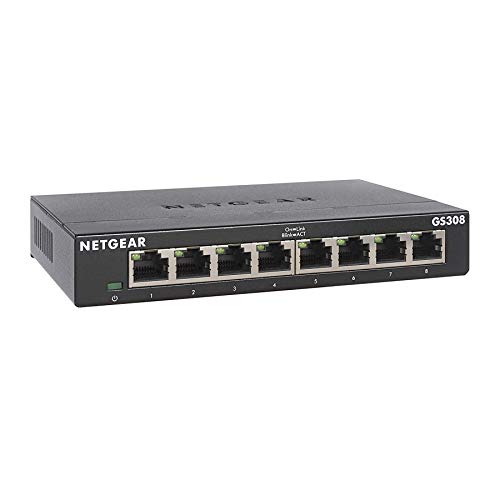
- Eight auto-negotiating 1Gbps Ethernet ports
- Fanless, energy-efficient operation
- Compact metal case supports desktop or wall mounting
Best For: Basic home and office networks that only need gigabit speeds
Compact Gigabit Starter

- Five auto-negotiating Gigabit ports
- Fanless metal design for quiet use
- Plug-and-play desktop or wall mounting
Best For: Small desks with standard Gigabit devices
Five-Port Multi-Gig Pick
NETGEAR MS305 5-Port 2.5G Switch

- Five 2.5Gbps Ethernet ports
- Works with Cat5e or Cat6 cables
- Silent fanless metal enclosure
Best For: Compact desks needing several 2.5Gbps links
Expanded Multi-Gig Capacity
NETGEAR MS308 8-Port 2.5G Switch

- Eight 2.5Gbps Ethernet ports
- Silent, energy-efficient fanless design
- Desktop or wall-mount installation
Best For: Growing small-desk networks needing more ports
Best Silent 5-Port Upgrade – TP-Link TL-SG105S-M2 2.5G Switch
For small desks that need faster wired networking without added configuration, the TP-Link TL-SG105S-M2 is a practical choice among multi-gigabit network switches for small desks. Its five 2.5Gbps ports, automatic speed negotiation, fanless design, and metal desktop/wall-mountable housing suit compact home offices, gaming setups, and media spaces.
Best For: Quiet 2.5Gbps networking for a few PCs, NAS devices, access points, or gaming systems.
Pros:
- Five 2.5Gbps ports provide up to 25Gbps of switching capacity.
- Auto-negotiates between 100Mbps, 1Gbps, and 2.5Gbps devices.
- Fanless operation and a durable metal case work well on a desk.
- Plug-and-play setup with desktop and wall-mounting options.
Cons:
- Only five ports are available for expansion.
- Unmanaged design does not provide advanced network controls.
This is a well-rounded small-desk switch when silence, simple installation, and sturdy construction matter more than managed features or a larger port count.
Best Compact Value – BrosTrend 5-Port 2.5G Ethernet Switch
The BrosTrend 5-Port 2.5G Switch keeps multi-gigabit networking straightforward for a small desk. All five RJ45 ports support 2.5Gbps, while the fanless, low-heat design and slim desktop/wall-mountable plastic enclosure make it easy to place near a PC, console, NAS, or wireless access point.
Best For: Affordable plug-and-play connections for gaming, entertainment, and small-office equipment.
Pros:
- Five 2.5Gbps ports deliver up to 25Gbps of switching capacity.
- Supports PCs, consoles, TVs, NAS devices, access points, and other Ethernet equipment.
- Fanless design operates quietly during demanding tasks.
- Compact 5.6-by-3.5-by-0.9-inch form factor suits crowded desks.
Cons:
- Plastic housing is less substantial than a metal-cased alternative.
- Unmanaged operation offers no configuration or traffic-management controls.
Choose this BrosTrend model when you want five fast wired connections and minimal setup in a compact enclosure, especially for a home gaming or media station.
Best for Expanding Desks – TP-Link TL-SG108S-M2 8-Port 2.5G Switch
When a small desk has more than a handful of wired devices, the TP-Link TL-SG108S-M2 provides eight 2.5Gbps ports without requiring network management. It automatically negotiates 100Mbps, 1Gbps, and 2.5Gbps links, and its fanless desktop/wall-mountable design is suited to home offices, workstations, and entertainment setups.
Best For: Small desks that need several multi-gigabit connections for computers, storage, access points, and media devices.
Pros:
- Eight 2.5Gbps ports provide up to 40Gbps of switching capacity.
- Auto-negotiation supports mixed 100Mbps, 1Gbps, and 2.5Gbps devices.
- Fanless operation keeps the switch quiet.
- Desktop and wall-mounting options help with flexible placement.
Cons:
- The larger eight-port enclosure takes more desk space than five-port models.
- Unmanaged operation lacks advanced configuration features.
This is the stronger fit when a compact workstation is growing beyond four wired peripherals and you want extra ports without adding software or network administration.
Best Feature-Rich 5-Port Pick – D-Link DMS-105 2.5G Switch
The D-Link DMS-105 adds useful traffic-handling features to the typical five-port 2.5Gbps switch. It fits well among multi-gigabit network switches for small desks with Wi-Fi 6 access points, NAS storage, gaming systems, or media equipment, offering QoS, IGMP snooping, flow control, and energy-efficient operation in a quiet metal enclosure.
Best For: Small networks that need simple setup plus basic traffic prioritization and multicast optimization.
Pros:
- Five multi-speed ports support 100Mbps, 1Gbps, and 2.5Gbps connections.
- QoS provides eight traffic-priority levels.
- IGMP snooping and flow control can help bandwidth-intensive applications.
- Fanless metal housing, LED speed indicators, and Energy-Efficient Ethernet support practical desktop use.
Cons:
- Only five ports are provided.
- It remains an unmanaged switch, so configuration options are limited.
The DMS-105 is a good choice when ordinary plug-and-play switching is not quite enough and you want built-in traffic prioritization without moving to a fully managed switch.
Compact 10G Flexibility – VunLink 6-Port Multi-Gigabit Switch
For multi-gigabit network switches for small desks, the VunLink offers a practical mix of high-speed ports in a compact, fanless design. It provides four 2.5GbE RJ45 ports plus two ports that support speeds up to 10GbE, making it suitable for connecting a fast NAS, workstation, wireless access point, and other home-office devices without configuration.
Best For: Small desks, home labs, and compact networks that need both 2.5GbE and 10GbE connectivity.
Pros:
- Combines four 2.5GbE ports with two multi-gig 10GbE ports.
- 60Gbps switching capacity and wire-speed forwarding support busy multi-device traffic.
- Fanless metal design supports quiet desktop or wall-mounted installation.
- Unmanaged plug-and-play setup requires no software or configuration.
Cons:
- Provides six ports total, fewer than larger eight-port alternatives.
- Only two ports support speeds up to 10GbE.
The VunLink is a strong space-conscious choice when a small desk setup needs a blend of 2.5GbE and 10GbE links. Its silent operation and flexible mounting add convenience for home and small-office installations.
Eight-Port 10G Powerhouse – TP-Link TL-SX1008 Multi-Gig Switch
The TP-Link TL-SX1008 is built for buyers who want maximum wired capacity from multi-gigabit network switches for small desks. All eight RJ45 ports support auto-negotiated speeds from 100Mbps through 10Gbps, so it can connect 10G storage, computers, servers, and access points while accommodating slower devices.
Best For: High-performance home labs, small offices, and desks with several 10GbE or multi-gig devices.
Pros:
- Eight ports support 100Mbps, 1G, 2.5G, 5G, and 10G connections.
- Offers up to 160Gbps of switching capacity.
- Plug-and-play operation avoids software installation and manual configuration.
- Metal desktop/rackmount construction and a speed-adjusting smart fan suit varied installations.
Cons:
- Its 11.57-inch length and 3.3-pound weight take more desk space than compact models.
- Smart-fan operation may be less silent than a fully fanless switch.
The TL-SX1008 is the most capable option here for a dense high-speed setup. Its eight uniform multi-gig ports reduce planning limitations, though the larger chassis is worth considering carefully on a small desk.
Simple Gigabit Value – NETGEAR GS308 8-Port Switch
The NETGEAR GS308 is a straightforward choice for small desks that need dependable wired expansion rather than multi-gig speeds. Its eight auto-negotiating 1Gbps ports work with existing Cat5e or Cat6 cables, while the unmanaged design keeps installation as simple as connecting power and Ethernet cables.
Best For: Basic home offices and small networks whose connected devices do not require speeds above 1Gbps.
Pros:
- Eight 1Gbps ports provide simple wired network expansion.
- Auto-negotiation works with existing Cat5e and Cat6 cabling.
- Fanless operation is silent and IEEE 802.3az support helps reduce power use.
- Compact metal housing supports desktop or wall-mounted placement.
Cons:
- It does not provide 2.5GbE, 5GbE, or 10GbE connectivity.
- It is listed for use in the U.S. and Canada only.
The GS308 is best viewed as a dependable gigabit switch rather than a future-facing multi-gig upgrade. It makes sense when affordability, quiet operation, and easy placement matter more than top-end throughput.
Compact Gigabit Starter – TP-Link TL-SG105
The TP-Link TL-SG105 is a compact, practical choice for small desks that need wired expansion rather than true multi-gigabit speeds. Its five auto-negotiating Gigabit Ethernet ports, fanless metal design, and plug-and-play setup make it well suited to basic home-office and small-network use.
Best For: Small desks needing five quiet, reliable Gigabit connections.
Pros:
- Five 10/100/1000Mbps RJ45 ports support auto-negotiation and Auto MDI/MDIX.
- Fanless operation keeps the switch quiet.
- Metal casing supports desktop or wall-mounted placement.
- Plug-and-play setup includes QoS and IGMP Snooping features for traffic handling.
Cons:
- Gigabit ports are slower than the 2.5Gbps options in this roundup.
- Only five ports are available.
Choose the TL-SG105 when affordability, simplicity, and quiet operation matter more than multi-gigabit throughput. It is a sensible fit for standard Gigabit devices and compact installations.
Five-Port Multi-Gig Pick – NETGEAR MS305 5-Port 2.5G Switch
The NETGEAR MS305 is a strong match for multi-gigabit network switches for small desks, with five 2.5Gbps Ethernet ports in a compact metal enclosure. It adds faster wired connectivity without requiring software configuration, and its ports can work with existing Cat5e or Cat6 cables.
Best For: Small desks with several 2.5Gbps-capable devices and limited space.
Pros:
- Five 2.5Gbps multi-gigabit RJ45 ports provide higher throughput than standard Gigabit switching.
- Auto-negotiation detects the appropriate connection speed.
- Fanless, energy-efficient operation is suitable for quiet workspaces.
- Compact metal housing supports desktop or wall mounting.
Cons:
- It is an unmanaged switch, so advanced configuration options are limited.
- Listed regional compatibility is limited to the U.S. and Canada.
The MS305 is the most balanced choice here for a small desk that genuinely needs multi-gigabit connectivity. Its five-port layout keeps things compact while providing 2.5Gbps links for compatible equipment.
Expanded Multi-Gig Capacity – NETGEAR MS308 8-Port 2.5G Switch
The NETGEAR MS308 expands the small-desk setup to eight 2.5Gbps ports, making it a practical choice when five connections are not enough. Like the MS305, it is unmanaged and plug-and-play, with auto-negotiation, fanless operation, and desktop or wall-mount flexibility.
Best For: Small workspaces or compact network closets needing eight 2.5Gbps connections.
Pros:
- Eight 2.5Gbps multi-gigabit ports provide useful expansion capacity.
- Auto-negotiation supports the appropriate speed for connected devices.
- Fanless design delivers silent operation with IEEE 802.3az energy efficiency.
- Metal housing supports desktop or wall-mounted installation.
Cons:
- Its eight-port enclosure takes more space than a five-port switch.
- As an unmanaged switch, it does not provide advanced network configuration.
- Listed regional compatibility is limited to the U.S. and Canada.
Select the MS308 if your small desk setup is growing and port count is the priority. It delivers the same 2.5Gbps class of connectivity as the smaller model while leaving room for more wired devices.
How We Picked These Multi-Gigabit Network Switches for Small Desks
We focused on unmanaged switches that are straightforward to install and practical for compact workspaces. Selection criteria included port speed, total port count, physical footprint, fanless or low-noise operation, construction, power requirements, and suitability for devices such as PCs, game consoles, Wi-Fi access points, and network-attached storage.
Because hardware varies considerably, check each product’s specifications before buying. A switch can only deliver multi-gigabit performance when the connected devices, Ethernet cabling, router, and internet or local network source support the required speed.
Quick Comparison
- Best for a basic 2.5GbE desk setup: A five-port 2.5GbE switch offers a compact way to connect a PC, NAS, console, and uplink.
- Best for more wired devices: An eight-port 2.5GbE model provides additional room for printers, access points, media devices, and future upgrades.
- Best for high-speed storage or workstation networks: A switch with 10GbE ports is better suited to fast NAS transfers and compatible professional hardware.
- Best for simple gigabit networking: Traditional gigabit models remain useful when connected devices do not exceed 1Gbps.
Key Buying Factors for Multi-Gigabit Network Switches for Small Desks
Port Speed and Layout
2.5GbE is usually the most practical upgrade for a home office or gaming desk because it is faster than gigabit while often working with existing Cat5e or better cabling. Choose 10GbE when you have compatible computers, storage, or uplinks that can use it. Also check whether the advertised speed applies to every port or only selected ports.
Port Count and Expansion
Five ports may be enough for a single workstation, but remember that one port is typically used for the uplink to your router or another switch. Choose eight ports if you expect to add equipment or want to avoid replacing the switch later.
Size, Heat, and Noise
For small desks, a compact fanless metal switch is often preferable. Fanless designs are quiet, but they still need ventilation. Avoid placing any switch under papers, inside a tightly enclosed cabinet, or directly beside another heat-producing device.
Unmanaged Versus Managed Features
All-in-one plug-and-play models are convenient, but unmanaged switches generally lack VLAN controls, traffic monitoring, link aggregation, and advanced security features. If your network requires those capabilities, look for a managed or smart-managed alternative instead.
Who Should Buy Which Multi-Gigabit Network Switches for Small Desks?
Choose a five-port 2.5GbE switch if you need a small, affordable upgrade for a desktop, console, and NAS. Choose an eight-port 2.5GbE model for a busier home office or media setup with several wired endpoints. Select a 10GbE model if fast local file transfers are central to your workflow and your computers, storage, and cabling support that standard. Finally, choose a gigabit switch when your devices and internet service are limited to 1Gbps; paying for multi-gigabit hardware will not increase speeds elsewhere in the network.