Choosing your first multi-gigabit switch can be confusing when product names, port speeds, and networking terms vary so widely. The right model can make it easier to connect a fast PC, gaming console, NAS, access point, or internet gateway without complicated configuration.
We selected 10 unmanaged switches ranging from basic gigabit models to 2.5GbE and 10GbE options. This roundup focuses on port speed, capacity, ease of use, hardware design, and practical upgrade value for home and small-office networks.
Best 10 Multi-Gigabit Network Switches for Beginners Picks for 2026
Best Budget-Friendly Pick
BrosTrend 5-Port 2.5G Ethernet Switch

- Five 2.5Gbps RJ45 ports
- Compact fanless design
- No SFP hardware required
Best For: Gamers and home users seeking simple multi-gig expansion
Best for Quiet Home Offices

- Five 2.5Gbps ports
- Silent fanless operation
- Metal desktop or wall-mount case
Best For: Home offices and entertainment setups needing quiet multi-gig networking
Best for Basic Gigabit Expansion
NETGEAR GS308 8-Port Gigabit Switch
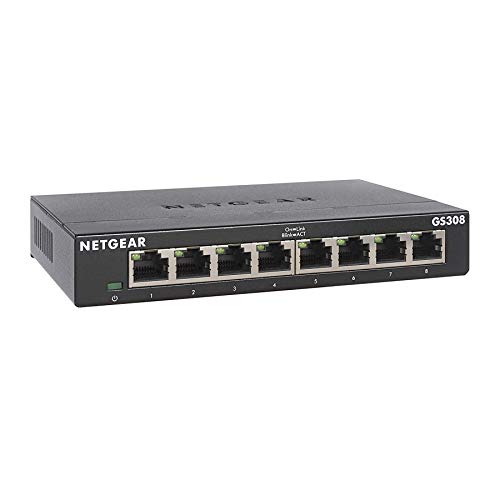
- Eight 1Gbps ports
- Simple plug-and-play setup
- Silent, energy-efficient design
Best For: Beginners who need more standard gigabit Ethernet connections
Best 10G Beginner Pick
TP-Link TL-SX105 5-Port 10G Switch

- Five 10G/multi-gig RJ45 ports
- Auto-negotiates from 100Mbps to 10Gbps
- Fanless, plug-and-play metal design
Best For: Beginners with 10G NAS, server, gaming, or Wi-Fi 6 equipment
Best 2.5G Starter Switch
NETGEAR MS305 5-Port Multi-Gig Switch

- Five 2.5Gbps Ethernet ports
- Works with Cat5e or Cat6 cabling
- Fanless metal design with desktop or wall mounting
Best For: Beginners upgrading compatible home devices to 2.5Gbps
Best Budget Gigabit Option
TP-Link TL-SG105 5-Port Switch

- Five 10/100/1000Mbps gigabit ports
- Simple plug-and-play installation
- Fanless metal case with QoS and IGMP Snooping
Best For: Beginners expanding a standard gigabit Ethernet network
Best Simple Gigabit Switch

- Eight 10/100/1000 Mbps Ethernet ports
- Plug-and-play, fanless, and quiet
- Metal housing with shielded ports and energy saving
Best For: Expanding a basic home or office gigabit network
Best Multi-Gig Expansion for Beginners

- Four 2.5GbE ports and two 10GbE ports
- 60Gbps switching capacity with wire-speed forwarding
- Fanless, plug-and-play design with desktop or wall mounting
Best For: Multi-gig home labs, NAS setups, and small offices
Best Overall – TP-Link TL-SG105-M2 5-Port 2.5G Switch
For beginners choosing multi-gigabit network switches, the TP-Link TL-SG105-M2 is a straightforward way to add five faster wired connections. Its five 2.5Gbps ports, automatic speed negotiation, fanless operation, and plug-and-play setup make it a practical upgrade for home networks with newer Wi-Fi access points, NAS devices, gaming PCs, or servers.
Best For: Beginners who want an all-2.5Gbps switch with a durable metal enclosure and flexible desktop or wall-mount placement.
Pros:
- Five 2.5Gbps RJ45 ports provide up to 25Gbps of switching capacity.
- Automatically supports 100Mbps, 1Gbps, and 2.5Gbps connections.
- Fanless design supports quiet operation.
- Requires no software installation or configuration.
Cons:
- Only five ports are available.
- It is an unmanaged switch, so advanced network controls are not included.
The TL-SG105-M2 balances speed, simplicity, and build quality well. It is especially appealing if you want multi-gig performance without replacing existing wiring with Cat6.
Best Budget-Friendly Pick – BrosTrend 5-Port 2.5G Ethernet Switch
The BrosTrend 2.5Gb Switch is a compact option for beginners who need several fast wired connections without dealing with SFP hardware. All five RJ45 ports support 2.5Gbps, and the unmanaged plug-and-play design keeps installation simple for gaming systems, NAS devices, access points, and home entertainment equipment.
Best For: Home users, gamers, and small offices that need five direct 2.5Gbps Ethernet connections in a compact enclosure.
Pros:
- Five 2.5Gbps RJ45 ports deliver up to 25Gbps of switching capacity.
- Works with PCs, consoles, TVs, NAS devices, access points, and other Ethernet equipment.
- Plug-and-play setup requires no software installation.
- Fanless design operates quietly during demanding tasks.
Cons:
- The plastic case may feel less substantial than a metal alternative.
- It does not provide SFP ports or advanced management features.
This switch is a sensible beginner choice when direct RJ45 connections are all you need. Its small footprint and silent operation make it easy to place near a desk, entertainment center, or home office.
Best for Quiet Home Offices – TP-Link TL-SG105S-M2
The TP-Link TL-SG105S-M2 gives beginners five 2.5Gbps wired ports in a quiet, unmanaged format. Automatic speed negotiation supports 100Mbps, 1Gbps, and 2.5Gbps devices, while the metal case and desktop or wall-mount design suit home offices, entertainment areas, and small workspaces.
Best For: Quiet home offices, LAN parties, and home entertainment setups that need fast wired connections without configuration.
Pros:
- Five 2.5Gbps ports offer up to 25Gbps of switching capacity.
- Auto-negotiation helps accommodate mixed-speed Ethernet devices.
- Fanless construction supports silent operation.
- Metal casing supports desktop or wall-mounted installation.
Cons:
- Five ports may be limiting for larger networks.
- As an unmanaged switch, it lacks advanced configuration options.
The TL-SG105S-M2 is a good fit when quiet operation and physical durability matter. It can also provide a 2.5Gbps upgrade without requiring a Cat6 rewiring project.
Best for Basic Gigabit Expansion – NETGEAR GS308 8-Port Gigabit Switch
The NETGEAR GS308 is a beginner-friendly choice when you need more wired connections but do not require 2.5Gbps speeds. Its eight auto-negotiating 1Gbps ports work with existing Cat5e or Cat6 cables, while plug-and-play installation, a fanless design, and desktop or wall mounting keep setup simple.
Best For: Beginners expanding a standard gigabit home or office network with up to eight wired devices.
Pros:
- Eight 1Gbps Ethernet ports provide more connection capacity than five-port models.
- Auto-negotiating ports work with Cat5e and Cat6 cabling.
- Plug-and-play setup requires no software or configuration.
- Fanless operation and IEEE 802.3az support help reduce noise and power use.
Cons:
- It is not a multi-gigabit switch; ports top out at 1Gbps.
- The supplied notes specify use in the U.S. and Canada only.
The GS308 is best viewed as a simple, higher-port-count gigabit alternative rather than a true multi-gig upgrade. Choose it if affordability and eight wired connections matter more than 2.5Gbps performance.
Best 10G Beginner Pick – TP-Link TL-SX105 5-Port 10G Switch
For beginners building a fast home or small-office network, the TP-Link TL-SX105 is a straightforward choice among multi-gigabit network switches for beginners. Its five RJ45 ports support 100Mbps, 1Gbps, 2.5Gbps, 5Gbps, and 10Gbps connections, while auto-negotiation handles speed matching automatically.
Best For: Users connecting 10G NAS devices, servers, gaming PCs, Wi-Fi 6 access points, or other high-speed equipment without wanting to configure a managed switch.
Pros:
- Five 10G/multi-gig ports provide up to 100Gbps of switching capacity.
- Plug-and-play setup requires no software or configuration.
- Fanless operation, a durable metal case, and desktop or wall mounting support flexible placement.
- Auto-negotiation supports five link speeds for broad device compatibility.
Cons:
- Only five ports are available.
- As an unmanaged switch, it does not provide advanced network configuration.
- Its 10G capability may be unnecessary for networks limited to standard gigabit equipment.
The TL-SX105 is the strongest performance option here, especially if your network includes several 10G devices. Its simple setup makes that speed accessible to beginners, although its higher-end capability may exceed basic networking needs.
Best 2.5G Starter Switch – NETGEAR MS305 5-Port Multi-Gig Switch
The NETGEAR MS305 is a practical entry point for multi-gigabit network switches for beginners who want more speed than gigabit without moving to 10G hardware. All five ports support 2.5Gbps and automatically select the appropriate speed for connected devices, including equipment using existing Cat5e or Cat6 cabling.
Best For: Home users upgrading compatible computers, access points, storage devices, or other network hardware to 2.5Gbps connections.
Pros:
- Five 2.5Gbps ports provide consistent multi-gig connectivity.
- Plug-and-play operation needs no software or configuration.
- Auto-negotiation works with existing Cat5e or Cat6 Ethernet cables.
- Compact metal construction supports desktop or wall mounting, with fanless operation for quiet use.
Cons:
- It offers 2.5Gbps ports rather than 5Gbps or 10Gbps connections.
- Only five ports are included.
- The supplied notes specify use in the U.S. and Canada only.
For a beginner-friendly network upgrade, the MS305 balances speed and simplicity well. It is a sensible fit when your devices support 2.5Gbps and you want a quiet, compact switch without management features.
Best Budget Gigabit Option – TP-Link TL-SG105 5-Port Switch
The TP-Link TL-SG105 is the simplest and most economical choice for beginners who need basic wired expansion rather than true multi-gig performance. Its five 10/100/1000Mbps ports provide standard gigabit connectivity, with auto-negotiation and Auto MDI/MDIX helping devices connect without manual setup.
Best For: Users adding a few wired devices to a standard gigabit network, such as desktops, printers, streaming equipment, or other everyday Ethernet hardware.
Pros:
- Five gigabit RJ45 ports support 10/100/1000Mbps connections.
- Plug-and-play setup requires no software or configuration.
- Fanless metal construction supports quiet operation and desktop or wall placement.
- Traffic features include 802.1p/DSCP QoS and IGMP Snooping.
Cons:
- It is limited to gigabit Ethernet, not 2.5G, 5G, or 10G speeds.
- Only five ports are available.
- It does not offer managed-switch configuration.
The TL-SG105 is a good fit if your current network and devices are gigabit-based. Choose a faster model if you are specifically planning a multi-gig upgrade, but this switch keeps basic wired expansion affordable and easy.
Best 10G Upgrade for Beginners – NETGEAR GS108MX
For beginners comparing multi-gigabit network switches for beginners, the NETGEAR GS108MX is a straightforward way to add one faster 10G connection without replacing an entire wired network. Its unmanaged, auto-negotiating design works with existing Cat5e or Cat6 cables and requires no software or configuration.
Best For: Home users who need one 10G/Multi-Gig port alongside seven standard 1G Ethernet ports.
Pros:
- Includes one 10Gbps Multi-Gig port and seven 1Gbps Ethernet ports.
- Plug-and-play setup with automatic speed negotiation.
- Fanless, energy-efficient design with desktop or wall-mount options.
- Compact metal housing and limited lifetime hardware warranty.
Cons:
- Only one port supports 10G/Multi-Gig speeds.
- It is unmanaged, so advanced traffic controls and configuration options are not included.
The GS108MX is a practical beginner-friendly choice when a network mainly uses gigabit devices but needs a single high-speed link for a NAS, workstation, or similar device.
Best Simple Gigabit Switch – TP-Link TL-SG108
The TP-Link TL-SG108 is a simple starting point for beginners who need more wired connections rather than multi-gig speeds. All eight RJ45 ports support 10/100/1000 Mbps, and its plug-and-play unmanaged design avoids setup menus or software.
Best For: Home offices, bedrooms, and small setups that need quiet, dependable gigabit connectivity for computers, printers, consoles, and other Ethernet devices.
Pros:
- Provides eight 10/100/1000 Mbps Ethernet ports.
- No configuration is required for installation.
- Fanless operation is suitable for noise-sensitive spaces.
- Sturdy metal housing, shielded ports, and energy-efficient operation.
Cons:
- It does not provide 2.5G or 10G multi-gigabit ports.
- As an unmanaged switch, it lacks advanced network configuration features.
Although it is not a true multi-gig switch, the TL-SG108 makes sense for beginners whose current devices are limited to gigabit Ethernet and who want an affordable, quiet network expansion.
Best Multi-Gig Expansion for Beginners – VunLink 10G/2.5G Switch
For beginners building a faster home lab or media network, this VunLink switch combines four 2.5GbE ports with two 10GbE RJ45 ports. Auto-negotiation and plug-and-play operation keep installation simple, while the 60Gbps switching capacity is designed for simultaneous multi-device traffic.
Best For: Homes and small offices connecting 2.5G PCs or wireless access points with 10G NAS, server, or workstation links.
Pros:
- Offers four 2.5GbE ports and two 10GbE ports.
- Supports auto-negotiation and auto MDI/MDIX without configuration.
- Fanless metal design provides quiet operation with desktop or wall mounting.
- 60Gbps switching capacity and wire-speed forwarding support busy networks.
Cons:
- It has only six total ports.
- The stated warranty is one year, with 30-day free replacement and lifetime technical support.
This is the most capable option here for a beginner who already owns several multi-gig devices. Its unmanaged design keeps setup approachable, while the mix of 2.5G and 10G ports leaves room for faster storage and networking gear.
How We Picked the Best Multi-Gigabit Network Switches for Beginners
We compared these switches by looking at the features that matter most for a first wired-network upgrade: supported Ethernet speeds, port count, plug-and-play setup, fanless or low-noise operation, enclosure quality, and compatibility with common home networking equipment. Because these are primarily unmanaged switches, they generally require no software, account, or advanced configuration.
We also included a range of options. Some models are affordable gigabit choices for basic connectivity, while others support 2.5GbE, 10GbE, or a mix of speeds for users building a faster home lab or NAS network.
Quick Comparison
| Best For | Recommended Speed | Typical Port Count | Setup |
|---|---|---|---|
| Basic wired expansion | 1GbE | 5–8 ports | Plug and play |
| Faster PCs, gaming, and NAS | 2.5GbE | 5 ports | Plug and play |
| High-speed storage and backbone links | 10GbE or mixed multi-gig | 5–8 ports | Plug and play |
Key Buying Factors for Multi-Gigabit Network Switches for Beginners
Port Speed and Compatibility
Choose a switch based on the fastest devices you plan to connect. A 2.5GbE switch is a useful middle ground for newer computers, Wi-Fi access points, and NAS devices. A 10GbE switch costs more but can help with demanding file transfers and high-speed network backbones. Multi-gigabit Ethernet typically negotiates downward, so faster ports can work with 1GbE equipment, though performance will be limited by the slowest link.
Port Count and Layout
Count current devices and leave room for expansion. Five ports may be enough for a desktop, NAS, console, and uplink, while eight ports provide more flexibility for an office or growing home lab. Remember that one port may connect the switch to your router, leaving fewer ports for local devices.
Cabling and Real-World Limits
Use good-quality Ethernet cables rated for the speed and distance you need. Cat5e can support some multi-gigabit connections over suitable runs, while Cat6 or better is a safer choice for 10GbE and longer cable paths. Internet speed is also separate from local network speed: a fast switch improves device-to-device transfers but does not increase a slower broadband plan.
Cooling and Placement
Fanless metal switches are often attractive for bedrooms, offices, and living rooms because they operate quietly and help dissipate heat. Place any switch in an open, ventilated area and avoid stacking it tightly against heat-producing equipment.
Who Should Buy Which Multi-Gigabit Network Switches for Beginners?
Choose a 1GbE model if you only need extra wired ports for ordinary streaming, printers, smart-home devices, or older computers. Choose a 2.5GbE switch if you have newer PCs, a Wi-Fi 6 or Wi-Fi 7 access point, a compatible NAS, or internet service above 1Gbps. Choose a 10GbE or mixed-speed model if you regularly move large media files, run virtual machines, or want a faster home-lab backbone.
For most first-time buyers, an unmanaged 2.5GbE switch offers the best balance of simplicity, performance, and upgrade potential. Confirm that your router, computers, NAS, and cabling can support the target speed before paying for higher-capacity hardware.