Indoor air can change quickly with cooking, cleaning, ventilation, humidity, and occupancy. The best premium air quality monitoring systems turn those changes into clear measurements you can act on.
We selected ten advanced monitors spanning radon detection, particulate tracking, CO2 and VOC measurement, smart-home integration, portable testing, and professional data logging. Use the guide below to match sensor coverage and features to your space.
Best 10 Premium Air Quality Monitoring Systems Picks for 2026
Best All-Around Coverage

- Monitors radon plus PM2.5, CO2, VOCs, and comfort conditions
- Battery-powered with customizable eInk display
- App alerts and cloud-based trend tracking
Best For: Homeowners seeking comprehensive, radon-inclusive monitoring
Best for Visible Room Readings

- Large LED display for room-wide visibility
- Measures PM2.5, CO2, temperature, and humidity
- Stores 12,000 records with CSV export
Best For: Shared spaces needing clear readings and data logging
Best for Automated Ventilation

- Measures PM2.5, TVOCs, CO2, humidity, and temperature
- Can trigger connected ventilation equipment
- Pass-through outlet and app-based room history
Best For: NuTone Overture households automating indoor ventilation
Best Open-Source Smart Monitor
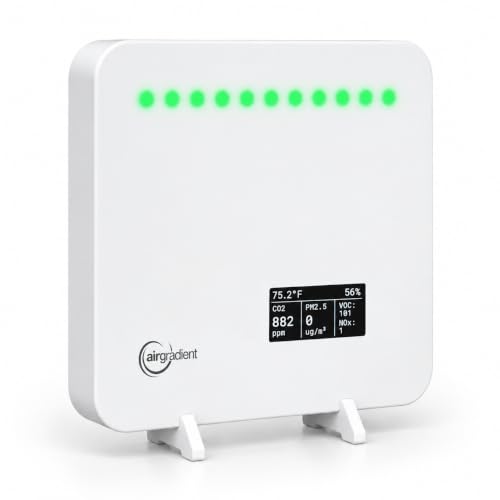
- Measures PM2.5, CO2, TVOCs, NOx, and comfort conditions
- Subscription-free dashboard, API, and Home Assistant support
- Tested, calibrated, and equipped with OLED display
Best For: Smart-home enthusiasts wanting open, flexible monitoring
Best Multi-Parameter Value
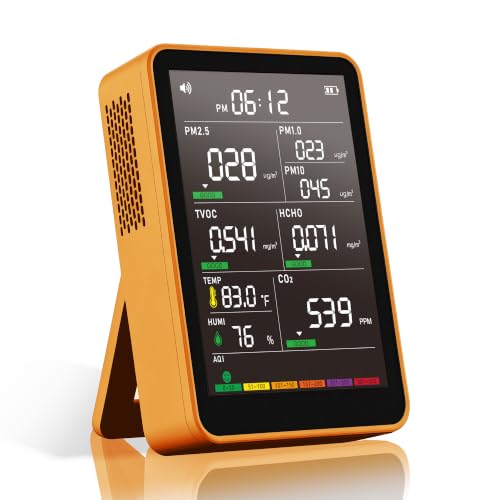
- Measures particles, gases, temperature, and humidity
- HD color display with readings every 1.5 seconds
- Portable USB-C design with 4–5-hour runtime
Best For: Broad, screen-based monitoring at home, work, or on the go
Best for Data Tracking

- Eight measurements including NDIR CO2 and formaldehyde
- 90-day app history with graphs and CSV export
- Up to 6 hours portable use with smart alerts
Best For: Connected monitoring, trend analysis, and remote notifications
Best Smart-Home Integration
AprilAire Smart 5-in-1 Monitor
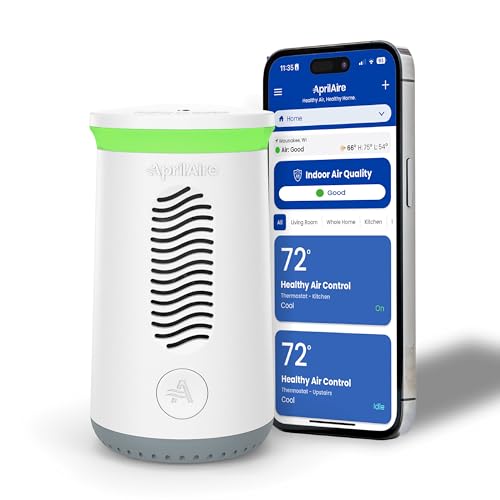
- Tracks CO2, VOCs, PM2.5, humidity, and temperature
- Healthy Air App provides trends, alerts, and guidance
- Can integrate with compatible AprilAire systems
Best For: App-guided home monitoring and AprilAire ecosystem users
Professional Integration Pick
Atmocube 12-in-1 Air Quality Monitor

- Tracks 12 pollutants and environmental conditions
- Includes wireless E-Ink companion display
- Offers cloud alerts and professional integrations
Best For: Offices, schools, healthcare, and smart-building systems
Smart Home Display Pick

- Monitors seven key indoor readings
- Features a 4-inch touchscreen and alarm clock
- Supports Wi-Fi app access and 30-day data export
Best For: Bedrooms and smart homes wanting clear local and remote readings
Large-Screen Value Pick
16-in-1 Indoor Air Quality Monitor

- Tracks CO2, particles, HCHO, TVOC, and more
- Uses a large 7-inch full-view display
- Offers calibration support and threshold alerts
Best For: Home offices, bedrooms, and spaces needing easy local monitoring
Best All-Around Coverage – Airthings View Plus
For shoppers comparing premium air quality monitoring systems, the Airthings View Plus stands out for combining radon detection with readings for PM2.5, CO2, VOCs, humidity, temperature, and air pressure. Its battery-powered design, customizable eInk screen, app tracking, and cloud history make it practical for ongoing monitoring throughout the home.
Best For: Homeowners who want broad pollutant coverage, including radon, in a cable-free monitor.
Pros:
- Measures radon, PM2.5, CO2, VOCs, humidity, temperature, and air pressure.
- Battery-powered placement with an estimated two-year battery life.
- App notifications, trend analysis, cloud storage, and pollen forecast integration.
- Optional free extended warranty registration can provide five years of coverage.
Cons:
- The monitor and app require internet access.
- An Airthings account and app are required for operation.
- Operating temperature is limited to 39–104°F.
The View Plus is a strong choice when radon monitoring is a priority alongside everyday air-quality measurements. Its reliance on the app and internet is worth considering, but the sensor range and flexible battery-powered design make it one of the more comprehensive options here.
Best for Visible Room Readings – Extech IAQ320
The Extech IAQ320 is a practical pick among premium air quality monitoring systems for users who want key readings visible across a room. It simultaneously displays PM2.5, CO2, temperature, relative humidity, and a health index, while its logging and export features support longer-term analysis.
Best For: Offices, classrooms, and other spaces where at-a-glance readings and recorded data are important.
Pros:
- Simultaneously measures PM2.5, CO2, temperature, and relative humidity.
- Large LED display is designed to be readable across the room.
- Tri-color LED bars visually indicate PM2.5 and CO2 levels.
- Stores up to 12,000 records and supports CSV export.
Cons:
- Its listed measurements do not include radon or VOCs.
- The supplied notes do not specify battery operation or wireless connectivity.
- Visual and audible alarms may be unnecessary for users seeking a quiet display.
The IAQ320 favors clear, shared visibility over a broad range of pollutants or smart-home integration. Its substantial data capacity and CSV export make it particularly useful for facility checks, workplace monitoring, and users who want documented readings.
Best for Automated Ventilation – NuTone Overture Room Sensor
The NuTone Overture Room Sensor takes a systems-oriented approach to premium air quality monitoring systems. It measures PM2.5, TVOCs, CO2, humidity, and temperature, then communicates with an Overture Wall Control so connected fans, range hoods, or HVAC equipment can respond when air quality changes.
Best For: Homes already using, or planning to build, a NuTone Overture ventilation system.
Pros:
- Monitors PM2.5, TVOCs, CO2, humidity, and temperature.
- Can help trigger connected ventilation devices when readings reach set parameters.
- Pass-through outlet preserves use of the receptacle for another device.
- Works with the Overture app, Alexa, and Google Assistant compatibility.
Cons:
- Requires an Overture Wall Control to operate.
- Requires a 2.4 GHz Wi-Fi network within 100 feet.
- Its operating temperature range is 32–95°F.
This sensor is less of a standalone monitor and more of a control component for an integrated ventilation setup. It is a compelling fit for Overture users, but buyers wanting independent operation should account for the required wall control and broader system components.
Best Open-Source Smart Monitor – AirGradient ONE
The AirGradient ONE is a strong option for shoppers seeking premium air quality monitoring systems with flexible software and smart-home support. It measures PM2.5, CO2, TVOCs, NOx, temperature, and humidity, and adds a subscription-free dashboard, free API access, Home Assistant compatibility, and open-source hardware and firmware.
Best For: Home Assistant users, developers, and technically minded buyers who want local-control and self-hosting flexibility.
Pros:
- Measures PM2.5, CO2, TVOCs, NOx, temperature, and humidity.
- Uses named sensor modules and includes individual testing, PM2.5 calibration, and a digital test report.
- Offers subscription-free dashboard access, free API access, and Home Assistant support.
- Includes an OLED display, color bar, wall-mounting option, and power adapter.
Cons:
- Its open-source and integration features may be more than casual users need.
- The supplied notes do not list radon measurement.
- It requires USB power rather than battery operation.
The AirGradient ONE is especially appealing when data ownership, integrations, and sensor transparency matter as much as the readings themselves. Its combination of broad pollutant coverage and open-source flexibility makes it a standout for connected homes and technically capable users.
Best Multi-Parameter Value – 16-in-1 Air Quality Monitor
For shoppers seeking premium air quality monitoring systems without committing to a connected app ecosystem, this portable 16-in-1 monitor offers broad coverage and a large color display. It tracks particulate matter, gases, temperature, and humidity with readings updated every 1.5 seconds.
Best For: Households, offices, bedrooms, vehicles, and other spaces where quick, local readings and flexible placement matter.
Pros:
- Tracks PM1.0, PM2.5, PM10, TVOC, HCHO, temperature, and humidity.
- Large HD color screen with color-coded air-quality readings.
- Portable design, USB-C charging, and 4–5 hours of continuous sampling.
- Includes a 12-month full-unit warranty.
Cons:
- Battery runtime is shorter than some competing portable monitors.
- Notes do not indicate app connectivity or historical data storage.
This is a practical choice when you want many measurements in one compact device and prefer checking the screen directly. Its simple controls and adjustable audio prompt also make it approachable for everyday household monitoring.
Best for Data Tracking – BREATHE Airmonitor Plus Gen 2
Among premium air quality monitoring systems, the BREATHE Airmonitor Plus Gen 2 stands out for combining broad sensor coverage with connected monitoring. Its NDIR CO2 sensor, particle sensing, app alerts, 90-day history, and CSV export support more detailed long-term analysis.
Best For: Users who want remote readings, historical trends, alerts, and portable monitoring for homes, offices, classrooms, or bedrooms.
Pros:
- Measures CO2, PM1, PM2.5, PM10, TVOC, HCHO, temperature, and humidity.
- Offers 90-day app history, data graphs, and CSV export.
- Provides configurable CO2 and PM2.5 alerts through 2.4 GHz Wi-Fi.
- Runs for up to 6 hours on battery and can operate through USB-C power.
Cons:
- App features require Wi-Fi and setup with the Breathe Tech app.
- The supplied notes do not specify whether all features work without the app.
This model is a strong fit for buyers who want to understand how cooking, cleaning, occupancy, HVAC use, and ventilation affect indoor air. It offers more useful history and analysis tools than a monitor designed only for on-device viewing.
Best Smart-Home Integration – AprilAire Smart 5-in-1 Monitor
The AprilAire ZAWTHCPV is designed for buyers who want premium air quality monitoring systems tied to guidance and broader home-air solutions. It measures CO2, VOCs, PM2.5, humidity, and temperature, then presents trends, alerts, and educational recommendations in the Healthy Air App.
Best For: Homeowners who want app-based alerts and may integrate monitoring with compatible AprilAire ventilation or filtration equipment.
Pros:
- Monitors CO2, VOCs, TVOC, PM2.5, humidity, and temperature.
- Provides notifications, real-time trends, and plain-language guidance in the app.
- Offers three light settings, including always-on and always-off options.
- Includes a three-year manufacturer warranty.
Cons:
- Requires the AprilAire Healthy Air App to function.
- Healthy Air Mode requires a compatible AprilAire Wi-Fi thermostat sold separately.
- It is corded electric rather than battery-powered.
This monitor makes the most sense within an AprilAire-centered home setup, especially if actionable notifications are more important than a long list of sensor types. Buyers should account for the app requirement and any separately sold compatible equipment.
Professional Integration Pick – Atmocube 12-in-1 Air Quality Monitor
For buyers seeking premium air quality monitoring systems, the Atmocube stands out with broad pollutant coverage, professional connectivity, and room-to-room visibility. It tracks 12 parameters, including CO2, particulate matter, formaldehyde, TVOC, NO2, ozone, noise, and light.
Best For: Offices, schools, healthcare spaces, and smart-building or HVAC integrations that need detailed monitoring and historical data.
Pros:
- Measures 12 air-quality and environmental parameters in real time.
- Includes a wireless, battery-powered E-Ink companion display.
- Supports Wi-Fi, Ethernet, PoE, MQTT, Modbus, REST API, and cloud trends.
- Provides alerts, historical data, and exportable compliance reports.
Cons:
- Its professional feature set may be more than a basic home user needs.
- Advanced integrations may require setup knowledge.
The Atmocube is the strongest choice here for comprehensive coverage and building-system integration. Choose it when actionable data, remote alerts, and flexible connectivity matter more than simplicity.
Smart Home Display Pick – Qingping Air Monitor Gen 2
The Qingping Air Monitor Gen 2 is a practical option among premium air quality monitoring systems for homes and bedrooms. Its touchscreen shows seven readings, including CO2, PM2.5, PM10, eTVOC, temperature, humidity, and noise, while Wi-Fi enables remote viewing.
Best For: Smart-home users who want an easy-to-read touchscreen, app access, historical data, and alarm-clock functionality.
Pros:
- Displays seven air-quality and comfort measurements in real time.
- Uses a clear 4-inch IPS touchscreen with automatic brightness adjustment.
- Supports 2.4GHz and 5GHz Wi-Fi, remote monitoring, and 30-day data export.
- Has a replaceable PM sensor for easier future maintenance.
Cons:
- Does not measure formaldehyde.
- USB power is recommended for daily use, and the adapter is not included.
- Battery operation lasts up to three hours after a full charge.
Choose the Qingping when a polished display and convenient smart-home access are priorities. Its replaceable PM sensor is useful for maintenance, but buyers specifically needing formaldehyde readings should consider another model.
Large-Screen Value Pick – 16-in-1 Indoor Air Quality Monitor
This 16-in-1 monitor is a straightforward choice for shoppers comparing premium air quality monitoring systems with large, glanceable displays. It combines readings for CO2, particulate matter, HCHO, TVOC, temperature, humidity, and AQI on a 7-inch screen.
Best For: Home offices, bedrooms, and shared spaces where a large display, audible alerts, and broad everyday monitoring are useful.
Pros:
- Tracks multiple air-quality readings, including CO2, PM1.0, PM2.5, PM10, HCHO, and TVOC.
- Large 7-inch display makes readings easy to view at a glance.
- Built-in calibration support helps users adjust readings when needed.
- Provides threshold alerts with a buzzer and mute function.
Cons:
- The supplied notes do not specify Wi-Fi, app support, or cloud history.
- Sensors should be kept away from perfumes and strong odors to help maintain accuracy.
- Its 1.47-pound weight and large footprint make it less portable than smaller monitors.
The large screen and audible alerts make this monitor especially practical for continuous room monitoring. It is a good fit when local visibility and broad sensor coverage matter more than connected-home features.
How We Picked These Premium Air Quality Monitoring Systems
We focused on monitors with meaningful sensor coverage, useful real-time feedback, and practical ways to review or share readings. The selection includes dedicated radon monitoring, PM2.5 and PM10 detection, CO2 and VOC tracking, temperature and humidity measurements, formaldehyde and NOx sensing, and models designed for professional logging or smart-home automation.
We also considered setup, display readability, battery or wired operation, app support, data access, and whether the device is better suited to a single room, a whole-home strategy, or portable spot checks. Sensor labels alone do not guarantee laboratory-grade performance, so buyers should review calibration information and intended use before relying on any monitor for health or compliance decisions.
Quick Comparison
| Priority | Look For | Best Fit |
|---|---|---|
| Broad household coverage | PM, CO2, VOC, temperature, and humidity | Families, bedrooms, and living areas |
| Radon awareness | Dedicated radon sensor with trend reporting | Basements and homes in higher-risk regions |
| Professional measurement | Data logging, configurable intervals, and documented specifications | Inspectors, facilities, and detailed investigations |
| Smart-home automation | Wi-Fi, open integrations, or Home Assistant support | Automated ventilation and alert routines |
| Portable testing | Battery operation, compact design, and readable display | Room-to-room checks and travel |
Key Buying Factors for Premium Air Quality Monitoring Systems
Sensor Coverage and Measurement Purpose
CO2 is a useful indicator of ventilation and occupancy, while PM2.5 can reveal smoke, cooking particles, and outdoor pollution entering the home. VOC, formaldehyde, NOx, and radon address different concerns and should not be treated as interchangeable. Choose sensors based on the problem you are trying to investigate rather than selecting the longest feature list.
Accuracy, Calibration, and Placement
Look for documented sensing technology, calibration guidance, and clear operating limits. Place the monitor away from windows, vents, kitchens, direct sunlight, and humidifiers unless you are intentionally testing those sources. A monitor can only represent the air around its sensor, so larger homes may need multiple units.
Alerts, History, and Connectivity
Trend graphs are often more useful than a single live number. App alerts can help you respond when CO2 or particles rise, while local displays are preferable when you want information without opening a phone. Open integrations matter if the monitor will trigger fans, purifiers, or HVAC equipment.
Power and Operating Cost
Battery models are flexible but may require periodic replacement or charging. Plug-in systems are better for continuous monitoring and stable connectivity. Also check subscription requirements, replacement sensors, data export options, and whether readings remain available if cloud services change.
Who Should Buy Which Premium Air Quality Monitoring Systems?
Choose a radon-capable system for a basement, ground-level bedroom, or home where long-term radon awareness is a priority. Select a professional meter or datalogger when you need repeatable field measurements, stored records, or more controlled testing. For smart-home users, prioritize reliable Wi-Fi or local integration and compatibility with the platform you already use.
For most households, a monitor covering CO2, PM2.5, VOCs, temperature, and humidity offers the most useful everyday picture. Portable multi-parameter units suit renters and people who want room-to-room checks, while large-display models work well for shared spaces, classrooms, and offices where readings need to be visible at a glance.