If you work on a Mac Studio, you need external storage that matches its power and workflow. You’ll want drives that deliver sustained speeds, reliable endurance, and the right ports or expandability for video, audio, or photo projects. Below are ten SSDs and hybrid options that balance performance, capacity, and connectivity — and one key buying factor that can make or break your studio setup.
SanDisk 1TB Extreme Portable SSD (SDSSDE61-1T00-G25)
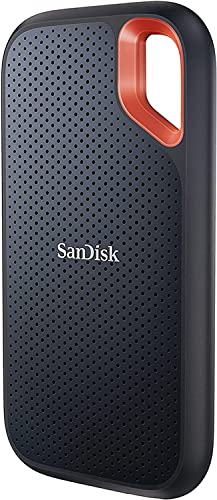
If you need a fast, rugged pocket drive to keep large photo and video libraries portable, the SanDisk 1TB Extreme Portable SSD is a strong match for Mac Studio users—its USB‑C/3.2 Gen 2 interface delivers up to 1050 MB/s read and 1000 MB/s write speeds, so you’ll move and edit 4K footage without long transfers, and the IP65 water/dust resistance plus 3‑meter drop protection means you can take it between shoots with confidence. You’ll get 1 TB capacity, hardware 256‑bit AES encryption, a carabiner loop, and a 5‑year warranty. It’s Mac compatible (software download required) and highly rated by users.
Best For: Mac Studio users and creative professionals who need a fast, rugged, portable 1TB drive for storing and editing large photo/video libraries on the go.
Pros:
- Up to 1050 MB/s read and 1000 MB/s write speeds via USB-C (USB 3.2 Gen 2) for smooth 4K workflows.
- Durable design with IP65 water/dust resistance, 3-meter drop protection, and carabiner loop for on-location use.
- Hardware 256-bit AES encryption and a 5-year limited warranty for security and peace of mind.
Cons:
- Mac users need to download SanDisk software for full compatibility/features.
- Performance can vary depending on host device and usage conditions; may not reach peak speeds on older hardware.
- Higher cost compared with traditional portable HDDs or lower-capacity SSD options.
SanDisk 2TB Extreme Portable SSD (SDSSDE61-2T00-G25)
For creatives who need fast, portable storage for large video and photo projects, the SanDisk 2TB Extreme Portable SSD delivers — offering up to 1050 MB/s read and 1000 MB/s write over USB-C (USB 3.2 Gen 2) so you can edit directly from the drive with minimal lag. You get 2TB of capacity in a rugged, pocketable chassis with 3-meter drop protection and IP65 water/dust resistance. A carabiner loop makes transport easy. Hardware 256-bit AES encryption and password protection keep files secure (macOS software available). SanDisk includes a 5-year warranty; user ratings average 4.6 stars from 89,249 reviews.
Best For: creatives and professionals who need fast, rugged, portable storage for large photo and video projects and want to edit directly from the drive with minimal lag.
Pros:
- Up to 1050 MB/s read and 1000 MB/s write over USB-C (USB 3.2 Gen 2) for smooth on-drive editing and fast transfers.
- Rugged, pocketable design with 3-meter drop protection, IP65 water/dust resistance, and a carabiner loop for easy transport.
- Hardware 256-bit AES encryption, password protection, and a 5-year limited warranty provide security and peace of mind.
Cons:
- Requires a compatible USB-C/USB 3.2 Gen 2 host to reach advertised speeds; older ports will be slower.
- macOS users need to download SanDisk software for full encryption/password support.
- Higher-capacity SSDs like 4TB can be significantly more expensive, and replacement/repair outside warranty may incur costs.
OWC StudioStack Thunderbolt 5 Dual-Drive Hybrid Storage and Connectivity Hub

Power users who need a combined high-speed NVMe and high-capacity HDD solution will appreciate the OWC StudioStack, which stacks neatly with Mac Studio and delivers up to 6,302 MB/s real-world NVMe performance alongside multi-terabyte HDD storage. You get an 8TB NVMe and up to 24TB HDD option in a Thunderbolt 5 dual-drive hybrid hub with three 80Gb/s TB5 ports and three 10Gb/s USB-A ports, compatible with TB5/4, USB4 and TB3 hosts. Its aircraft-grade aluminum case aids cooling, and a smart fan keeps noise low. You can buy ready-to-run or build your own; a one-year warranty is included.
Best For: Power users and creative professionals who need a stacked, Thunderbolt 5 hub combining ultra-fast NVMe performance with multi-terabyte HDD capacity for Mac Studio/Mac mini setups or other TB/USB4 hosts.
Pros:
- Combines up to 6,302 MB/s NVMe speed with up to 24TB HDD capacity for a fast + high-capacity hybrid workflow.
- Three Thunderbolt 5 (80 Gb/s) ports and three USB-A (10 Gb/s) ports provide flexible high-bandwidth connectivity and daisy-chaining.
- Rugged aircraft-grade aluminum design with smart, near-silent fan and easy DIY upgradeability (2280 NVMe and larger SATA drives).
Cons:
- 1-year limited warranty may be short compared with some competitors offering longer coverage.
- Larger HDD capacities and NVMe upgrades can increase cost, especially for preconfigured ready-to-run units.
- Physical stacking optimized for Mac Studio/Mac mini may be less ideal aesthetically or spatially for other workstation layouts.
OWC miniStack STX Upgradable Storage Enclosure and Thunderbolt Hub (Supports 3.5″/2.5″ SSD/HDD & M.2 NVMe)

Photographers, video editors, and pro users who need both lots of capacity and a built-in Thunderbolt hub will appreciate the OWC miniStack STX. You can install 3.5″ or 2.5″ HDDs/SSDs and an M.2 NVMe, expanding storage massively for Mac Studio or Mac mini. It provides three Thunderbolt ports, four USB-C ports, support for two displays, and chaining up to five Thunderbolt devices. Expect up to 770 MB/s real-world speeds, 96W notebook charging, and whisper-quiet aluminum cooling. Compatibility spans Thunderbolt 3–5 and USB devices; USB-A needs an adapter. OWC backs drives with a 3-year warranty, enclosure one year.
Best For: Photographers, video editors, and pro users who need high-capacity, swappable storage plus a built-in Thunderbolt hub for Mac Studio, Mac mini, and other Thunderbolt/USB systems.
Pros:
- Supports 3.5″ and 2.5″ HDDs/SSDs plus an M.2 NVMe for massive, upgradable storage capacity.
- Built-in Thunderbolt hub with three Thunderbolt/USB-C ports, support for two displays, device chaining, and up to 96W notebook charging.
- Quiet, durable aluminum design with active cooling and strong warranty coverage for drives (3 years) and enclosure (1 year).
Cons:
- USB-A devices require a separate adapter (sold separately).
- Real-world speeds up to ~770 MB/s may be slower than some dedicated NVMe-only enclosures or RAID arrays for extreme performance needs.
- Enclosure warranty is only one year compared with the three-year drive warranty.
OWC 20TB miniStack STX 7200 RPM Hard Drive Expansion and Thunderbolt Hub/Mini Dock
If you need a high-capacity, multi-role expansion that doubles as a Thunderbolt 4 hub, the OWC 20TB miniStack STX is built for creative professionals and prosumers who juggle large video projects and multiple displays. You get a 20TB 7200 RPM enterprise drive with 512MB cache plus slots for a 2.5-inch drive and NVMe M.2 SSD, so you can mix capacity and speed. Thunderbolt-certified with three 40Gb/s ports, it supports up to five TB devices, three USB devices, high-res displays (up to 8K@60Hz), and delivers 96W host power. It includes cable and OWC warranty coverage.
Best For: Creative professionals and prosumers who need high-capacity local storage plus a Thunderbolt 4 hub for multi‑display video editing workflows.
Pros:
- Massive 20TB 7200RPM enterprise drive with 512MB cache plus slots for a 2.5″ SATA and NVMe M.2 SSD for flexible capacity/performance mixes.
- Thunderbolt 4 certified with three 40 Gb/s ports, support for multiple displays (up to 8K@60Hz) and 96W host power delivery.
- Upgradeable/stackable design and broad device compatibility (Thunderbolt 3–5, USB devices, iPads, PCs) with included Thunderbolt cable and OWC warranty.
Cons:
- Large mechanical 7200RPM HDD may not match NVMe SSD speeds for demanding realtime I/O despite the M.2 slot.
- USB-A connectivity requires a separate adapter and some older devices may need extra cables/adapters.
- Enclosure warranty is only 1 year (drive/SSD solutions covered for 3 years), which may be short for long-term heavy use.
Samsung T7 Portable 1TB External SSD (USB 3.2 Gen 2)
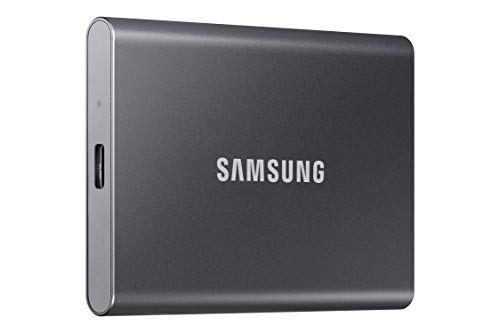
For Mac Studio users who need fast, portable scratch or backup storage, the Samsung T7 1TB delivers NVMe speeds (up to 1,050/1,000 MB/s) in a compact, shock‑resistant aluminum case. You’ll get PCIe NVMe performance over USB 3.2 Gen 2, nearly twice the T5, making 4K60 video capture, editing, and large file transfers snappier. The drive works across PCs, phones, and cameras, so you can move projects easily. It survives drops up to six feet and uses an aluminum unibody for durability. Backed by Samsung’s in‑house manufacturing and flash expertise, it’s a reliable, portable option.
Best For: Mac Studio users and creative professionals who need fast, portable NVMe-level scratch or backup storage for 4K60 video editing, large file transfers, and cross-device workflows.
Pros:
- PCIe NVMe performance over USB 3.2 Gen 2 (up to 1,050/1,000 MB/s) for fast transfers and smooth 4K60 editing.
- Compact, shock-resistant aluminum unibody with drop protection up to 6 feet for durable portability.
- Broad compatibility with PCs, phones, and cameras and backed by Samsung’s in-house flash manufacturing for reliability.
Cons:
- Speeds are limited by USB 3.2 Gen 2 — won’t reach full NVMe internal SSD performance.
- No built-in hardware cooling; sustained heavy workloads may see thermal throttling.
- Lacks integrated cable storage and may require adapters or extra cables for some devices.
Lexar ES3 1TB External SSD (USB 3.2 Gen2 Portable SSD)

Need fast, pocketable storage that keeps up with large video and photo files? The Lexar ES3 1TB delivers USB 3.2 Gen 2 speeds—read up to 1050MB/s and write up to 1000MB/s—so you can move projects to and from your Mac Studio quickly, provided you use a Gen 2 port. It’s thin, durable, and just 42g and 10.5mm thick, slipping into a pocket with the included Type-C cable. It’s compatible with modern phones, laptops, cameras, and consoles (iPhone 15+ supported; iPhone 14 and older aren’t). Lexar DataShield™ 256-bit AES encryption protects your files.
Best For: Creators and professionals who need fast, pocketable external storage for large photo and video files and have devices with USB 3.2 Gen 2 ports.
Pros:
- Fast read/write speeds (up to 1050MB/s read, 1000MB/s write) for quick transfers and editing.
- Compact, lightweight, and durable design (42g, 10.5mm) with included Type-C cable for portability.
- Built-in Lexar DataShield™ 256-bit AES encryption for secure file protection.
Cons:
- Peak performance requires a USB 3.2 Gen 2 port; speeds may drop on older ports or some Macs.
- Not supported on iPhone 14 and earlier, limiting use with older iOS devices.
- No mention of IP-rated ruggedness or integrated cable storage, so physical protection and cable management are limited.
OWC 8TB miniStack STX 7200 RPM External HDD and Thunderbolt Hub/Dock
Power users who juggle multiple high-resolution streams will appreciate the OWC 8TB miniStack STX’s combination of roomy 8TB capacity and Thunderbolt 4 throughput, letting you edit 4K video at up to 770 MB/s while also acting as a Thunderbolt hub that powers and connects displays and peripherals. You get a 7200 RPM HDD with 256 MB cache plus an M.2 NVMe bay for fast tiering, all in a stackable, upgradeable chassis. Four Thunderbolt 4 ports (one host), 96W host power, and support for up to one 8K@60 or two 4K@60 displays make it a versatile dock. Warranty covers drives three years, enclosure one year.
Best For: Power users and content creators who need high-capacity, upgradeable storage with Thunderbolt 4 throughput and hub functionality for editing multi-stream 4K/8K video and connecting displays/peripherals.
Pros:
- 8TB 7200 RPM HDD with 256 MB cache plus M.2 NVMe slot for fast tiering—large capacity + performance flexibility.
- Thunderbolt 4 hub with four TB4 ports (one host), 96W host power, and support for up to one 8K@60 or two 4K@60 displays.
- Stackable, upgradeable design and Thunderbolt-certified compatibility with Macs, PCs, iPads, Chromebooks, and Android tablets.
Cons:
- Primary storage is a mechanical 7200 RPM HDD—slower than NVMe-only enclosures for sustained high-speed workflows.
- Enclosure warranty is only 1 year (drives/SSDs covered 3 years), which may concern long-term hardware reliability.
- Physical size and requirement for Thunderbolt cables/ports may be overkill or incompatible for users with only USB-A/limited-port systems.
SanDisk 1TB Portable SSD (SDSSDE30-1T00-G26)

If you want a compact, rugged drive that moves large media files quickly between your Mac Studio and portable devices, the SanDisk 1TB Portable SSD (SDSSDE30-1T00-G26) is a solid pick. You’ll get 1TB in a 2.5-inch, 1.44-ounce rubber-enclosed package with a handy tough hook and two-meter drop protection. USB 3.2 Gen 2 Type-C delivers up to 800 MB/s reads (write speeds are lower), 0.1 ms latency, and a small 1 MB cache. Compatibility spans USB-enabled laptops and devices. It’s backed by a three-year limited warranty, strong customer ratings, and top-ten SSD sales placement.
Best For: Creative professionals and travelers who need a compact, rugged external SSD to quickly move large media files between desktop and portable devices.
Pros:
- Fast USB 3.2 Gen 2 Type-C reads up to 800 MB/s for quick file transfers.
- Rugged rubber enclosure with two-meter drop protection and a tough hook for portability.
- Compact, lightweight 1TB capacity with a 3-year limited warranty and strong customer ratings.
Cons:
- Write speeds are lower than the advertised read speeds (specific write figures not provided).
- Very small cache (1 MB) may limit sustained performance in some workloads.
- 2.5-inch form factor and rubber housing may be bulkier than ultra-slim pocket SSD alternatives.
SSK Portable 1TB USB-C External SSD (Up to 1050MB/s)

For creative professionals who move large projects between Mac Studio and mobile devices, the SSK Portable 1TB SSD delivers near‑NVMe speeds (up to 1050MB/s) in a compact aluminum enclosure, so you’ll get fast, reliable transfers and cross‑platform compatibility without carrying a bulky drive. You’ll see ~1TB on macOS (≈931GB on Windows) and benefit from USB 3.2 Gen2 10Gbps links via included USB‑C and USB‑A cables. Writes reach about 1000MB/s, with a 25% adaptive cache, TRIM support, and S.M.A.R.T. health monitoring. It’s featherlight, works with phones, consoles, and computers, and ships with a three‑year warranty.
Best For: Creative professionals and power users who need fast, portable, cross‑platform storage to move large projects between desktops (including Mac Studio) and mobile devices.
Pros:
- Compact, lightweight aluminum enclosure with near‑NVMe speeds (up to 1050MB/s read, ~1000MB/s write) over USB 3.2 Gen2 (10Gbps).
- Includes both USB‑C to C and USB‑A to C 10Gbps cables for wide device compatibility (phones, tablets, consoles, PCs, Macs).
- Features useful maintenance tech—25% adaptive cache, TRIM support, and S.M.A.R.T. monitoring—plus a 3‑year warranty.
Cons:
- Capacity reports ~931GB on Windows (full 1TB on macOS), which may confuse some users.
- Performance may vary with very large sustained transfers despite caching—design notes only guarantee no slowdowns for files <250GB.
- No mention of hardware encryption or ruggedized protection for heavy field use.
Factors to Consider When Choosing Mac Studio External SSD Solutions
When picking an external SSD for your Mac Studio, you’ll want to weigh performance and bandwidth against the capacity you need and how easily you can expand. Check connectivity and port types to match your workflow, and prioritize reliability, durability, plus security features like encryption. These factors will determine real-world speed, longevity, and data protection.
Performance and Bandwidth
Because Mac Studio workloads demand consistent throughput, you’ll want to focus on sustained read/write speeds and interface bandwidth when choosing an external SSD. Look for drives advertising strong sustained rates — many reach about 1050 MB/s read and 1000 MB/s write — since those numbers translate directly into faster transfers and smoother timeline playback. Check the host interface: USB 3.2 Gen 2 tops out at 10 Gbps, suitable for many tasks, while Thunderbolt (now up to Thunderbolt 5) delivers far higher throughput — up to 80 Gb/s — for heavy video or multi-stream editing. Also consider drives with advanced caching to keep write performance steady under large transfers. Remember real-world speeds vary by Mac Studio configuration and workload, so match interface and SSD tech to your needs.
Capacity and Scalability
Although you may start with a smaller drive, plan your capacity around the projects you handle today and expect to take on next year, since Mac Studio workloads—multi‑layer video, raw photo libraries, virtual machines—can eat through terabytes quickly. Choose capacities from 1TB to 8TB+ so you don’t bottleneck projects; larger libraries and VM images benefit from higher-capacity drives. Prioritize scalable solutions—hot‑swap bays, modular enclosures, or RAID chassis—so you can expand without migrating data constantly. Match capacity choices with sustained performance: drives offering read speeds up to ~1050MB/s and write speeds near 1000MB/s keep large-file workflows smooth. Finally, consider durability—drop protection and water resistance—if you move drives between studios or on location to protect growing archives.
Connectivity and Ports
Many users overlook ports, but the right mix of connectivity—Thunderbolt 3/4, USB‑C, and USB 3.2 Gen 2—can make or break your Mac Studio workflow. Prioritize Thunderbolt 3 or 4 for the highest sustained transfer rates and lowest latency, especially for 4K/8K video editing. Confirm USB 3.2 Gen 2 support if you need a cost-effective 10Gbps option for fast backups and file transfers. Check how many ports the drive provides: multiple ports let you daisy-chain displays or connect peripherals without eating your Mac Studio’s ports. Make sure ports support power delivery so the SSD can charge devices and reduce cable clutter. Finally, choose drives with cross-platform compatibility so you can move drives between Mac and PC seamlessly.
Reliability and Durability
When you’re buying an external SSD for your Mac Studio, prioritize reliability and durability so your work and data stay protected during transport and daily use. Choose drives with robust drop protection—many models withstand drops from up to 3 meters—so accidental slips won’t cost you projects. Look for IP65 or higher ratings to keep out dust and resist water exposure when you’re working in varied environments. Prefer aluminum enclosures for better impact resistance and heat dissipation rather than plastic shells. Seek shock-resistant, rubberized, or rugged designs that absorb bumps and shocks during travel. Finally, check the manufacturer’s warranty: a 3–5 year warranty typically signals confidence in long-term reliability and means you’re covered if something goes wrong.
Security and Encryption
Because your Mac Studio often holds sensitive work, pick an external SSD that gives you strong, standards‑based protection: look for 256‑bit AES hardware encryption and password‑protected access, plus vendor software that manages keys and encrypted volumes so you can control who sees your files. Verify the drive’s encryption complies with industry standards and that the vendor provides clear documentation on implementation. Prefer drives with built‑in secure erase or secure file deletion so you can permanently remove sensitive data when needed. Test the password recovery and key‑management tools before relying on them. Finally, review warranty and support policies — responsive vendor support can help resolve security issues, firmware updates, or encryption compatibility problems without disrupting your workflow.
Budget and Value
Strong encryption matters, but you also need an external SSD that fits your budget and delivers the best value for your Mac Studio workflow. Decide capacity first—1TB suits light projects, while 10–20TB supports large video libraries; capacity drives price, so match size to real needs. Compare read/write speeds—faster drives (up to ~1050 MB/s) save time on transfers and editing, improving value for intensive tasks. Check durability: IP ratings (like IP65) and drop protection reduce replacement risk and can justify higher cost. Factor warranty length and support—3–5 years offers reassurance. Finally, read user ratings and feedback; consistent high scores (around 4.6/5) often signal reliable performance and better long-term value.